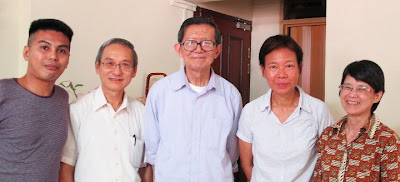
Saturday, October 08, 2011

The life and times of Ho Piao : The torture of a political prisoner

 
Ho Piao was 26 when he was detained during Operation Cold Store (2 Feb 1963). He held the dubious distinction of being the third longest held political detainee under the ISA. He was severely tortured by the ISD and released after 18 years, on 1 June 1981.

Educated in Serangoon English School and Raffles Institution, Ho Piao was a Queen's Scout and rowed round Singapore island alone. He entered University of Malaya in 1957 and was an active member of the University Socialist Club. He left the university partly due to his growing commitment to trade union work. After his release, Ho Piao married and left for London. He died in 2007. Below is the eulogy delivered by his good friend, Francis Khoo.

- Teo Soh Lung

**************************************************************

HO PIAO - His life and times (1937-2007 )
By Francis Khoo


Shortly after the ANC won, I took Ho Piao to a victory reception at the South African High Commission at Trafalgar Square. There were ex-political prisoners who had fought against apartheid. When introduced to Dennis Goldberg, Ho proudly revealed he had been in prison for 18 1/2 years. When pressed, Goldberg replied he was himself in for "24 years". Sensing he had embarrassed and upstaged Ho, he then said: "I was at a gathering of ex-Spanish Civil War veterans and thought I was the longest in, until I met an old lady who had spent nearly 40 years under Franco. I then had to shut up." I think Ahmad Kathrada, 27 years, and contemporary of Nelson Mandela, was there as were other younger ex-inmates of Robben Island.

The instant bonding and comaradie was quite inspiring: separated by different struggles, different continents, these elderly gentlemen seemed to giggle a lot and were self-effacing. Still retaining youthfulness and child-like curiosity about the world around them, they were generous in spirit and showed no bitterness. For Ho, his world was no longer just Singapore and Malaya. He was now also a South African. And a Palestinian and an Iraqi.

On 17 January, 1961, Patrice Lumumba, Congo's first prime minister, was assassinated by the Belgian and CIA surrogates. The whole non-alignment movement erupted in anger. Ho proudly remembered his part in a mass protest rally. All 7,000 of them were chanting: Lumumba! Lumumba! in the Singapore Badminton Hall. Singaporeans then had a keen sense of history and geography. He was an internationalist who loved his country. He believed you cannot be a patriot unless you supported every people's struggle for justice and equality. At the same time, he had no time for the vague 'citizen of the world' grounded in no concrete place. You ended up 'neither here nor there' rather than being 'both here and there'. That would be the height of irresponsibility.

On 2 February 1963, Said Zahari, Dr Lim Hock Siew, Dr Poh Soo Kai, Ho Piao and over a 100 patriots were rounded up. In a later wave, opposition MP Chia Thye Poh was arrested. Amnesty International adopted them Prisoners of Conscience. Like Mandela and his comrades, they remained steadfast; unlike Mandela, they were never tried in court.

The British and their approved successors in Singapore and neighbouring Malaysia needed a pretext to wipe out all progressive dissent - writers, journalists, liberals, socialists, trade unionists, members of parliament. When the legal Communist Party of Malaya was banned, an 'emergency' was declared and draconian laws were passed in 1948. Thousands were imprisoned or deported, many more perished as they retreated into the jungle. By tarnishing anyone with the label 'communist' and hence a security threat, the secret police could hold that person indefinitely without trial. If you wished to get out early, denounce your beliefs, endorse the government, confess over TV and grass on your friends. By 1987, reports spoke of 5,000 detention having been made.

Intense coffee-shop debates were once typical and widespread in Singapore and everyone was engaged. That is gone today, snuffed out by a dominant one-party state that controls every aspect of your life - from the bedroom, literally, to the boardroom. They want a nation which knows the price of everything and the value of nothing. Nothing is taboo and the market is all.

Modern Singapore is Asia's most dynamic economy after Japan and enjoys a standard of living often higher than Britain. With industrialisation export-oriented for the multinational corporations, the global city is the world's largest oil refinery centre and port, a hi-tech manufacturing, trading and financial services centre. There is the same inequality you find in Britain without the safety net of a welfare state. You fall ill or lose your livelihood at your peril. Civil liberties are distinctly Blairite. This is a world of stark extremes, where there is no such thing as a free lunch. Of course, MPs and ministers can well pay for their lunch - in a population a 20th of Britain, they can eat more than five times more lunches. In fact, the best paid lunches in the world. This is a tale of the two farmers with two chickens. The first has two chickens while the other has none. The politicians boast therefore, that statistically, each farmer has on average one chicken each.

Mussolini tried in vain to create the Corporate State as arbiter of labour for capital, where workers are organised in the service of state capital. Singapore is an unashamedly successful one. The trade union movement is today based upon Israel's Histadrut. It mirrors yet eschews Switzerland, with its multi-ethnic character and neutrality in regional conflicts. Opting for an Israeli combat-readiness and psyche, suspicious of regional intentions, militarised, with every able-bodied man in national service, it is a strategic ally of the US in its ‘war on terror’. Totalitarian, with generals in the government, it is yet no tin-pot jackboot dictatorship. Not moustachioed Generals Galtieri or Pinochet, rather but more apartheid South Africa and Israel.

The world Ho found upon release must have been a very alien one indeed. He went inside as a youthful 25 year old and emerged, un-cowed, a middle-aged man. Those 18 1/2 years were tumultuous times in the country, the region and the world: the best of times and the worst of times. Singapore and neighbouring Malaya tried but failed at merger. In 1965, the Indonesian army massacred half a million people while the US sent in 500,000 marines into Vietnam. The PLO won the battle of Karameh, student campuses all over the world rebelled, the civil rights movement in the US and Ireland reached their peak. Mao launched his cultural revolution. The entire 1970s decade was lost to him: Chile attacked by terrorists on its own 9/11 1973 when Pinochet overthrew Allende. Portugal lost its colonies in Angola, Mozambique, Guinea-Bissau, East Timor. In that same 1975, the fall of the US in Vietnam, Laos and Cambodia, and four years later the fall of the Shah of Iran and the Sandinista victory in Nicaragua.

When he went in, Harold Macmillan was British prime minister. Alec Douglas Home followed, then Ted Heath, Harold Wilson, Jim Callaghan and finally Margaret Thatcher. Kennedy was then in the White House, giving way to Johnson, Nixon, Ford, Carter and then Reagan. But Lee Kuan Yew was prime minister in 1963 -indeed, since 1959 - and was still prime minister in 1981. His son is the current PM but Lee remains the guru-like Minister Mentor.

News of the world outside were smuggled in despite censorship and tight access to TV, newspapers and books. The prison wall, as they say, has two sides and so the struggle continues inside. Like the Irish, South Africans and Palestinians, prison was a place to study, discuss, develop minds and mature. It was the best university: many achieving, despite the odds, law and other degrees.

And outside the prison gates, Ho's own late mother led the detainees' families in demonstrations to highlight the conditions inside. They disrupted the January 1971 Commonwealth Conference in Singapore, prompting the internal police to complain: "Your mother is the worst mother in the world!" Ho took that as a compliment and always beamed with pride when he recalled this. She was no mere mother; she was, like Gorky's Mother, a comrade.

Ho's soft gentle demeanour belied his toughness and resilience. He endured solitary confinement for months on end and waged several hunger strikes, one of which lasted over a hundred days. His demand for political status was akin to those of the Irish; he took to heart the 1981 hunger strike and death of Bobby Sands and the nine other republican prisoners.

In one of the rare published interviews he gave, he said: "The whole day I was tied to a wooden chair. They pulled my hair, pressed my nose and poured water in my nose and mouth." According to the account, one of the interrogators then grabbed Ho by the throat and drove his fist into his stomach. With his hands tied, his torturers continued punching his stomach. As he gasped for air, another officer laid one more punch - only this time he didn't pull back, but let his fist bear into Ho's aching gut, cutting off his breathing. When the prisoner came close to passing out, the officer pulled back, only to have others come in to smash their knuckles into his rib cage. Another delivered a karate chop to his chest while a third hurled himself at Ho and threw the prisoner to the floor. Ho curled up as his torso and his chest heaved in pain. While on the icy floor, his interrogators poured cold water on him causing his body to go into a painful contraction. Before he could recover from the shock, the thugs bore down on him yet again, kicking and punching his head.

"This is how we treat animals," one of them snarled. "This is an introductory gesture." Ho later said: "Their torture made my body feel like a corpse. I could not move. They pulled me up from the floor and tied me to the chair. Another group came to torture me. I would recognise them. They used the same method. They poured water over me 64 times. This torture went on for four days. My body was drench and shivering. They shouted in my ears and prized open my eyes. I did not eat or sleep or drink for four days."

As he lay on the ground, one officer lifted Ho's chin with his shoe. "This is a strange man, when we poured water over him, he did not shiver," he said. "But when we stopped, he started to shiver." The assaults only stopped when he finally lost consciousness.

In a statement he gave to his lawyer, he reiterated: "I firmly believe in my principles. I will never be a party to wage slavery and feudal bondage of my people. I will work to shatter these … even though I am meted out a long lingering agonising road to the grave."

In 1963-65 merger failed because the political elites of Malaysia and Singapore were unable to handle the contradictions of the national question, the many centrifugal forces pulling the society apart pitted against the centripetal forces bringing the communities together. The communities had different histories and experiences. In the second world war, some anti-colonial Malays and Indians viewed Japan as tactical allies in the fight against British and Dutch colonialism in India and Indonesia, respectively. But the Chinese saw Japan as the foe because of its invasion of China. The colonialists and chauvinists sought to exploit those differences.

British divide-and-rule policies has caused untold damage. Consider India and Pakistan, Hindu and Muslim, Black and White South Africa, Arab and Jew in Palestine, Catholic and Protestant Irish. In Singapore and Malaya, immigrants from China and India and indigenous Malays.

Today, Vietnam is united, Germany is one, Taiwan will return to China, Korea will be together again and so will Ireland. Inevitably, Singapore will again reunite with the Malayan mainland.

So what does it mean to be a Singaporean and Malayan? In a multi-ethnic, multi-religious largely immigrant post-colonial society, the patriots saw Malay as the lingua franca, the national language to unite the people. Mandarin, Tamil and English would also be recognised as official languages.

Ho himself was totally English-educated. Yet he loved Chinese culture, food, literature and history and was inspired by the Chinese revolution. But he was born in Singapore and never considered China his country. He was a Chinese Singaporean, never a Singapore Chinese. He was a Singaporean who happened to be of Chinese ethnicity. He was not a Chinese who happened to be born in Singapore. That was why, in addition to being fluent in English, Mandarin and his Hainanese dialect, he assiduously studied and mastered Malay in prison. All the top leadership and cadres of the independence movement spoke at least three of the four official languages.

He had what the Germans call "weltenshaaung" - a world view. He knew why the rich grew richer and the poor poorer, who benefits under colonialism and imperialism, why there is war and how peace is achieved.
His philosophy of life: Firstly, do not merely interpret the world but help change it. Artists paint, while some choose to be gallery critics. Musicians perform but some choose to be music critics. Chefs cook while others make a living criticising their food. Actors perform the drama of life before an audience, some of whom cheer them on while others choose to pillory on the side-lines. He was no bystander but an artist, a musician, a cook and an actor.

Secondly, he was no theorist with abstract ideas. Son of a militant seaman and working-class mother, he was leader of the seamen's union. He asserted correct ideas did not drop from the skies or were innate in the mind, but must come from social practice, and from it alone. His was Praxis - reflection based upon action which then invited further reflection.

Thirdly, Ho Piao knew which side he was on. In 1931, 11,000 US miners went on strike to protest a 10-percent pay cut. The state of Kentucky charged 11 of them for first degree murder.

Incensed by the injustice, Florence Reece, wife of one of the strike leaders, wrote: Which side are you on? Which side are you on?" Her song became the rallying cry of our own miners in the 1984-85 strike. Ho understood the root causes of poverty and injustice and dedicated his whole life to combating it.

Before his execution, Joe Hill urged: "Don't mourn. Organise."

Of course, we shall mourn the untimely death of Mr Ho but he also wants us to organise.

FRANCIS KHOO 2 March 2007

Tuesday, October 04, 2011

My life under ISA detention : Dr Poh Soo Kai

by Teo Soh Lung

ISA detainees in the 1960s and 1970s were not given proper medical care. Sick detainees were treated like sick animals and locked in cages.

Mr Chan Fook Wah was diagnosed to be suffering from advanced cancer by fellow detainee, Dr Poh Soo Kai and not the prison doctors. Not only did they fail to give him proper medical care after diagnosis, the doctors and prison authority were totally unsympathetic and negligent.

Mr Chan Fook Wah was an odd job worker. He was arrested on 17 February 1971 and released on 13 March 1978 when the ISD knew that he was near his death. For 7 years, the prison doctors failed to detect  Mr Chan's illness. Even after being diagnosed as having advanced cancer, they refused to  send him to hospital for treatment. It was only after being pressurised by detainees that they  sent him to hospital.

Why did the ISD release Mr Chan when he was so near his death? It was likely they did not want to have to deal with a death in prison and a coroner's inquiry where evidence of how he was treated in prison would have to be disclosed.   Mr Chan died 13 days after his release on 26 March 1978.

The attitude of the ISD  towards sick detainees was incredible. Dr Poh himself was not properly treated when he was ill.  He nearly lost his life when prison doctors failed to diagnose his illness. It was by a stroke of good luck that Dr Poh who comes from an illustrious family of doctors, that he is alive today.

The Ministry of Home Affairs' recent refusal to set up a Commission of Inquiry is understandable.  They knew that  many former detainees suffered immensely under the hands of the ISD and that a commission may expose them to legal proceedings for compensation.

Below is the second part of Dr Poh speech delivered on 13 September 2011  in Singapore.

*************************************************************************************

Moon Crescent Centre (MCC)

I was kept in solitary confinement for almost a year in this 8-cell block, the largest in Moon Crescent Center (MCC). Then I was transferred to a smaller 5-cell block situated at the extreme west end of the MCC, separated from other blocks by the administrative block. This was unofficially known as the “tough” block. I found myself in pleasant company. Chan Fook Wah, Ho Piao and Chia Thye Poh, having got advance news of my arrival, were waiting behind the door to welcome me. It was nice to be with friends again after so many months in solitary confinement.

I made it a rule not to see detainees when they were sick as I could not treat them. I always insisted that they see the prison doctor. One day, Fook Wah complained of a stomach ache, and Dr. N. Singh came, examined him at the corridor just inside the compound. It was a cursory examination. He prescribed some antacids which were delivered that afternoon. By 10 p.m. when we were all locked in our individual cells, Fook Wah called for me. He said the stomach pain had not improved with the medication, it had worsened.

Fook Wah was a very stoic person. Terribly beaten in the lock-up, he had lifted his chair and decided to fight with the ISD brutes to the bitter end. What do you do with a man who is not afraid of death? The ISD boss was called in, and he wisely told the Neanderthals to stop the torture. Fook Wah was a leader in the Chinese High School students’ movement, and had to run when the police were going after its leaders. Though coming from a rich family, he endured the privations while on the run without any grumbles. When he called me from his cell, I knew the pain must have been severe, but what could I do. So I told him I would see him the first thing in the morning when the guard came to unlock us. In the dawn’s dim light, made worse in a prison cell, I could see no jaundice, but felt a huge lump in the abdomen. He must have noticed that I hesitated, for his next words were, “Soo Kai, do not be afraid to tell me the truth. I can take whatever it is.” I told him he had cancer and it was at a late stage. I wrote a letter to the Superintendent. I am not supposed to communicate with the prison doctor. Fook Wah was transferred to General Hospital, found to be inoperable, and sent back to our cell.

Upon returning to the block, the prison superintendent wanted to send him to the Changi prison hospital which was no more than a dormitory with cages for sick detainees. It was not a hospital. We could provide him with better care in the prison block. We all objected to Fook Wah going to the prison hospital and were prepared to fight against his being transferred there. The warder came with a wheel chair. Fook Wah refused to go. The warder was sent back to tell the superintendent. After a few days, the prison relented, and agreed to send Fook Wah back to the General Hospital’s prison block. He was there for a week or so, only to be released to go home when death was imminent.

Then one day I was sent to Whitley Road Detention Centre for a few months. This time I was alone in a large open cell with a small exercise yard. You can shout to your neighbours, but you can’t see them. Dr. Toh Siang Wah, the acting head of department when I was posted to Kandang Kerbau Maternity Hospital (KKMH) in 1961, came to see me. We had a chat and he decided to send me a bible, and said he will arrange for someone to read with me. That someone turned out to be a senior officer at Whitley. I had no objection. I only insisted on reading the bible from page one. And he did not know anything from Genesis. They must have found my interpretation more reasonable, for soon the session was over.

Sometime later, I was taken to the changing room and told to change into the clothes I was arrested in. More presentable now, I was wondering where they would be taking me to. Soon I was in the prison’s staff rest room. Tea and cakes were laid on the table. And to my surprise, I was warmly greeted by two doctors who had worked with me in hospital. They were Dr. Teo and Dr. Nagulendran. Both consultant psychiatrists at Woodbridge Hospital. They explained that they had been requested to conduct a psychiatric survey of detainees. The apparent objective was to have a psychiatric profile – like cardiac profile, or arthritic profile which I am sure you all are more used to. With this, it would save time and money to sieve through the hundreds of student applicants, etc. to higher institutions of learning. So detainees are on the way to becoming psychiatric patients, and maybe Whitley will be later known as a psychiatric hospital.

I was given forms to answer, questions ranged from IQ tests, to whether I was best loved at home. I was not going to fill the questionnaire. Then Dr. Nagulendran said the study would be absolutely secret and have nothing to do with the ISD. Further, I was free to participate or to reject participation.

I had my cakes, thanked them as I was happy to see some old friends. Told them I would decline participation. I was wondering what other detainees would do, most probably participate but give every untruthful answer they can. I was later to find my guess was right.

However, some 10 days later, I was called to the interrogation room. The sole interrogator, an inspector, put on an angry face and started by telling me that I will be punished for not participating in the survey. I smiled, and asked him how he came to know of my non-participation when I was assured by the doctors that the whole process was confidential and secret. He did not reply.

Then, suddenly I was transferred back to MCC, to my old block with Chia Thye Poh and Ho Piao.


Brush with death

Finally, in 1980 I was again transferred back to Whitley.  This time in Whitley, I was also kept alone in the large cell. I was taken to the interrogation room about once a week to have small talk, sometimes on health problems and read papers.

Early one morning in 1981, I had a very severe pain running from the top of my head to my neck. I must have fainted, for the next thing I knew was that the guard had spotted me lying in the yard at about 4.30 a.m. and had called the inspector on duty. They came into my cell and enquired about my condition. I said I needed hospitalization for I think intra-cranial pressure had somehow increased. They rang up their superior and told me their order was to send me back to Changi Prison. The doctor there would attend to me. So early in the morning I was driven, with a severe headache and vomiting, to Changi Prison.

The male nurse on duty was kind. He told me that Dr. N. Singh had been informed and would see me the first thing in the morning when he came on duty. It was around 6.30 a.m. I was admitted into the prison hospital. It was a dormitory with two cages at the entrance, one on each side. I was put into one. He gave me two panadol, and I felt better lying in the bed.

It so happened that morning was my family visit day. My family on arriving at Whitley was redirected to Changi Prison.  Vomiting and in bad shape, I was led along narrow corridors until I reached the visiting room. There was no intercom now. I told my family my condition and why they had sent me to Changi Prison hospital.  Has Dr. Singh seen me? No. My dad was very worried. On returning home he telephoned my brother, who contacted his friends in the Health Ministry. It was arranged that a consultant from Changi General Hospital would come to see me.

The consultant physician came at about 3.30 p.m. He recommended that I be transferred to Changi General Hospital. It was a pleasure to have nice bedsheet, and a comfortable bed after so many years in prison. But I was too exhausted to really enjoy the new environment. The neurologist thought I needed an X-ray of my skull and I was dispatched to TTSH.  They did multiple x-rays and came to no diagnosis. There was a huge mass pressing on the nasal cavity and the forehead.

The decision was to ask the neurosurgeon to come in. The operation was fixed on a Monday. I had been in the air-conditioned ward for close to a week. It must have been the air-conditioning, for a day or so before the scheduled operation, I coughed up a whole lump of mucus. The diagnosis was now obvious. I had a mucus cyst stretching from forehead to the cheek, and it had burst just in time before the operation! My skull need not be cut open. Instead the ENT surgeon was called in to operate on the very chronic sinusitis.

All went well. By the third day, when the pack left in the nasal cavity to stop the bleeding was being removed by the ENT surgeon, the wall of the cavity, weakened by continuous pressure from the expanding cyst, gave way. So, the pack was removed together with an artery that the wall was attached to. As a result, no blood went to the brain and I fainted. The only way then was to ligature the carotid, which a surgeon did. But then my heart stopped. My poor friend, the ENT surgeon frantically pumped at my chest. I was told that revived me, but I felt as if I had a fractured rib on recovery.  Lack of oxygen to the retina, and alteration in the geometry of the eye socket became my main defects. Thanks to my friends, I survived.


My Release

Some three months in hospital in 1981, I was served another 2 years detention order and sent back to Whitley to recuperate. In August 1982, I was told I would be released. But I was warned that I should not criticize anyone, that I would not be allowed to hold a press conference to discuss my case and the charges against me, and that the ISD would be issuing a statement on my behalf. They even called in my parents to warn them that if I were to call a press conference, I would be rearrested straight away. I would have to follow the usual restriction orders whether I signed acknowledging receipt or not.

My reply was that I was a civilized person, and if reporters knocked at my door, I would invite them in. They had better post their men outside my door and shoo the reporters away. I would definitely deny whatever statement attributed to me but not signed by me.

I was released on Aug 26 1982, having spent all 17 years in Lee’s prison without a trial. No reporters came to see me for a few days. Then a person by the name of Mr. D’Silva from Associated Press came to my house. I told him of my restrictions and threat of imprisonment should I discuss my case. From this he could draw his own conclusion.

I was to run into him some time later. He told me that after the interview, he had gone to Albert Street to have a bite that evening. There was a tap on his shoulder and he was asked to follow the ISD officers to Whitley. He told them that whatever I said in my interview was all recorded in his tape, and they could have a look at his dispatch. They showed no interest. He was brought to the staff meeting room and sat there for the whole night. Early in the morning, he was asked to sign a statement that he had been well treated and then allowed to go. I suppose this was to frighten other foreign reporters in case they showed more courage than their local counterparts.

Harassment tactics continued. For example, when I was employed by a clinic at the airport, I was not allowed a pass onto the tarmac. Civil servants unfortunately dared not think. I just told them to ring up my clinic owner, a British nurse, and tell her that I had been denied entry onto the tarmac. So should any emergency arise, I was in no way responsible. A few phone calls followed, and I was issued with the pass.

After that short stint at the airport clinic, I started a private practice in Upper Serangoon Road before migrating to Canada in 1989.

(Dr Poh Soo Kai now resides in Malaysia and Singapore)

-------------------------------------------------------------------

Ex-detainees call for Commission of Inquiry

Govt rejects Commission of Inquiry

Dr Poh Soo Kai and MHA's fiction of his involvement with the injured bomber (Part 1)

MHA's malicious and false allegation against Dr Poh Soo Kai

by Teo Soh Lung

Attached is a page from Hansard concerning MHA's claim that Dr Poh Soo Kai rendered medical aid to an injured bomber in Masai.

G. Raman who was arrested in February 1977 under the ISA and subjected to physical torture and sleep deprivation, made a statement implicating Dr Poh. Raman said that he, Dr Poh and his wife went to Masai to render medical aid to an injured bomber. Raman subsequently retracted that claim before a senior public prosecutor at the Attorney-General's Chamber.

Earlier, then prime minister, Lee Kuan Yew threatened that he was going to refer Dr Poh to the Medical Council for helping an injured bomber. Dr Poh was never brought before the Council. To date, ISD and MHA have not challenged Raman's retraction of his confession.

Would MHA retract its malicious and false allegation against Dr Poh and apologise to him?


Sunday, September 25, 2011

Dr Poh Soo Kai and MHA's fiction of his involvement with the injured bomber


[ Background : Within 24 hours following the surprise announcement on Sept 15, 2011 by Malaysian Prime Minister Najib Tun Razak to abolish the Internal Security Act, Singapore's Ministry of Home Affairs issued a press release to defend the use of the ISA in Singapore. At the same time, opposition parties, civil society groups and bloggers weigh in to call for the abolishment of the ISA. One particular letter, signed by 16 former detainees of the ISA, prompted another response by the MHA, who cited the case of a detainee who had "provided medical assistance to a CPM saboteur who was hiding in Malaysia."Although MHA did not name the detainee, Dr Poh Soo Kai had in an earlier speech on 13th September rebutted these allegations against him. ]


by Teo Soh Lung

Dr Poh Soo Kai, Mr Lim Chin Siong and Dr Lim Hock Siew, Assistant Secretary-General, Secretary General and Central Committee Member  respectively of the Barisan Sosialis together with at least 120 of their colleagues and friends in the party and trade unions were arrested and imprisoned without trial on 2 February 1963 (Operation Cold Store). Those detained included prominent opposition politicians, doctors, lawyers, economists, teachers, journalists, trade unionists, university graduates, undergraduates and school students. They were the cream of our society. The British played a primary role in Operation Cold Store. The purpose was to prevent them from contesting in the September 1963 general election. By imprisoning the vocal and capable opposition, the British helped Lee Kuan Yew to retain power while preserving their own interest in Singapore and Malaya.

Even after the general election in September 1963, where 5 Barisan members were elected, the arrest of political opponents continued. Three of the elected Barisan Members of Parliament namely S T Bani, Lee Tee Tong and Loh Meow Gong were arrested even before they could be sworn into Parliament. Another two Barisan MPs left Singapore and did not return when the PAP government refused to give an assurance that they would not be arrested. In 1964, another 88 were arrested and detained.

Dr Poh was released after 11 years of imprisonment without trial in 1973.  Defiant, principled and courageous, he called upon the PAP government to release his comrades in prison. He and a group of friends were in the process of forming a civil rights society when he was again arrested in 1976.  The following year, his friends were also arrested and imprisoned. Dr Poh was to be detained for another 6 years, thus spending a total of 17 years of the prime of his life in jail.

On 23 September 2011, MHA issued a statement accusing Dr Poh (though he was not named) of assisting a CPM saboteur. The statement reads:

“… In 1974, one of them provided medical assistance to a CPM saboteur who was hiding in Malaysia. The saboteur had been conveying a bomb for an attack in Singapore, and was travelling along Still Road (Katong) when it detonated prematurely, injuring him and killing his two accomplices...”

Dr Poh denies providing medical assistance to the injured even though under the Hippocratic Oath he has a duty to treat an injured person, whatever his political affiliation may be. MHA’s statement referred to a fiction composed by the ISD.  That fiction imagined Dr Poh, his wife and Dr G Raman visiting Masai in Johor to treat an injured person who the ISD claimed to be a communist. Dr Raman in a statement made in 1977 (which statement  is in the possession of the Attorney General’s Chambers) had already denied visiting Masai with Dr Poh and his wife.  Further, Dr Poh’s passport which the ISD had sight of, proved that he never went to Masai. Indeed, Dr Poh has until today never visited Masai.

Below is the first of two parts of a speech delivered on 13 September 2011. Dr Poh spoke about his arrests and detentions. Coincidentally, he also talked about the government’s baseless allegation that he treated an alleged bomber in 1974.

 ****************************************************************************

MY ARREST AND DETENTION IN 1976

I was detained in Operation Cold Store i.e. 2nd Feb 1963, and released at the end of 1973. On the day of my release, I was advised by a very senior ISD officer that on release I should not publicize nor seek the release of my comrades in detention. It was not only dangerous for me but made their release more difficult. It was a friendly advice, and I believe made with good intentions.

However, I could not accept this bully-logic reflected in the thuggish policy pursued by the ISD. So on release, I met with four other comrades, P. Govindasamy, Lau Ah Lek, Fu Yang Yeow, and Tan Kim Sim, who were released on the same day, at my house. We issued a joint press statement, describing our individual detention - from three years to near 11 years - and called for the unconditional release of all detainees. We ended by calling Lee Kuan Yew a “political pimp.”

On the 11th anniversary of Operation Cold Store in 1974, I made a recorded speech of the mass arrests and a plea for support from FUEMSSO. The recorded speech was played at a meeting organized in London by FUEMSSO. I pointed out that on the very day of Operation Cold Store in 1963, Lee Kuan Yew had denied responsibility for the mass arrests in his press interview at the Singapore airport on his return from the (Internal Security Council) ISC meeting in K.L. This had infuriated Lord Selkirk who called him up, threatening to publish the relevant documents. Of course the press was blamed. In a later interview, he amended his earlier denial. However, it was clear to all, the denial was a publicity stunt to hit the headlines the day after the arrest. The subsequent correction would not have the same impact or it could even be ignored by the public.

The U.K., as chairman of the Internal Security Council (ISC), shared the responsibility for the arrests. The order for the arrests in February 1963, the carrying out of Operation Cold Store came directly from London. Selkirk and the others just enforced it. By handing the detainees over to the PAP government without first releasing them before the merger in September 1963, the U.K. shared responsibility for their continued detention. This moral responsibility cannot be shrugged off by any legalistic talk. Thus, in my speech to the FUEMSSO students in 1974, I said students in the U.K. should demand the UK government make a statement calling for their release, make their stand transparent and condemn the PAP for the continued detention of those they (the British) had earlier detained.

Later in 1974, I attended the Tokyo conference on imperialism organized by the World Council of Churches. There I described the police state that is Singapore. Friends at the Conference assured me of support should I be rearrested. During my re-arrest, these friends including some Japanese Parliamentarians, petitioned the PAP for my release.

In the same year, I met Ms Small of the International section of the British Labour Party, and a delegation of trade unionists from Sweden who were here to attend a NTUC function at Raffles Hotel. I met them separately at my home. They wanted to know more of the Internal Security Act, the conditions of detention, the people detained, the length of detention, and the conditions of release with restrictions, making of a security statement (a statement that implicates others), TV appearances, etc. I did not know then that they were planning to bring a motion asking the PAP to explain the detention, prolonged imprisonment, and ill treatment of its opponents in the forth coming Socialist International Conference to be held in Brussels in mid 1976.

Coincidentally, in early 1976 a few of us discussed the formation of a civil rights society, akin to the NGOs of today. G Raman, Ong Bock Chuan, M Fernandez, Gopinath Pillai (the PAP ambassador at large), Jing Quee, Gopal Baratham, and I had touched briefly upon the subject at a house warming party thrown by M. Fernandez.

This discussion developed into a pro-tem committee consisting of G. Raman, Michael Fernandez, Ong Bock Chuan, and I. We agreed to invite Father Joseph Ho, Dr. Gwee Ah Leng, and Dr. Un Hon Hin to join the committee. Tan Jing Quee did not join. He came to my house later with Kay Yew to express their deep concern that the PAP could use this civil rights society as a pretext for arrests. He was to be proven right.

Shortly after its formation, there was news that the Socialist International conference in Brussels would be tabling a motion asking its fraternal member, the PAP to explain the arrests without trial, and prolonged detention of political opponents.

The stage was set for our detention. By talking of civil rights, demanding the release of detainees, highlighting freedom of speech and assembly, as well as transparency and accountability to the people, we could become an embarrassment that needed to be nipped in the bud.

But how to present this as a serious threat to national security to the Singapore public and international opinion? Despite the visit of Harold Wilson, ex-Labour Party Prime Minister of Great Britain to Temasek, international opinion was unfavourable to Singapore against the backdrop of the Socialist International rapping the PAP for its long term detention without trial of its opponents. Hence, the communist bogey was invoked.


MY  ARREST

There was no more the knock upon the door in the wee hours of the morning. The ISD officers were waiting for me at the car park of my flat. As I came down the flight of steps to enter my car at about 7.30 a.m., I was approached by a couple of men who identified themselves as police officers. They said I was under arrest, but I would have to lead them back to the flat. When we entered my flat, they immediately closed all the windows. They were afraid neighbors would notice. They searched my study and took a few things away. Then as we were leaving, I asked if I could write a note to my wife, Grace, who had gone to work some half hour earlier. I wrote that the ISD had come. She should be brave and that I loved her. Inspector Lim read the note. He commented that we had been expecting the arrest. I nodded.

That I would be arrested was no secret. The PAP had to resign from the Socialist International as it could not honestly explain its totally undemocratic actions. Moreover, the PAP did not take well to moral pressure from any quarter. A week or so before my arrest in 1976, C.V. Devan Nair was dispatched to the Socialist International conference in Brussels to boast of his anti-colonial past, blithely ignoring the fact that experienced politicians attending the conference regarded him as a turncoat. He declared that he and I were acquainted and that I was a communist. That we were acquainted is without doubt. I had helped his family financially while he was under detention. But he should have checked with the ISD, being a turncoat and leading the PAP delegation, whether I was a communist before declaring that he knew that I was one. The ISD would have told him that it had sent me a letter through the prison authorities, in reply to my request for an issue of the Barisan Newspaper, that I am NOT a communist, and thus the request was allowed. Perhaps he was too lazy to check his accusations, or perhaps he did. That probably is a trait of a turncoat.

Devan’s allegation of me being a communist was in the headline of The Straits Times. It was all orchestrated. So I was expecting the arrest. Perhaps the PAP wanted me to flee, for during my interrogation, an officer made the comment that I was a Kamikaze. But he did not elaborate.

Continuing with the first day of my re-arrest, I was driven to my clinic on Balestier Road. They searched my consultation room. I do not know what they were looking for. But I was worried that they may plant ammunition there and “find” it. The thought that they were capable of fabrication was foremost in my mind, as I suddenly remembered what they said and did in Marshall’s Anson by-election of 1961. Then The Straits Times headlined a plot to kill the PAP ministers.  The Director of the Special Branch, Mr. G Bogaars, personally led a raid on a house in Telok Kurau – not far from my place. Some men were arrested, and ammunition reportedly found. Photos abound in the newspaper. All was quiet for a week or so. Then when Marshall spoke up at Anson to say he doubted the authenticity of the story, the ST printed, in small print and in the inside pages, a report to say that the ISD had received the information from “overzealous” police agents. Who were these overzealous police agents who had given false reports, and what happened to the ammunition found in the house – and who were their owners? Nothing more was ever disclosed.

I was led to the police car, made to put on a pair of spectacles that had a layer of foam on the inside. I was totally blinded. Even though my clinic was only a stone’s throw from the Whitley Holding Centre, it took quite a while to reach there. It was a poor attempt to disorientate me and a total waste of petrol.

After changing into a T-shirt and short cotton pants, the spectacles were now off, I was led to my cell. It was on one limb of a U-shaped single-story structure with a flat concrete roof. There were more cells on the other limb. The prison guard’s station and the lavatory occupied the junction of the two limbs. In the centre of the building was the exercise yard, fenced off on all sides from the cells. The walls were high, and you could only see angled skies and the top of distant trees. The cell measured some 5 feet by10 feet with a fixed bunk in the center. The fluorescent light was on all the time when I was in the cell. Once it blew, and all was in darkness. The guard could see nothing through the peep hole in his regular rounds. Immediately I was moved to an adjacent cell while the electrician on call promptly replaced the bulb.

My first family visit was a disaster. My younger brother, a clinical professor came to visit me. He worked as a chest physician at Tan Tock Seng Hospital.  His first question was, “Have you newspapers to read?” “No reading material,” was my reply. Click. The intercom was cut off. I was not to talk of matters in the centre. And so ended prematurely the visit for the family for the week.

I was summoned to go to an interrogation cell on the first day of my re-arrest. The guards had to be careful. If there was a red light at the end of the corridor, he had to stop, make me face the wall of the corridor, lest we run into some other escorted detainees approaching the right angle junction. New traffic rules had to be learned!!

Strange as it may seem, the officers asked no questions. We sat and looked at each other, and engaged in small talk. One told me he had recently returned from a posting in Cambodia. He was on the last plane out of Phnom Penh before the city fell. Another asked me to talk on socialism and try to convince him. I told him it is not possible unless we change places. They were friendly, but kept on telling me that if I do not write a confession I will definitely rot in prison. So I asked them to ask me questions if they want to know anything. They would not! The reply I got was that if they did, then I would know what they knew of me! So we sat there from about 6.00 a.m. to midnight staring at each other. They placed a small clock on the table and told me I could go back to my cell only at midnight. That kind of interrogation went on daily for the six months I was in Whitley Road Detention Centre.

The interrogation rooms were cold. For the evening session, the officers came in warm clothing while I shivered. Going back to the cell, however, was not comfortable either. It was terribly hot- like entering a furnace, more so after the cold of the interrogation room. I was most happy when it rained, for then the cell was much more comfortable. The heat did not dissipate from the poorly ventilated room until well passed 2.00 a.m.

Then one day, Deputy Director Si-Toh walked in accompanied by some 6-8 rough-looking men. They stood behind me and by my two sides. But Si Toh was polite. He asked if I had made night calls in my medical practice lately. On reflection I told him yes, one. He showed interest. Who did I attend to? It was a tenant on the ground floor who had abdominal pain. Any more night calls? No. Disappointment showed in his face. Did I send out letters lately? I did. I knew then that my letter to Lin Chew after the PAP’s walk-out from the Socialist International had been intercepted. In the letter, I had told her that I agreed with the Socialist International’s move to ask the PAP to explain its detention of political opponents, but I told her that she was not to worry over me. The PAP would have to find a scapegoat for that humiliation and I was prepared for it. Maybe because they had intercepted my letter, they did not ask me questions regarding Lin Chew or the Socialist International.

And then suddenly the door of the interrogation room was flung open and H.H was pushed in, onto the floor. I know him. He was an ex-detainee. An honest man but I had suspected that he had links with the Singapore Revolutionary Party, an organization I would not touch.  He was my patient. They had beaten him up and he was in bad shape. He looked at me and said sorry to me. Though he did not finish his sentence, I surmised that he must have told the ISD that I had given him medicine for the injured bomber. (A year back, two bombers attempted to attack the Nanyang Shoe Factory but the home-made bomb went off in the attackers’ car while they were driving to the factory, killing the driver and injuring the other bomber.)  I told HH not to worry, just tell them the truth. After that they dragged HH out of the room. They never interrogated me about the prescription but I was not concerned as the drugs were prescribed for HH’s flu symptoms. In fact, the ISD officers had gone to my clinic and taken H H’s medical case notes and a few days later, they showed me my own prescription for HH. Thus the poker game they played with me ended on an anti-climax note for the ISD.

Back to waiting for the clock to strike midnight. But there was one incident I must tell you. One day I was brought to the upper floor of the interrogation block. The Nepalese guard, the ghurka, stood outside the closed door. I was alone in the room. Suddenly I heard an extremely loud stamping of the boot in salute. The door was opened  and expecting some big shot to come in – thus the  unusually extra loud salute—I turned my head to look at the entrance. In walked a man, spotlessly dressed, in his late thirties, perhaps early forties. He was alone and that was unusual, because very senior officers nearly always come in pairs. He walked round to the other side of the table, pulled out the chair and sat down. He smiled, and said “Dr. Poh, may I call you Dr. Poh”. We were given numbers, and were never addressed by name. He was trying to be polite and nice. My reply was, “Of course you can.” Then the next question made my day. He asked, “Dr. Poh, now what is your story?” My reply was direct, “what story do you want?” He knew he had lost. He got up and stiffly walked out of the room.

After some months, I was transferred to Moon Crescent Center. A few weeks in a three-cell block with friends, then solitary in a big 8-cell block.

In early February 1977, the ISD officers informed me of my wife’s, Grace, detention. They said I could visit her at Whitley Road Detention Centre. She had just been arrested. I knew that her detention was aimed at me. I would not let them enjoy and exploit my discomfort. I turned down the offer to see my wife. She was detained for a month, with days and nights in the cold interrogation room.

Also, some time in early February 1977, I heard of the arrest of my friends, G. Raman (who was my lawyer), A. Mahadeva, Jing Quee, Kay Yew, Joethy, etc.

Then through the prison grapevine, came the news that in an arranged BBC interview, Lee Kuan Yew had said that G.Raman had sworn an affidavit that he, Grace and I had gone one night to treat an injured man in Masai, Johor. That G. Raman, a senior lawyer held under detention, had been brought under guard – though Lee Kuan Yew took pains to stress that there were no uniformed officers around – to the magistrate court to swear an affidavit, testified to the contemptuous attitude Lee had of Singapore’s judiciary.

And so Lee declared that based upon Raman’s affidavit, he would let the Singapore Medical Council (SMC) judge me. I would be judged by my peers. Presumably, Lee thought that this would satisfy some of the critics of my arrest.

But this was all a public relations exercise. Fabricate a story, hog the headlines, then quietly forget it. The SMC was never instructed by the government to summon me for an enquiry. I received no request to appear before the SMC.

In fact, my copy of the newspaper of the BBC interview was censored. Why keep me in the dark when I would be appearing before the Medical Council and be judged by my peers? The sad thing is, up to quite recently, I was surprised to hear a young friend telling me that it is the ethical duty of every doctor to treat any injured person anywhere. If there was an injured person in Masai, going to Masai was perfectly right and ethical. The young friend could not believe his ears when I told him that up till today, I had not been to Masai. He must be wondering, what other nonsense and myths he had believed in since his school days. He thanked me for waking him up.

-------------------------------------------------------------------

My life under ISA detention : Dr Poh Soo Kai

Monday, September 19, 2011

Detained under the ISA for starting a civil rights society : Dr Poh Soo Kai

Three of Singapore's longest-held ex-political detainees in a recent photo. From left : Dr Chia Thye Poh (32 years), Dr Poh Soo Kai (17 years), Dr Lim Hock Siew (19 years). Seated is the late Mr Tan Jing Quee, twice detained under the ISA. The photo is published in a booklet distributed during the memorial for Tan Jing Quee.

*******************************

Dr Poh Soo Kai


Dr Poh Soo Kai was detained under the ISA for a total of 17 years. A brilliant young doctor, he resigned from government service in 1961 in order to participate in politics. He was then an intern in Kandang Kerbau Maternity Hospital and was just awarded a scholarship for Obstetrics and Gynaecology training in UK. Together with Dr Lim Hock Siew they established Rakyat Clinic in Balestier Road.

Dr Poh would have been a great asset to Singapore's development had he not been arrested under the ISA on 2 February 1963 (Operation Cold Store) together with more than150 others.  He was then the Vice Secretary of Barisan Sosialis and had posed a serious political threat to the then prime minister, Lee Kuan Yew.  Released after 11 years, Dr Poh continued to be defiant. He called for the release of those who were still in prison, issued press statements, gave interviews and attended conferences, both in Singapore and abroad.

Towards the middle of the 1970s, several intellectuals began  thinking about the setting up a human rights society. Dr Poh was one of those interested in such a project.  But before any plans could take root, he was rearrested in June 1976. A few months later, all those interested in setting up the human rights society were  detained under the ISA. Dr Poh languished in jail for another 6 years.

Below is his speech delivered at Tan Jing Quee's Memorial Service on 27 August 2011  in Kuala Lumpur


****************

Friends and Comrades,

When Jing Quee entered the University of Malaya and joined the University Socialist Club, where he was enormously active, especially in the production of its organ, Fajar, I had graduated and was very busy working in the hospital. The work-load was such that I seldom had the time to socialize with club members. As a result, I can’t say I knew Jing Quee really well at that time.

Operation Cold Store on February 2nd 1963, signaled the start of severe state repression of Singapore’s anti-colonial movement. Over 100 trade unionists and opposition political leaders were detained. Despite this prevailing atmosphere of fear, Jing Quee upon graduating, true to his conviction, courageously became a trade unionist, was appointed paid Secretary of the Singapore  Business Houses Employees’ Union and became the Assistant Secretary General of Singapore Association of Trade Unions (SATU), at its foundation. He joined the Barisan Sosialis and stood as its candidate in the September 1963 General Election, knowing full well the Barisan Sosialis and opposition anti-colonial groups had been so badly crippled so as to ensure victory for the PAP. In fact, the prediction of the U.K. High Commissioner’s office on the result of an election after Operation Cold Store, was extremely accurate. Only the date of the election was wrongly predicted.

When I was released at the end of 1973, Jing Quee had already been released, gone to the U.K. to study law, and had returned as a lawyer. He came to see me, and together with like-minded friends, we discussed the formation of a civil rights society – much like the NGOs of today. G Raman, Michael Fernandez, Ong Bock Chuan and I agreed to be in the pro-tem committee, whose membership would be enlarged by approaching Dr. Gwee Ah Leng, Dr. Un Hon Hing and Father Ho. Jing Quee did not join the committee. Later, he came to my house, and expressed serious concern that the PAP government would demonise the formation of this civil rights committee and use it as a pretext to re-detain me. He was to be proven right.

Coincidentally, shortly after, the Socialist International held a conference at Brussels in 1976. On the agenda was an item asking its fraternal member, the PAP, to explain the arrest without trial and prolonged detention of its citizens. Unable and unwilling to explain its fascist actions, the PAP sent Mr. Devan Nair to the conference. He was to withdraw the PAP from the Socialist International. At the conference he declared that he was acquainted with me, and that I am a Communist. That we were acquainted, is beyond doubt. I had helped his family financially while he was under detention. His speech must have been vetted and approved by Lee Kuan Yew whose Internal Security Department officials must have told him that I am not a Communist. ISD had written me a letter while I was in prison acknowledging that I am not a Communist. The stage was now set for my re-detention.

Jing Quee’s cautiousness in not joining the pro-tem committee however did not prevent him from being re-detained a second time in early 1977. Friends abroad, especially in Japan, demanded our release. Lacking a credible excuse, Lee Kuan Yew in 1977 in an interview with the BBC, claimed that I had gone with G. Raman in separate cars across the causeway to treat an injured bomber in Masai, Johore. He said he was bringing up my case before the Singapore Medical Council, so that I could be judged by my peers. But it was all a publicity stunt. I seriously doubted he intended to bring up my case before the Medical Council. After the BBC publicity, nothing more was heard. I received no summons to present myself before the Medical Council. Neither was it ever approached to reprimand me.

Upon my unconditional release in late 1982, Lee Kuan Yew’s press statement stated that I had been defiant but he was willing to give me a second chance. Defiance has now become a reason for detention. I suppose defiance was also the reason for Jing Quee’s second arrest. Perhaps I had shown my defiance not only in forming the Civil Rights Committee, but more so, as I had called him a “political pimp” in my statement upon my first release in 1973.

Jing Quee worked hard at his law practice. His silence was broken when in Feb 2006, together with fellow ex-detainee M. Fernandez, he described his detention at a public forum on “Detention – Writing – Healing” in Singapore. This forum was significant, as it was, after nearly a generation, political detainees for the first time identified themselves and addressed the public as such.

Noting the very favourable response, the PAP government came out with a warning: “ex-detainees will not be permitted to re-write history.” But the dyke has been breached. And fear receded. The internet gave access to news and views and questions and doubts, not printed in the press. Ex-detainees began to speak out and write about their experiences, and the tortures they underwent. There is an increasing demand for historical facts, for freedom of speech and assembly, and Singaporeans are no longer “dull.” They have begun to question the official version of the history of Singapore’s formative years, and to seek truth from the propagated myths, and question what has been dished out to them through the years.

Suffice for me to point out one example. Lee Kuan Yew in his memoirs stated that as he was working for the Japanese broadcasting at Cathay Building during the Japanese occupation. Hence, he was able to receive news before other Singaporeans of the impending Allied return to Singapore. He claimed he had discreetly disseminated the information. As such, he was afraid the Japanese authority would punish him for doing so if he were identified. It was a heroic act. He fled to Cameron Highlands to hide till the return of the Allied forces.

But after the publication of his memoirs, Mei Ling Chung Harding in her book, Escape from Paradise  stated that Lee Kuan Yew was working for the Japanese Intelligence. We may note that Intelligence is a very different sector from Broadcasting.

She was never sued for libel. If you believe her story, then logically Lee Kuan Yew’s flight to Cameron Highlands could not be to evade the Japanese, as claimed. I am sure this puzzle must be in the minds of most of you, and especially those who will be attending the Memorial service at Nilai tomorrow, in honour of those who died fighting against the Japanese aggressors.

Jing Quee has indeed opened the flood gates, and the latest election in Singapore is a testimony to the people’s desire for truth, transparency and free debates as well as to Singaporeans’ over-riding desire to discard fabrications, falsehoods and myths. In this, Jing Quee has done Singapore an enormous service, and lived the life he wanted to.

Thank you.

Dr Poh Soo Kai

_____________________________

Further readings :
More ex-detainees speak out : Political violence and the abuse of the ISA in Singapore
What the left-wing stood for : Dr Poh Soo Kai
I'll forgive Lee Kuan Yew if he admits to his error and apologises to me : Lim Hock Siew
New PAP book neglects founding members detained for 19 years

Friday, August 19, 2011

Time to set up a Truth and Reconciliation Commission and abolish the ISA

[ Read also More ex-detainees speak out : Political violence and the abuse of the ISA in Singapore ]


by Teo Soh Lung

Photo : Singapore's longest-held political prisoner Chia Thye Poh (centre), with detainees of 1987's "Marxist Conspiracy" arrests at a Chinese New Year gathering this year in Chia's home in Ang Mo Kio. Chia is currently working in the Netherlands.


From left : Activist Isrizal Mohd Isa, ex-detainees Vincent Cheng, Chia Thye Poh, Wong Souk Yee and Teo Soh Lung.


Tan Jing Quee and Michael Fernandez were the first ISA detainees to speak about their detention in 2006. Both men were detained in 1963 and again in 1977. It took them more than 40 years to talk about their imprisonment.

In 2009, Jing Quee composed a poem “ISA Detainee”. There he recorded the prison conditions in the 1960s as well as that of 1977.

1977 saw the arrest of at least 28 people, mostly professionals. They were labelled “Euro Communists” by the PAP government. I was a young lawyer then and personally knew some of the people who were arrested. When they were released, none of them spoke about their experiences.

Earlier this month, Dr Ang Swee Chai who now lives in London, wrote about what she went through as a ISA prisoner in 1977. ISD officers had visited the hospital where she worked to arrest her. The hospital staff were so terrified of those plain clothes men that they interrupted her while she was performing an operation in order to inform her of their presence. I felt really sad for her as well as for my country when I read her note. Why do we have to respect the ISD so much that the hospital staff had to announce their presence even when she was performing an operation? I am glad Dr Ang was able to remain calm and successfully completed the operation.

It is clear from Dr Ang’s account that her experience had remained fresh in her mind for the past 34 years. She remembers graphic details of how she was arrested and treated in the cold room. She even remember her prison number.

From 1970 to 1979, 149 people were arrested under the ISA. Among them were prominent theatre practitioners Kuo Pao Kun and Goh Lay Kuan and writers like cultural medallion recipient, Yeng Pway Ngon. Yet none of them had until today, written about their experiences.

If ISA victims of the 1970s were silent until recently, those of the 1960s also suffer in silence. In 1963, Operation Cold Store saw the arrest of at least 145 people. Among them were prominent doctors, politicians, newspaper editors, journalists and trade unionists. How could the then Prime Minister Lee Kuan Yew and his cabinet ministers imprisoned fellow Singaporeans without trial for decades? Between 1960 and 1969, a total of at least 284 were detained. Among them were :

Lim Chin Siong (Secretary of Barisan) 6 years

Dr Poh Soo Kai (Vice Secretary of Barisan)
17 years

Said Zahari (Editor of Utusan Melayu, Chairman Partai Rakyat)
17 years

Dr Lim Hock Siew (Central Committee of Barisan)
20 years

Ho Piao (Paid Secretary of SNSU) 18 years

Lee Tee Tong (Barisan Member of Parliament)
18 years

Loh Meow Gong (Barisan Member of Parliament)
7 years

Wee Toon Lip (Barisan candidate) 10 years

S T Bani (Barisan Member of Parliament)
3 years

Michael Fernandez (Paid Secretary, SCHFEU)
9 years

Chia Thye Poh (Barisan Member of Parliament)
26 years

Chia Thye Poh, a member of parliament was imprisoned for 26 years and subjected to restrictions for another 6 years. I met up with Chia sometime this year. I was told by his father who is now in his 90s that Chia his eldest born was a brilliant student. He was a bookworm and was always at the top of his class. He did not participate in student activities. It was only when he became a lecturer at the Nanyang University that he became interested in politics. He stood as a Barisan candidate in 1963 and won. When he was arrested in October 1966 his mother suffered a stroke and had not been in good health ever since. Today, she is bedridden. Both parents are being looked after by his younger sister. Chia who has a doctorate degree, works abroad and returns home irregularly. Life is tough.

The PAP have wrecked many lives and deprived many parents of their children. There must be thousands whose lives were damaged by the ISA. Said Zahari wrote an account of his prison days in Dark Clouds at Dawn published in 2001. Low Miao Gong wrote briefly about her experience in “The Two Faces of Men in White” (published in The May 13 Generation). No others who were detained in the 1960s have to date written about their experience.

When Nelson Mandela was released after 27 years on Robben Island, he went on to become the President of South Africa. A Truth and Reconciliation Commission was set up to investigate the atrocities committed by the past government. Can we in Singapore ever expect such a Commission to be set up to investigate all ISA cases? Will I be able to see the repeal of the ISA during my lifetime?

On Saturday, 20 August 2011 at 2 p.m. at the Chinese Chamber of Commerce, friends of Tan Jing Quee will pay tribute to him for his contributions in re-writing the history of Singapore. Let us hope that their voices will bring change to our nation one day.

Sunday, August 14, 2011

Prime Minister Lee Hsien Loong should apologise to Dr Ang Swee Chai


by Teo Soh Lung

Dr Ang Swee Chai, a prominent surgeon and author of From Beirut to Jerusalem has now written about her arrest and detention without trial under the ISA in 1977. She was one of at least 28 people, mostly professionals, who were arrested and labelled as Euro Communists by the PAP government.

Dr Ang was arrested on 15 March 1977, one month after Tan Jing Quee was arrested. At the time of her arrest, her husband of two weeks, Francis Khoo, a lawyer had escaped to London after many of their friends were arrested and imprisoned. Both she and her husband now live as exiles in London. The documents and photographs seized have not been returned to them.


"On the morning of my arrest, I was operating, when one of my colleagues came to tell me that a number of plain clothes policemen were looking for me. I told him that I got to finish operating on my patient before I could see them. They waited outside the operating theatre, maybe about 10 of them altogether, since we left in 2 cars. One of them wanted to hand-cuff me, but I told them I was not going to run away, and could not anyway. Furthermore they should not lead me with hand cuffs through the crowded hospital corridors for everyone to see, since some of the people sitting along the corridor were my patients.

They took me first to our own flat. We were married 2 weeks prior to this and had just moved into this flat. They started going through all our things, taking a whole lot of documents and books away, and helped themselves to our wedding photos. Then they went to Francis' mother's house and took away Francis's things. Next they went to my parents's house to search. It was in the late afternoon when I was finally taken to Whitley Detention Centre. I was made to change into canvas/linen prisoner's clothes, and all my own clothes - including my bra and watch were taken away. I was thumb-printed and had photographs taken with my prison number which was 116. From there I was taken straight to interrogation. It was hard to know how long I was interrogated, since there was no clock, and my own watch was taken away. But since there was about 9-12 change of shifts I must have been questioned initially for at least 72 hours. The interrogation was conducted by about 6 male officers with one female officer watching in each shift.

There was initial banging of tables and threat that they would throw the key away for ever, and no one can get me out. They accused me of being a communist and a terrorist! The room was cold and I was shivering. I was then given strong tea with sugar and no milk, which coupled with all the threats sent my heart rate thumping.

After what I thought must be the first 72 hours of continuous interrogation, I was taken to a small cell, no mattress, and the door shut. Lights were on. There was a small window in the door which was shut. As I sat on the cement floor, a Gurkha brought me rice wrapped in brown paper. There was one tiny fish, and I just could not eat anything. I was then taken to the toilet, but not allowed to close the door. By this time I was well and truly constipated. I just could not use the toilet with Gurkha soldiers standing guard at an open door. After that I was taken to an enclosed field and told to exercise for about 10 minutes.

Then I was taken back for interrogation by yet a new set of officers. I was given lots of blank paper and questioned about Francis. I must have spent a couple of days being questioned, and writing and re-writing pages on Francis - most of what I wrote I remember was trivial initially. But later it was clear that what they were after was for me to implicate Francis as a terrorist. This I refused to do, as I know Francis was not. Then they put it to me that Francis had been lying and hiding things from me. They told me they had evidence to support their allegations, but could not show me.

After about another 48 hours I was taken back to my cell. This time I was given fried Hor Fun by my case officer, who told me that my boss, Mr J E Choo, the Head of Outram Road General Hospital had rung the head of the ISD asking what they wanted with me. Apparently he had recently operated on the head of the ISD. The late Mr J E Choo was Senior State Surgeon and extremely well respected. This phone call I suspect had improved my deal.

I was also given a mattress on the floor of my cell this time and told I was to sleep for two hours. Once the door shut I burst into tears, but then stopped since I thought I could be watched, and it was stupid to cry. After this time when I was again taken out for interrogation, the officers seemed friendly and polite, and advised me that in order to save my marriage I should go to Europe and persuade Francis to come back. They emphasized that apart from the shock of being suddenly picked up, I was treated well, and since I was able to go through with this, I should challenge Francis to go through this as well. I think they call it "coming clean". Of the pages and pages I have written, I signed some of them. The officers explained that I was a reasonable middle class professional (division one officer) and they could talk to me without resorting to using force, and it was easy to work with me. But with labourers and workers they usually had to beat them up to get co-operation. They gave me the impression that I was sensible, co-operative, not a terrorist but misled by my husband, and they wanted to help Francis correct his "deviant" ways before he get into very deep waters! They also told me not to worry about the hospital since it was also part of the civil service as the ISD was, and they had applied for me to have a fortnight's leave, so nobody would query where I went, and as few people should know that I have been "picked up" by the ISD as possible. I somehow never challenged them about my doctor colleagues, who saw me being taken away in broad daylight from the hospital.

When I was released a week later, it was surreal to see the metal gates of the detention centre closed behind me and getting into a taxi to go home! I knew that Francis had escaped to either Holland or London, and I had promised the ISD that I would go to Europe to talk to him. Despite all their assurances, I had made up my mind that I would not want Francis to come back to be interrogated, as I suspected he would be badly treated. The ISD officers laughed when I became defensive at one point and told me that I should not worry since they would not beat me up - Francis would see the bruises and make an issue of them, they told me.

So this is my brief account of an encounter with ISD. Apart from getting some information about Francis, this arbitrary detention was not only unpleasant for me personally but a criminal waste of police resources and taxpayers' money. Through this incident, I realised that despite being a division one civil servant, I could be put behind bars without charge, with no access to the outside world and could have disappeared with no one knowing. I was fortunate to be arrested in the hospital during working hours, and my colleagues who saw the arrest had told Mr Choo, my boss and he chose to intervene. If I was arrested in the middle of the night from my home, and there were no witnesses, then I could have been locked up forever as the ISD threatened. Even now I frequently ask myself, what kind of society is this who treat her citizens in this way."

Ang Swee Chai
5 August 2011
London

Thursday, April 28, 2011

Ex-detainee's suit settled out of court

Apr 22, 2011
Ex-detainee's suit settled out of court
By Cai Haoxiang
STRAITS TIMES

Dr Lim had sued four parties over an error in a book.

A DEFAMATION suit filed by former political detainee Lim Hock Siew against four parties over a news item in a book has been settled out of court.

The four sued by Dr Lim, 80, were book publisher Editions Didier Millet (EDM), the National Library Board, book editor-in-chief Peter Lim and printer Tien Wah Press.

Dr Lim said yesterday that under the settlement, EDM, which published the book titled Chronicle Of Singapore: Fifty Years Of Headlines News (1959-2009), apologised for an offending item in it and paid him an undisclosed sum.

The apology appears in today's edition of The Straits Times.

All unsold copies of the book have been withdrawn from circulation after the discovery of the error, and the page will be replaced before the book is made available again.

Dr Lim sued the four in February. He took issue with an item headlined 'Lim Chin Siong hurt in prison fight'. The item, culled from newspapers, said Dr Lim and his supporters were in a fight at Changi Prison with fellow detainee and Barisan Sosialis secretary-general Lim Chin Siong and his supporters.

In the suit, Dr Lim said there was 'no truth in the report that there was a fight' and the 'widespread publication' of the offending words seriously tarnished his reputation and caused him considerable hurt, distress and embarrassment.

Dr Limwas a political activist first with the People's Action Party and then the opposition Barisan Sosialis. In 1963, he was arrested and detained without trial for nearly 20 years before his release in 1982.

Details of the fight and a reported injury to Mr Lim were first published in 1965 in The Straits Times and in the Chinese daily Sin Chew Jit Poh. But in 1966, the newspapers - in court hearings on libel suits against them by Dr Lim and Mr Lim - settled the cases. In statements read at the time, their lawyers confirmed that there was no truth in the allegations about Dr Lim and Mr Lim in the articles.

The article was based on information from an outside source which was believed at the time to be reliable and genuine, but subsequently found to be false, the lawyers had said.

Mr Peter Lim, a former editor-in-chief of Singapore Press Holdings' English and Malay newspapers who oversaw the book's editorial team, joined the publishers in apologising.

Said Dr Lim yesterday: 'Since they said they were not malicious and it was an innocent error, we settled.'

Friday, April 01, 2011

1963 - The death of two-party democracy in Singapore

Out the 13 Barisan Sosialis Members of Parliament elected in the 1963 Elections ( held after Operation Coldstore), five of whom were arrested under the ISA, two are in exiled, and another sued for bankruptcy by a PAP leader.

Two of those arrested are Dr Chia Thye Poh and Mr Lee Tee Tong (or Lee Tse Tong). Dr Chia's detention of almost 32 years is shortened by 6 years in the report below. Mr Lee was detained for almost 18 years.

Read and watch everything in this link to understand Singapore's legacy of adversarial politics.


What happened to the Barisan 13?
Straits Times, 1 Apr 2011

Until 10 days ago when he was introduced as a PAP candidate for the coming general election, very few people knew that labour leader Ong Ye Kung was the son of one of the 13 Barisan Sosialis MPs elected in the 1963 General Election. Where are they now and what happened to the most powerful opposition party in Singapore's history?

By Leong Weng Kam, Senior Writer

Barisan Sosialis MPs posing outside Parliament House with a banner proclaiming the death of democracy, after resigning their seats on Oct 8, 1966. They are (from left) Mr Koo Young, Mr Ong Lian Teng, Mr Tan Cheng Tong, Mr Chia Thye Poh and Mr Poh Ber Liak. -- ST FILE PHOTOS

WHEN National Trades Union Congress (NTUC) assistant secretary-general Ong Ye Kung, 41, was unveiled as a People's Action Party (PAP) candidate for the coming polls, Singaporeans were astonished to learn that his father was one of the Barisan Sosialis MPs who sought to overthrow the PAP Government in the 1960s.

Mr Ong Lian Teng, who died in 2009 aged 74, was once a firebrand leftist politician and one of the 13 Barisan Sosialis representatives elected in the crucial 1963 General Election.

He was among the group of Barisan MPs who took their party's struggle to the streets. They marched to Parliament House with their supporters to hand in their resignation letters on Oct 8, 1966.

As the picture above shows, they posed behind a black banner with the seven Chinese characters - guo hui min zhu yi si wang, meaning 'parliamentary democracy is dead' - outside the chamber's building before riot policemen dispersed them.

The elder Ong was an active Chinese community leader in rural Singapore in 1961 when he joined Barisan, a breakaway faction of the PAP which came into power three years earlier.

The camp led by leftist trade unionist Lim Chin Siong was opposed to the PAP's founding secretary-general Lee Kuan Yew and company over Singapore's merger with Malaysia and other ideological issues.

Mr Ong was one of the few remaining Barisan MPs who boycotted Singapore's first Parliament session after its independence in August 1965 to resign his seat, claiming that parliamentary democracy was dead after a series of government arrests just before and after the 1963 elections.

The crackdown included Operation Cold Store in February, which imprisoned more than 110 activists, and Operation Pechah in October, which rounded up another 190.

Three of the 13 Barisan MPs - trade unionists S.T. Bani, Lee Tee Tong and Loh Miaw Gong - were among those arrested in Operation Pechah on the eve of an industrial strike planned by the then left-wing Singapore Association of Trade Unions (Satu).

Mr Bani, who was Satu's president, resigned from Barisan and his seat in Parliament on his release, following a public confession on Jan 9, 1966. Both Madam Loh and Mr Lee resigned from Parliament later in 1966 while they were still in prison.

Three other elected members, Mr Chan Sun Wing, Mr Wong Soon Fong and Mr Tan Cheng Tong, were among the original 13 leftist PAP legislative assemblymen who broke away from the PAP to form Barisan in 1961. After escaping arrest in Operation Pechah, Mr Chan and Mr Wong vacated their parliamentary seats. They now live in exile in Southern Thailand.

Mr Lim Huan Boon, a chemistry graduate from the former Nanyang University (Nantah) was the first to quit in December 1965, four months after Singapore's independence. He resigned from Barisan and his seat in Parliament because he disagreed with party chairman Dr Lee Siew Choh's decision to opt for 'extra-parliamentary struggle', claiming Singapore's independence was phoney and there was no parliamentary democracy.

Now 82, Mr Lim, who is better known as a Malay language scholar today, had said that Barisan should not have boycotted Parliament.

Explaining his decision to retire from politics for good, he had said: 'I joined Barisan because I was against merger with Malaysia. With Singapore's independence, there is nothing for me to fight for.'

His departure was followed in January 1966 by that of Mr Chio Cheng Thun and Mr Kow Kee Seng, who were also at loggerheads with Dr Lee.

With the opposition bench empty, the PAP held and won all the by-elections to fill the seats, resulting in its total dominance of Parliament until 1981 when Anson was captured by then Workers' Party secretary-general J.B. Jeyaretnam in a by-election.

So why did the most powerful opposition party in the history of Singapore boycott Parliament, thus handing it to the PAP on a silver platter? This is one question that has long intrigued historians and political pundits.

Minister Mentor Lee Kuan Yew, in the book Men In White, published by Singapore Press Holdings in 2009, called it 'a stroke of destiny' because Barisan's action led to the absence of opposition in Parliament, allowing the ruling party to focus on economic and social development unhindered and undistracted by politicking.

In the book, which featured the voices of many leftists, Barisan chairman Dr Lee defended his decision, saying the 1965 parliamentary walkout was the right move as it drew people's attention to the 'undemocratic practices' of the PAP.

For example, he said, after the September 1962 referendum on merger, Barisan MPs had been pressing the Government for an open meeting on merger, but they were always ignored.

He added: 'For quite a number of months, there was hardly any meeting in Parliament. And while we were waiting, Singapore's independence was declared!'

Instead of holding any Parliament sitting, he charged, 'there were only arrests, arrests and arrests of our people'.

On reflection, Mr Lee Tee Tong, now 79, tells Insight this week that he agreed with Dr Lee. He notes that Operation Cold Store in February 1963 had already nabbed Barisan's top leaders before the general election in September.

They included Mr Lim Chin Siong, Mr Fong Swee Suan, Dr Lim Hock Siew, Dr Poh Soo Kai, Mr S. Woodhull and Mr Dominic Puthucheary.

The son of Mr Puthucheary, Dr Janil Puthucheary, a 38-year-old paediatrician in Singapore, was also introduced as a PAP candidate last week.

Mr Lee says: 'After the general election, a second wave of arrests put more of our leaders, including myself and two other elected Barisan members, behind bars. Many others who contested unsuccessfully were also not spared.

'I don't think Barisan lost in the 1963 election for lack of good people or a better party ideology, but because of the wave after wave of arrests of our leaders.'

Another former Barisan MP, Mr Tan Cheng Tong, now 80, says he was in a fix and had no choice but to resign his Jalan Kayu seat because it was the party's position.

'Looking back, it was an extreme position that we had taken, but the actions against us then were really undemocratic,' he adds.

Former Barisan activist C.C. Chin, 70, now an independent scholar on leftist history, however, takes the view that Barisan's boycott of Parliament was political suicide.

'The party should have continued to fight the PAP constitutionally in spite of the arrests and I am sure today it will still be a political force the ruling party would have to contend with,' he argues.

He believes that the party, having taken the fight to the streets by boycotting Parliament, had lost the support and trust of the people almost completely.

He points out that when Dr Lee merged Barisan with the Workers' Party in 1988 and fielded a unified team for Eunos GRC in the general election held that year, it lost, albeit narrowly, to the PAP. Barisan was a spent force, he says.

In the view of National University of Singapore history lecturer Huang Jianli, every current situation would be contingent upon the past and no one could tell what the outcome would have been if all 13 elected Barisan MPs did not resign their seats between 1965 and 1966.

'Hypothetically speaking, there can be a broad range of possibilities. At the optimistic end of the spectrum is the possibility of greater political pluralism with a much less dominating PAP Government. At the pessimistic end is having more or less the same as today.

'This is because, given the overall authoritarian tendency of the PAP leadership, it would still probably have used other avenues and summoned other means to clamp down on alternative voices,' he says.

Dr Cheng Yinghong, an associate professor in history at Delaware State University in the United States, believes that Barisan in the 1960s was greatly influenced by the Cultural Revolution in China. Whether its elected members remained in Parliament after the 1963 General Election or not, he was pessimistic of the party's prospects.

'The Barisan was a Maoist party by the mid- and the second half of the 1960s. Globally, Maoist influence was disastrous not just in terms of its destructive impact on societies but also to leftist movements themselves.

'When I read those ferocious verbal attacks on their own comrades published in Barisan newspapers, I believed that it was fortunate that such a party failed in its struggle for state power,' he says.

-----------------------------------------

WHY BARISAN LOST
'I don't think Barisan lost in the 1963 election for lack of good people or a better party ideology, but because of the wave after wave of arrests of our leaders.'
Mr Lee Tee Tong
-- ST PHOTO: LEONG WENG KAM


Barisan's rallies before the 1963 General Election attracted large crowds. -- ST FILE PHOTOS


Of the 13 former Barisan Sosialis MPs, six are in Singapore, two live in exile in Thailand, four have passed away, and the whereabouts of one is unknown. Here's an update.


Photos from Singapore Notes

MR LEE TEE TONG
Bukit Timah, 79
Former treasurer of the defunct Singapore Bus Workers' Union.
Detained under the Internal Security Act (ISA) for alleged pro-communist activities for 17 years from October 1963 to February 1981.
After his release, he married a nurse and worked as an electrician until his retirement in the early 1990s.

MR TAN CHENG TONG
Jalan Kayu, 80
One of the original 13 leftist PAP assemblymen who broke away from the ruling party to form Barisan in 1961.
After quitting Parliament and retiring from politics in 1966, he took up chicken and pig farming in Punggol before moving to other businesses.

MR KOW KEE SENG
Paya Lebar
Former secretary of the Singapore Bus Workers' Union. In the 1972 election, he contested in Paya Lebar as an independent, losing to PAP's Tay Boon Too.
In 1974, he was made a bankrupt after a libel suit against him by then Singapore Ambassador to Indonesia, Mr Lee Khoon Choy. He died several years ago.

MR ONG LIAN TENG
Bukit Panjang
Former treasurer and assistant general affairs secretary of the defunct Singapore Rural Dwellers' Association.
The tropical fish farm owner died in 2009, aged 74. The older of his two sons, Mr Ong Ye Kung, 41, has been named a PAP candidate for the coming polls.

MADAM LOH MIAW GONG
Havelock, 75
Former branch vice-chairman of the Singapore General Employees Union.
Detained under ISA for seven years between 1963 and 1970.
She worked for the former Shanghai Book Company for many years before retiring, and now looks after her grandchildren.

MR CHIA THYE POH
Jurong, 70
Former university lecturer and Nantah graduate.
Detained under ISA for 26 years between 1966 and 1992.
After his release, he has spent most of his time in Europe.

MR KOO YOUNG
Thomson
Former Chinese primary school teacher.
Detained under ISA for seven months between June 1967 and January 1968.
After his release, he worked as a private tutor. People who knew him said he died from a heart attack many years ago.

MR WONG SOON FONG
Toa Payoh, 76
Former Works Brigade commander.
He was a founding member of Barisan Sosialis in 1961. After the 1963 elections, he fled to Indonesia to escape arrest. He joined MCP and was an armed guerilla along the Thai-Malaysian border until 1989. He lives in Hat Yai today.
In 2007, he published his memoirs in Chinese.

MR CHAN SUN WING
Nee Soon, 77
Parliamentary secretary to then Prime Minister Lee Kuan Yew after PAP came to power in 1959. One of the 13 leftist assemblymen who broke away from PAP to form Barisan in 1961.
After the 1963 polls, he fled to Indonesia. He joined the Malayan Communist Party (MCP) and was an armed guerilla until 1989. He now resides in Hat Yai.

MR S.T. BANI
Crawford
Former president of the defunct Singapore Association of Trade Unions.
Detained under ISA between October 1963 and January 1966.
After his release, he joined the People's Association and became principal of the National Youth Leadershp Training Institute. Later, he went into personnel management. He died in 1985, aged 51.

MR POH BER LIAK
Tampines, 74
The Nanyang University (Nantah) history graduate has been running his publishing firm, Intellectual Publishing Company, since 1970. It publishes mainly Chinese-language books and magazines.

MR CHIO CHENG THUN
Chua Chu Kang
Former rural community activist and trade unionist.
After resigning from Barisan and Parliament in 1966, he joined the People's Association. In 1980, he was an industrial relations officer with the then Singapore Industrial Labour Organisation.
His whereabouts are unknown. He would be 70 if he is still alive.

MR LIM HUAN BOON
Bukit Merah, 82
The Nantah chemistry graduate is better known as a Malay language scholar after retiring from politics. Two years ago, he published a compilation of Malay phrases with Chinese translations.