The Straits Times
Oct 15, 2005
I refer to the letter, "Films Act : Did MediaCorp run foul of the law?" (ST, Oct 14), by Mr Kevin Lau Jit Hwee. He asked if MediaCorp's screening of a series on PAP leaders earlier this year could have violated the Films Act.
The series referrred to is the programme Up Close, which featured five ministers. In the series, the ministers discussed with invited guests policy issues pertaining to their portfolios, such as youth, employment, education and health.
The series clearly did not breach the Films Act as the discussions were conducted in a non-partisan manner and were aired by MediaCorp for the purpose of reporting current affairs.
K. Bhavani (Ms)
Direcor
Corporate Communications
Ministry of Information, Communication and the Arts
_______________________________________________________________
My views
1) Interesting that MICA has chosen not to invoke the exemptions provided for in Section 40 of the Films Act but opted instead for Section 33 which allows films relating to "reporting of current events." Does this mean that anyone who wishes to make a documentary about opposition figures can now do so if they follow exactly the same format as 'Up Close?'
2) More than one person has commented to me that 'Singapore Rebel' feels exactly like 'Up Close'. My video does not contain a single mention of Chee Soon Juan's party nor its platforms. Until now, MDA has not told me exactly why 'S'pore Rebel' has been deemed a 'party political film.' The above letter does not bother to disclose the reason either.
3) The police report lodged against MediaCorp for the screening of 'Up Close' includes another documentary, made by Hong Kong-based RTHK and shown on CNA in 2002. Success Stories : Lee Kuan Yew charts the political career of Lee Kuan Yew and contains scenes on the Government's responses to political opponents such as Francis Seow, Tang Liang Hong, JB Jeyaratnam and Chee Soon Juan. Would the Government qualify this documenatary as "non-partisan" and aired "for the purpose of reporting current affairs" as well?
4) Interesting that the above letter has chosen the term "ministers" instead of "PAP ministers" and "non-partisan" rather than "unbiased." Section 33 of the Films Act, for which I am under investigations for, is much broader than that. That MICA has now given the all-clear to Up Close means that the series
- did not contain any wholly or partly any matter which is intended or likely to affect voting in any election or national referendum in Singapore
- did not contain wholly or partly either partisan or biased references to or comments on any political matter, including
i) an election or a national referendum in Singapore;
(ii) a candidate or group of candidates in an election;
(iii) an issue submitted or otherwise before electors in an election or a national referendum in Singapore;
(iv) the Government or a previous Government or the opposition to the Government or previous Government;
(v) a Member of Parliament;
(vi) a current policy of the Government or an issue of public controversy in Singapore; or
(vii) a political party in Singapore or any body whose objects relate wholly or mainly to politics in Singapore, or any branch of such party or body.
The above letter suggest that all five episodes of Up Close did not make a single biased reference to any of the above.
(Martyn See can only scratch his head and wait for the next police call...)
Saturday, October 15, 2005


Friday, October 14, 2005
Films Act: Did MediaCorp run foul of the law?
The Straits Times
Oct 14, 2005
I REFER to Mr Chen Hwai Liang's letter, 'Govt doesn't depend on 'calibrated coercion' (ST, Oct 12), in which he reiterated that 'the Government must act when the law is broken, whether by opposition politicians or government supporters'.
Police are investigating independent Singaporean film maker Martyn See for making a documentary about an opposition leader as he may have violated the Films Act, which bans political advertising using film or video.
Earlier this year, MediaCorp screened a series on PAP leaders. Is it possible that it could have violated the Act? If yes, shouldn't it face police investigation too?
Kelvin Lau Jit Hwee
___________________________________________________
The letter writer may not be aware that a police report has been lodged against MediaCorp for the screening of Up Close and Success Stories.
Here are a few possible replies.
1. Section 40 the Films Act says
"This Act shall not apply to any film sponsored by the Government."
Therefore, in reply to the above query on the screening of 'Up Close' by MediaCorp's CNA, no police investigation will be initiated as the series was funded by the Government and hence is exempted from the Films Act. However, this does not mean that we practised a "one country, two laws" system. The Government makes responsible and unbiased films; Martyn See has made a irrensponsible and biased political film.
2. The Films Act also state that
"The Minister may, subject to such conditions as he thinks fit, exempt any person or class of persons or any film or class of films from all or any of the provisions of this Act."
Therefore, the Minister has decided that both 'Up Close' and 'Success Stories' are exempted from the Films Act and hence no investigation is required. Martyn See's "Singapore Rebel', on the other hand, has been deemed a 'party political film' for which he must face the consequences if charged and convicted. Ministers are responsible people who do not make biased judgements on what constitutes a biased film. Ministers are elected leaders who make informed and balanced decisons based on feedback and consultation with a view of ensuring the long-term well-being of Singapore.
3. Martyn See's video is being investigated by the police for presenting political issues in a 'biased, partisan' manner. His subject, Dr Chee Soon Juan, is an opposition member and the video is made to accentuate partisan politics. 'Up Close' and 'Success Stories', on the other hand, are balanced, non-partisan documentaries made about Government leaders. Broadcasters who produce and import shows about their own governments are the norm all over the world. We will risk falling behind if we penalise our broadcasters for putting out thoughtful documentaries about Singapore leaders.
4. We thank Mr Kelvin Lau for his letter and would like to inform him that a police report has indeed been filed against MediaCorp for the showing of 'Up Close' and 'Success Stories.' The Media Development Authority is looking into the matter. Meanwhile, Mr Martyn See has not been charged yet. We are mindful that the law must be applied equally.
Oct 14, 2005
I REFER to Mr Chen Hwai Liang's letter, 'Govt doesn't depend on 'calibrated coercion' (ST, Oct 12), in which he reiterated that 'the Government must act when the law is broken, whether by opposition politicians or government supporters'.
Police are investigating independent Singaporean film maker Martyn See for making a documentary about an opposition leader as he may have violated the Films Act, which bans political advertising using film or video.
Earlier this year, MediaCorp screened a series on PAP leaders. Is it possible that it could have violated the Act? If yes, shouldn't it face police investigation too?
Kelvin Lau Jit Hwee
___________________________________________________
The letter writer may not be aware that a police report has been lodged against MediaCorp for the screening of Up Close and Success Stories.
Here are a few possible replies.
1. Section 40 the Films Act says
"This Act shall not apply to any film sponsored by the Government."
Therefore, in reply to the above query on the screening of 'Up Close' by MediaCorp's CNA, no police investigation will be initiated as the series was funded by the Government and hence is exempted from the Films Act. However, this does not mean that we practised a "one country, two laws" system. The Government makes responsible and unbiased films; Martyn See has made a irrensponsible and biased political film.
2. The Films Act also state that
"The Minister may, subject to such conditions as he thinks fit, exempt any person or class of persons or any film or class of films from all or any of the provisions of this Act."
Therefore, the Minister has decided that both 'Up Close' and 'Success Stories' are exempted from the Films Act and hence no investigation is required. Martyn See's "Singapore Rebel', on the other hand, has been deemed a 'party political film' for which he must face the consequences if charged and convicted. Ministers are responsible people who do not make biased judgements on what constitutes a biased film. Ministers are elected leaders who make informed and balanced decisons based on feedback and consultation with a view of ensuring the long-term well-being of Singapore.
3. Martyn See's video is being investigated by the police for presenting political issues in a 'biased, partisan' manner. His subject, Dr Chee Soon Juan, is an opposition member and the video is made to accentuate partisan politics. 'Up Close' and 'Success Stories', on the other hand, are balanced, non-partisan documentaries made about Government leaders. Broadcasters who produce and import shows about their own governments are the norm all over the world. We will risk falling behind if we penalise our broadcasters for putting out thoughtful documentaries about Singapore leaders.
4. We thank Mr Kelvin Lau for his letter and would like to inform him that a police report has indeed been filed against MediaCorp for the showing of 'Up Close' and 'Success Stories.' The Media Development Authority is looking into the matter. Meanwhile, Mr Martyn See has not been charged yet. We are mindful that the law must be applied equally.
Tuesday, October 04, 2005
Let us watch political films, say ST readers

Published in the Straits Times on May 21 2005
Last week, Insight looked at the restrictions on party political films under the Films Act. Readers wrote in and SMS-ed their views. Here's a sampling:
"If political parties' newsletters are allowed to be published and distributed, I see no reason why the same cannot apply to political films.
As long as issues of race and religion are not depicted, the question of evoking emotive reactions need not arise.
Most Singaporeans are now well-educated, more open and discerning. They know that some films are made in a partisan manner and have a political agenda.
Imposing restrictions may give the wrong impression that the Government views Singaporeans as immature and not enlightened enough to know what is right and what is wrong."
JEFFREY LAW
"There could be a classification if the Government is so unnerved by films like Singapore Rebel.
It is the apt balance between letting us watch what we want and being cautioned that a particular film's themes are controversial. I watched Singapore Rebel on the Internet and it further demonstrates that political films can be viewed by the public regardless of the Government's anachronic prohibition of political films."
JEREMY TAN
"After reading the article, my immediate response is : Why not?
'Speak up, speak out, speak well,' encourages Prime Minister Lee Hsien Loong.
Are films not one way of speaking out?
Supporters of the act stress that it ensures that Singapore politics does not degenerate into an advertising slugfest during elections.
But giving electoral speeches is already a form of advertising."
SMS from PAMELA LIU
"Fahrenheit 9/11 was released in 2004. It was a film dealing with political issues and was biased against the Bush administration. It was not restricted.
It was released in the year of the US elections. With the movie fresh in their minds, Americans went to vote. Bush won.
What this shows is a mature society is capable of thinking for itself. By stifling us with such restrictions, the Government is attempting to protect Singaporeans from this very thought process.
How is our society expected to progress when decisions are always being made for us?"
LAVIN ACHUDAN
"We should relax the restriction. Any party can make its own party film if all the rules are followed.
The PAP can make a film about the founding of the party, its founding fathers, and about MM Lee fighting for Singapore. Because Singaporeans nowadays really don't care about our history and many don't even know our history. If the PAP truly has the support of the people, why worry?"
SMS from reader
Tuesday, September 27, 2005
Amnesty International and SEAPA appeals
Oh boy, two international organisations, Amnesty International and SEAPA, have issued appeals for me, and on the same day. I vouch that this has taken me by surprise. Am I pleased? Or fearful that the repercussions might be more severe now that the police investigations into a short video has sparked an international outcry against the Government? Not a time for wild speculations, I'm afraid, for it paralyses me each time I worry about the consequences.
"If you have fear of some pain or suffering, you should examine whether there is anything you can do about it. If you can, there is no need to worry about it; if you cannot do anything, then there is also no need to worry."
- Dalai Lama, quoting Master Shantideva
Link to Amnesty International appeal
Singapore: Stifling freedom of expression - Film Maker Martyn See Threatened With Prosecution
Singaporean film maker Martyn See is under police investigation for making a short documentary film about an opposition politician in the city state. He has been threatened with prosecution under the Films Act, after a making of a 26-minute documentary on Dr Chee Soon Juan, the leader of the opposition Singapore Democratic Party (SDP), and could face up to two years in jail or a fine of up to S$100,000 (approx. US$59,000).
In March 2005 government movie censors ordered the withdrawal of his documentary, entitled Singapore Rebel, from the country’s annual international film festival on the grounds that that it breached the Films Act. Subsequently, as police conducted a criminal investigation, Martyn See was called for questioning and compelled to surrender his video camera, existing tapes of the documentary and other related material.
The Films Act, just one of a wide range of restrictive laws that curtail freedom of expression in Singapore, prohibits "party political films". The Act broadly defines such films as those containing "…either partisan or biased references to or comments on any political matter".
The subject of the film, Dr Chee Soon Juan, is prominent among the limited number of Singaporeans who remain vocal and active in opposition politics despite the serious obstacles and personal pressures that such a role can entail.
Chee Soon Juan has been imprisoned for holding peaceful public meetings, and following civil defamation suits lodged by leaders of the ruling People's Action Party (PAP) now faces possible bankruptcy. As a bankrupt he would be barred from standing in parliamentary elections.
Martyn See denies making the film in support of any particular political belief or party, commenting that he sought to "find out Chee Soon Juan's motivation, as to why he does what he does." Although banned in Singapore, the film has been screened at human rights festivals in the United States and New Zealand and may soon be shown in Canada.
Background
Freedom of expression, association and assembly is strictly controlled in Singapore, a city-state of just over four million people. A broad array of restrictive legislation, including the Films Act, the Newspaper and Printing Presses Act, the Societies Act, the Undesirable Publications Act and the Public Entertainments and Meetings Act, imposes tight curbs on free speech and civil society activities.
In respect to curbs on allegedly "political" or other "unacceptable" films, a 15-minute documentary made by three college lecturers about veteran former opposition leader J B Jeyaretnam was banned in 2001 after it was found to have violated the Films Act. In 2003, a film by Roystan Tan, 15, telling the story of delinquent teenage gangsters, was ordered cut by government censors after police deemed it a threat to national security, though it was reportedly well received at the Vienna Film Festival.
In a recent protest action against the Films Act and other censorship in Singapore, internet activist Yap Keng Ho lodged a police complaint in August in relation to the production and screening by a state-owned television company of allegedly "political" films profiling PAP leaders. Yap Keng Ho stated he wanted to expose a pro-ruling party bias in the Act and its application. Police are investigating the complaint.
Amid hopes of a possible relaxation of political and social controls, Prime Minister Lee Hsien Loong (son of former longstanding Prime Minister Lee Kuan Yew) in his 2004 inaugural speech called for greater participation by Singaporeans in a more "open" and "inclusive" society.
However, continuing tight restrictions, including the use of the Films Act, continue to inhibit political life. In particular, financially ruinous civil defamation suits lodged by PAP leaders against prominent opposition figures deter and intimidate government critics. Following a series of such defamation suits, former opposition leader J B Jeyaretnam was declared bankrupt in 2001, expelled from parliament and barred from contesting elections.
Amnesty International considers these defamation suits were politically motivated and have had a wider 'chilling' effect on the right to freedom of expression in Singapore. The US State Department Human Rights Report has also criticised Singapore for using defamation suits to intimidate opposition politicians, and the press organisation Reporteurs Sans Frontières ranks Singapore 147th out of 167 countries on press freedom.
SEAPA urges Singapore to stop probe of filmmaker, repeal Films Act
26 September 2005
Source: Southeast Asian Press Alliance (SEAPA)
The Southeast Asian Press Alliance is seriously concerned over deepening police investigations into the work and causes of Singaporean filmmaker Martyn See, and urges free expression advocates worldwide to condemn this latest harassment of a citizen for the "crime" of having spoken his mind. At the same time, SEAPA said the case of Martyn See highlights the harshness of Singaporean state practices and laws in stifling free expression.
See is the subject of ongoing police investigations revolving around his production of a documentary on the life of a leading Singaporean opposition figure in the city state. His filmmaking equipment were recently sequestered, and now he has expressed concern that his communications are being closely monitored by the state.
See's documentary— "Singapore Rebel" —focuses on the life of Chee Soon Juan, the secretary general of the Singapore Democratic Party who himself was sued for defamation by Singaporean leaders for political speeches he made while stumping for a parliamentary seat in 2001. Dr. Chee is currently facing bankruptcy proceedings.
"Singapore Rebel" was pulled from a Singapore film festival early this year after censors warned that it was too "political". The country's Films Act bars the production and distribution of "party political" films—defined as films "made by any person and directed towards any political end in Singapore."
Reports coming out of Singapore now suggest that police have begun expanding their investigations, interviewing See's friends and acquaintances, and in at least one case reportedly tracking down one such friend via an unlisted mobile phone number.
Blogger Jacob George wrote an account of his encounter with the police on his blog, omekanahuria.blogspot.com.
George says that when he asked why he was being interviewed, the police merely said that investigators are "talking to some of Martyn's friends and acquaintances as part of the investigations." The police then reportedly added that they were simply aware that he "has been in contact with Martyn via SMS."
When the police called, George asked how they got his mobile number. "He just replied 'through our investigations,'" the blogger said. "I asked him a few times but he gave the same reply. Not many people have my mobile number. Those who do would've told me if they had been approached for my number. Nobody did."
SEAPA finds the developments troubling and suspicious, and urges the Singaporean government to drop its investigations of Martyn See and respect his right to free expression. SEAPA finds the continuing harassment of Mr. See appalling, especially as the state has not even bothered to spell out what they find so objectionable with his film.
"As far as we have seen, "Singaporean Rebel" is a responsible piece of filmmaking and journalism. It deals with a true story, a genuine issue, and something of absolute concern to Singaporeans," SEAPA executive director Roby Alampay said.
SEAPA also urged Singapore to repeal its Films Act, and all state policies that restrict Singaporeans' rights to free expression. Despite its economic strength, Singapore has one of the strictest regimes for controlling news, opinion, and information in Southeast Asia. All mass media in the city-state are under the influence of the government, and the nation's leaders have routinely sued critics, journalists, and even international media giants to discourage any criticism of the government or its leaders.
"If you have fear of some pain or suffering, you should examine whether there is anything you can do about it. If you can, there is no need to worry about it; if you cannot do anything, then there is also no need to worry."
- Dalai Lama, quoting Master Shantideva
Link to Amnesty International appeal
Singapore: Stifling freedom of expression - Film Maker Martyn See Threatened With Prosecution
Singaporean film maker Martyn See is under police investigation for making a short documentary film about an opposition politician in the city state. He has been threatened with prosecution under the Films Act, after a making of a 26-minute documentary on Dr Chee Soon Juan, the leader of the opposition Singapore Democratic Party (SDP), and could face up to two years in jail or a fine of up to S$100,000 (approx. US$59,000).
In March 2005 government movie censors ordered the withdrawal of his documentary, entitled Singapore Rebel, from the country’s annual international film festival on the grounds that that it breached the Films Act. Subsequently, as police conducted a criminal investigation, Martyn See was called for questioning and compelled to surrender his video camera, existing tapes of the documentary and other related material.
The Films Act, just one of a wide range of restrictive laws that curtail freedom of expression in Singapore, prohibits "party political films". The Act broadly defines such films as those containing "…either partisan or biased references to or comments on any political matter".
The subject of the film, Dr Chee Soon Juan, is prominent among the limited number of Singaporeans who remain vocal and active in opposition politics despite the serious obstacles and personal pressures that such a role can entail.
Chee Soon Juan has been imprisoned for holding peaceful public meetings, and following civil defamation suits lodged by leaders of the ruling People's Action Party (PAP) now faces possible bankruptcy. As a bankrupt he would be barred from standing in parliamentary elections.
Martyn See denies making the film in support of any particular political belief or party, commenting that he sought to "find out Chee Soon Juan's motivation, as to why he does what he does." Although banned in Singapore, the film has been screened at human rights festivals in the United States and New Zealand and may soon be shown in Canada.
Background
Freedom of expression, association and assembly is strictly controlled in Singapore, a city-state of just over four million people. A broad array of restrictive legislation, including the Films Act, the Newspaper and Printing Presses Act, the Societies Act, the Undesirable Publications Act and the Public Entertainments and Meetings Act, imposes tight curbs on free speech and civil society activities.
In respect to curbs on allegedly "political" or other "unacceptable" films, a 15-minute documentary made by three college lecturers about veteran former opposition leader J B Jeyaretnam was banned in 2001 after it was found to have violated the Films Act. In 2003, a film by Roystan Tan, 15, telling the story of delinquent teenage gangsters, was ordered cut by government censors after police deemed it a threat to national security, though it was reportedly well received at the Vienna Film Festival.
In a recent protest action against the Films Act and other censorship in Singapore, internet activist Yap Keng Ho lodged a police complaint in August in relation to the production and screening by a state-owned television company of allegedly "political" films profiling PAP leaders. Yap Keng Ho stated he wanted to expose a pro-ruling party bias in the Act and its application. Police are investigating the complaint.
Amid hopes of a possible relaxation of political and social controls, Prime Minister Lee Hsien Loong (son of former longstanding Prime Minister Lee Kuan Yew) in his 2004 inaugural speech called for greater participation by Singaporeans in a more "open" and "inclusive" society.
However, continuing tight restrictions, including the use of the Films Act, continue to inhibit political life. In particular, financially ruinous civil defamation suits lodged by PAP leaders against prominent opposition figures deter and intimidate government critics. Following a series of such defamation suits, former opposition leader J B Jeyaretnam was declared bankrupt in 2001, expelled from parliament and barred from contesting elections.
Amnesty International considers these defamation suits were politically motivated and have had a wider 'chilling' effect on the right to freedom of expression in Singapore. The US State Department Human Rights Report has also criticised Singapore for using defamation suits to intimidate opposition politicians, and the press organisation Reporteurs Sans Frontières ranks Singapore 147th out of 167 countries on press freedom.
SEAPA urges Singapore to stop probe of filmmaker, repeal Films Act
26 September 2005
Source: Southeast Asian Press Alliance (SEAPA)
The Southeast Asian Press Alliance is seriously concerned over deepening police investigations into the work and causes of Singaporean filmmaker Martyn See, and urges free expression advocates worldwide to condemn this latest harassment of a citizen for the "crime" of having spoken his mind. At the same time, SEAPA said the case of Martyn See highlights the harshness of Singaporean state practices and laws in stifling free expression.
See is the subject of ongoing police investigations revolving around his production of a documentary on the life of a leading Singaporean opposition figure in the city state. His filmmaking equipment were recently sequestered, and now he has expressed concern that his communications are being closely monitored by the state.
See's documentary— "Singapore Rebel" —focuses on the life of Chee Soon Juan, the secretary general of the Singapore Democratic Party who himself was sued for defamation by Singaporean leaders for political speeches he made while stumping for a parliamentary seat in 2001. Dr. Chee is currently facing bankruptcy proceedings.
"Singapore Rebel" was pulled from a Singapore film festival early this year after censors warned that it was too "political". The country's Films Act bars the production and distribution of "party political" films—defined as films "made by any person and directed towards any political end in Singapore."
Reports coming out of Singapore now suggest that police have begun expanding their investigations, interviewing See's friends and acquaintances, and in at least one case reportedly tracking down one such friend via an unlisted mobile phone number.
Blogger Jacob George wrote an account of his encounter with the police on his blog, omekanahuria.blogspot.com.
George says that when he asked why he was being interviewed, the police merely said that investigators are "talking to some of Martyn's friends and acquaintances as part of the investigations." The police then reportedly added that they were simply aware that he "has been in contact with Martyn via SMS."
When the police called, George asked how they got his mobile number. "He just replied 'through our investigations,'" the blogger said. "I asked him a few times but he gave the same reply. Not many people have my mobile number. Those who do would've told me if they had been approached for my number. Nobody did."
SEAPA finds the developments troubling and suspicious, and urges the Singaporean government to drop its investigations of Martyn See and respect his right to free expression. SEAPA finds the continuing harassment of Mr. See appalling, especially as the state has not even bothered to spell out what they find so objectionable with his film.
"As far as we have seen, "Singaporean Rebel" is a responsible piece of filmmaking and journalism. It deals with a true story, a genuine issue, and something of absolute concern to Singaporeans," SEAPA executive director Roby Alampay said.
SEAPA also urged Singapore to repeal its Films Act, and all state policies that restrict Singaporeans' rights to free expression. Despite its economic strength, Singapore has one of the strictest regimes for controlling news, opinion, and information in Southeast Asia. All mass media in the city-state are under the influence of the government, and the nation's leaders have routinely sued critics, journalists, and even international media giants to discourage any criticism of the government or its leaders.
Saturday, September 24, 2005
An analysis of 'party political films' by ex-journalist
Cherian George is an ex-journalist with the Straits Times and the author of Air-Conditioned Nation. He is currently an assistant professor at the National Technological University.
Cherian is also a blogger.
Singapore: New Media, Politics & the Law & Air Conditioned Nation
Wednesday, September 14, 2005
MOVING IMAGES
In 2002, Parliament amended the Films Act to declare moving pictures to be an illegal medium for furthering any political objective. The Government's justification for such a sweeping move was basically that video is an irrational and emotional medium, and should not be exploited for political competition. The additional impact is to control a medium that has become increasingly accessible to small producers, in terms of technology and cost.
The Act bans anyone from importing, making, reproducing, exhibiting, or possessing for the purpose of distributing, a "party political film". If found guilty, the offender can be fined up to $100,000 or imprisoned up to two years.
If you think there's a loophole in the "party political" label, think again. The law defines this genre to cover not only "an advertisement made by or on behalf of any political party in Singapore" but even any film "made by any person and directed towards any political end in Singapore".
Although the old-fashioned term "film" is used, the Act defines this medium broadly, to include not just celluloid, but also digital material that can be displayed "as wholly or partly visual moving pictures". This seems to cover CD-ROMs with some video content, streaming video on the internet, and so on.
So, at its broadest, the Act bans anyone from having anything to do with showing any moving images intended to further any political cause.
The only apparent wiggle-room is in the intentions of the offenders. First, the phrase "directed towards" any political end suggests that the political effect of the film must be intentional. Second, a person is said to commit an offence if he distributes or shows a film "knowing or having reasonable cause to believe" that the film is party-political.
Therefore, it looks as if the Act is not meant to catch the filmmaker who makes a political film by accident (which could happen if a film’s message is exploited for political ends after it is made - for example, Jack Neo's "The Best Bet" could be screened to serve an anti-casino platform during an election, even if such use wasn't Neo's original intent; in such a scenario, Neo would probably be safe). In addition, distributors oblivious to the content of a film could plead ignorance.
It should also be pointed out that the Act does not appear to make it an offence to watch a party political film, or to possess a copy for personal use. This is in keeping with the Singapore authorities' broad approach to censorship, which is to tackle producers and distributors, rather than go after individual consumers.
That's what the Act says. In a letter to the media in May 2005, the information ministry (MICA) clarified how it would interpret the Act's provisions. MICA said that "it is not true that all films with political themes will be disallowed".
"The ban here is only on films which deal with political issues in a partisan manner, such as a film aimed at furthering the cause of a political party or influencing the outcome of an election, or which presents a one-sided view of political issues of the day. Unbiased reporting of political issues on film would not be unlawful," MICA's letter said.
MICA also restated the official rationale for the ban: " 'Party political films' are disallowed because they are an undesirable medium for political debate in Singapore. They can present political issues in a sensational manner, evoking emotional rather than rational reactions, without affording the opportunity for a meaningful rebuttal or explanation to audience and viewers."
In principle, the legislation applies equally to the ruling party and to the Opposition. However, it disadvantages the Opposition disproportionately, for two reasons.
First, with government-supervised mainstream media already biased towards the ruling party, the Opposition is more dependent than the PAP on alternative channels such as video (and the internet). Second, the PAP's ideological dominance is such that much of its platform now sounds like "common sense" rather than patently "political". Furthermore, being the government of the day allows it to couch its messages as ostensibly apolitical "national education". Thus, while a video biography of JB Jeyaretnam would probably fall foul of the Films Act as furthering a "political end", a video biography of Lee Kuan Yew would be regarded by regulators as part of the Singapore story.
(Correction : The Films Act was amended in 1998, and not 2002 as stated by Cherian above)
Cherian is also a blogger.
Singapore: New Media, Politics & the Law & Air Conditioned Nation
Wednesday, September 14, 2005
MOVING IMAGES
In 2002, Parliament amended the Films Act to declare moving pictures to be an illegal medium for furthering any political objective. The Government's justification for such a sweeping move was basically that video is an irrational and emotional medium, and should not be exploited for political competition. The additional impact is to control a medium that has become increasingly accessible to small producers, in terms of technology and cost.
The Act bans anyone from importing, making, reproducing, exhibiting, or possessing for the purpose of distributing, a "party political film". If found guilty, the offender can be fined up to $100,000 or imprisoned up to two years.
If you think there's a loophole in the "party political" label, think again. The law defines this genre to cover not only "an advertisement made by or on behalf of any political party in Singapore" but even any film "made by any person and directed towards any political end in Singapore".
Although the old-fashioned term "film" is used, the Act defines this medium broadly, to include not just celluloid, but also digital material that can be displayed "as wholly or partly visual moving pictures". This seems to cover CD-ROMs with some video content, streaming video on the internet, and so on.
So, at its broadest, the Act bans anyone from having anything to do with showing any moving images intended to further any political cause.
The only apparent wiggle-room is in the intentions of the offenders. First, the phrase "directed towards" any political end suggests that the political effect of the film must be intentional. Second, a person is said to commit an offence if he distributes or shows a film "knowing or having reasonable cause to believe" that the film is party-political.
Therefore, it looks as if the Act is not meant to catch the filmmaker who makes a political film by accident (which could happen if a film’s message is exploited for political ends after it is made - for example, Jack Neo's "The Best Bet" could be screened to serve an anti-casino platform during an election, even if such use wasn't Neo's original intent; in such a scenario, Neo would probably be safe). In addition, distributors oblivious to the content of a film could plead ignorance.
It should also be pointed out that the Act does not appear to make it an offence to watch a party political film, or to possess a copy for personal use. This is in keeping with the Singapore authorities' broad approach to censorship, which is to tackle producers and distributors, rather than go after individual consumers.
That's what the Act says. In a letter to the media in May 2005, the information ministry (MICA) clarified how it would interpret the Act's provisions. MICA said that "it is not true that all films with political themes will be disallowed".
"The ban here is only on films which deal with political issues in a partisan manner, such as a film aimed at furthering the cause of a political party or influencing the outcome of an election, or which presents a one-sided view of political issues of the day. Unbiased reporting of political issues on film would not be unlawful," MICA's letter said.
MICA also restated the official rationale for the ban: " 'Party political films' are disallowed because they are an undesirable medium for political debate in Singapore. They can present political issues in a sensational manner, evoking emotional rather than rational reactions, without affording the opportunity for a meaningful rebuttal or explanation to audience and viewers."
In principle, the legislation applies equally to the ruling party and to the Opposition. However, it disadvantages the Opposition disproportionately, for two reasons.
First, with government-supervised mainstream media already biased towards the ruling party, the Opposition is more dependent than the PAP on alternative channels such as video (and the internet). Second, the PAP's ideological dominance is such that much of its platform now sounds like "common sense" rather than patently "political". Furthermore, being the government of the day allows it to couch its messages as ostensibly apolitical "national education". Thus, while a video biography of JB Jeyaretnam would probably fall foul of the Films Act as furthering a "political end", a video biography of Lee Kuan Yew would be regarded by regulators as part of the Singapore story.
(Correction : The Films Act was amended in 1998, and not 2002 as stated by Cherian above)
Friday, September 23, 2005
'Singapore Rebel' witchhunt?
Some things you and I should know about this rather troubling turn of events.
- Other than Jacob George, another friend, a leading Singaporean filmmaker at that, was called up and was interviewed by ASP Chan Peng Kuang on Monday. I had known who she was but I had wanted to respect her privacy. A young journalist at TODAY apparently went ahead and got the scoop. Watch for the report later today.
- I have not been told exactly why 'Singapore Rebel' was deemed a party political film. Was the film intended for a political end? Did it contain biased references to political issues? Was it an advertisement made for a political organisation? Neither MDA nor the police has told me the exact reason for its classification.
- 'Singapore Rebel' contains not a single mention of 'SDP' or 'Singapore Democratic Party.' The only political party mentioned is the PAP. In my view, it had potrayed Chee Soon Juan as an activist isolated by his own deliberate acts of civil disobedience. But of course this is a totally subjective view, and others who have seen it will harbour diametrically opposite interpretations, and hence it brings into question what constitutes a 'biased reference' in the first place, and also who gets to decide what is 'party political film.' Was the labelling of 'Singapore Rebel' as a PPF a decision made by a commitee or by one individual at the Media Development Authority? And how did he (or they) arrive at his (or their) decision?
- The report below does not contain any statement from the police. Surely the Straits Times must verify with Home Affairs that Jacob George was indeed called up, and the other obvious question is why the need to tap my mobile phone, if indeed it's been tapped.
- On a separate note, I am currently researching for my next short film - on an ex-detainee. And I will probably spend a lot of time hanging out with him, like I did with Chee Soon Juan. But the film will ultimately be my vision, not his or anybody else's. Hopefully, all of you will get to see it, legally of course.
Martyn See
__________________________________________________
Film probe : Activist called for interview
BY ZAKIR HUSSAIN
STRAITS TIMES, 22 Sept 2005
The police have called political activist Jacob George, 36, for an interview in connection with the ongoing invetigations into filmmaker Martyn See's documentary, Singapore Rebel.
Mr George said on his Internet blog that he received the phone call on his cellphone on Monday afternoon.
An assistant superintendent of police explained to him that he was talking to friends and acquaintances of Mr See.
No date has been fixed for the interview, he added, but said it would likely be next week.
Mr See's 26-minute documentary chronicles several of the political activities of opposition Singapore Democratic Party secretary-general Chee Soon Juan.
Making a party political film is an offence under the Films Act, which bans the making or distribution of such films, including advertisement by political parties or other political organisations, or films "directed towards any political end in Singapore".
If found guilty, a filmmaker can be jailed for up to two years or fined up to $100,000.
But Mr See, 36, has not been charged with any offence.
Mr George said in his blog that the police officer who called him mentioned that he got his number through their investigations, and Mr George had been in contact with Mr See through SMS.
He told The Straits Times yesterday he had a "very short, pleasant conversation" with the officer, during which he said he had nothing to do with Singapore Rebel.
The film was withdrawn from the Singapore International Film Festival in March after the Board of Film Censors found it objectionable. The board then made a report to the police.
The Media Development Authority said the board had made the report as making a party political film is an offence.
Last month, after a three hour-long interview with the police, Mr See was asked to surrender his tapes and video camera.
On Tuesday, Mr See wrote in his blog: "Not only am I unable to speak freely on my own phone, the police is now closing in on individuals who are totally unconnected with the making of Singapore Rebel."
Local film-makers questioned
POLICE questioned Singapore film-maker Tan Pin Pin on Monday in an ongoing investigation into Martyn See's documentary on Singapore Democratic Party secretary-general Mr Chee Soon Juan.
.
The authorities began investigating the documentary Singapore Rebel after the Board of Film Censors lodged a complaint that it had breached the Films Act.
.
Apart from the Ms Tan and the documentary's producer, Mr See, police have also questioned Mr Jacob George, formerly from the Think Centre.
.
Making a party political film is an offence under the Films Act, which bans the making or distribution of such films, including advertisements by political parties or other political organisations, or films "directed towards any political end in Singapore". The offence carries a jail term of up to two years or a fine up to $100,000. Mr See, however, has not been charged with any offence.
.
Ms Tan, who received international acclaim for her documentary Singapore GaGa, was the representative signatory for 10 film-makers who wrote a letter to The Straits Times forum page in May this year.
.
The 10 wanted to know where the OB markers lay for what the government deemed as "political film-making".
.
Ms Tan declined comment last night. — Vinita Ramani
- Other than Jacob George, another friend, a leading Singaporean filmmaker at that, was called up and was interviewed by ASP Chan Peng Kuang on Monday. I had known who she was but I had wanted to respect her privacy. A young journalist at TODAY apparently went ahead and got the scoop. Watch for the report later today.
- I have not been told exactly why 'Singapore Rebel' was deemed a party political film. Was the film intended for a political end? Did it contain biased references to political issues? Was it an advertisement made for a political organisation? Neither MDA nor the police has told me the exact reason for its classification.
- 'Singapore Rebel' contains not a single mention of 'SDP' or 'Singapore Democratic Party.' The only political party mentioned is the PAP. In my view, it had potrayed Chee Soon Juan as an activist isolated by his own deliberate acts of civil disobedience. But of course this is a totally subjective view, and others who have seen it will harbour diametrically opposite interpretations, and hence it brings into question what constitutes a 'biased reference' in the first place, and also who gets to decide what is 'party political film.' Was the labelling of 'Singapore Rebel' as a PPF a decision made by a commitee or by one individual at the Media Development Authority? And how did he (or they) arrive at his (or their) decision?
- The report below does not contain any statement from the police. Surely the Straits Times must verify with Home Affairs that Jacob George was indeed called up, and the other obvious question is why the need to tap my mobile phone, if indeed it's been tapped.
- On a separate note, I am currently researching for my next short film - on an ex-detainee. And I will probably spend a lot of time hanging out with him, like I did with Chee Soon Juan. But the film will ultimately be my vision, not his or anybody else's. Hopefully, all of you will get to see it, legally of course.
Martyn See
__________________________________________________
Film probe : Activist called for interview
BY ZAKIR HUSSAIN
STRAITS TIMES, 22 Sept 2005
The police have called political activist Jacob George, 36, for an interview in connection with the ongoing invetigations into filmmaker Martyn See's documentary, Singapore Rebel.
Mr George said on his Internet blog that he received the phone call on his cellphone on Monday afternoon.
An assistant superintendent of police explained to him that he was talking to friends and acquaintances of Mr See.
No date has been fixed for the interview, he added, but said it would likely be next week.
Mr See's 26-minute documentary chronicles several of the political activities of opposition Singapore Democratic Party secretary-general Chee Soon Juan.
Making a party political film is an offence under the Films Act, which bans the making or distribution of such films, including advertisement by political parties or other political organisations, or films "directed towards any political end in Singapore".
If found guilty, a filmmaker can be jailed for up to two years or fined up to $100,000.
But Mr See, 36, has not been charged with any offence.
Mr George said in his blog that the police officer who called him mentioned that he got his number through their investigations, and Mr George had been in contact with Mr See through SMS.
He told The Straits Times yesterday he had a "very short, pleasant conversation" with the officer, during which he said he had nothing to do with Singapore Rebel.
The film was withdrawn from the Singapore International Film Festival in March after the Board of Film Censors found it objectionable. The board then made a report to the police.
The Media Development Authority said the board had made the report as making a party political film is an offence.
Last month, after a three hour-long interview with the police, Mr See was asked to surrender his tapes and video camera.
On Tuesday, Mr See wrote in his blog: "Not only am I unable to speak freely on my own phone, the police is now closing in on individuals who are totally unconnected with the making of Singapore Rebel."
Local film-makers questioned
POLICE questioned Singapore film-maker Tan Pin Pin on Monday in an ongoing investigation into Martyn See's documentary on Singapore Democratic Party secretary-general Mr Chee Soon Juan.
.
The authorities began investigating the documentary Singapore Rebel after the Board of Film Censors lodged a complaint that it had breached the Films Act.
.
Apart from the Ms Tan and the documentary's producer, Mr See, police have also questioned Mr Jacob George, formerly from the Think Centre.
.
Making a party political film is an offence under the Films Act, which bans the making or distribution of such films, including advertisements by political parties or other political organisations, or films "directed towards any political end in Singapore". The offence carries a jail term of up to two years or a fine up to $100,000. Mr See, however, has not been charged with any offence.
.
Ms Tan, who received international acclaim for her documentary Singapore GaGa, was the representative signatory for 10 film-makers who wrote a letter to The Straits Times forum page in May this year.
.
The 10 wanted to know where the OB markers lay for what the government deemed as "political film-making".
.
Ms Tan declined comment last night. — Vinita Ramani
Tuesday, September 20, 2005
Blogger listed on Martyn See's phone called up by police over Singapore Rebel
The police has intesified investigations against me by calling up blogger Jacob George whose number is listed on my mobile. The walls are closing in. Not only am I unable to speak freely on my own phone, the police is now closing in on individuals who are totally unconnected with the making of 'Singapore Rebel.'
Depressed,
Martyn See
News alert from omekanahuria.blogspot.com/
Depressed,
Martyn See
News alert from omekanahuria.blogspot.com/
A call from the police
About 12.15pm yesterday, I received a call from an ASP Chan of the Singapore Police Force. He requested an interview with me with regards to the ongoing investigations into the documentary, Singapore Rebel, by Martyn See.
I asked the ASP why he wanted to talk to me. He replied that he's talking to some of Martyn's friends and acquaintances as part of the investigations. He mentioned that I've been in contact with Martyn via SMS.
When the ASP called, I asked him how he got my mobile number. He just replied "through our investigations". I asked him a few times but he gave the same reply. Not many people have my mobile number. Those who do would've told me if they had been approached for my number. Nobody did.
We will probably meet next week.
Like I've written so many times before, it's not as if the documentary was a training video for the JI terrorist group!!
This unneccessary investigation is being taken to ridiculous levels.
I asked the ASP why he wanted to talk to me. He replied that he's talking to some of Martyn's friends and acquaintances as part of the investigations. He mentioned that I've been in contact with Martyn via SMS.
When the ASP called, I asked him how he got my mobile number. He just replied "through our investigations". I asked him a few times but he gave the same reply. Not many people have my mobile number. Those who do would've told me if they had been approached for my number. Nobody did.
We will probably meet next week.
Like I've written so many times before, it's not as if the documentary was a training video for the JI terrorist group!!
This unneccessary investigation is being taken to ridiculous levels.
Saturday, September 17, 2005
17 year old to face sedition charges
"In regulating the Internet, the MDA adopts a balanced and light-touch approach..The MDA also encourages industry self-regulation and public education efforts to complement its light-touch regulatory approach."
- Media Development Authority
Just 17, hate blogger charged
TODAY WEEKEND
17 Sept 2005
JUST four days after two men were charged with making racist remarks online, another blogger has joined their ranks.
.
This one is only 17, but his remarks appeared to be at least as virulent as those made by the two men charged on Monday.
.
Gan Huai Shi appeared in court on Friday, faced with seven charges under the Sedition Act for remarks he made between April 4 and July 16 this year.
.
The target of his ire were Malays and Muslims.
.
In some astonishing rants, he compared them to "rodents".
.
He claimed he wanted to blow up Muslim holy sites and wrote that "the Malays must be eliminated before it is too late".
.
He made insulting remarks about the community, most of which are not fit for publication. In his first entry Gan claimed that he was "extremely racist".
.
Like Benjamin Koh Song Huat, 27, and Nicholas Lim Yew, 25, Gan faces charges under the Sedition Act where conviction under the first charge could result in up to three years' jail and subsequent offences up to five years.
.
There have been concerns in many quarters that the Internet, which started as a platform for free speech, has, in some cases, evolved into a space for racist rants.
.
Observers have pointed out that recent actions taken by the authorities could rein in such outpourings. — Loh Chee Kong
_______________________________________________________________________
When was the Sedition Act last used in Singapore?
Like many of the security laws in Singapore and Malaysia, including the one that allows for detention without trial, the Sedition Act was first passed by the Malayan Government under the British colonialists. Today, both countries still carries the legislation.
While the Malaysian Government regularly invokes the Sedition Act, which MM Lee Kuan Yew himself was almost a casualty 40 years ago, and still used today against the likes of Malaysiakini, Malaysia Today and blogger Jeff Ooi, it is unclear when the Sedition Act was last used in Singapore.
And then I came across this deft piece of research at mykel-ism.blogspot.com
"According to "Mallal's Digest : Legislation Citator, 1932 to 2003", a respected collection of all legal cases in Singapore and Malaysia published by the Malayan Law Journal in 2004, Singapore has not made use of the Sedition Act from 1965 to 2003. I suspect the charge of our 2 protagonists on Monday to be the first case in our nation's history. It's also interesting to note that the Undesirable Publications Act (Cap 338) and MDA content regulations were not used. The choice of the Sedition Act thus reveals the intention for calibrated coercion on the PAP's part.
Thus, the issue at hand is thus NOT about the boundaries of free speech in cyberspace, it is NOT about whether our two protagonists are bloggers or not, NOR is it the issue about the maintenance of racial and religious harmony in Singapore.
Rather, as Xenoboy contends, the use of the Sedition Act represents a symbolic dialogue between ruling party PAP and the Singaporean blogosphere. It is indicative of the surveillance present on the internet medium and the PAP's willingness to crush both offline and online dissenting views when the need arises.
The stakes are higher this time."
posted by mykel at mykel-ism.blogspot.com
- Media Development Authority
Just 17, hate blogger charged
TODAY WEEKEND
17 Sept 2005
JUST four days after two men were charged with making racist remarks online, another blogger has joined their ranks.
.
This one is only 17, but his remarks appeared to be at least as virulent as those made by the two men charged on Monday.
.
Gan Huai Shi appeared in court on Friday, faced with seven charges under the Sedition Act for remarks he made between April 4 and July 16 this year.
.
The target of his ire were Malays and Muslims.
.
In some astonishing rants, he compared them to "rodents".
.
He claimed he wanted to blow up Muslim holy sites and wrote that "the Malays must be eliminated before it is too late".
.
He made insulting remarks about the community, most of which are not fit for publication. In his first entry Gan claimed that he was "extremely racist".
.
Like Benjamin Koh Song Huat, 27, and Nicholas Lim Yew, 25, Gan faces charges under the Sedition Act where conviction under the first charge could result in up to three years' jail and subsequent offences up to five years.
.
There have been concerns in many quarters that the Internet, which started as a platform for free speech, has, in some cases, evolved into a space for racist rants.
.
Observers have pointed out that recent actions taken by the authorities could rein in such outpourings. — Loh Chee Kong
_______________________________________________________________________
When was the Sedition Act last used in Singapore?
Like many of the security laws in Singapore and Malaysia, including the one that allows for detention without trial, the Sedition Act was first passed by the Malayan Government under the British colonialists. Today, both countries still carries the legislation.
While the Malaysian Government regularly invokes the Sedition Act, which MM Lee Kuan Yew himself was almost a casualty 40 years ago, and still used today against the likes of Malaysiakini, Malaysia Today and blogger Jeff Ooi, it is unclear when the Sedition Act was last used in Singapore.
And then I came across this deft piece of research at mykel-ism.blogspot.com
"According to "Mallal's Digest : Legislation Citator, 1932 to 2003", a respected collection of all legal cases in Singapore and Malaysia published by the Malayan Law Journal in 2004, Singapore has not made use of the Sedition Act from 1965 to 2003. I suspect the charge of our 2 protagonists on Monday to be the first case in our nation's history. It's also interesting to note that the Undesirable Publications Act (Cap 338) and MDA content regulations were not used. The choice of the Sedition Act thus reveals the intention for calibrated coercion on the PAP's part.
Thus, the issue at hand is thus NOT about the boundaries of free speech in cyberspace, it is NOT about whether our two protagonists are bloggers or not, NOR is it the issue about the maintenance of racial and religious harmony in Singapore.
Rather, as Xenoboy contends, the use of the Sedition Act represents a symbolic dialogue between ruling party PAP and the Singaporean blogosphere. It is indicative of the surveillance present on the internet medium and the PAP's willingness to crush both offline and online dissenting views when the need arises.
The stakes are higher this time."
posted by mykel at mykel-ism.blogspot.com
Friday, September 16, 2005
Power to the people?
Say you want a revolution
We better get on right away
Well you get on your feet
And out on the street
Singing power to the people
Power to the people
Power to the people
Power to the people, right on
- John Lennon
States 'not run by people's will'
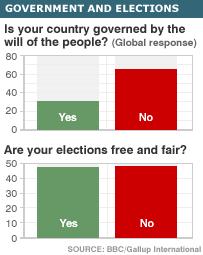
Sixty-five percent of citizens across the world do not think their country is governed by the will of the people, a poll commissioned by the BBC suggests.
The Gallup International Voice of the People 2005 poll questioned more than 50,000 people in 68 states for the BBC World Service survey about power.
Only in Scandinavia and South Africa do the majority believe that they are ruled according to their wishes.
But 47% thought elections in their countries were free and fair.
The figure is 55% for the US and Canada and up to 82% in EU countries - but just 24% in West Africa.
The survey also found that only 13% of people trusted politicians and only 16% thought they should be given more power.
About a third of those asked thought more power should go to writers and academics.
A quarter felt more should go to religious leaders - who are also seen as the most trusted group.
A fifth of those asked thought military, business leaders and journalists should be given more power.
Other key findings include:
Family exerts the greatest single influence on people
Sixty-one percent said a partner or family member has most influenced decisions about their life in the past year.
In Mexico, the figure is 88%. The lowest rating for family influence comes from North America (35%), where people report a wider range of influences, especially religious leaders (12%).
There is a wide gap between the developed and developing world on the degree to which people feel they can control their lives
Least control is felt in Africa, the Asia-Pacific region and the former Soviet bloc.
The highest scores are in Latin America (65%), followed by Canada and the US (62%) and Europe (53%).
National identity is still strong
Nationality was used by a third of those surveyed to 'define' themselves. About a fifth chose religion.
The sense of nationality is strongest in Latin America (54%).
Religion gained the highest scores in Africa (56%), followed by the US and Canada (32%).
Wealth 'empowers' East Asians
By Bethan Jinkinson
BBC News
East Asians from wealthy countries are more likely to feel they have control over their lives, a new poll suggests.
Those from South Korea, Japan and Singapore feel they have the most power to alter their own destiny.
In contrast, those surveyed in Vietnam, one of East Asia's poorest countries, feel there is very little they can do to change their own lives.
Gallup International questioned nearly 9,000 people in East Asia for the BBC's Who Runs Your World? survey.
Respondents were asked who had power over their lives, who they trust and if they have the power to change their own lives.
The BBC World Service commissioned the Gallup International Voice of the People 2005 poll of more than 50,000 people in 68 countries.
Nationalism is an important part of the East Asian identity: More than a third of those surveyed found it more important than religion, ethnicity or continent.
In South Korea, 73% of respondents considered their nationality more important than anything else.
Lack of trust
In terms of who they trust, East Asians are more likely to look up to intellectuals, journalists and religious leaders than the military and business elite.
That is apart from the Japanese, who appear to trust virtually no-one.
Over 70% of the Japanese surveyed do not trust either military, religious, business or political leaders - perhaps surprising when you consider the fact that the ruling Liberal Democratic party has been in power almost continuously for the last 50 years.
Democracy does not appear to be alive and well in the region.
Fewer than 30% of East Asians believe that their country is governed by the will of its people.
This is even more remarkable when you consider that people from some of the least democratic countries - such as Burma, North Korea and China - were unable to take part in the survey.
_________________________________________________
I don't believe in magic,
I don't believe in I-ching,
I don't believe in bible,
I don't believe in tarot,
I don't believe in Hitler,
I don't believe in Jesus,
I don't believe in Kennedy,
I don't believe in Buddha,
I don't believe in mantra,
I don't believe in Gita,
I don't believe in yoga,
I don't believe in kings,
I don't believe in Elvis,
I don't believe in Zimmerman,
I don't believe in Beatles,
I just believe in me,
Yoko and me,
And that's reality.
The dream is over,
What can I say?
The dream is over,
- John Lennon
We better get on right away
Well you get on your feet
And out on the street
Singing power to the people
Power to the people
Power to the people
Power to the people, right on
- John Lennon
States 'not run by people's will'

Sixty-five percent of citizens across the world do not think their country is governed by the will of the people, a poll commissioned by the BBC suggests.
The Gallup International Voice of the People 2005 poll questioned more than 50,000 people in 68 states for the BBC World Service survey about power.
Only in Scandinavia and South Africa do the majority believe that they are ruled according to their wishes.
But 47% thought elections in their countries were free and fair.
The figure is 55% for the US and Canada and up to 82% in EU countries - but just 24% in West Africa.
The survey also found that only 13% of people trusted politicians and only 16% thought they should be given more power.
About a third of those asked thought more power should go to writers and academics.
A quarter felt more should go to religious leaders - who are also seen as the most trusted group.
A fifth of those asked thought military, business leaders and journalists should be given more power.
Other key findings include:
Family exerts the greatest single influence on people
Sixty-one percent said a partner or family member has most influenced decisions about their life in the past year.
In Mexico, the figure is 88%. The lowest rating for family influence comes from North America (35%), where people report a wider range of influences, especially religious leaders (12%).
There is a wide gap between the developed and developing world on the degree to which people feel they can control their lives
Least control is felt in Africa, the Asia-Pacific region and the former Soviet bloc.
The highest scores are in Latin America (65%), followed by Canada and the US (62%) and Europe (53%).
National identity is still strong
Nationality was used by a third of those surveyed to 'define' themselves. About a fifth chose religion.
The sense of nationality is strongest in Latin America (54%).
Religion gained the highest scores in Africa (56%), followed by the US and Canada (32%).
Wealth 'empowers' East Asians
By Bethan Jinkinson
BBC News
East Asians from wealthy countries are more likely to feel they have control over their lives, a new poll suggests.
Those from South Korea, Japan and Singapore feel they have the most power to alter their own destiny.
In contrast, those surveyed in Vietnam, one of East Asia's poorest countries, feel there is very little they can do to change their own lives.
Gallup International questioned nearly 9,000 people in East Asia for the BBC's Who Runs Your World? survey.
Respondents were asked who had power over their lives, who they trust and if they have the power to change their own lives.
The BBC World Service commissioned the Gallup International Voice of the People 2005 poll of more than 50,000 people in 68 countries.
Nationalism is an important part of the East Asian identity: More than a third of those surveyed found it more important than religion, ethnicity or continent.
In South Korea, 73% of respondents considered their nationality more important than anything else.
Lack of trust
In terms of who they trust, East Asians are more likely to look up to intellectuals, journalists and religious leaders than the military and business elite.
That is apart from the Japanese, who appear to trust virtually no-one.
Over 70% of the Japanese surveyed do not trust either military, religious, business or political leaders - perhaps surprising when you consider the fact that the ruling Liberal Democratic party has been in power almost continuously for the last 50 years.
Democracy does not appear to be alive and well in the region.
Fewer than 30% of East Asians believe that their country is governed by the will of its people.
This is even more remarkable when you consider that people from some of the least democratic countries - such as Burma, North Korea and China - were unable to take part in the survey.
_________________________________________________
I don't believe in magic,
I don't believe in I-ching,
I don't believe in bible,
I don't believe in tarot,
I don't believe in Hitler,
I don't believe in Jesus,
I don't believe in Kennedy,
I don't believe in Buddha,
I don't believe in mantra,
I don't believe in Gita,
I don't believe in yoga,
I don't believe in kings,
I don't believe in Elvis,
I don't believe in Zimmerman,
I don't believe in Beatles,
I just believe in me,
Yoko and me,
And that's reality.
The dream is over,
What can I say?
The dream is over,
- John Lennon
Tuesday, September 13, 2005
Dog lovers' racial rants may have threatened national security
"In regulating the Internet, the MDA adopts a balanced and light-touch approach..The MDA also encourages industry self-regulation and public education efforts to complement its light-touch regulatory approach."
- Media Development Authority
Dog lovers' Internet remarks earn Singaporean sedition charges
Two men in Singapore have been charged with sedition, and face jail terms for making anti-Muslim remarks on the Internet.
The case was triggered when a local Muslim woman complained about uncaged dogs travelling in Singapore taxis, and leaving behind drool and dirt.
In a letter to the editor of the Straits Times newspaper, she pointed out that contact with dog saliva is prohibited for many Muslims.
A 25-year-old Chinese man responded with allegedly anti-Muslim remarks on a dog lovers' website.
Police say a second man who works at a dog kennel made an expletive-filled posting about the Muslim woman on his personal website.
In Singapore, political and religious Internet content is closely monitored.
Ever since race riots in the 1960s, the local authorities have regarded racial harmony as a fundamental social principle.
Under the Sedition Act, both men face a maximum penalty of three years jail and a fine.
Other Links
Two charged over online racist rants
2 arrested over racist blogs
Singaporeans face jail terms over dog commentsDog comments on net are sedition
2 charged with making racist remarks on Net
Two Singapore men charged with seditious remarks aimed at Malay community
What constitutes a 'seditious tendency'?
Seditious tendency.
3. (1) A seditious tendency is a tendency -
(a) to bring into hatred or contempt or to excite disaffection against the Government;
(b) to excite the citizens of Singapore or the residents in Singapore to attempt to procure in Singapore, the alteration, otherwise than by lawful means, of any matter as by law established;
(c) to bring into hatred or contempt or to excite disaffection against the administration of justice in Singapore;
(d) to raise discontent or disaffection amongst the citizens of Singapore or the residents in Singapore;
(e) to promote feelings of ill-will and hostility between different races or classes of the population of Singapore.
(2) Notwithstanding subsection (1), any act, speech, words, publication or other thing shall not be deemed to be seditious by reason only that it has a tendency -
(a) to show that the Government has been misled or mistaken in any of its measures;
(b) to point out errors or defects in the Government or the Constitution as by law established or in legislation or in the administration of justice with a view to the remedying of such errors or defects;
(c) to persuade the citizens of Singapore or the residents in Singapore to attempt to procure by lawful means the alteration of any matter in Singapore; or
(d) to point out, with a view to their removal, any matters producing or having a tendency to produce feelings of ill-will and enmity between different races or classes of the population of Singapore,
if such act, speech, words, publication or other thing has not otherwise in fact a seditious tendency.
Offences.
4 (1) Any person who -
(a) does or attempts to do, or makes any preparation to do, or conspires with any person to do, any act which has or which would, if done, have a seditious tendency;
(b) utters any seditious words;
(c) prints, publishes, sells, offers for sale, distributes or reproduces any seditious publication; or
(d) imports any seditious publication,
shall be guilty of an offence and shall be liable on conviction for a first offence to a fine not exceeding $5,000 or to imprisonment for a term not exceeding 3 years or to both, and, for a subsequent offence, to imprisonment for a term not exceeding 5 years; and any seditious publication found in the possession of that person or used in evidence at his trial shall be forfeited and may be destroyed or otherwise disposed of as the court directs.
(2) Any person who without lawful excuse has in his possession any seditious publication shall be guilty of an offence and shall be liable on conviction for a first offence to a fine not exceeding $2,000 or to imprisonment for a term not exceeding 18 months or to both, and, for a subsequent offence, to imprisonment for a term not exceeding 3 years, and such publication shall be forfeited and may be destroyed or otherwise disposed of as the court directs.
- Media Development Authority
Dog lovers' Internet remarks earn Singaporean sedition charges
Two men in Singapore have been charged with sedition, and face jail terms for making anti-Muslim remarks on the Internet.
The case was triggered when a local Muslim woman complained about uncaged dogs travelling in Singapore taxis, and leaving behind drool and dirt.
In a letter to the editor of the Straits Times newspaper, she pointed out that contact with dog saliva is prohibited for many Muslims.
A 25-year-old Chinese man responded with allegedly anti-Muslim remarks on a dog lovers' website.
Police say a second man who works at a dog kennel made an expletive-filled posting about the Muslim woman on his personal website.
In Singapore, political and religious Internet content is closely monitored.
Ever since race riots in the 1960s, the local authorities have regarded racial harmony as a fundamental social principle.
Under the Sedition Act, both men face a maximum penalty of three years jail and a fine.
Other Links
Two charged over online racist rants
2 arrested over racist blogs
Singaporeans face jail terms over dog commentsDog comments on net are sedition
2 charged with making racist remarks on Net
Two Singapore men charged with seditious remarks aimed at Malay community
What constitutes a 'seditious tendency'?
Seditious tendency.
3. (1) A seditious tendency is a tendency -
(a) to bring into hatred or contempt or to excite disaffection against the Government;
(b) to excite the citizens of Singapore or the residents in Singapore to attempt to procure in Singapore, the alteration, otherwise than by lawful means, of any matter as by law established;
(c) to bring into hatred or contempt or to excite disaffection against the administration of justice in Singapore;
(d) to raise discontent or disaffection amongst the citizens of Singapore or the residents in Singapore;
(e) to promote feelings of ill-will and hostility between different races or classes of the population of Singapore.
(2) Notwithstanding subsection (1), any act, speech, words, publication or other thing shall not be deemed to be seditious by reason only that it has a tendency -
(a) to show that the Government has been misled or mistaken in any of its measures;
(b) to point out errors or defects in the Government or the Constitution as by law established or in legislation or in the administration of justice with a view to the remedying of such errors or defects;
(c) to persuade the citizens of Singapore or the residents in Singapore to attempt to procure by lawful means the alteration of any matter in Singapore; or
(d) to point out, with a view to their removal, any matters producing or having a tendency to produce feelings of ill-will and enmity between different races or classes of the population of Singapore,
if such act, speech, words, publication or other thing has not otherwise in fact a seditious tendency.
Offences.
4 (1) Any person who -
(a) does or attempts to do, or makes any preparation to do, or conspires with any person to do, any act which has or which would, if done, have a seditious tendency;
(b) utters any seditious words;
(c) prints, publishes, sells, offers for sale, distributes or reproduces any seditious publication; or
(d) imports any seditious publication,
shall be guilty of an offence and shall be liable on conviction for a first offence to a fine not exceeding $5,000 or to imprisonment for a term not exceeding 3 years or to both, and, for a subsequent offence, to imprisonment for a term not exceeding 5 years; and any seditious publication found in the possession of that person or used in evidence at his trial shall be forfeited and may be destroyed or otherwise disposed of as the court directs.
(2) Any person who without lawful excuse has in his possession any seditious publication shall be guilty of an offence and shall be liable on conviction for a first offence to a fine not exceeding $2,000 or to imprisonment for a term not exceeding 18 months or to both, and, for a subsequent offence, to imprisonment for a term not exceeding 3 years, and such publication shall be forfeited and may be destroyed or otherwise disposed of as the court directs.
Thursday, September 08, 2005
Eric Khoo's movie poster banned
No gay or lesbian images please, we're Singaporeans.
Singapore bans "lesbian" movie poster for Cannes-exhibited film
Agence France Presse
September 7, 2005
SINGAPORE
SINGAPORE'S media watchdog said Wednesday, Sept 7, that it banned the original promotional posters for a critically acclaimed local film for depicting "lesbian intimacy" between the main actresses.
However, the movie Be With Me which received good reviews at the Cannes Film Festival was approved uncut and will be screened locally from Thursday with a rating of M18, meaning viewers must be at least 18 years old.
"One of the guidelines states that posters must not depict or promote homosexual or lesbian intimacy," a spokeswoman from the Media Development Authority said in reply to queries from AFP.
"As such, the distributor was advised to use alternative visuals," she said.
The original poster depicted a scene from the movie with the two main actresses locked in an embrace.
It has been replaced instead by an image of a man necking with one of the actresses.
Be With Me is the latest movie by influential local film maker Eric Khoo and contains three plots, one of which involves love between two teenage schoolgirls.
Khoo told the New Paper tabloid Wednesday that he was "disappointed" the original posters did not pass the censors.
"There's nothing in the image or the film that shows anything graphic or raunchy," Khoo was quoted as saying.
The movie was screened at the Cannes Film Festival in May where it was reported to have received good reviews from international critics. It is to be released internationally after Singapore.
Despite a tradition of censorship here, a nascent independent film industry is emerging in Singapore touching on previously taboo topics, but politically-oriented films remain heavily restricted.
An independent Singaporean film maker, Martyn See, is under police investigation for making a documentary about an opposition leader.
Singapore bans "lesbian" movie poster for Cannes-exhibited film
Agence France Presse
September 7, 2005
SINGAPORE
SINGAPORE'S media watchdog said Wednesday, Sept 7, that it banned the original promotional posters for a critically acclaimed local film for depicting "lesbian intimacy" between the main actresses.
However, the movie Be With Me which received good reviews at the Cannes Film Festival was approved uncut and will be screened locally from Thursday with a rating of M18, meaning viewers must be at least 18 years old.
"One of the guidelines states that posters must not depict or promote homosexual or lesbian intimacy," a spokeswoman from the Media Development Authority said in reply to queries from AFP.
"As such, the distributor was advised to use alternative visuals," she said.
The original poster depicted a scene from the movie with the two main actresses locked in an embrace.
It has been replaced instead by an image of a man necking with one of the actresses.
Be With Me is the latest movie by influential local film maker Eric Khoo and contains three plots, one of which involves love between two teenage schoolgirls.
Khoo told the New Paper tabloid Wednesday that he was "disappointed" the original posters did not pass the censors.
"There's nothing in the image or the film that shows anything graphic or raunchy," Khoo was quoted as saying.
The movie was screened at the Cannes Film Festival in May where it was reported to have received good reviews from international critics. It is to be released internationally after Singapore.
Despite a tradition of censorship here, a nascent independent film industry is emerging in Singapore touching on previously taboo topics, but politically-oriented films remain heavily restricted.
An independent Singaporean film maker, Martyn See, is under police investigation for making a documentary about an opposition leader.
Tuesday, September 06, 2005
Activist files complaint against national broadcaster
Agence France Presse
September 2, 2005
SINGAPORE
A SINGAPOREAN activist has filed a police complaint against national broadcaster MediaCorp for allegedly violating the island's Films Act banning political advertising using film or video.
The complaint, filed by Yap Keng Ho, accuses MediaCorp of screening two programs about ruling People's Action Party leaders and is meant as a protest against Singapore's stringent censorship, Yap said.
Yap told AFP Friday, Sept 2, he wanted to expose a pro-ruling party bias in the legislation banning political films with his complaint, which comes as police investigate independent Singaporean film maker Martyn See for making a documentary about an opposition leader.
The Films Act bans political advertising using films or videos, as well as movies directed towards any political end such as promoting parties.
"I feel that it is a very unfair and biased legislation," Yap, a 44-year-old information technology consultant, told AFP. "I want to show the world whether law enforcement (in Singapore) is going to be fair or not."
Yap's complaint alleges that MediaCorp had violated the Films Act by screening two programs in 2002 and this year featuring Singapore's founding father Lee Kuan Yew and his son, Prime Minister Lee Hsien Loong, respectively.
A spokesman for the Singapore police confirmed they received the complaint "and are currently making the necessary checks with the Media Development Authority (MDA)."
A spokesman for MediaCorp said they were unaware of Yap's complaint.
On Monday, filmmaker See surrendered to police his camera and remaining tapes of the documentary "Singapore Rebel" about Chee Soon Juan, secretary-general of the opposition Singapore Democratic Party.
Chee, the most vocal opposition politician in Singapore, is facing bankruptcy after the High Court ordered him to pay S$500,000 (US$300,000) for defaming PAP leaders.
Affluent Singapore has often been criticised by human rights groups for maintaining strict political controls despite its rapid modernisation since becoming a republic 40 years ago last month. Singapore has been ruled by the PAP since independence.
September 2, 2005
SINGAPORE
A SINGAPOREAN activist has filed a police complaint against national broadcaster MediaCorp for allegedly violating the island's Films Act banning political advertising using film or video.
The complaint, filed by Yap Keng Ho, accuses MediaCorp of screening two programs about ruling People's Action Party leaders and is meant as a protest against Singapore's stringent censorship, Yap said.
Yap told AFP Friday, Sept 2, he wanted to expose a pro-ruling party bias in the legislation banning political films with his complaint, which comes as police investigate independent Singaporean film maker Martyn See for making a documentary about an opposition leader.
The Films Act bans political advertising using films or videos, as well as movies directed towards any political end such as promoting parties.
"I feel that it is a very unfair and biased legislation," Yap, a 44-year-old information technology consultant, told AFP. "I want to show the world whether law enforcement (in Singapore) is going to be fair or not."
Yap's complaint alleges that MediaCorp had violated the Films Act by screening two programs in 2002 and this year featuring Singapore's founding father Lee Kuan Yew and his son, Prime Minister Lee Hsien Loong, respectively.
A spokesman for the Singapore police confirmed they received the complaint "and are currently making the necessary checks with the Media Development Authority (MDA)."
A spokesman for MediaCorp said they were unaware of Yap's complaint.
On Monday, filmmaker See surrendered to police his camera and remaining tapes of the documentary "Singapore Rebel" about Chee Soon Juan, secretary-general of the opposition Singapore Democratic Party.
Chee, the most vocal opposition politician in Singapore, is facing bankruptcy after the High Court ordered him to pay S$500,000 (US$300,000) for defaming PAP leaders.
Affluent Singapore has often been criticised by human rights groups for maintaining strict political controls despite its rapid modernisation since becoming a republic 40 years ago last month. Singapore has been ruled by the PAP since independence.
Minister happy with 147th press freedom ranking and political film ban
Some Singaporeans are "not sufficiently discerning", so we should continue to ban 'political' films, says the Minister for Information, Communication and the Arts (MICA) Dr Lee Boon Yang.
Below is an excerpt of the article published by the Straits Times on August 5, 2005.
Media Freedom
SINGAPORE was recently ranked 147th out of 167 countries on the press freedom index.
But it is not something that Dr Lee loses sleep over.
Singapore has developed a "different model for its media" - one that "worked well over the years".
He is confident that Singaporeans find local media "credible".
"Singaporeans find the newspapers, whether it's the Straits Times, Lianhe Zaobao or Business Times or other newspapers, highly respected newspapers. If the Singapore newspapers are not credible, I don't see them being around for so long.
"Now if Singaporeans do not trust our newspaper, don't forget we have in circulation in Singapore today 4,500 foreign publications. They will turn more and more to alternative sources.
"And yet Straits Times is able to preserve its readership amidst all this challenge and continues to grow. So I take it as a strong endorsement, as a sign of its relevance and credibility to the society."
As for the Government's policy on censorship, he says: "Censorship should be in tandem with a society's development and evolution of social norms. The guidelines change as society changes."
Do the arts and media - as opinion leaders - have a role in pushing social boundaries?
"Certainly there's some truth in it that the arts, film, cultural practitioners are there to experiment and push the norms. Yes, I accept that.
"But the Government should not join them in pushing it up rapidly at the expense of the vast majority not yet comfortable with such an avant garde approach."
And even as Singapore evolves, he stresses, there are certain fundamentals that do not - and cannot - change. "We're a young nation, multiracial, multi-religious; there are always weak points in our society that can be exploited."
This concern about the faultlines in Singapore's young society is behind the ban on political videos.
Film and video are "emotional media" that "can arouse all kinds of reactions without an opportunity for the rebuttal to be made effectively."
Aren't Singaporeans mature enough to discern?
"I think that Singapore people are intelligent and mature. And I think they can make their own judgement.
"But there may some who are not sufficiently discerning and if one day something goes wrong, then we will have to repair the damage."
Negative articles on the Government, on the other hand, are "part of the democratic debate."
But it will be "unhealthy for the media to emabark on crusading journalism".
Whom do these curbs benefit?
"I'm saying it's for Singapore, not for the ruling party alone, not for the Government. You're helping Singaporeans be better prepared for a world that is going to be more challenging."
Below is an excerpt of the article published by the Straits Times on August 5, 2005.
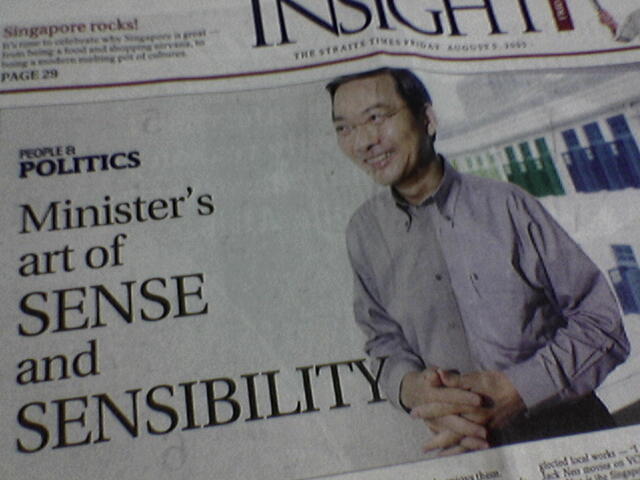
Media Freedom
SINGAPORE was recently ranked 147th out of 167 countries on the press freedom index.
But it is not something that Dr Lee loses sleep over.
Singapore has developed a "different model for its media" - one that "worked well over the years".
He is confident that Singaporeans find local media "credible".
"Singaporeans find the newspapers, whether it's the Straits Times, Lianhe Zaobao or Business Times or other newspapers, highly respected newspapers. If the Singapore newspapers are not credible, I don't see them being around for so long.
"Now if Singaporeans do not trust our newspaper, don't forget we have in circulation in Singapore today 4,500 foreign publications. They will turn more and more to alternative sources.
"And yet Straits Times is able to preserve its readership amidst all this challenge and continues to grow. So I take it as a strong endorsement, as a sign of its relevance and credibility to the society."
As for the Government's policy on censorship, he says: "Censorship should be in tandem with a society's development and evolution of social norms. The guidelines change as society changes."
Do the arts and media - as opinion leaders - have a role in pushing social boundaries?
"Certainly there's some truth in it that the arts, film, cultural practitioners are there to experiment and push the norms. Yes, I accept that.
"But the Government should not join them in pushing it up rapidly at the expense of the vast majority not yet comfortable with such an avant garde approach."
And even as Singapore evolves, he stresses, there are certain fundamentals that do not - and cannot - change. "We're a young nation, multiracial, multi-religious; there are always weak points in our society that can be exploited."
This concern about the faultlines in Singapore's young society is behind the ban on political videos.
Film and video are "emotional media" that "can arouse all kinds of reactions without an opportunity for the rebuttal to be made effectively."
Aren't Singaporeans mature enough to discern?
"I think that Singapore people are intelligent and mature. And I think they can make their own judgement.
"But there may some who are not sufficiently discerning and if one day something goes wrong, then we will have to repair the damage."
Negative articles on the Government, on the other hand, are "part of the democratic debate."
But it will be "unhealthy for the media to emabark on crusading journalism".
Whom do these curbs benefit?
"I'm saying it's for Singapore, not for the ruling party alone, not for the Government. You're helping Singaporeans be better prepared for a world that is going to be more challenging."
Thursday, September 01, 2005
Police report made against ChannelNewsAsia
Aug 30, 2005
Mr Yap Keng Ho aka Uncle Yap, an activist in Singapore, made a police report today against CNA. Uncle Yap is asking the police to look into two programmes by the state-controlled local broadcaster ChannelNewsAsia or CNA, Success Stories and Up Close. These programmes can also be considered "party political films" under the Films Act. (Read my earlier post Keep up the good work MDA!)
Martyn See, a local filmmaker is being investigated by the police for his 26 minute documentary Singapore Rebel about Chee Soon Juan.
Read more
Complaint lodged against MediaCorp for showing political films
30 Aug 05
Internet activist Mr Yap Keng Ho has lodged a police report to complain against the production and/or screening of political films regarding PAP leaders.
Mr Yap made the report at the Tampines Neighbourhood Police Centre today, citing that two films, Success Story which portrayed Mr Lee Kuan Yew and Up Close which featured five PAP ministers including Mr Lee Hsien Loong, were screened on Channel News Asia in 2002 and 2005 respectively.
The complaint comes at a time when the police are investigating Mr Martyn See for making a film about Dr Chee Soon Juan, which the Media Development Authority has said is “political” in nature and therefore a violation of the Films Act.
Mr Yap said in his report that the screening of the political documentaries of Mr Lee Kuan Yew and the PAP ministers likewise contravened the Films Act and has asked the police to investigate the matter.
Read more
Mr Yap Keng Ho aka Uncle Yap, an activist in Singapore, made a police report today against CNA. Uncle Yap is asking the police to look into two programmes by the state-controlled local broadcaster ChannelNewsAsia or CNA, Success Stories and Up Close. These programmes can also be considered "party political films" under the Films Act. (Read my earlier post Keep up the good work MDA!)
Martyn See, a local filmmaker is being investigated by the police for his 26 minute documentary Singapore Rebel about Chee Soon Juan.
Read more
Complaint lodged against MediaCorp for showing political films
30 Aug 05
Internet activist Mr Yap Keng Ho has lodged a police report to complain against the production and/or screening of political films regarding PAP leaders.
Mr Yap made the report at the Tampines Neighbourhood Police Centre today, citing that two films, Success Story which portrayed Mr Lee Kuan Yew and Up Close which featured five PAP ministers including Mr Lee Hsien Loong, were screened on Channel News Asia in 2002 and 2005 respectively.
The complaint comes at a time when the police are investigating Mr Martyn See for making a film about Dr Chee Soon Juan, which the Media Development Authority has said is “political” in nature and therefore a violation of the Films Act.
Mr Yap said in his report that the screening of the political documentaries of Mr Lee Kuan Yew and the PAP ministers likewise contravened the Films Act and has asked the police to investigate the matter.
Read more
Wednesday, August 31, 2005
Sex and violence OK, but no politics or human rights please
28 Aug 2005
South China Morning Post
Headline: Adapt or die: a lesson for the Lion City
Byline: Singapore is freeing up its attitudes to sex and free speech
in a bid to reinvent itself. But critics say the changes are
cosmetic and real reform is needed, writes Peter Kammerer
Singapore's leaders have done amazing things with their tiny,
resource-poor country. In the 40 years since nationhood, they have
built an economic powerhouse with most of the trappings of a first-
world society.
From a manufacturing base, they evolved the city into a regional
financial hub and now a budding centre for biotechnology and other
21st century industries.
But with the thrusting economic expansion of China and India, the
island nation, variously called the Lion City or the Little Red Dot
and perceived by foreign observers as having a conservative, staid
image, has reached a crossroads. Put bluntly, it is a matter of
adapt or die, its leaders contend.
Such beliefs offer a spark of hope to critics of the governing
People's Action Party (PAP) which has ruled the island state since
its founding. Decades of agitation have made little impact on the
government's stranglehold on power or its control of the media and
free speech.
Prime Minister Lee Hsien Loong last Sunday gave the strongest
indication yet that change was on the way. Marking the 40th National
Day, the son of founding father and Minister Mentor Lee Kuan Yew
said that a dramatic shift in approach was necessary to meet the
challenges.
"It must be a totally different Singapore, because if it's the same
Singapore today, we're dead," he said. "We have to remake Singapore -
our economy, our education, our mindsets, our city."
As inspiration, Mr Lee pointed to the free-wheeling US city of Las
Vegas, referred to by Americans as "Sin City" for its casinos and
open policy on sex. The Singaporean leader was quick to qualify his
admiration: "Out of nothing in a desert they have built a city.
Forty million people visit it every year. We don't want to become
Las Vegas, but we should learn from their spirit."
In the past few months, the government has already given a foretaste
of a Las Vegas-style policy. In April, a ban on casinos was reversed
when approval was given for the construction of two gaming resorts
by 2009. The following month, Singapore was named as the first city
in Asia to host the Crazy Horse Paris cabaret, which features
scantily clad dancers. Last week, authorities gave approval in
principle to the island state's first sex expo, which media
reports said would include furniture "designed to enhance love-
making" and an erotic toy section when it opened in November.
The moves follow a gradual loosening of regulations on
entertainment, which officials have determined are necessary to
cater for a population increasingly exposed to international
influences.
But while cinemas can now show movies featuring nudity and internet
sites like Sarongpartygirl, the explicit blog of a sexually
uninhibited university arts student, are tolerated, social
restrictions abound. Homosexual and oral sex are considered crimes
while foreign publications and television programmes like Sex in the
City are frequently censored.
Singapore's best-known writer, Catherine Lim, last week called the
concessions remarkable and immense.
"When I go to a movie and nudity is shown or explicit sex, I
think, 'Oh my God, they're never going to have that for 100 years in
Malaysia or Indonesia," the novelist and political commentator
said. "It's amazing - there are changes in the arts scene and now
we're going to have a sex expo. When I read about that I wondered
whether I was reading right."
Lim believes the government sees Singapore's survival in changes in
the economy, education and arts and there is a genuine desire to
bring about positive change.
"There is frenetic activity to roll with the times and stay ahead.
Singapore's mantra is if you don't stay ahead, you not only slide
backwards, you go under." Nonetheless, Lim said the line would be
drawn on human and political rights.
Of the 84 elected members of parliament, 82 are from PAP. Political
activists claim that unfair electoral rules and the government's
total control of the media prevent opposition politicians from
having a fair chance of being elected. Laws such as the much-
criticised Internal Security Act have been used to silence
opponents, and opposition politicians have been sued into bankruptcy
and jailed for breaking rules on political gatherings.
The latest assessment of political and civil rights around the world
by the respected US-based Freedom House determined Singapore
was "partly free". It was ranked alongside Armenia, Congo-
Brazzaville, Jordan, Liberia and Morocco - nations far less
economically and socially developed.
Gay activist Alex Au shared Lim's assessment, determining that
Singapore's opening up was selective. "There is a bit more space for
pure entertainment, even of the slightly more erotic variety," Mr Au
said. "There is a call for political engagement by citizens, but it
is clearly on the PAP's own terms. Essentially, they want ideas and
suggestions from the people to help them govern better but without
in any way trimming or threatening their political monopoly."
Homosexuality was one area the government refused to discuss, he
said. While Hong Kong recently lowered the age for consensual gay
sex from 21 to 16, in Singapore homosexual relations remains
illegal. "The government has shown absolutely no willingness to
consider repealing that, nor have they demonstrated any real
willingness to remove censorship regarding discussion of such
subjects, which they consider sensitive," he said.
Yet Singapore has a thriving gay and lesbian scene, with eight
dedicated bars and pubs for the community and others that hold
regular "gay nights". An annual festival was recently banned for
unspecified reasons, but a month-long series of exhibitions and
workshops was permitted and is presently being held.
Mr Au said undercover police had attended each session, sometimes
filming the proceedings. Participants had responded by filming the
police.
The government has answered calls for freer speech, though, most
notably with the introduction of a "Speaker's Corner" and last
October's decision to permit indoor meetings. But permits are
required, issues such as race and religion cannot be discussed and a
law banning unauthorised outdoor gatherings of five or more people
is still in place.
Since the September 11 terrorist attacks, official phone-tapping -
previously an open secret - has been announced as legal.
But change, however small, is still welcome, the president of the
non-government ThinkCentre, Sinapan Samydorai, said. There is a big
difference now to 10 years ago. His organisation - which aims
to "critically examine issues related to political development
democracy, rule of law, human rights and civil society" - is further
proof.
"But when it comes to political decision-making and governance,
that's where the caution is," Mr Samydorai suggested. "They don't
want to open up too fast ... they're opening up slowly, but not in a
very liberal way."
Observers have not seen any moves to relax government control of the
media. Internet sites considered inappropriate are blocked and
distribution of foreign publications is delayed until censors have
given approval.
Veteran journalist and commentator Ravi Veloo does not find the
availability of articles and websites about sex unusual. "There is
freedom of the press in Singapore, but only for sex and violence,
not politics," Veloo said. "The boundaries are in the political
dimension- that is where the legitimacy of the government can be
threatened."
A website giving legitimacy to an alternative point of view that the
government was uncomfortable with would be shut down. But Singapore
was changing and it had to, like any other country in the world, he
believed.
For the government, the biggest factor is the number of foreign
organisations in the country and how to deal with that from a
cultural, economic and political point of view.
But Lim also believes it has to contend with increasingly vocal
young Singaporeans. "We have a young group coming up who like to
call themselves Cosmopolitans rather than Singaporeans," she
said. "They are highly educated, sophisticated, globally exposed,
very savvy on the internet. They are becoming more vocal in debates."
There is no debate about whether Singapore is changing; there is,
however, uncertainty about which force will push the government to
make deeper, more far-reaching changes.
Singapore's government did not respond to efforts to get comment for
this article.
http://singaporerebel.blogspot.com/2005/06/repeat-mantra-singapore-is-opening.html
South China Morning Post
Headline: Adapt or die: a lesson for the Lion City
Byline: Singapore is freeing up its attitudes to sex and free speech
in a bid to reinvent itself. But critics say the changes are
cosmetic and real reform is needed, writes Peter Kammerer
Singapore's leaders have done amazing things with their tiny,
resource-poor country. In the 40 years since nationhood, they have
built an economic powerhouse with most of the trappings of a first-
world society.
From a manufacturing base, they evolved the city into a regional
financial hub and now a budding centre for biotechnology and other
21st century industries.
But with the thrusting economic expansion of China and India, the
island nation, variously called the Lion City or the Little Red Dot
and perceived by foreign observers as having a conservative, staid
image, has reached a crossroads. Put bluntly, it is a matter of
adapt or die, its leaders contend.
Such beliefs offer a spark of hope to critics of the governing
People's Action Party (PAP) which has ruled the island state since
its founding. Decades of agitation have made little impact on the
government's stranglehold on power or its control of the media and
free speech.
Prime Minister Lee Hsien Loong last Sunday gave the strongest
indication yet that change was on the way. Marking the 40th National
Day, the son of founding father and Minister Mentor Lee Kuan Yew
said that a dramatic shift in approach was necessary to meet the
challenges.
"It must be a totally different Singapore, because if it's the same
Singapore today, we're dead," he said. "We have to remake Singapore -
our economy, our education, our mindsets, our city."
As inspiration, Mr Lee pointed to the free-wheeling US city of Las
Vegas, referred to by Americans as "Sin City" for its casinos and
open policy on sex. The Singaporean leader was quick to qualify his
admiration: "Out of nothing in a desert they have built a city.
Forty million people visit it every year. We don't want to become
Las Vegas, but we should learn from their spirit."
In the past few months, the government has already given a foretaste
of a Las Vegas-style policy. In April, a ban on casinos was reversed
when approval was given for the construction of two gaming resorts
by 2009. The following month, Singapore was named as the first city
in Asia to host the Crazy Horse Paris cabaret, which features
scantily clad dancers. Last week, authorities gave approval in
principle to the island state's first sex expo, which media
reports said would include furniture "designed to enhance love-
making" and an erotic toy section when it opened in November.
The moves follow a gradual loosening of regulations on
entertainment, which officials have determined are necessary to
cater for a population increasingly exposed to international
influences.
But while cinemas can now show movies featuring nudity and internet
sites like Sarongpartygirl, the explicit blog of a sexually
uninhibited university arts student, are tolerated, social
restrictions abound. Homosexual and oral sex are considered crimes
while foreign publications and television programmes like Sex in the
City are frequently censored.
Singapore's best-known writer, Catherine Lim, last week called the
concessions remarkable and immense.
"When I go to a movie and nudity is shown or explicit sex, I
think, 'Oh my God, they're never going to have that for 100 years in
Malaysia or Indonesia," the novelist and political commentator
said. "It's amazing - there are changes in the arts scene and now
we're going to have a sex expo. When I read about that I wondered
whether I was reading right."
Lim believes the government sees Singapore's survival in changes in
the economy, education and arts and there is a genuine desire to
bring about positive change.
"There is frenetic activity to roll with the times and stay ahead.
Singapore's mantra is if you don't stay ahead, you not only slide
backwards, you go under." Nonetheless, Lim said the line would be
drawn on human and political rights.
Of the 84 elected members of parliament, 82 are from PAP. Political
activists claim that unfair electoral rules and the government's
total control of the media prevent opposition politicians from
having a fair chance of being elected. Laws such as the much-
criticised Internal Security Act have been used to silence
opponents, and opposition politicians have been sued into bankruptcy
and jailed for breaking rules on political gatherings.
The latest assessment of political and civil rights around the world
by the respected US-based Freedom House determined Singapore
was "partly free". It was ranked alongside Armenia, Congo-
Brazzaville, Jordan, Liberia and Morocco - nations far less
economically and socially developed.
Gay activist Alex Au shared Lim's assessment, determining that
Singapore's opening up was selective. "There is a bit more space for
pure entertainment, even of the slightly more erotic variety," Mr Au
said. "There is a call for political engagement by citizens, but it
is clearly on the PAP's own terms. Essentially, they want ideas and
suggestions from the people to help them govern better but without
in any way trimming or threatening their political monopoly."
Homosexuality was one area the government refused to discuss, he
said. While Hong Kong recently lowered the age for consensual gay
sex from 21 to 16, in Singapore homosexual relations remains
illegal. "The government has shown absolutely no willingness to
consider repealing that, nor have they demonstrated any real
willingness to remove censorship regarding discussion of such
subjects, which they consider sensitive," he said.
Yet Singapore has a thriving gay and lesbian scene, with eight
dedicated bars and pubs for the community and others that hold
regular "gay nights". An annual festival was recently banned for
unspecified reasons, but a month-long series of exhibitions and
workshops was permitted and is presently being held.
Mr Au said undercover police had attended each session, sometimes
filming the proceedings. Participants had responded by filming the
police.
The government has answered calls for freer speech, though, most
notably with the introduction of a "Speaker's Corner" and last
October's decision to permit indoor meetings. But permits are
required, issues such as race and religion cannot be discussed and a
law banning unauthorised outdoor gatherings of five or more people
is still in place.
Since the September 11 terrorist attacks, official phone-tapping -
previously an open secret - has been announced as legal.
But change, however small, is still welcome, the president of the
non-government ThinkCentre, Sinapan Samydorai, said. There is a big
difference now to 10 years ago. His organisation - which aims
to "critically examine issues related to political development
democracy, rule of law, human rights and civil society" - is further
proof.
"But when it comes to political decision-making and governance,
that's where the caution is," Mr Samydorai suggested. "They don't
want to open up too fast ... they're opening up slowly, but not in a
very liberal way."
Observers have not seen any moves to relax government control of the
media. Internet sites considered inappropriate are blocked and
distribution of foreign publications is delayed until censors have
given approval.
Veteran journalist and commentator Ravi Veloo does not find the
availability of articles and websites about sex unusual. "There is
freedom of the press in Singapore, but only for sex and violence,
not politics," Veloo said. "The boundaries are in the political
dimension- that is where the legitimacy of the government can be
threatened."
A website giving legitimacy to an alternative point of view that the
government was uncomfortable with would be shut down. But Singapore
was changing and it had to, like any other country in the world, he
believed.
For the government, the biggest factor is the number of foreign
organisations in the country and how to deal with that from a
cultural, economic and political point of view.
But Lim also believes it has to contend with increasingly vocal
young Singaporeans. "We have a young group coming up who like to
call themselves Cosmopolitans rather than Singaporeans," she
said. "They are highly educated, sophisticated, globally exposed,
very savvy on the internet. They are becoming more vocal in debates."
There is no debate about whether Singapore is changing; there is,
however, uncertainty about which force will push the government to
make deeper, more far-reaching changes.
Singapore's government did not respond to efforts to get comment for
this article.
http://singaporerebel.blogspot.com/2005/06/repeat-mantra-singapore-is-opening.html
Tuesday, August 30, 2005
Singapore filmmaker surrenders tapes, camera to police
Tuesday August 30, 02:26 PM
Singapore filmmaker surrenders tapes, camera to police
SINGAPORE (AFP) - A Singaporean film maker who could be jailed for making a documentary on an opposition politician has surrendered his video camera and tapes to police investigators.
Martyn See told AFP the equipment and six existing tapes of "Singapore Rebel," a documentary about Chee Soon Juan, secretary-general of the Singapore Democratic Party, were handed over on Monday evening.
He was told to surrender the tapes, including two master copies, and the digital video camera after police questioned him a second time last week about the documentary.
"I have no idea when they will return or even if they will return at all," See said. "They just said they need the camera and tapes to investigate my case which was violating the Films Act."
Singapore's Films Act bans political advertising using films or videos, as well as movies directed towards any political end such as promoting political parties.
A police spokesman told AFP the investigation was still ongoing.
See's "Singapore Rebel" has been classified by local censors as having violated the act because of its political content, an accusation that the filmmaker rejects.
If convicted, See could be jailed for up to two years or fined up to 100,000 Singapore dollars (60,000 US).
He said the documentary was made to further his own understanding about the plight of opposition politicians in Singapore.
While banned at home, his documentary has been screened at two human rights festivals in the United States and New Zealand.
Affluent Singapore has often been criticised by human rights groups for maintaining strict political controls despite its rapid modernisation since becoming a republic 40 years ago this month.
Singapore has been ruled by the People's Action Party of founding father Lee Kuan Yew since independence. His son Lee Hsien Loong promised to loosen political restrictions after taking over as prime minister a year ago from Goh Chok Tong.
Chee, the most vocal opposition politician in Singapore, is facing bankruptcy after the High Court ordered him to pay 500,000 Singapore dollars (300,000 US) for defaming Goh and the elder Lee.
Singapore filmmaker surrenders tapes, camera to police
SINGAPORE (AFP) - A Singaporean film maker who could be jailed for making a documentary on an opposition politician has surrendered his video camera and tapes to police investigators.
Martyn See told AFP the equipment and six existing tapes of "Singapore Rebel," a documentary about Chee Soon Juan, secretary-general of the Singapore Democratic Party, were handed over on Monday evening.
He was told to surrender the tapes, including two master copies, and the digital video camera after police questioned him a second time last week about the documentary.
"I have no idea when they will return or even if they will return at all," See said. "They just said they need the camera and tapes to investigate my case which was violating the Films Act."
Singapore's Films Act bans political advertising using films or videos, as well as movies directed towards any political end such as promoting political parties.
A police spokesman told AFP the investigation was still ongoing.
See's "Singapore Rebel" has been classified by local censors as having violated the act because of its political content, an accusation that the filmmaker rejects.
If convicted, See could be jailed for up to two years or fined up to 100,000 Singapore dollars (60,000 US).
He said the documentary was made to further his own understanding about the plight of opposition politicians in Singapore.
While banned at home, his documentary has been screened at two human rights festivals in the United States and New Zealand.
Affluent Singapore has often been criticised by human rights groups for maintaining strict political controls despite its rapid modernisation since becoming a republic 40 years ago this month.
Singapore has been ruled by the People's Action Party of founding father Lee Kuan Yew since independence. His son Lee Hsien Loong promised to loosen political restrictions after taking over as prime minister a year ago from Goh Chok Tong.
Chee, the most vocal opposition politician in Singapore, is facing bankruptcy after the High Court ordered him to pay 500,000 Singapore dollars (300,000 US) for defaming Goh and the elder Lee.
Monday, August 29, 2005
We celebrate the power of filmmaking in Singapore
"In the wrong hands film can have a powerful impact"
- Former Information and Art Minister George Yeo, 1998
Of course Mr Yeo did not mean that in the right hands, film will have negligible impact. In fact, no other country recognises and honours the value of filmmaking more than Singapore. That the potent combination of moving pictures and sound can influence minds, document reality and propel the nation forward is not lost on our nation's leaders.
For example, in his most important speech of the year, Prime Minister Lee Hsien Loong used video clips to exhort Singaporeans to strive for a higher standard of service. The audience responded favourably to the two short clips "Tau Gay Not Enough" and applauded wildly when animated fireworks exploded in the the skyline of an artist impression of Marina Bayfront.

The ever-efficient Singapore police force also recognises the value of filmmaking in documenting evidence. In my video 'Singapore Rebel,' there were scenes of plainclothes police officers filming members of the public outside the Tanglin Police Station. Here in this picture, a young officer in civilian wear practises his camera skills at the book launch of opposition figure Chee Soon Juan.
Even the tools used for filmmaking is honoured by the Singapore authorities. In their investigation into my video 'Singapore Rebel', the police has asked that I hand over all tapes and even the camera to them. The video camera does not store images on its own. It requires cassette tapes to record and store these images. That the police would want to seize an empty video camera, is to my mind, their endorsement of the power of filmmaking. First the tapes, then the camera and finally the filmmaker himself..
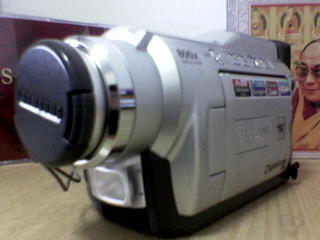
Update : My tapes and camera were handed over to the police at the Police Cantonment Complex at about 6.45 pm this evening. When asked if I can get my camera back soonest, ASP Chan said "No promise."
- Former Information and Art Minister George Yeo, 1998
Of course Mr Yeo did not mean that in the right hands, film will have negligible impact. In fact, no other country recognises and honours the value of filmmaking more than Singapore. That the potent combination of moving pictures and sound can influence minds, document reality and propel the nation forward is not lost on our nation's leaders.
For example, in his most important speech of the year, Prime Minister Lee Hsien Loong used video clips to exhort Singaporeans to strive for a higher standard of service. The audience responded favourably to the two short clips "Tau Gay Not Enough" and applauded wildly when animated fireworks exploded in the the skyline of an artist impression of Marina Bayfront.

The ever-efficient Singapore police force also recognises the value of filmmaking in documenting evidence. In my video 'Singapore Rebel,' there were scenes of plainclothes police officers filming members of the public outside the Tanglin Police Station. Here in this picture, a young officer in civilian wear practises his camera skills at the book launch of opposition figure Chee Soon Juan.
Even the tools used for filmmaking is honoured by the Singapore authorities. In their investigation into my video 'Singapore Rebel', the police has asked that I hand over all tapes and even the camera to them. The video camera does not store images on its own. It requires cassette tapes to record and store these images. That the police would want to seize an empty video camera, is to my mind, their endorsement of the power of filmmaking. First the tapes, then the camera and finally the filmmaker himself..
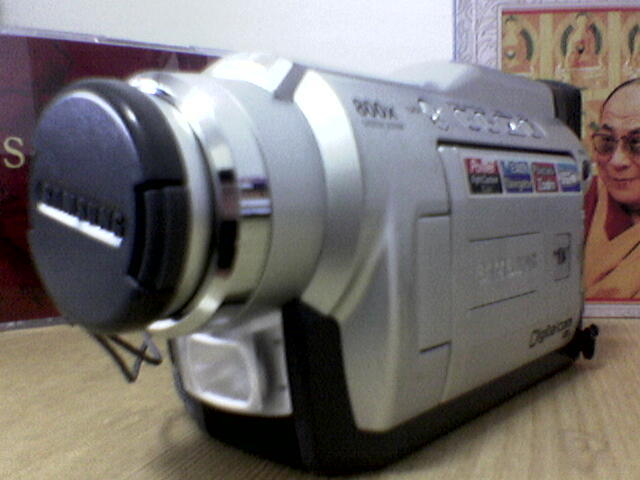
Update : My tapes and camera were handed over to the police at the Police Cantonment Complex at about 6.45 pm this evening. When asked if I can get my camera back soonest, ASP Chan said "No promise."
Saturday, August 27, 2005
Singapore police asks filmmaker to turn in camera
Saturday August 27, 2005
Cops want to seize "Singapore Rebel"
Singapore investigates film
AP , SINGAPORE
Saturday, Aug 27, 2005
A film director who could face charges over his documentary about an opposition politician said yesterday that police have asked him to surrender all remaining copies of the film and the equipment used to make it.
Martyn See said authorities have also asked him to hand over shipping documents for Singapore Rebel, which he sent for screening at the New Zealand Human Rights Film Festival and the Amnesty International Film Festival in Hollywood earlier this year.
See said police questioned him for three hours on Thursday.
Police have said See may have broken the law by knowingly showing or distributing a "party political film." See could be imprisoned up to two years or fined up to S$100,000 (US$60,606) if convicted.
Singapore's government is trying to promote this ultramodern city-state as an Asian regional arts and media hub -- but its leaders have been widely criticized for their strict censorship policies and other controls on free speech.
Leaders argue that such regulations help maintain the stability that has turned Singapore into one of Asia's safest and wealthiest countries.
Singapore Rebel is about outspoken government critic Chee Soon Juan, who faces bankruptcy due to defamation lawsuits filed by former leaders Lee Kuan Yew and Goh Chok Tong.
The 26-minute film was pulled from this year's Singapore International Film Festival after organizers were warned that it may contain some politically sensitive material.
See said that an assistant police superintendent questioned him on Thursday about his political affiliations.
He said police also quizzed him about his online journal, and about how he had obtained archived newspaper articles posted on his Web site.
"The mood was relaxed until near the end of the interview, when I felt many questions were totally irrelevant to the making of Singapore Rebel," See said in an e-mail to The Associated Press.
The filmmaker agreed to surrender the video, documents and copies on Aug. 29 after he was informed that the items would be returned.
Singapore's government has called politically motivated films "an undesirable medium" to debate issues. See has said he made the film independently and is not an opposition member.
Police spokesman Victor Keong confirmed that investigators met See on Thursday.
He gave no further details, saying only that "investigations are ongoing."
Friday August 26, 6:34 PM
Singapore police asks filmmaker to turn in camera
SINGAPORE, Aug 26 (Reuters) - Singapore police have asked a filmmaker to surrender a video camera and tapes he used to make a documentary on opposition figure Chee Soon Juan as part of its investigation for possible breach of film laws.
Martyn See, a 36-year-old Singapore filmmaker, told Reuters the demand was made after he had been questioned for three hours at a police station on Thursday in connection with his film "Singapore Rebel".
See said on Friday it was the second time Singapore authorities interviewed him about the 26-minute documentary he withdrew from the city-state's annual film festival in March under pressure from government censors, who told festival organisers the work violated the Films Act.
"The questions were more political than last time and I think they were intended to find out about my political affiliation," he said, adding that while the talk took place in a relaxed atmosphere he would object to the request to hand in his camera.
"I don't mind them inspecting the camera but I need it back to do my work," he said.
See said the police officer had offered no explanation as to why they wanted the video camera.
A police spokesman declined to comment.
Under provisions introduced to the Films Act in 1998, anyone involved in producing or distributing "party political films" -- including those containing commentaries on government policies -- can be fined up to S$100,000 ($59,840) or jailed up to two years.
The film at the heart of the controversy focuses on the life of Chee Soon Juan, who lost in January a three-year legal battle against defamation charges brought by Singapore's founding prime minister, Lee Kuan Yew, and his successor.
In 2002, a documentary about veteran opposition politician J.B. Jeyaretnam was pulled from the film festival after its filmmakers were told it breached the act.
Opposition politicians have said the Films Act stifles political debate in the city-state, which has been ruled by the People's Action Party since independence in 1965. Its 84-member Parliament has only two opposition members.
Lee Hsien Loong, the eldest son of Lee Kuan Yew, took over as the island republic's third prime minister last year, promising greater openness and saying Singaporeans "should feel free to express diverse views...or simply be different".
International free-press advocates have repeatedly criticised Singapore for its tight media controls, such as a government ban of non-commercial private ownership of satellite dishes. Films and TV shows are routinely censored for sex and violence.
The government says a high degree of control over public debate and the media is needed to maintain law and order.
The U.S. State Department, in its February annual report, sharply criticised Singapore for using libel suits to intimidate the opposition, saying the threat inhibits opposition politics and has led to a culture of self-censorship in the media. ($1 = 1.671 Singapore dollar)
Film maker to surrender political documentary to police
Agence France Presse
August 28, 2005
SINGAPORE
A SINGAPOREAN film maker whose documentary about a local opposition politician was banned from being shown in the city-state said Sunday, Aug 28, he would surrender his tapes to police as part of an investigation.
Martyn See was questioned by police for the second time last Friday about his movie "Singapore Rebel" and asked to surrender his video camera and the six existing tapes used as part of the documentary's production, he told AFP.
"Their reasoning is that the movie is deemed by MDA (Media Development Authority) to be a party political film," said See, 36.
"I do not think that it is, though," he said.
See said the police had not given any indication if charges will be filed against him and he planned to comply with the order to surrender the six mini-DV tapes on Monday -- but not his video camera.
"I have an issue about the (video) camera so I have asked the lawyer to formally request that the camera be inspected on the spot and returned to me," See said.
"I need the camera for my work... I fail to see why the camera should be confiscated," he said.
Singapore has often been criticised by human rights groups for maintaining strict political controls despite its rapid modernisation since becoming a republic 40 years ago this month.
The MDA classified See's documentary about opposition politician Chee Soon Juan of the Singapore Democratic Party (SDP) as having violated the Films Act because of its political content, an accusation that the film maker rejects.
If convicted, See could be jailed for up to two years or fined up to S$100,000 (US$60,000).
"It is not a party political film in the sense that I did not make it on behalf of anybody but myself, and it does not contain any mention of SDP," See said.
The documentary was to further his understanding of the plight of opposition politicians, said See, who does not see himself as a political activist.
"I wanted to find out through Chee Soon Juan's experience why the Singapore opposition is marginalised.
"I consider myself a video documentalist of social and political issues," he said.
Chee, the most vocal opposition politician in Singapore, is facing bankruptcy after the High Court ordered him to pay S$500,000 (US$300,000) for defaming the city-state's two former premiers, Lee Kuan Yew and Goh Chok Tong.
Singapore has been ruled by the People's Action Party of founding father Lee since independence. His son Lee Hsien Loong promised to loosen political restrictions after taking over as prime minister a year ago from Goh Chok Tong.
The Straits Times, Aug 27, 2005
Chee film tapes, camera for cops
http://straitstimes.asia1.com.sg/sub/storyprintfriendly/0,5578,336968,00.html?
FREELANCE filmmaker Martyn See, 36, will surrender to the police on Monday tapes and a video camera used to film a documentary on opposition politician Chee Soon Juan.
He was interviewed at Central Police Station in Cantonment Road on Thursday evening for about three hours.
The police wanted him to hand over his video camera and also the tapes of Singapore Rebel, a 26-minute documentary on Dr Chee's political activities. This is the second time Mr See has been called in for questioning over the film. The first was in May.
His film was withdrawn from the Singapore International Film Festival in March, after he was told it violated the Films Act. The law bans the making or distribution of 'party political' films.
These include advertisements by political parties or other political organisations here, or films 'directed towards any political end in Singapore'. A police spokesman confirmed Thursday's interview but would not comment further on the investigation.
Mr See said that while the interviewer was cordial, he felt the questions were more 'politically skewed' compared to May's session and he admitted to being 'a little shaken up'. He posted some of the questions on his blogsite singaporerebel.
They include: 'Did you make any application to be a member of any political party in Singapore?' and 'Do you have any intention to do so?'
Mr See said he has agreed to surrender the tapes on Monday. But he has also asked a lawyer to write to the police saying that seizure of the camera is unnecessary.
'I still need it for my work,' he said last night.
Cops want to seize "Singapore Rebel"
Singapore investigates film
AP , SINGAPORE
Saturday, Aug 27, 2005
A film director who could face charges over his documentary about an opposition politician said yesterday that police have asked him to surrender all remaining copies of the film and the equipment used to make it.
Martyn See said authorities have also asked him to hand over shipping documents for Singapore Rebel, which he sent for screening at the New Zealand Human Rights Film Festival and the Amnesty International Film Festival in Hollywood earlier this year.
See said police questioned him for three hours on Thursday.
Police have said See may have broken the law by knowingly showing or distributing a "party political film." See could be imprisoned up to two years or fined up to S$100,000 (US$60,606) if convicted.
Singapore's government is trying to promote this ultramodern city-state as an Asian regional arts and media hub -- but its leaders have been widely criticized for their strict censorship policies and other controls on free speech.
Leaders argue that such regulations help maintain the stability that has turned Singapore into one of Asia's safest and wealthiest countries.
Singapore Rebel is about outspoken government critic Chee Soon Juan, who faces bankruptcy due to defamation lawsuits filed by former leaders Lee Kuan Yew and Goh Chok Tong.
The 26-minute film was pulled from this year's Singapore International Film Festival after organizers were warned that it may contain some politically sensitive material.
See said that an assistant police superintendent questioned him on Thursday about his political affiliations.
He said police also quizzed him about his online journal, and about how he had obtained archived newspaper articles posted on his Web site.
"The mood was relaxed until near the end of the interview, when I felt many questions were totally irrelevant to the making of Singapore Rebel," See said in an e-mail to The Associated Press.
The filmmaker agreed to surrender the video, documents and copies on Aug. 29 after he was informed that the items would be returned.
Singapore's government has called politically motivated films "an undesirable medium" to debate issues. See has said he made the film independently and is not an opposition member.
Police spokesman Victor Keong confirmed that investigators met See on Thursday.
He gave no further details, saying only that "investigations are ongoing."
Friday August 26, 6:34 PM
Singapore police asks filmmaker to turn in camera
SINGAPORE, Aug 26 (Reuters) - Singapore police have asked a filmmaker to surrender a video camera and tapes he used to make a documentary on opposition figure Chee Soon Juan as part of its investigation for possible breach of film laws.
Martyn See, a 36-year-old Singapore filmmaker, told Reuters the demand was made after he had been questioned for three hours at a police station on Thursday in connection with his film "Singapore Rebel".
See said on Friday it was the second time Singapore authorities interviewed him about the 26-minute documentary he withdrew from the city-state's annual film festival in March under pressure from government censors, who told festival organisers the work violated the Films Act.
"The questions were more political than last time and I think they were intended to find out about my political affiliation," he said, adding that while the talk took place in a relaxed atmosphere he would object to the request to hand in his camera.
"I don't mind them inspecting the camera but I need it back to do my work," he said.
See said the police officer had offered no explanation as to why they wanted the video camera.
A police spokesman declined to comment.
Under provisions introduced to the Films Act in 1998, anyone involved in producing or distributing "party political films" -- including those containing commentaries on government policies -- can be fined up to S$100,000 ($59,840) or jailed up to two years.
The film at the heart of the controversy focuses on the life of Chee Soon Juan, who lost in January a three-year legal battle against defamation charges brought by Singapore's founding prime minister, Lee Kuan Yew, and his successor.
In 2002, a documentary about veteran opposition politician J.B. Jeyaretnam was pulled from the film festival after its filmmakers were told it breached the act.
Opposition politicians have said the Films Act stifles political debate in the city-state, which has been ruled by the People's Action Party since independence in 1965. Its 84-member Parliament has only two opposition members.
Lee Hsien Loong, the eldest son of Lee Kuan Yew, took over as the island republic's third prime minister last year, promising greater openness and saying Singaporeans "should feel free to express diverse views...or simply be different".
International free-press advocates have repeatedly criticised Singapore for its tight media controls, such as a government ban of non-commercial private ownership of satellite dishes. Films and TV shows are routinely censored for sex and violence.
The government says a high degree of control over public debate and the media is needed to maintain law and order.
The U.S. State Department, in its February annual report, sharply criticised Singapore for using libel suits to intimidate the opposition, saying the threat inhibits opposition politics and has led to a culture of self-censorship in the media. ($1 = 1.671 Singapore dollar)
Film maker to surrender political documentary to police
Agence France Presse
August 28, 2005
SINGAPORE
A SINGAPOREAN film maker whose documentary about a local opposition politician was banned from being shown in the city-state said Sunday, Aug 28, he would surrender his tapes to police as part of an investigation.
Martyn See was questioned by police for the second time last Friday about his movie "Singapore Rebel" and asked to surrender his video camera and the six existing tapes used as part of the documentary's production, he told AFP.
"Their reasoning is that the movie is deemed by MDA (Media Development Authority) to be a party political film," said See, 36.
"I do not think that it is, though," he said.
See said the police had not given any indication if charges will be filed against him and he planned to comply with the order to surrender the six mini-DV tapes on Monday -- but not his video camera.
"I have an issue about the (video) camera so I have asked the lawyer to formally request that the camera be inspected on the spot and returned to me," See said.
"I need the camera for my work... I fail to see why the camera should be confiscated," he said.
Singapore has often been criticised by human rights groups for maintaining strict political controls despite its rapid modernisation since becoming a republic 40 years ago this month.
The MDA classified See's documentary about opposition politician Chee Soon Juan of the Singapore Democratic Party (SDP) as having violated the Films Act because of its political content, an accusation that the film maker rejects.
If convicted, See could be jailed for up to two years or fined up to S$100,000 (US$60,000).
"It is not a party political film in the sense that I did not make it on behalf of anybody but myself, and it does not contain any mention of SDP," See said.
The documentary was to further his understanding of the plight of opposition politicians, said See, who does not see himself as a political activist.
"I wanted to find out through Chee Soon Juan's experience why the Singapore opposition is marginalised.
"I consider myself a video documentalist of social and political issues," he said.
Chee, the most vocal opposition politician in Singapore, is facing bankruptcy after the High Court ordered him to pay S$500,000 (US$300,000) for defaming the city-state's two former premiers, Lee Kuan Yew and Goh Chok Tong.
Singapore has been ruled by the People's Action Party of founding father Lee since independence. His son Lee Hsien Loong promised to loosen political restrictions after taking over as prime minister a year ago from Goh Chok Tong.
The Straits Times, Aug 27, 2005
Chee film tapes, camera for cops
http://straitstimes.asia1.com.sg/sub/storyprintfriendly/0,5578,336968,00.html?
FREELANCE filmmaker Martyn See, 36, will surrender to the police on Monday tapes and a video camera used to film a documentary on opposition politician Chee Soon Juan.
He was interviewed at Central Police Station in Cantonment Road on Thursday evening for about three hours.
The police wanted him to hand over his video camera and also the tapes of Singapore Rebel, a 26-minute documentary on Dr Chee's political activities. This is the second time Mr See has been called in for questioning over the film. The first was in May.
His film was withdrawn from the Singapore International Film Festival in March, after he was told it violated the Films Act. The law bans the making or distribution of 'party political' films.
These include advertisements by political parties or other political organisations here, or films 'directed towards any political end in Singapore'. A police spokesman confirmed Thursday's interview but would not comment further on the investigation.
Mr See said that while the interviewer was cordial, he felt the questions were more 'politically skewed' compared to May's session and he admitted to being 'a little shaken up'. He posted some of the questions on his blogsite singaporerebel.
They include: 'Did you make any application to be a member of any political party in Singapore?' and 'Do you have any intention to do so?'
Mr See said he has agreed to surrender the tapes on Monday. But he has also asked a lawyer to write to the police saying that seizure of the camera is unnecessary.
'I still need it for my work,' he said last night.
Thursday, August 25, 2005
Police to confiscate camera and tapes relating to 'S'pore Rebel'
This evening, I was again interviewed by the police regarding the making of my short video Singapore Rebel. The interview lasted about 3 hours and was conducted at the Cantonment Police Complex. The officer interviewing me was Assistant Superintendent Chan Peng Khuang. Again, the mood was relaxed until near the end of the interview when I felt many questions were totally irrelevant to the making of Singapore Rebel and I threatened to walk out. ASP Chan told me it is alright to refuse to answer questions which I deemed to be irrelevant. At the end of the interview came the cruncher that I was to surrender all tapes, courier invoices and even the video camera that were used for the filming of Singapore Rebel. I agreed to surrender them to him on Monday 29 August 2005.
Before the interview began, I asked ASP Chan : So I am here to answer further questions about the making of Singapore Rebel. Right?
ASP Chan : Yes
Here is a sample of some of the questions which totalled about 60.
When asked what inspired you to make this film, you claimed that political opposition in Singapore is marginalised. What do you mean by "marginalised?"
What in your opinion should the media do?
So you mean that the Singapore media is being unfair to political opposition?
You claimed that you took two and a half years to make the film. So is it normal for filmmakers to take such such a period to make a 26 minute film?
What sort of activities of Chee Soon Juan were you waiting that you think was worth shooting?
You mentioned that a friend of yours named Peter did the voiceover for the film? Is he contactable?
You mentioned that you edited the film on a friend's Macintosh laptop. Is he contactable?
How was the item (laptop) passed to you and how was it returned to him?
Did you save any of the footages in his computer?
Do you own a computer now?
There were some newspaper articles on your blog? How did you secure those articles?
In your film, there were footages of Chee Soon Juan making speeches at a election rally. Where did you secure the footage?
Did you duplicate the video before returning?
Why was the election rally audio muted?
When did you know that Singapore Rebel was classified a party political film?
I am informing you that Lesley Ho's (of Singapore International Film Festival) email dated March 2005 had mentioned that Philip (co-director of SIFF) was told that Singapore Rebel was objectionable pertaining to party political films. You were told that if you did not withdraw the film, the "full extent of the law" will apply. What do you have to say to that?
So you agree that at this stage when you read Lesley's email, you knew that Singapore Rebel was classified as a party political film?
Since you knew that the film "may have been" a party political film at that stage, why would you want to circulate the film to overseas film festivals?
Did you make any application to be a member of any political party in Singapore?
Do you have any intention to do so?
Can you recall participating in any activities organised by any political party in Singapore?
(Somewhere at this point of the interview, I told ASP Chan that I would walk out if questions continue along this line).
Did Chee Soon Juan direct you to do the filming on May Day (arrests of 2002)?
On 19th July, 2005, Chee Soon Juan and some members was speaking at Speakers Corner? Were you there to film the event? Who directed you to film the event?
On August 11, 2005, were you present in front of CPF Building when Chee Soon Juan and other SDP members gathered for a protest?
Did you contact Chee Soon Juan after the video interview on Singapore Rebel?
Are you still in contact with Chee Soon Juan now?
I do not want to go to your house. Are you able to produce to the police the following items?
1) Two remaining copies of Singapore Rebel
2) Receipts from courier services of you mailing the film to New Zealand and USA (as mentioned in your earlier statement)
3) The Samsung mini-DV camera you used to make Singapore Rebel, and
4) Any raw footages of Singapore Rebel before the editing.
I ask : When are you going to return them to me?
ASP Chan : On completion of the case. Won't be too long.
Before the interview began, I asked ASP Chan : So I am here to answer further questions about the making of Singapore Rebel. Right?
ASP Chan : Yes
Here is a sample of some of the questions which totalled about 60.
When asked what inspired you to make this film, you claimed that political opposition in Singapore is marginalised. What do you mean by "marginalised?"
What in your opinion should the media do?
So you mean that the Singapore media is being unfair to political opposition?
You claimed that you took two and a half years to make the film. So is it normal for filmmakers to take such such a period to make a 26 minute film?
What sort of activities of Chee Soon Juan were you waiting that you think was worth shooting?
You mentioned that a friend of yours named Peter did the voiceover for the film? Is he contactable?
You mentioned that you edited the film on a friend's Macintosh laptop. Is he contactable?
How was the item (laptop) passed to you and how was it returned to him?
Did you save any of the footages in his computer?
Do you own a computer now?
There were some newspaper articles on your blog? How did you secure those articles?
In your film, there were footages of Chee Soon Juan making speeches at a election rally. Where did you secure the footage?
Did you duplicate the video before returning?
Why was the election rally audio muted?
When did you know that Singapore Rebel was classified a party political film?
I am informing you that Lesley Ho's (of Singapore International Film Festival) email dated March 2005 had mentioned that Philip (co-director of SIFF) was told that Singapore Rebel was objectionable pertaining to party political films. You were told that if you did not withdraw the film, the "full extent of the law" will apply. What do you have to say to that?
So you agree that at this stage when you read Lesley's email, you knew that Singapore Rebel was classified as a party political film?
Since you knew that the film "may have been" a party political film at that stage, why would you want to circulate the film to overseas film festivals?
Did you make any application to be a member of any political party in Singapore?
Do you have any intention to do so?
Can you recall participating in any activities organised by any political party in Singapore?
(Somewhere at this point of the interview, I told ASP Chan that I would walk out if questions continue along this line).
Did Chee Soon Juan direct you to do the filming on May Day (arrests of 2002)?
On 19th July, 2005, Chee Soon Juan and some members was speaking at Speakers Corner? Were you there to film the event? Who directed you to film the event?
On August 11, 2005, were you present in front of CPF Building when Chee Soon Juan and other SDP members gathered for a protest?
Did you contact Chee Soon Juan after the video interview on Singapore Rebel?
Are you still in contact with Chee Soon Juan now?
I do not want to go to your house. Are you able to produce to the police the following items?
1) Two remaining copies of Singapore Rebel
2) Receipts from courier services of you mailing the film to New Zealand and USA (as mentioned in your earlier statement)
3) The Samsung mini-DV camera you used to make Singapore Rebel, and
4) Any raw footages of Singapore Rebel before the editing.
I ask : When are you going to return them to me?
ASP Chan : On completion of the case. Won't be too long.
Tuesday, August 16, 2005
Next police interview on 25th August
My second date with the police over the making of Singapore Rebel will be held next Thursday on the 25th August at 6.30pm at the Cantonment Police Complex.
After the first interview, which had included queries about my academic qualifications, CPF contributions, PC ownership and brand of video camera used, I have no clue as to what further information they may need to know.
http://singaporerebel.blogspot.com/2005/05/interview-over-but-investigation-will.html
When is PM Lee giving his National Day Rally Speech?
Last year, he announced that police permits will be waived for indoor meetings. Perhaps in another effort to show that Singapore is truly "opening up," he will announce the abolition of Section 33 of the Films Act, and spare me the potential ignominy of a criminal record. And by that, Mediacorp will also be free to produce the long-awaited historical epic of Lee Kuan Yew and PAP.
Duh.
After the first interview, which had included queries about my academic qualifications, CPF contributions, PC ownership and brand of video camera used, I have no clue as to what further information they may need to know.
http://singaporerebel.blogspot.com/2005/05/interview-over-but-investigation-will.html
When is PM Lee giving his National Day Rally Speech?
Last year, he announced that police permits will be waived for indoor meetings. Perhaps in another effort to show that Singapore is truly "opening up," he will announce the abolition of Section 33 of the Films Act, and spare me the potential ignominy of a criminal record. And by that, Mediacorp will also be free to produce the long-awaited historical epic of Lee Kuan Yew and PAP.
Duh.
Tuesday, August 09, 2005
9 Aug 1965 - Suddenly, Singapore was out .. And gained independence
Today, on 9th August 2005, as Singaporeans celebrate 40 years of sovereignty and independence, it is worthwhile to note that 40 years ago on this day, the mood was anything but celebratory. Rather, according to these reports from the Straits Times, the Singapore Government had seemed more intent to publicise its mourning over the Separation than revelling in the formation of an independent nation.
Did the PAP really thought that Merger with Malaysia was feasible? Did Lee really harbour an ambition to be the Malaysia's Prime Minister? Was the concept of a Malaysian Malaysia a realistic one? Did Singapore earn its independence by virtue of its exit from from Malaysia? What exactly are we celebrating on National Day?
The full account of Singapore's road to independence has yet to be written. Through these excerpts from the press archives, I hope to have contributed a little in providing a fresher perspective than just the pomp and pageantry of National Day Parades.
Meanwhile, I still have a police investigation to worry about...
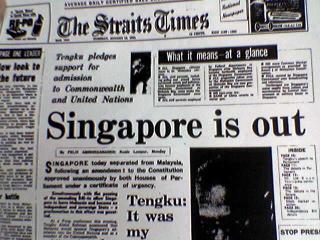
STRAITS TIMES, AUG 9 1965
Singapore today separated from Malaysia, following an amendment to the Constitution approved unanimously by both Houses of Parliament under a certificate of urgency.
Simultaneously with the passing of the amending Bill - to allow Singapore to leave Malaysia and become an independent and sovereign State - a proclamation to this effect was gazetted.
At a Press Conference this evening, Tengku Abdul Rahman annouced that Malaysia would sponsor Singapore's admission into the United Nations and as a member of the Commonwealth.
At his own press conference in Singapore, Mr Lee Kuan Yew called on his people to remain firm and calm. His eyes brimming with tears: "What has happened has happened. Everybody will have a place in Singapore and will continue helping the Malays in competition with UMNO."
Secret Signing
Today's dramatic turn follows the secret signing of the Independence of Singapore Agreement last Saturday by leaders of the two Governments.
THis document provides a treaty on external defence and mutual assistance between the two Governments and stipulates that:
BOTH GOVERNMENTS will establish a joint defence council for external defence and mutual assistance.
THE MALAYSIAN GOVERNMENT will give "reasonable and adequate" assistance for Singapore's external defence. In return, Singapore will contribute a "resaonable" number of units from its own armed forces.
THE MALAYSIAN GOVERNMENT will continue to maintain military bases within Singapore and will be permitted to use these bases for defence purposes.
NEITHER GOVERNMNTS will enter into any treaty or agreement with a foreign country which may be deterimental to the independence and defence of either.
Meanwhile, Singapore acted swiftly to establish itself as an independent State, completely unconnected with the mainland.
In the early hours of the morning, while Singapore slept, coded messages were being flashed to about 20 heads of Governments abroad - explaining the situation.
Mr Lee Kuan Yew stayed up all night to get these messages out. With him were most of his Cabinet colleagues who have had little sleep since the big break began on Saturday.
Early TV
Sharp on the hour, Radio Singapore went on the air to announce the separation.
Television came on at 4.30 pm, two hours ahead of schedule, with a telecast of the Prime Minister's press conference.
The news spread swiftly through the city after the radio annoucement. In a number of places, it was greeted with a thunderous explosion of fire-crackers.
Police patrols throughout the island were intensified. The force had been alerted two days before.
In a letter to the Commissioner of Police, Mr John Le Cain, Dated 7 Aug. Dato (Dr) Ismail bin Dato Haji Abdul Rahman, Malaysia's Minister of Home Affairs, had said :
"I herewith instruct you as from Aug. 9 1965 to take orders from Mr Lee Kuan Yew, Prime MInister of Singapore, in order to enable him to discharge his responsibility for the internal security of Singapore."
The same day, the Tengku also instructed Brigadier S.M. Alsagoff, Commander of the Singapore-based 4th Federal Infantry Brigade:
"In the absence of the Tun, I take full responsibility in giving you this instruction.
"As from Aug 9 1965, you are to take instructions from Mr Lee Kuan Yew, Prime Minister of Singapore, as he is now onward in charge of the defence and security of Singapore. Other orders will be issued in due course."
Meanwhile, all Malaysian flags fluttered down and were replaced by Singapore flags by noon.

Did the PAP really thought that Merger with Malaysia was feasible? Did Lee really harbour an ambition to be the Malaysia's Prime Minister? Was the concept of a Malaysian Malaysia a realistic one? Did Singapore earn its independence by virtue of its exit from from Malaysia? What exactly are we celebrating on National Day?
The full account of Singapore's road to independence has yet to be written. Through these excerpts from the press archives, I hope to have contributed a little in providing a fresher perspective than just the pomp and pageantry of National Day Parades.
Meanwhile, I still have a police investigation to worry about...
STRAITS TIMES, AUG 9 1965
Singapore today separated from Malaysia, following an amendment to the Constitution approved unanimously by both Houses of Parliament under a certificate of urgency.
Simultaneously with the passing of the amending Bill - to allow Singapore to leave Malaysia and become an independent and sovereign State - a proclamation to this effect was gazetted.
At a Press Conference this evening, Tengku Abdul Rahman annouced that Malaysia would sponsor Singapore's admission into the United Nations and as a member of the Commonwealth.
At his own press conference in Singapore, Mr Lee Kuan Yew called on his people to remain firm and calm. His eyes brimming with tears: "What has happened has happened. Everybody will have a place in Singapore and will continue helping the Malays in competition with UMNO."
Secret Signing
Today's dramatic turn follows the secret signing of the Independence of Singapore Agreement last Saturday by leaders of the two Governments.
THis document provides a treaty on external defence and mutual assistance between the two Governments and stipulates that:
BOTH GOVERNMENTS will establish a joint defence council for external defence and mutual assistance.
THE MALAYSIAN GOVERNMENT will give "reasonable and adequate" assistance for Singapore's external defence. In return, Singapore will contribute a "resaonable" number of units from its own armed forces.
THE MALAYSIAN GOVERNMENT will continue to maintain military bases within Singapore and will be permitted to use these bases for defence purposes.
NEITHER GOVERNMNTS will enter into any treaty or agreement with a foreign country which may be deterimental to the independence and defence of either.
Meanwhile, Singapore acted swiftly to establish itself as an independent State, completely unconnected with the mainland.
In the early hours of the morning, while Singapore slept, coded messages were being flashed to about 20 heads of Governments abroad - explaining the situation.
Mr Lee Kuan Yew stayed up all night to get these messages out. With him were most of his Cabinet colleagues who have had little sleep since the big break began on Saturday.
Early TV
Sharp on the hour, Radio Singapore went on the air to announce the separation.
Television came on at 4.30 pm, two hours ahead of schedule, with a telecast of the Prime Minister's press conference.
The news spread swiftly through the city after the radio annoucement. In a number of places, it was greeted with a thunderous explosion of fire-crackers.
Police patrols throughout the island were intensified. The force had been alerted two days before.
In a letter to the Commissioner of Police, Mr John Le Cain, Dated 7 Aug. Dato (Dr) Ismail bin Dato Haji Abdul Rahman, Malaysia's Minister of Home Affairs, had said :
"I herewith instruct you as from Aug. 9 1965 to take orders from Mr Lee Kuan Yew, Prime MInister of Singapore, in order to enable him to discharge his responsibility for the internal security of Singapore."
The same day, the Tengku also instructed Brigadier S.M. Alsagoff, Commander of the Singapore-based 4th Federal Infantry Brigade:
"In the absence of the Tun, I take full responsibility in giving you this instruction.
"As from Aug 9 1965, you are to take instructions from Mr Lee Kuan Yew, Prime Minister of Singapore, as he is now onward in charge of the defence and security of Singapore. Other orders will be issued in due course."
Meanwhile, all Malaysian flags fluttered down and were replaced by Singapore flags by noon.
Sunday, August 07, 2005
5 days before Separation ...
Part Xl of the retrospective on Singapore's road to independence
STRAITS TIMES, Aug 4 1965
Examining the PAP concept of Malaysian Malaysia, Inche Senu said: "The PAP itself a shining example of what its Malaysian Malaysia stands for.
"One can judge for oneself the troubles and tensions in Singapore ever since the PAP captured the State administration.
"First there was a tirade against all opposition parties and leaders coupled, of course, with the mailed fist shown to professionals, social workers, trade unionists and others.
"The PAP used every tactic and strategy familiar to Communism to create an air of anxiety and despair among the people - then baited them into submission with promises of patronage and protection to those conforming.
'Twisted'
"Every legislative and administrative organ in the State was twisted to suit the polemics of the party and its ruling clique.
"Rivals and opponents were placted for a while with false promises of co-operation and ruthlessly weeded them out.
"Now the PAP has isolated itself that it fears its own shadow. Probably memories of its past misdeeds - arrests, liquidation and elimination of opposition by any means - are haunting its leadership so much that it is now convulsed with fear of retribution.
"Let me tell you this: If you are sincere about a Malaysian Malaysia, then do not betray the trust, however unknowingly placed in you, by the people of Singapore. Do not become heroes on someone else's blood."
Ten years ago, he said, there were some who had felt uneasy about independence. But instead of losing all to the Malays - as some then feared - Malaysians of all walks of life gained immensely through independence.
Inche Senu then referred to "threats" by Mr Lee Kuan Yew that if the Central Government did not yield to his interpretation of a Malaysian Malaysia, Britain, Australia and New Zealand may do some serious re-thinking about helping to defend Malaysia.
"First of all," Inche Senu said,"Mr Lee must know that the defence of Malaysia is primarily the responsibility of Malaysians themselves.
'Clarify' call
"Our Commonwealth allies are here by invitation of the Malaysian Government for the specific purpose of assisting in our external defence.
"Do Mr Lee's threats mean that the purpose of our allies in helping to defend our integrity is merely to prop up Mr Lee Kuan Yew and the PAP?
"I think they know better than to interfere in our internal affairs."
"Whoever is trying to implicate others in our local affairs is in fact betraying our national interests and may be considered by the people as a stooge of foreign powers."
STRAITS TIMES, Aug 4 1965
Examining the PAP concept of Malaysian Malaysia, Inche Senu said: "The PAP itself a shining example of what its Malaysian Malaysia stands for.
"One can judge for oneself the troubles and tensions in Singapore ever since the PAP captured the State administration.
"First there was a tirade against all opposition parties and leaders coupled, of course, with the mailed fist shown to professionals, social workers, trade unionists and others.
"The PAP used every tactic and strategy familiar to Communism to create an air of anxiety and despair among the people - then baited them into submission with promises of patronage and protection to those conforming.
'Twisted'
"Every legislative and administrative organ in the State was twisted to suit the polemics of the party and its ruling clique.
"Rivals and opponents were placted for a while with false promises of co-operation and ruthlessly weeded them out.
"Now the PAP has isolated itself that it fears its own shadow. Probably memories of its past misdeeds - arrests, liquidation and elimination of opposition by any means - are haunting its leadership so much that it is now convulsed with fear of retribution.
"Let me tell you this: If you are sincere about a Malaysian Malaysia, then do not betray the trust, however unknowingly placed in you, by the people of Singapore. Do not become heroes on someone else's blood."
Ten years ago, he said, there were some who had felt uneasy about independence. But instead of losing all to the Malays - as some then feared - Malaysians of all walks of life gained immensely through independence.
Inche Senu then referred to "threats" by Mr Lee Kuan Yew that if the Central Government did not yield to his interpretation of a Malaysian Malaysia, Britain, Australia and New Zealand may do some serious re-thinking about helping to defend Malaysia.
"First of all," Inche Senu said,"Mr Lee must know that the defence of Malaysia is primarily the responsibility of Malaysians themselves.
'Clarify' call
"Our Commonwealth allies are here by invitation of the Malaysian Government for the specific purpose of assisting in our external defence.
"Do Mr Lee's threats mean that the purpose of our allies in helping to defend our integrity is merely to prop up Mr Lee Kuan Yew and the PAP?
"I think they know better than to interfere in our internal affairs."
"Whoever is trying to implicate others in our local affairs is in fact betraying our national interests and may be considered by the people as a stooge of foreign powers."
Friday, August 05, 2005
Police investigation on Singapore Rebel resumes
Hi all,
Police Assistant Superintendent Chan Peng Kuang called me today, 5 August 1600 hours, to request for a second interview regarding the making of my short film Singapore Rebel.
The first interview was conducted on 16 May 2005 by the same officer.
http://singaporerebel.blogspot.com/2005/05/interview-over-but-investigation-will.html
I've told ASP Chan that I'll call him to arrange a date for the next interview.
Police Assistant Superintendent Chan Peng Kuang called me today, 5 August 1600 hours, to request for a second interview regarding the making of my short film Singapore Rebel.
The first interview was conducted on 16 May 2005 by the same officer.
http://singaporerebel.blogspot.com/2005/05/interview-over-but-investigation-will.html
I've told ASP Chan that I'll call him to arrange a date for the next interview.
Subscribe to:
Posts (Atom)