Friday, August 05, 2005

UMNO 'extremists' may detain Lee, alleged PAP

Part X of the retrospective on Singapore's road to independence


STRAITS TIMES, June 8 1965

The Central Government was today urged to take consitutional measures to exclude Singapore from Malaysia or to "put Mr Lee Kuan Yew away to sober him up."

The call came from the Alliance whip in the Senate, Dato T.H. Tan, who said,"Either of these measures will ensure peace and harmony in our country. No one who has gone berserk should be let loose."

The Senate was debating a motion to thank the king for his speech from the Throne when he opened the present session of Parliament.

During the debate, all sections of the House took Mr Lee to task for talking about a Malaysian Malaysia and convening the Malaysian Solidarity Convention.

Dato T.H. Tan thought that Mr Lee should be told on no uncertain terms that Malaysia could do without Singapore.

Steps

If Mr Lee persisted in his "anti-Malay and his unpatriotic conduct", constitutional steps should be taken to separate Singapore.

Appealing to the public "not to follow Mr Lee", Dato Tan said,"There appears to be little doubt that Mr Lee through his words and deeds is stirring up emotions and causing dissension.

"The man must be stopped before irreparable harm is done. Mr Lee is trying to split the races here and to partition our country.

"It was on the basis of inter-racial unity that Tengku Abdul Rahman and his colleagues won independence for us. Now this very unity is being undermined."

"He added: "Let Mr Lee stew in the Communist soup bowl that is Singapore. If he does not think much of the Communists, then let us release Lim Chin Siong and other comrades and let us see how Mr Lee can stand up to them, face to face, man to man."

Inche Ahmad Haji Taff (Singapore) said Singapore's Prime Minister, Mr Lee Kuan Yew, was like a frog in a coconut shell.

Referring to his concept of a Malaysian Malaysia, Inche Ahmad sais: "Mr Lee is doing nothing except to irritate the feelings between the non-Malays and Malays."

He accused Mr Lee of trying to get rid of the Malay Rulers and the head of the nation.

"Mr Lee is trying to get rid of all Sultans and make this country a republic with himself as the president. Perhaps he is not satisfied with Islam being the State's religion."

He told the House: "Let Mr Lee spell out exactly what he wants. Let him show when the Alliance Government had infringed the Constitution.

"Let the Malays in the PAP tell him to change his attitude and not to kill our nation. We do not want to have two Prime Ministers."

Dato Dr Cheah Toon Lok said that "political parties like the PAP living in a different envirnment cannot think as we do."

Since Mr Lee has said that he was neither a Communist or a pro-Communist but a neutral, he could be only one thing - a political opportunist willing to sacrifice the peace of Malaysia for his own ambition.

Inche Saidon bin Kechut described Mr Lee as a "troublemaker with a hatred of the Malays and who wants to destroy them."

He was also greedy for power. "Not satisfied with being a dictator in Singapore he is now seeking to extend his power. He now wants to control the Central Goverment."


STRAITS TIMES, July 9 1965

Dr Toh Chin Chye, Singapore's Deputy Prime Minister, said here today that instructions had been issued for a case to be made out for the detention of Lee Kuan Yew.

But Dr Toh would not say who had issued the instructions, and to whom they had been issued.

At a press conrference in City Hall this afternoon, he said: "I personally do not wish to enlarge on the matter, but I would say that those in the Government who are responsible for such matters know that we know.

"It can rest at that."

Soilidly united

The press conference had been called to explain the Singapore Government's stand on the expulsion of free-lance journalist Mr Alex Josey and "attempts by extremists in the Alliance, particularly the UMNO," to have Mr Lee arrested.

With Mr Toh were the Minister for Law, Mr E.W. barker, and the Minister for National Development, Mr Lim Kim San.

Dr Toh opened the conference with the announcement that the entire Singapore Cabinet was solidly united on this matter.

'First step'

The expulsion of Mr Josey was only the first step towards the suppression of liberalism in Malaysia's political field, he said.

Then, reading from a prepared statement Dr Toh said: "If the Central Government continues to placate these extremist elements, further respressive measures must be taken which must lead to the break-up of Malaysia.

"Another demand was the arrest and detention of Mr Lee Kuan Yew."


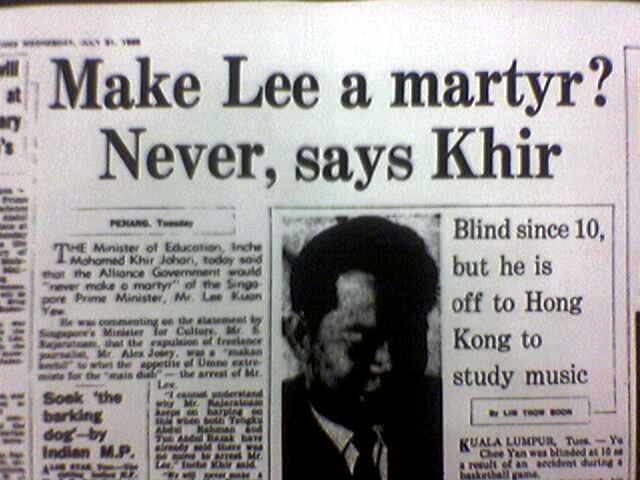
STRAITS TIMES, July 21 1965

The Minister of Education, Inche Mohammed Khir Johari, today said that the Allaince Government would "never make a martyr" of the Singapore Prime Minister, Mr Lee Kuan Yew.

He was commenting on a statement by Singapore's Minister for Culture, Mr S. Rajaratnam, that the expulsion of freelance journalist, Mr Alex Josey, was a "makan kechil" to whet the appetite of UMNO extremists for the "main dish" - the arrest of Mr Lee Kuan Yew.

"I cannot understand why Mr Rajaratnam keeps on harping on this when both Tengku Abdul Rahman and Tun Abdul Razak have already said there was no move to arrest Mr Lee," Inche Khir said.

"We will never make a martyr of the Singapore Prime Minister. All this hope of impending arrest exists only in the minds of the PAP leaders."

Lee branded a 'traitor', told to 'sit down, get out'

Part lX of the retrospective on Singapore's road to independence


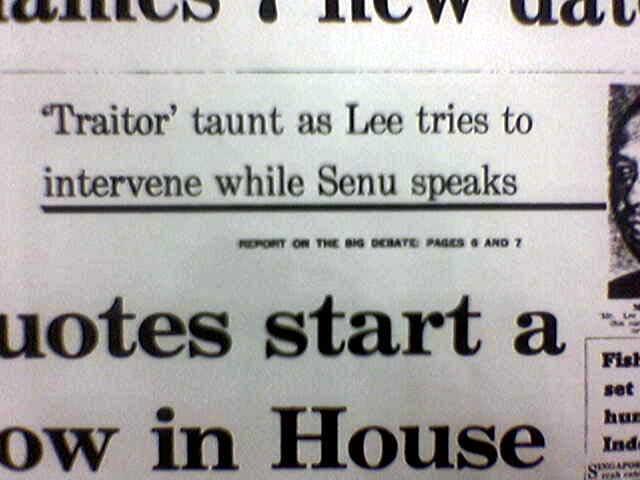
STRAITS TIMES, JUNE 2 1965

Shouts of "traitor," "sit down" and "get out" rang out in the House of Reprsentatives today when Singapore's Prime MInister, Mr Lee Kuan Yew, twice tried to interrupt a speech by the Minister of Information and Broadcasting, Inche Senu bin Abdul Rahman.

The first outburst occurred when Inche Senu read extracts of a speech Mr Lee had made in Singapore's Delta community centre on Sunday where he had spoken of building a "new nation out of ashes..."

Mr Lee rose to clarify his remarks, but was shouted down from all sections of the House. Looking appealingly at the Speaker, he said: "As you wish."

Inche Senu continued: "He wants to destroy this nation and build a new one..."

There were more noisy interruptions when Inche Senu read extracts from Mr Lee's speeches during his recent visit to Australia.

Yelled

In one speech, Mr Lee was quoted as having said that Tengku Abdul Rahman had made a "stupid, naive mistake" about the allocation of Parliamentary seats for Borneo.

Mr Lee got up. As one man, the backbenchers thumped their tables and yelled: "Sit down ... sit down ... traitor ... get out."

The Speaker, Dato C.M. Yusof, banged his gravel hard and in a raised voice said: "Will Honourable members stop shouting out loud and behaving in an unparliamentary way..."


Leading the Alliance condemnation of the PAP was the Minister of Finance, Mr Tan Siew Sin, who said that co-operation with the Singapore Government was out of the question as long as Mr Lee Kuan Yew remained Prime Minister.

Mr Tan described Mr Lee as the "greatest disruptive force in the entire history of Malaysia and Malaya."

He warned that Mr Lee's idea of partitioning Malaysia would only lead to bloodshed. He cited India and Cyprus as examples.

At 8.15 pm, Mr Lee - as mover of the amendment to the resolution to say "thank you" to the Yang di-Peruan Agong for his gracious speech from the Throne - asked be allowed to exercise his right of reply.

The Speaker told him there were two Central Government Ministers who wished to speak before him. But by the time Inche Senu and the Minister for Lands and Mines, Inche Rahman Ya'akub, had finished it was 9pm - time for the House to adjourn till Thursday.


The Minister of Finance, Mr Tan Siew Sin, said today that co-operation with the Singapore Government was out of the question as long as Mr Lee Kuan Yew remained Prime Minister of the island State.

He told the House of Representatives: "It would be easier for the camel to pass through the eye of the proverbial needle than for the Central Government to co-operate with the Government of Singapore."

He warned that Mr Lee's idea of partitioning Malaysia would only lead to bloodshed, as had happened in India and Cyprus.

"Any man who can make these proposals "cooly and carefully," he said, "has boundless capacity for mischief.

"I say this in sorrow rather than in anger. Only a warped mind, frustrated in its quest for power, can support this idea.

"It is a warped mind which is prepared to sacrifice thousands of lives, to shed blood, in order to ensure that the owner of the mind achieves supreme power. That is the measure of Mr Lee Kuan Yew.

A pity

Mr Tan said: "It is terrible pity that this is so. It is a pity that differences are becoming so acute and so serious. I am convinced that not only should Malaysia be one but that human race itself should be one."

"In the last analysis, the interest of Malaysia is far more important than the interest of any political party, or even the interest of a single State.

Wednesday, August 03, 2005

"PAP is using communal tactics"

Part Vlll of the retrospective on Singapore's road to independence

By June 1965, it had become clear that Singapore's Merger with Malaysia was about to collapse. In a last ditch attempt to shore up relations, PM Lee Kuan Yew proposed the possibilty of "partitioning" where States who had wanted a Malaysian Malaysia can run a system different from the Central Government's. It provoked an outcry in Malaysia's Parliament. Two and a half decades later, Chinese Premier Deng Xiapeng decreed the One Country Two Systems policy for China and Hong Kong. Lee was among the first to heap effusive praise for Deng's formula.


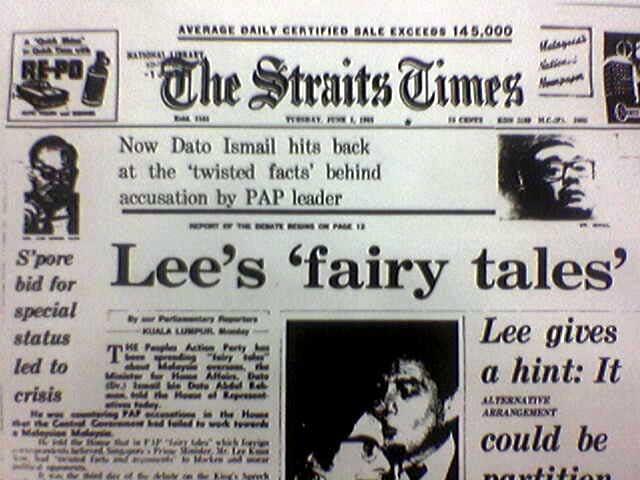
STRAITS TIMES, JUNE 1 1965

The People's Action Party has been spreading "fairy tales" about Malaysia overseas, the Minister for Home Affairs, Dato (Dr) Ismail bin dato Abdul Rahman, told the House of Representatives today.

He was countering PAP accusations in the House that the Central Government had failed to work towards a Malaysian Malaysia.

He told the House that in PAP "fairy tales" which foreign correspondents believed, Singapore's Prime Minister, Mr Lee Kuan Yew, had "twisted facts and arguments" to blacken and smear political opponents.


STRAITS TIMES, JUNE 1 1965

Singapore's Prime Minister, Mr Lee Kuan Yew, last night spoke of the possibility of partitioning as an "alternative arrangement" should unconstitutional methods be used to prevent a Malaysian Malaysia.

Those States which wanted a Malyasian Malaysia could get together.

He could think of three - Singapore, Sabah and Sarawak. Malacca and Penang were possibilities.

He said the present internal and international situation favoured an immediate decision on whether there was going to be a Malaysian Malaysia.

'Other ideas'

"Another resaon why it is necessary to decide now, not later on, is because it is easier for us, if they do not want a Malaysian Malaysia, to make alternative arrangements some other way," he said.

"The agreement in the Constitution must lead to a Malaysian Malaysia, and if they want to stop it they must use unconstitutional methods to stop it.

"So I say if they want to do that, do it now. It will be easier for us to make other alternative arrangements.

If Malays were daily exhorted to unite on the basis of race and not nation, in five years' time it would be very difficult to change the thinking on the ground.

Malaysian rule

Mr Lee said he did not want to talk too much about alternative constitutional arrangements.

He declared that Singapore had never agreed to Malay rule when it joined Malaysia. What it agreed to was Malaysian rule.

Talk that the people of Singapore were not accustomed to Malay rule, unlike the people of Kelantan and Trengganu, "was all bunkum."


STRAITS TIMES, JUNE 1 1965


The PAP was resurrecting the communal angle, Dato Ismail said, because the party was aware that this was an "effective weapon."

The Alliance had buried this question and was concentrating on building inter-racial harmony.

He described as untrue PAP claim that special privilges for the Malays only benefited capitalist Malays.

"Even if the Malays try hard to become millionaires, I do not think they will succeed. The odds are gainst them. They are not endowed as other Malaysians are in the ingenuity to acquire and accumulate wealth.

"The ratio in Government service benefits all sections of Malays who are qualified."

Referring to Mr Lee's charges that the allaince was creating a Malay Malaysia, dato Ismail said: "We Malay Malaysians, as the honourable Member from Singapore would like to call us, is not afraid of the truth."

He referred Mr Lee to the comparitively small number of Malays in commerce and industry, and the small number of Malays in the University of Malaya, and said:

"If Mr Lee adds up the strength and weakness of Malaysia, he cannot accuse the Malays of dominating Malaysia.

"With Indonesian confrontaion, the Malays cannot afford to dominate Malaysia without ruining this country."

Dato Ismail added: 'Like Dr Jekyll and Mr Hyde, the two images of the PAP cannot remain separate for long. The two must come together. The time for merging must come.

"The PAP is a party that shouts 'fire, fire' but commits arson."

He then paraphrased Abraham Lincoln: "You can fool some of the Malaysians all the time, all the Malaysians some of the time, but not all Malaysians all the time."

Saying that the Alliance had won independence for Malaya and helped Singapore gain independence, he added: "Surely, we can win the battle against the PAP."

In the battle to win the hearts and minds of the people, the Allaince would abide by democratic principles as long as the Opposition did likewsie."

MR CHIA THYE POH (Barisan Socialis - Singapore) took the PAP to task for "burying democracy" in Singapore by what he called "calculated steps."

He said Malaysia had not brought independence in the true sense of the term. Foreign troops were still in the land and more were coming in.

But apart from this, the PAP was the party which sought the friendship of the Allaince to fight and oppose one section of the Alliance during the last elections.

"Now the same PAP is fighting the Alliance in the open for its own ends.

"In the past, the PAP made friends and made use of the workers and students to gain power. Once they came into power they discarded them.

"In the past, they also made use of political opponents for their own ends. They now oppose all of them. What is the reason behind this whole plot?" he asked.

Mr Chia said there was no political democracy in Singapore because the PAP had banned all public rallies by the Barisan Socialis.

"The PAP, the devil, is now posing as an angel to this House. I ask that this be taken with a pinch of salt," he added.

Tuesday, August 02, 2005

UMNO members demanded detention of Lee Kuan Yew

Part Vll of the retrospective on Singapore's road to independence


STRAITS TIMES, MAY 16 1965

Tengku Abdul Rahman today urged UMNO leaders to keep calm over sentiments expressed by Singapore's Prime Minister, Mr Lee Kuan Yew, in recent weeks.

"I often said before that my intention was to make Singapore the New York of Malaysia and in order to do that the Singapore leaders should confine all the time and attention to the well-being of Singapore.

"It is obvious that every right-thinking person and every business man feels that Singapore's place is with Malaya. Without Malaya, Singapore would not enjoy the prosperity that she is enjoying today."

Mr Lee Kuan Yew had even gone so far as to suggest that even the Malays were not indigenous people of this country.

This, of course, is rather childish because everyone knew that under the Constitution the Rulers of the various States were hereditary.

That alone was sufficient proof that the Malays were the natives of this country. To suggest that the Malays were not was to say that the English were not natives of England. ven before the arrival of teh Anglo-Saxons, the Celts had already been there!

It would be best for UMNO to play down communal politics.

Mr Lee could not influence the minds of the Chinese because the Chinese were practical-minded people. They knew what they wanted and got what they wanted and that's all they cared about., except of course, the Communist sympathisers who will never be satisfied until they can turn Malaysia into a third China.

Opportunities

The Chinese were given fullest opportunities to trade, to do business and to make money and also to take part in politics, education and culture.

In fact they owned three fourths of the economy of this country and most of the businesses.

We will stick to words, says Ismail

Keep calm. This was also the tenor of Dato (Dr) Ismail bin Haji Abdul Rahman's speech at the UMNO general assembly today when the delegates demand the detention of the Singapore Prime Minister, Mr Lee Kuan Yew.

"This is not the way we do things in Malaysia," Dato Ismail admonished the delegates. "We must act constitutionally."

"Mr Lee has confined his attacks to speeches and we should reply in like manner.

"To use force in these circumstances is wrong and undemocratic."

Strong Action

Dr Ismail was speaking on a resolution calling on the Central Government to take "strong action" against Mr Lee for his remarks against the Malays.

Dato Ismail said: "If Mr Lee uses force, I'll put him in detention. I have been given this power and will use it very carefully."

"If we are not careful, we will play into the hands of the PAP.

"We are a democratic nation and not a totalitarian one. We must show the world that we have the power and also believe in the practice of democracy.

"The only weapon we can use in the matter is to fight constitutionally and to persudae the Chinese and Indians not to believe the PAP and its leaders.

"If we can have the support of the Chinese and the Indians to gain our independence, then we can have their support to fight the PAP.

Mr Lee, Dato Ismail said, might be clever, but every clever person had a little foolishness and stupidity.

"He should know that no one can rule this country without the support of the Malays," Dato Ismail added.


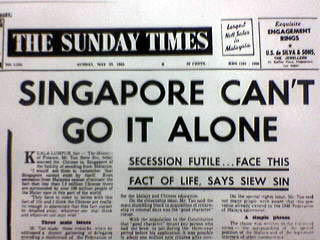
STRAITS TIMES, MAY 23 1965


The Minister of Finance, Mr Tan Siew Sin, today warned the Chinese in Singapore of the futility of seceding from Malaysia.

"I would ask them to remember that Singapore cannot exist by itself. Even secession from Malaysia cannot eliminate the fact that less than 1.5 million Chinese there are surrounded by over a 100 million people of the Malay race in this part of the world.

"They have to come to terms with this fact of life and I think the Chinese are realistic enough to appreciate that this fact cannot be brushed away, whatever one may think and whatever one may wish."


The day a young Mahathir blasted Lee and PAP


STRAITS TIMES, MAY 27 1965

The big debate on yesterday's Speech from the Throne by the Yang di-Pertuan Agong opened in the House of Representatives today with a strong Government attack on Opposition parties and the trade union movement.

Dr Mahathir bin Mohammed (All-Kota Star Selatan), who moved the resolution to thank the King for his gracious speech, described the PAP as being pro-Chinese, Communist-orientated and positively anti-Malay.

He said,"The last item has been kept in limbo until lately, when for reasons of political strategy and in an attempt to win over the Chinese and foreign countries to its side, the PAP decided to come out in the open with this basic anti-Malay principle.

"Everyone must have noticed the change in PAP strategy. When the PAP first made overtures to the Malayan Government on the common market and merger, UMNO was never attacked.

Lee attacked

Dr Mahathir then charged the PAP with paying lip-service to the national language, while playing to chauvinist ideas by retaining multi-lingualism.

In education, national language schools were the worst treated.

In industry, the PAP policy, he charged, was to encourage Malays to become labourers, but Malays were not given facilities to invest as well.

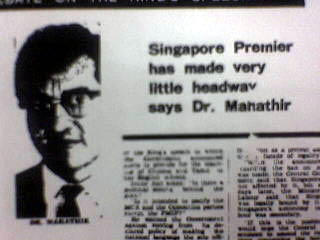
Dr Mahathir said that the Singapore Prime Minister, Mr Lee Kuan Yew, having made little headway to win true Malaysians into the PAP camp, embarked on a "most unseeminly programme" to get countries friendly to Malaysia to use their influence and opinion to change the political adherence of Malaysians.

"The PAP leader does not want to be the Prime Minister of Malaysia, unless of course it is to the good of Malaysia, and he never missed an opportunity to emphasise that it would be good of Malaysia if he were the Prime Minister.

"Already Time magazine has dubbed Mr Lee as the man who can save Malaysia. Other American papers and journals have spoken in like vein. But the Australians and British, being more knowledgeable or more diplomatic, have not been so open.

"So Mr Lee embarked on his crusade to the south, to Australia and New Zealand, to garner Anzac opinion.

"Carefully organised and brilliantly conducted by the maestro himself, the progress of Mr Lee would have made Dr Goebbels feel like a rank amateur.

Monday, August 01, 2005

Lee had ambitions to be PM of Malaysia, alleged UMNO

Part VI of the retrospective on Singapore's road to independence

STRAITS TIMES, MAR 24 1965

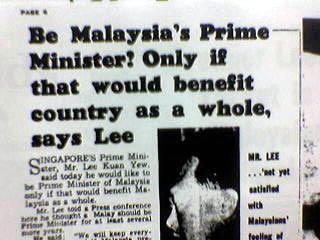
SINGAPORE'S Prime Minister, Mr Lee Kuan Yew, said today he would like to be Prime Minister of Malysia only if that would benefit Malaysia as a whole.

Mr Lee told a Press conference here he thought a Malay should be Prime Minister for at least several more years.

He said: "We will keep everyone alarmed if Malaysia presents an international image of immigrant and indigenous stock able to find accomodation on a rational basis."

Asked to what extent Malaysians had a sense of national unity, Mr Lee said: "I am not satisfied with their feeling of nationalism.

"It will take some time to fuse four different entities, sometimes with conflicting interests."


STRAITS TIMES, MAY 9 1965

The Minister of Information and Broadcasting, Inche Senu bin Abdul Rahman, said today that Mr Lee Kuan Yew's ambition to be Prime Minister of Malaysia could ruin the country.

Adressing members of the UMNO branch, Inche Senu said Mr Lee had humiliated the Malays by saying that no one race can say this is their native land.

"Mr Lee made an attempt to distort history," Inche Senu said, "and I wish to give him a piece of advice that whoever wants to contradict history or fight against the process of history will destroy himself in that process.

'Dangerous'

"What he really means by that remark is that Malays should have no special privileges or rights as duly constituted and agreed to him before the formation of Malaysia."

Describing this as a "dangerous political tactic, Inche Senu went on: "No one party can rule this country without the support of the Malays. Mr Lee know this.

"If you want to rule, they must have two things before them. First, they must co-operate with UMNO; second, they have to isolate, split and destroy the UMNO at every level."

"This can be done by instigating and dividing teh Malaysians. This is what Mr Lee attempted to do when he made such humiliating remarks."

Inche Senu the said that since teh alliance came into power, it did not have any trouble or conflict with the races in this country.

'Too Small'

"Now Mr Lee is impatient to be the Prime Minister of Malaysia. Singapore island is too small for him. "

"He thinks he is clever, but he forgets there are people in Malaysia who understand his manoeuvres. He is drunk with flattery, showered upon him by the foreign press."


STRAITS TIMES, MAY 9 1965

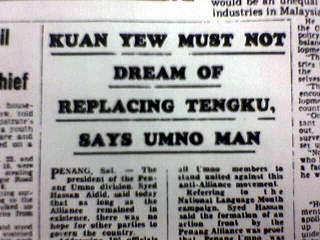
The president of the Penang UMNO division, Syed Hassan Aidid, said today that as long as the Alliance remained in existence, there was no hope for other parties to govern the country.

"Even is Lee Kuan Yew feels that he is a smart man - smarter than Tengku Abdul Rahman - he must not dream of replacing the Tengku as leader of the Central Government," he said.

"As long as Mr Lee keeps on abusing the Malays, he can never hope to get any support from them and without this, he will never gain the reins of government."


STRAITS TIMES, MAY 11 1965

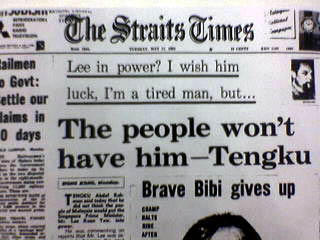
Tengku Abdul Rahman said today that he did not think the people of Malaysia would put the Singapore Prime Minister, Mr Lee Kuan Yew, into power.

He was commenting on reports that Mr Lee was aspiring to be become the nect Prime Minister of Malaysia.

"I wish him good luck. I am a tired man," said the Tengku.

"If he succeeds, let him take over, but I don't think he can, as I'm sure the people of would not want to put him in power."

Friday, July 29, 2005

PAP locked horns with Malaysian Government

Part V of the retrospective on Singapore's road to independence

Accusations and counter-threats flew back and forth across the causeway in early 1965. At one point, it became all a little too much for Singapore's PM Lee Kuan Yew as he filed a libel writ against UMNO's Secretary-General.


STRAITS TIMES, FEB 15, 1965

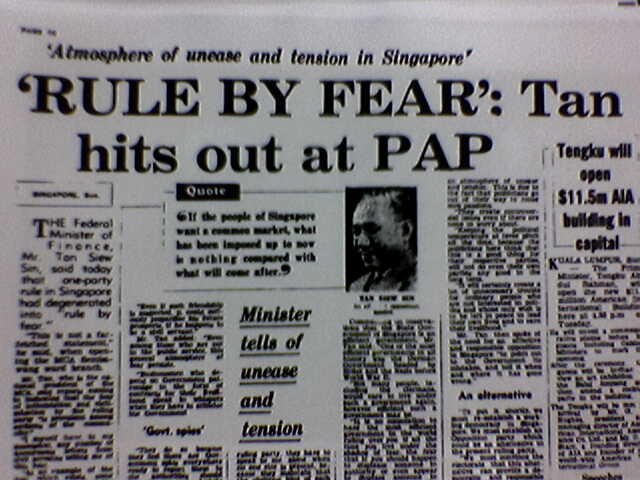
The Federal Minister of Finance, Mr Tan Siew Sin, said today that one-party rule in Singapore had degenerated into "rule by fear."

"This is not a far-fetched statement," he said, when opening the MCA Sembawang ward branch.

Mr Tan, who is the national president of the MCA, said reports coming indicated that the fear of intimidation and victimisation by the ruling party "is prevalent among sections of the community."

"I myself have in my possession many number of anonoymous letters from civil servants telling me of this fear.

"They say that it is risky to be regarded as even a personal friend of a member of any Opposition party.

"Even among those who are not in the public service, this general atmosphere of fear persists.

"Businessmen who depend on Government patronage in the form of contracts for their livelihood speak in whispers when they have to criticise the Government.

"They maintain that the slightest hint of such association with a member of the Opposition, and this naturally includes the Alliance, would bring down upon their heads the kind of persecution at which the ruling party is so adept.

"Such a campaign would be waged with utter ruthlessness and venomous thoroughness one associates with totalitarian regimes imposed by the Communists, Nazis and Fascists prior to World War ll."

"This skill at using terror tactics is even more amazing when you consider that they are being wielded by a State Government whose major powers have been substantially curtailed since Malaysia Day."

Commenting on observation that the State Government of Singapore is an efficient government, Mr Tan said: "One of the most efficient governments in all history was the German Government headed by Hitler before World War ll.

"It is no consolation to have the most efficient government in the world ruling over you if all the time you live under the shadow of fear, the fear that if you should happen to displease someone in authority or even appear to displease someone in authority, that may be the end of yourself or those near and dear to you.

"In Singapore there is an atmosphere of unease and tension. This is due to the fact that politicians go out of their way to rouse mob passions. They create controversial issues even if there are none to worry about."

Mr Tan then spoke of the need for an effective and responsible opposition in Singapore "to point out to the Government its mistakes, and tell it when and where it has gone wrong."


STRAITS TIMES, FEB 23 1965

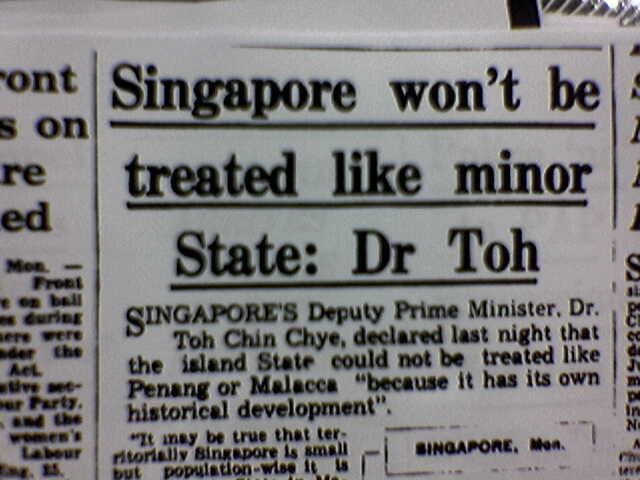
Singapore's Deputy Prime Minister Dr Toh Chin Chye declared last night that the island State could not be treated like Penang or Malacca "because it has its own historical development."

It may be true that teritorially Singapore is small but population-wise it is the biggest State in Malaysia," he said.

He said: "Furthermore, Singapore had its own commercial and economic importance even before it joined Malaysia.

"In these circumstances these circumstances trying to absorb Singapore into the orbit of the Central Government by treating it as a minor State is a mistake.

The PAP, he reiterated, had not been founded as a communal party but as a multi-racial party with a positive political philosophy. And it was on this basis that the party had succeeded for the last 10 years.


STRAITS TIMES, MAR 3 1965

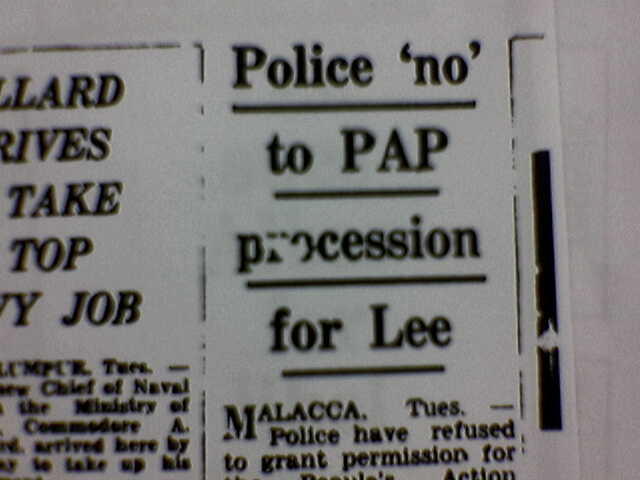
Police have refused to grant permission for the People's Action Party branch here to hold a procession from the airport to its headquarters at Kampong Pantai tomorrow evening.

The procession had been planned to give the Singapore Prime Minister, Mr Lee Kuan Yew, a motorcade escort when he arrives by air from Kuala Lumpur to open the branch headquarters.


STRAITS TIMES, APR 28 1965

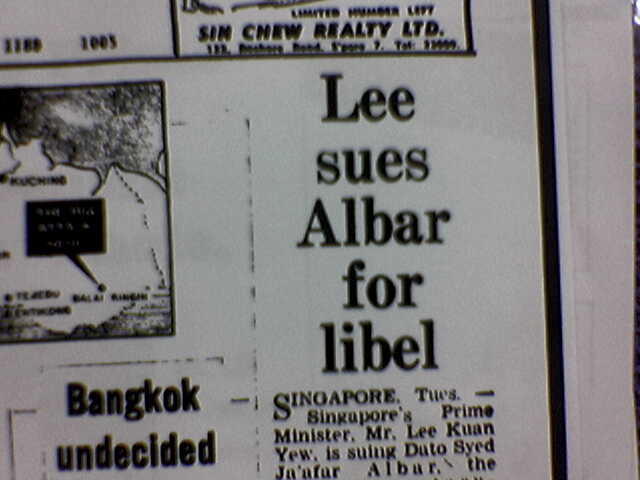
Singapore's Prime Minister Mr Lee Kuan Yew is suing Dato Syed Ja'afar Albar, the Secretary-General, for libel.

Two writs were titled in the High Court Registry early today by Graham Hill of Messrs. Rodyk and Davidson on behalf of Mr Lee.

In the first suit against the UMNO leader alone, the libel is alleged to have been contained in an open and undated letter from him to Mr Dennis Bloodworth, South-east Asia correspondent of the London Observer, on or about Aug 7 last year.

In the second suit against Dato Syed Ja'afar, the Utusan Melayu and its editor, Inche Melan bin Abdullah, the libellious statements are alleged to have been contained in two articles appearing in the Utusan Melayu on March 25, 1964 and last March 27.

According to the writ, the articles were headed: "Lee is accused of being an enemy of Malaysia and an agent of Indonesia. Walk over my dead body first - Albar," and "Albar accuses Kuan Yew of being an agent of the Communists."

In both suits, Mr Lee is claiming damages, costs and other or further relief as the court may see fit.

Thursday, July 28, 2005

The day a bomb exploded on Orchard Road

Part lV of the retrospective on Singapore's road to independence

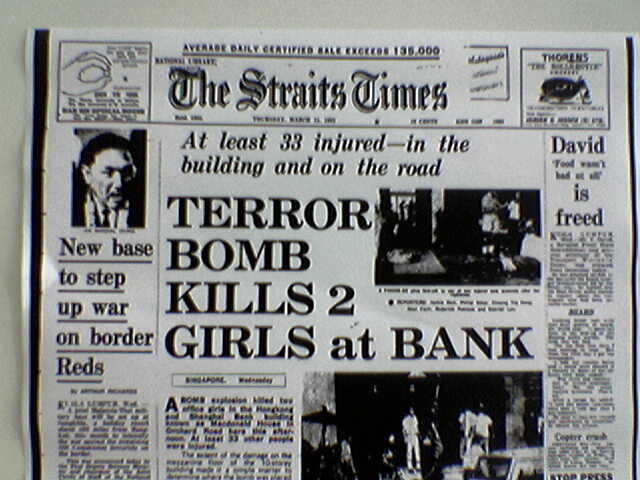
'Konfrontasi', the guerilla warfare that was waged by Indonesian President Soekarno against the Federation of Malaysia, hit Singapore with devastating impact on March 10, 1965. Prior to this attack, Indonesian saboteurs and infiltrators have been arrested in Johore and on Singapore shores, but this bomb blast in the MacDonald House has been etched into Singapore's post-colonial history as the probably the most brazen act of terrorism ever recorded.


STRAITS TIMES, MAR 11 1965

A BOMB explosion killed two office girls in the Hongkong and Shanghai Bank building known as MacDonald House in Orcahrd Road here this afternoon. At least 33 other people were injured.

The extent of the damage on the mezzanine floor of the 10-storey building made it a simple matter to determine where the bomb was placed - near the lift.

An inner wall at this level was blasted inwards and collapsed in a mass of rubble into the bank on the ground floor.

Windows shattered


Killed immediately were Mrs Suzie Choo, 36, private secretary to the Bank Manager, and Miss Juliet Goh, 23, a filing clerk in the bank.

Many others - in the bank and on the road - fell like ninepins, many seriously injured.

Every window within a hundred yards was shattered, and almost every car immediately outside the building and across the car was damaged.

An Australian Trade Commission station wagon, parked near the entrace was flung on the road divider. (The offices of the Australian High Commission are immediately above the mezzanine floor.)

Two buried

The bomb exploded at 3.17 pm - just eight minutes before the Wearne Brothers' motor mechanics were due to gather by the side of the building for their tea break.

It is not known if the bomb had a timing device.

The explosion ripped off a lift door - but it was one of the inner walls on the mezzanin floor that took the full force of the blast.

On the other side of this wall was the correspondence office of the bank in which Mrs Choo and Miss Goh were working. Both were buried by rubble.


STRAITS TIMES MARCH 16 1965

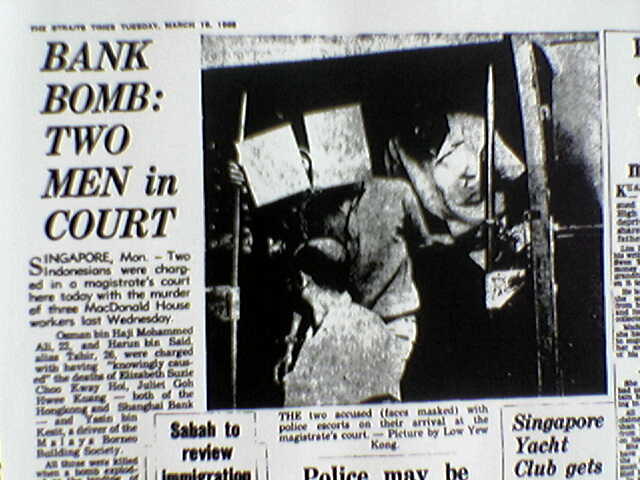
Two Indonesians were charged in a magistrate's court here today with the murder of three MacDonald House workers last Wednesday.

Osman bin Haji Mohammed Ali, 22, and Harun bin Said alias Tahir, 26, were charged with having "knowingly caused" the deaths of Elizabeth Suzie Choo Kway Hoi, Juliet Goh Hwee Kuang - both of the Hongkong and Shanghai Bank - and Yasin bin Kesit, a driver of the Malaya Borneo Building Society.

All three were killed when a bomb exploded on the landing of the mezzanine floor of MacDonald House at 3.07 pm on Wednesday.

1964 - PAP accused of being "double-tongued" and "double-faced"

Part lll of the retrospective on Singapore's road to independence
Policies differences, personality clashes and power-tripping dogged the PAP's role as the opposition in Malaysia's Parliament. The Merger, celebrated just a year earlier, was resembling more like a marriage of convenience than a union of mutual trust and understanding.


STRAITS TIMES, DECEMBER 3 1964
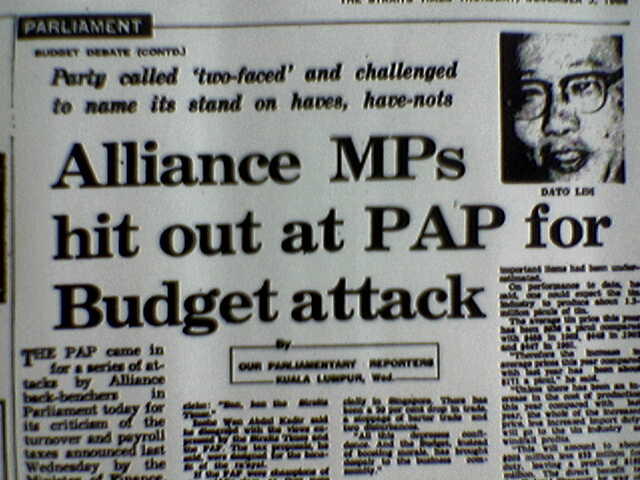
The PAP came in for a series of attacks by Alliance back-benchers in Parliament today for its criticism of the turnover and payroll taxes announced last Wednesday by the Minister of Finance, Mr Tan Siew Sin.

The sharpest attack was delivered by Mr Lee San Choon (All Segamat) who accused the PAP of being two-faced.

He challenged PAP members to state publicly whether they had stood for the "haves" or "have nots."

Dealing with the budget, Inche Wan Abdul Kadir bin Ismail said the Straits Times had been publishing a lot of articles attacking the tax proposals. PAP speakers had also come to the House voicing the same views.

A voice in the Government back-benches was heard to exclaim: "Ban, ban the Straits Times."

Inche wan Abdul Kadir said he disagreed with the views expressed by the Straits Times and the PAP. The tax proposals, he said, were designed for the benefit of the ra'ayat.

If the PAP were champions of the middle-class, as they were now claiming, why did they cut the salaries of civil servants who belonged to the middle-class?

It claimed to champion the cause of the have-nots. But what had it done for the have-nots in Geylang Serai and Kampong Glam? he asked. He accused the PAP of being "double-tongued."

Inche Abdul Samad bin Ahmad (PMIP) stressed that the his party supported the budget. It had pledged to work with the Central Government in meeting confrontation.

He then launched into a strong attack on the PAP, which he described as "of the same colour" as the Barisan Socialis.

He recalled that Mr Lee Kuan Yew had met the "Plen" and asked why the Central Government had not arrested him.

Mr Lee San Choon, political secretary to the Finance Minister, said members of the Alliance were "honest and sincere" and did not have the ability to twist and distort facts like the PAP.

"We are not double-faced and we are unable to talk with different tongues in different places," he said.

"Unlike the PAP, we do not champion the cause of so-called socialism and at the same time advocate free enterprise.

"Unlike the PAP, we do not identify ourselves as leftists and give pioneer status to wholly owned Western capitalist organisations.

"Also, unlike the PAP, we do not attempt to secure support through class struggle."


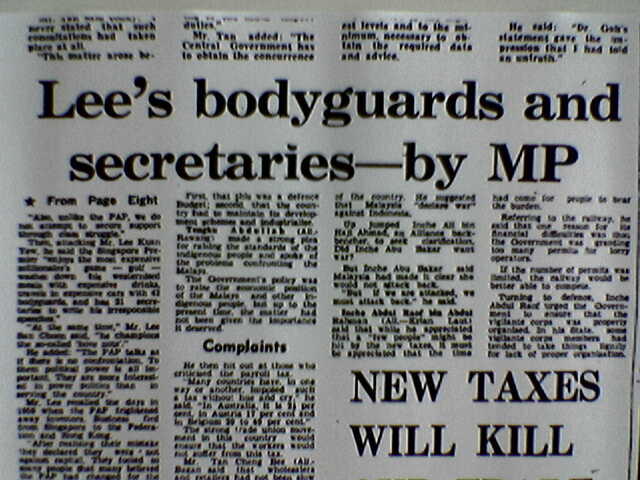
Then, attacking Mr Lee Kuan Yew, he said the Singapore Premier "enjoys the most expensive millionaire's game - golf - washes down his westernised meals with expensive drinks, travels in expensive cars with 42 bodyguards, and has 21 secretaries to write his irresponsible speeches."

"At the same time," Mr Lee San Choon said, "he champions the so-called have-nots."

He added: "The PAP talks as if there is no confrontation. To them political power is all important. They are more interested in power politics than in serving the country."

Mr Lee recalled the days in 1959 when the PAP frightened away investors. Business fled from Singapore to the Federation and Hong Kong.

"After realising their mistake they declared they were not against capital. They fooled so many people that many people the PAP had changed for the better. Now we know.

"They are still wolves in sheep skin, their heart is the same. They are fighting the Barisan for political power, but ideologically they are the same."


STRAITS TIMES, DEC 31 1964
The Finance Minister, Mr Tan Siew Sin, today accused the Singapore Government of using all the machinery at the disposal of the State to inflame "mob passions" against the turnover and payroll taxes.

He said this when introducing the Supply Bill in the Senate. "They have even gone so far as to allow members of the public to speak on Radio Singapore to denounce the tax proposals," he said.

Held responsible


"I should warn the Singapore Government that if this were to happen, they will be held responsible.

"These actions are indeed strange, coming from a Government which calls itself pro-Malaysia but which is doing everything it can do to wreck proposals that are designed to ensure the financial and economical stability of Malaysia in the face of growing commitments for defence and development which we now have to meet if we wish to survive."

Monday, July 25, 2005

1964 - Fighting in the streets of Singapore

Singapore and Malaysia leaders blame Indonesia's Soekarno for inciting racial violence.
Part ll of the retrospective on Singapore's road to independence


The first year of Merger proved to be a tumultous year for Singapore. While PAP leaders were shuttling back and forth from Kuala Lumpur to engage the Central Government in Parliamentary debates, political tensions arising from the Merger spilled onto the streets of Singapore.

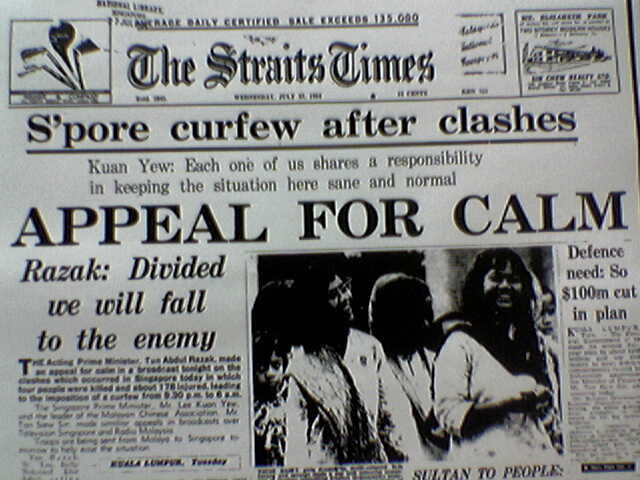
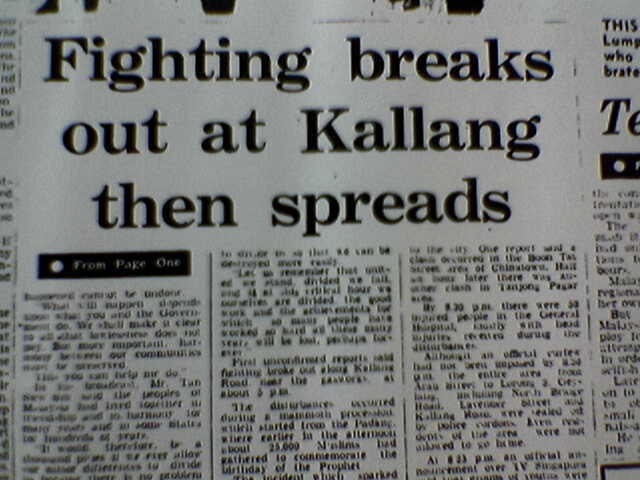
On 21 July 1964, near Kallang Gasworks, fighting between Malay and Chinese youths during a Muslim procession celebrating the Prophet Muhammad's birthday erupted into racial riots, in which twenty-three people were killed and hundreds injured.

While Singapore and Malaysia were quick to pin the blame on Indonesia's President Soekarno, who had declared a state of Konfrantasi (Confrontation) against Malaysia and initiated military and other acts to provoke the Malays against the Chinese, historians suggest the communal tensions arising Singapore's merger had been the main catalyst.

Upon Merger in 1963, Malays and Muslims in Singapore were being increasingly incited by the Malaysian Federial Government's accusations that the PAP was mistreating the Malays. Numerous racial riots resulted, and curfews were common in order to restore order.

The riot on July 21 proved to be Singapore's most notorious, with twenty three killed and hundreds injured. Today, it is still disputed how it started, and theories include a bottle being thrown into a Muslim rally. More riots broke out in September 1964. The price of food heavily skyrocketed during this period due to the disruption in transport, which caused further hardship.

The race riots in Singapore in 1964 were a large contributing factor in the expulsion of the state from Malaysia.


STRAITS TIMES, JULY 22 1964

The Acting Prime Minister, Tun Abdul Razak, made an appeal for calm in a broadcast tonight on the clashes which occured in Singapore today in which four people were killed and about 178 injured, leading to the imposition of a curfew from 9.30pm to 6am.

The Singapore Prime Minister, Mr Lee Lee Kuan Yew and the leader of the Malayan Chinese Association, Mr Tan Siew Sin, made similar appeals in broadcasts over Television Singapore and Radio Malaysia.

Troops are being sent from Malaya to Singapore tomorrow to help ease the situation.

In his broadcast, Tun Razak reminded Malaysians that they had lived together in peace for hundred of years.

Dangerous

Malaysians of different races and religion had never "disturbed" their good relations with one another.

"We now face a very critical situation. It is very dangerous for all of us, whether we are Chinese, Malays, Indians or other races.

"You must not forget that we are facing a common enemy. This is an enemy dangerous to us all. If we are divided, we shall be destroyed. "

Tun Razak warned that the Central Government "will not allow any group or community to be oppressed in Malaysia."

He added: "We have made our position positively clear. I ask you to place your trust in the Government to keep the peace and gurad the country in the interests of all races."

At 10.45 pm the Singapore premier went on the air and said: "this afternoon, shortly after five, when the procession of Muslims celebrating Prophet Mohammed's birthday was passing Lorong Soopoo, near the Kallang gas works, a member of the Federal Reserve Unit asked a group who were straggling away from the procession to rejoin the main stream.

"Instead of being obeyed he was set upon by them. Thereafter a series of disturbances occured as more groups became unruly and attacked passer-by and spectators.

"These disturbances have spread rapidly throughout the Geylang area between Kallang and Geylang Serai. By about 7.30, two hours after it started, disturbances took place in the city itself.

"After consulatations between Tun Abdul Razak with the Commissioner of Police and I, it has been decided that there would be a curfew from 9.30 tonight to 6.00 tomorrow morning.


STRAITS TIMES JULY 23, 1964

At 6 a.m. the situation seemed under control when the curfew, which was imposed at 9.30 a.m. last night, was lifted.

But tensions was still high in the air as thousands of workers streamed into the city and business carried on as usual.

Ny 7 a.m. however, reports of sporadic clashes in various parts of the island began to trickle into Times House.

At 9.40 a.m. Tun Abdul Razak flew into Singapore to study the situation.

At 11 a.m. unconformed reports at the General Hospital recorded twp more deaths and 57 injured.

Interviewed in the hospital casualty room, most of the injured said they were on their way to work when they were being attacked by groups of marauding youths.

Traffic jams

At 11.10 a.m. Radio Singapore announced that the curfew would be re-imposed from 11.30 a.m. and advised people to stay indoors.

The annoucement caused office workers to rush home by whatever transport they could get. There were big traffic jams in several places.

All bars and restaurants were also closed and cinemas throughout the island cancelled their shows.

By 11.30 a.m. most of the shops and business establishments were closed.

At the C.I.D. the general alarm was sent out and all members of the police force were ready to go into action.


STRAITS TIMES, SEPT 5 1964

A "STATE OF DANGER" has been proclaimed in Singapore, where the casualty toll in 48 hours of sporadic Indonesian-inspired clashes was given officially this evening as eight killed and 60 injured - 14 of them in hospital.

The proclamation, under the Public Order (Preservation)Ordinance, was made by Dato (Dr.) Ismail bin Dato Abdul Rahman, Malaysian Minister of Home Affairs, this afternoon.

At 2 p.m. a curfew was imposed over the entire island. It will be lifted from 5.30 a.m. to 9 a.m. tomorrow.

Malaysian troops who have been fighting Indonesian commandos in Johore were moved this afternoon to Singapore to help maintain order.

'Trouble in Singapore not communal or racial but political'

Tengku blames Soek

TENGKU Abdul Rahman tonight blamed Indonesia for stirring the racial disturbances here and appealed to the people to be calm, cool and composed so that they would be in a better position to fight Indonesia or Soekarno and his agents.

Speaking in a television and radio broadcast here tonight, the Tengku said the trouble in Singapore started with the killing of an innocent old trishaw peddler.

Motive

He asked: "Who can gain by killing him? Neither the Chinese or the Malays. Who did it? Nobody knows. And waht was the motive in doing it? The authorities know."
He said it was done to stir up trouble when the people were celebrating their Merdeka to coincide with the landing of paratroopers from Indonesia.
"By this simple process of creating trouble and disturbance within the country Soekarno hopes that Malaysians themselves will make enough trouble in this country to bring about the end of Malaysia."
"Soekarno has made no secret of his intention to stir up trouble here. First, he started to attack the Chinese, now he has started to attack me by saying that the reason forming Malaysia is to persecute the Chinese."

Saturday, July 23, 2005

The day when Singapore became part of Malaysia

Part l of the retrospective on Singapore's road to independence.

Before its own independence in 1965, Singapore had officially ceased to be a British colony when it decided to merge with its northern neighbour. On September 16, 1963, the new nation of Malaysia was born, comprising of Federation of Malaya, Sarawak, Sabah and Singapore. This was how the Straits Times reported the event.


STRAITS TIMES, SEPT 16, 1963

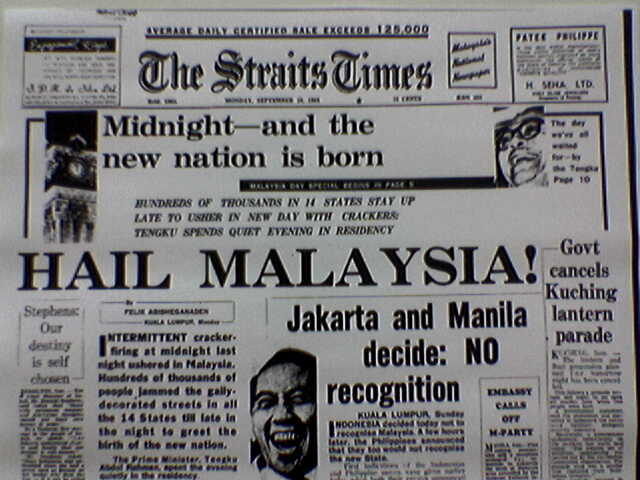
Intermittent cracker firing at midnight last night ushered in Malaysia. Hundreds of thousands of people jammed the gaily-decorated streets in all the 14 States till late in the night to greet the birth of the new nation.

The Prime Minister, Tengku Abdul Rahman, spent the evening quietly in the residency.

In all States colourful parades will be held this morning when the new Malaysia flag with 14 stars will be ceremoniously unfurled.

Singapore's big moment will come when the proclamation is read on the City Hall steps at 5 p.m.


STRAITS TIMES, SEPT 17, 1963

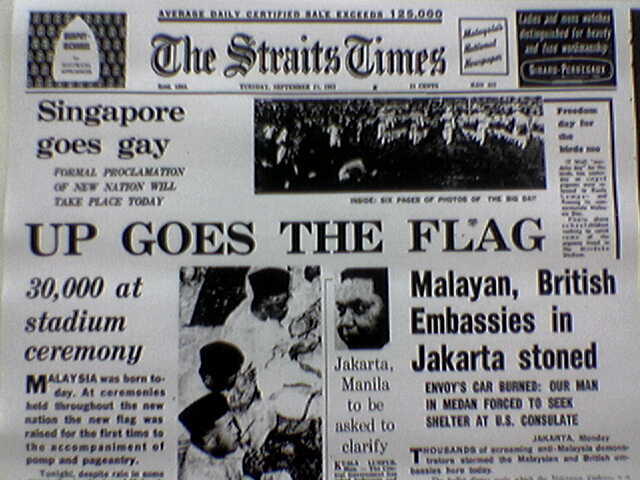
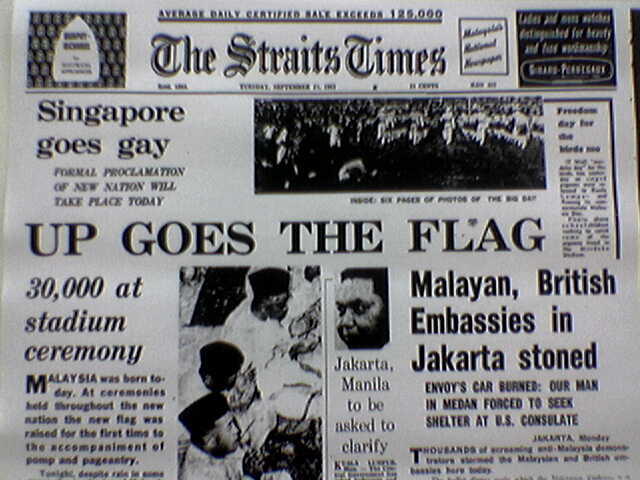
Malaysia was born today. At ceremonies held throughout the new nation the new flag was raised for the first time to the accompaniment of pomp and pageantry.

Tonight, despite rain in some areas, the territories of Malaysia were a feast of light and colour and sound as 10 million celebrated.

More than 30,000 people Kuala Lumpur jammed the Merdeka Stadium in the early hours of the morning to witness the history-making Malaysia inaugural ceremony.

In Singapore, the moment of history was when the Prime Minister slowly intoned: "Now I, Lee Kuan Yew, the Prime Minister of Singapore, do hereby proclaimed and declare, on behalf of the people of Singapore, that as from today, the 16th day of September 1963, Singapore shall forever be a part of the sovereign and independent State of Malaysia, founded upon the principles of liberty and justice and ever seeking the welfare and happiness of her people in a more just and more equal society." Then to the strains of "Negara Ku", the Malaysian flag was raised.


STRAITS TIMES, SEPT 17, 1963

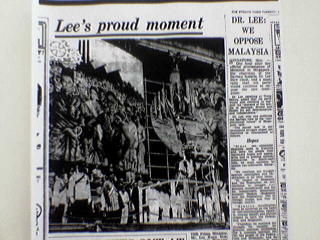
The Prime Minister, Mr. Lee Kuan Yew, makes his Malaysia proclamation from the City Hall Steps against a backdrop of a Malaysian multitude marching forward hand-in-hand.

This was Mr. Lee's proudest moment, and as read out the proclamation his voice shook with emotion and tears welled up in his eyes.

Independence through merger was the aim of the Premier and his People's Action Party which swept to power in 1959. This was his day of "fulfilment."

DR. LEE : WE OPPOSE MALAYSIA

One hour after the official proclamation of Malaysia in Singapore, the chairman of the Barisan Socialis, Dr. Lee Siew Choh, told a mass rally that his party would continue to oppose the new federation.

Dr. Lee, speaking at Tiong Bahru, added that his party would also continue to support the "demand of the people of Sarawak, Brunei and Sabah for self-determination and independence."

Dr. Lee, who was outlining the Barisan view on the "constitutional future" of Singapore, said:

"Since neo-colonialist Malaysia seeks to frustrate and deny the people their legitimate hopes and aspirations and to prolong colonial domination in South-east Asia, we must continue to oppose neo-colonialist Malaysia.

"We continue our struggle against colonialism and imperialism in all their forms."

"In respect of Singapore and the Federation we will continue to struggle for genuine reunification and for an independent democratic socialist Malaya (Singapore and the Federation) free of foreign troops and free of foreign control.

"Genuine reunification must be achieved on the basis of self-determination, equality, mutual benefit and mutual respect to both the Federation and Singapore.

"Therefore we continue our struggle for equality, for genuine common citizenship, for a common political life for the people of the Federation and Singapore; and we continue to safeguard and protect the economic interests of the people of Singapore.

Detainees

"Self-determination must of course include the immediate and unconditional release of all political detainees (especially those detained because of their anti-Malaysia activities) and the normalisation of all political life and activities in the country.

"Self-determination must include the restoration of all the fundamental rights of the people, including the freedom of travel, speech and publication, association and assembly.

"Self-determination must include the right to pursue an independent foreign policy of neutralism, and to oppose colonialist or neo-colonialist blocs, whether functioning under Malaysia or Seato.


Tuesday, July 19, 2005

Singapore drive on 'yellow culture' goes on

"I went for high culture, and forgot pop culture. That is where the money is."
- MM Lee Kuan Yew, Apr 17, 2005


More blasts from the past. In June 1959, jukeboxes and pin-tables got onto the nerves of the newly elected PAP Government headed by Lee Kuan Yew, Singapore's first Prime Minister.


The Singapore Standard, June 13 1959.

By BOB PERIES

The Singapore Government yesterday cracked down on pin-table parlours and silenced jukeboxes in bars and coffee shops, in a Police drive that started at 6 p.m.

The crackdowm is another step in the Government's campaign to rid of the island of "yellow culture."

The Minister for Culture, Mr S. Rajaratnam, announced earlier in the week that rock n' roll and sentimental music would be drastically reduced in Radio Singapore broadcasts.

The Government has also ordered cinema exhibitors to withdraw from screening about 30 films and to send some back for re-examination by the censor.

Brutality, Low Moral Tone

The films came from America, Japan and Hong Kong.

It is understood that these films, in part, showed excessive brutality or were of a low moral tone.

The film censor, Mrs Cynthia Koek, however, would not comment.

Groups of Police officers, detectives and constables, acting on the instructions of the Government fanned out at 6 p.m. from all Police divisional stations to proclaim the big ban.

Armed with sheafs of documents authorising the ban, Policemen moved into hundreds of pintable arcades, bars and coffee shops.

After informing the proprietors of these establishments, they slapped the notices announcing the cancellation of their licences to operate the machines.

Saloons Quiet And Deserted

By 8 p.m., the saloons were deserted and the jukeboxes in bars and coffee shops blared no more.

A Standard reporter, who toured the island at 7 p.m. found several saloons in the Chinatown and Jalan Besar areas had closed down voluntarily - after getting wind of the impending swoop.

Unlicensed gaming shacks, which had mushroomed all over the island quietly shut their doors when messages were realyed through underworld agents.

This is an eye-witness account of the swoop: At 6 p.m., Police Officers moved in silently into saloons, bars and coffee shops and explained the ban to teh shocked proprietors.

They were warned that any breach of the ban would lead to a fine.

Notices were then pasted or nailed on the walls of the premises and above jukeboxes.

The proprietors asked their customers to leave and then shut their doors immediately.

The Singapore Standard, June 16 1959

Several hundred workers who have been thrown out of employment as a result of the ban on pin-tables amd jukeboxes have asked the Singapore Government to reconsider the order so that they would not add to the number receiving public assistance.

"We do not want to go on the dole," declared 300 employees of the Asia Novelty Emporium, one of the largest pin-table operating establishments on the island, whose licence was cancelled on Friday when the Government ban was imposed.

Twelve representatives of the workers, headed by the manager, Mr. Low Boon Kwee, yesterday met the Minister for Labour and Law, Mr. K.M. Byrne, to ask for the temporary rescindment of the ban so as to give them time to find other employment.

Mr. Low claimed that they were still uncertain if the ban was a temporary suspension of the game or a permanent prohibition.

As a result, the workers still keep coming to the place of work in case the suspension is lifted. They are not paid for it.

"The immediate closing down of the establishment has put us in a quandary and we are unable to find other jobs because it had been so sudden," he added.

Bread-winners

Of the 300 employees, 100 are girls, and they are the bread-winners for about a 1000 people, said Mr. Low.

At the one-hour meeting with the Minister yesterday, Mr. Low said that Mr. Byrne expressed his sympathy but said that he could not rescind the order. He would, however, bring the matter before the Cabinet and would give an answer to the delegation of the workers next Monday.

The emporium began functioning ten years ago and the workers are paid daily wages.

The Government, however, is not likely to reconsider its ban on the operation of jukeboxes and pin-tables.

Classical Music

The Minister for Culture, Mr S Rajaratnam said yesterday that it was up to the operators to convince the Government as to why the machines should not be banned.

Mr Rajaratnam said the suggestion by the operators that they were prepared to play classical music instead of provocative hits could not be entertained.

The Minister said it was not possible to check whether they were playing classical music as it would require a large staff of inspectors to watch them.

The decision to ban the jukeboxes and pin-tables was taken by the Ministry of Culture last week as part of the Government's policy to get rid of the "yellow culture" on the island.

Wednesday, July 13, 2005

Singapore police seized video at book launch

Over the weekend in Kuala Lumpur, Malaysians were treated to 38 films which had explicitly promoted themes of human rights, freedom of expression and other socio-political issues, including an unapologetically one-sided film higlighting the injustices of the Internal Security Act.

As a true blue, law-abiding Singaporean, I had asked the organiser of the Freedom Film Festival if any of the films were submitted to the authorities for approval. She looked at me, shrugged her shoulders and said, "No, but if they want to censor us, we'll defend our rights to freedom of expression."

So that's how things are in Malaysia. They just do it, and worry about consequences later.

After the festival, I took the coach back to Singapore. Upon crossing the causeway, I was greeted by this piece of news. The homecoming couldn't have been more sobering.

Published in the Straits Times, July 12 2005

No cert, so video shown at SDP leader's book launch seized

The police have seized a video that was screened at the launch of a book by oppoistion leader Chee Soon Juan last Saturday.

The organisers had not applied for a certificate to show the Hong Kong-made film, said the police.

The clip - titled July and which documents peaceful protests by Hong Kong people on July 1, 2003, against a proposed national security law - was screened while Dr Chee was signing copies of his new book.

The book, The Power of Courage, advocates the use of non-violent protests and civil disobedience against what Dr Chee described as "unjust laws" here.

The book launch at Grand Plaza Parkroyal was attended by about 50 members of the public, including supporters from Dr Chee's Singapore Democratic Party (SDP) and the Workers' Party.

Posted by Picasa

"We have more important things to do!", said this unidentified police officer.

Yesterday, a police spokesman said: "During the event, a video disc was screened to the public.

"As the disc did not possess a certificate for its public exhibition, it was seized under the Films Act for investigations."

Asked if he knew that he could not air the film here without a certificate, Dr Chee, who organised the event, said he "didn't even know the video was being screened."

However, a presenter did announce that it would be screened during his autograpgh session.

When queried about the annoucement, Dr Chee said: "You will have to ask the presenter."

The police questioned Dr Chee on Saturday but declined to say if more people were being interviewed. They are still investigating the matter.

Tuesday, July 05, 2005

Singapore's war on pop culture

"I went for high culture, and forgot pop culture. That is where the money is."
- MM Lee Kuan Yew, Apr 17, 2005


It all began in 1959...

As part of my own commemoration of Singapore's upcoming 40th birthday, here is a series of historical snapshots from the Straits Times and The Singapore Standard.

Before independence in 1965, Singapore had been granted self-governance by the British.

On June 9, 1959, barely 10 days after being voted into public office, the new PAP administration initiated a clampdown on rock music, jukeboxes, publications, strip tease shows (yes, we used to have that!), films and all popular entertainment that were deemed as "yellow culture" contributing to "the decline in the moral standards of society."


The Straits Times, June 10 1959 (Page 1 headlines)

RADIO: THE NEW ORDER
More serious programmes - with emphasis on Malaya

No more rock around the clock
Singapore, Tuesday


ROCK N' ROLL and sentimental music are to take a back seat in future Radio Singapore programmes.

Instead, the Minister of Culture, Mr. S. Rajaratnam, announced today, more time will be devoted to serious programmes with a Malayan emphasis.

He told the Straits Times: "We do not intend to ban rock n' roll and other light music. We feel, however, that there is too much of it at present.

"We aim to achieve a more even balance.

"The new policy will apply to vernacular as well as English programmes. It will govern the selection of recorded programmes supplied by overseas broadcasting companies and corporations.

"News commentaries and reviews will be compiled first from the Malayan and then the Asian point of view.

"We want listeners to think as Malayans. It is no use looking at Asian affairs through Western eyes.

First choice

"Wherever possible, local men will be given priority in commenting on the news, though this does not mean that foreign commentators will be excluded altogether."

Mr Rajaratnam said he and officials of his Ministry were deciding how the broadcasting and information departments could be co-ordinated.

He said he might go to Kuala Lumpur for talks with Radio Malaya authorities. No date had been fixed for these talks yet, he added.


June 9 1959, The Singapore Standard Posted by Picasa

SINGAPORE'S Minister for Home Affairs, Mr. Ong Pang Boon, yesterday banned eight publications and withdrew the licence of the Mei Hua (Plum Blossom) Stage Show, which was playing at the Great World Amusement Park.

The Minister decided on the ban after consultation with Prime Minister Mr. Lee Kuan Yew and Senior Police officials yesterday morning.

The publications banned are: The Weekender (Free Press), the Free Press, Weekender Annual, the Nanyang Weekender, Arrow News, Kung Sang Pau, New Life News, Ti Press and the Fan Hua Pao.

Mr. Ong, in a written statement clarifying his decision to ban the stage show and the eight publications, said that it was part of "an active policy of eliminating all pornographic culture and all activities which are detrimental to the growth of a new and healthy society and culture."

He pointed out that under "colonial rule" Singapore had not only been exploited economically and politically but had also been culturally devastated.

Moral decline

"There has been a steady decline in the moral standards of society, particularly in the post-war decade, during which the degeneration has been very great," he said.

He pointed out that Singapore's young boys and girls "rock n' rolled" in the streets while its young wasted their time playing billiards and listening to sexy songs; striptease shows were performed freely and publicly.

"The continued development of such a situation will eventually lead to the total bankruptcy of the moral standards of our society," he said.

Mr. Ong said that the PAP told the people before it came into power that it would eliminate all the factors which contributed to the decline of moral standards of society and which stood in the way of the creation of both healthy social standards and of a healthy culture.


Straits Times, June 12 1959 (page 9) Posted by Picasa

The Minister for Culture, Mr. S. Rajaratnam, hinted today that a clean-up of the cinemas would be launched if it became necessary to prevent the screening of films which were detrimental to the morals of the people.

Books and periodicals which exploited sex would also come in for action.

"We have laid down a policy that where books or films are detrimental to morals and come very close to being classified as "yellow culture", it follows logically that they will be banned," he said.

"The film censorship policy will reflect this new attitude."

He said any action taken would be done in consultation with the Minister for Home Affairs, Mr. Ong Pang Boon, who deals with film censorship.

Pin-tables

Besides juke boxes, against which the Government is expected to take action, pin-tables are also likely to come in for similar action.

These are found in coffee shops and amusement parks. In some places they are the haunts of hooligans and gangsters.

The newly-appointed Parliamentary Secretary to the Minister for Culture, Mr. Lee Khoon Choy, today moved into his office adjoining that of Mr. S. Rajaratnam in the Department of Information Services.

The Minister and the Information Services expect to move into new offices in City Hall in about a fortnight.

S'pore make amends with film retrospective

After decades of weaning its population away from potentially decadent forms of popular entertainment, the Singapore government is now promoting local pop music and films, on its own terms, of course.

Excerpt of report published in the Straits Times, July 5, 2005

See Singapore morph from bucolic rural backwater to buzzing urban metropolis next month.

Screen Singapore: A Festival Of Singapore Films celebrates the nation's 40th birthday with a celluloid feast that serves up 31 feature films and 14 short films.

The programme runs the gamut from classic P. Ramlee films to controversial new offerings like Royston Tan's gangster movie 15.

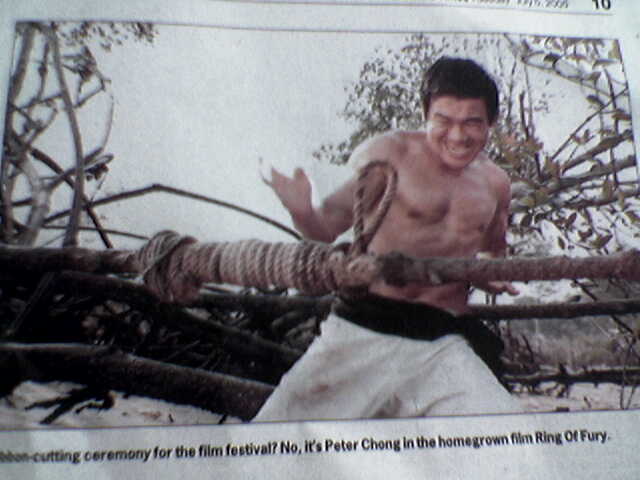
The main attraction is a long-lost film from 1973 called Ring Of Fury. Directed by Tony Yeow and James Sebastian, it stars Singaporean karate master Peter Chong. But it was banned because of the storyline, which deals with a hawker facing extortion from a gang. It is receiving its Singapore debut 32 years after the fact.


Peter Chong from 70s homegrown flick Ring Of Fury, Straits Times, July 5 2005 Posted by Picasa

Organised by Phish Communications, the festival is sponsored by the Singapore Film Commission and the Ministry of Information, Communications and the Arts.

Click here for the list of films to be shown at Screen Singapore. (Note that there are no local films at all from the eighties)

Friday, July 01, 2005

Look at the mess we're in

Below is an abbreviation of '50 facts that should change the world', a book by BBC journalist Jessica Williams.

In the foreword, she wrote, "Setting out to change the world is a pretty difficult task. But I firmly believe each one of the 50 facts in this book is capable of changing the way we think - and when it comes to changing the world, that's the most important step we can take."

"Some of the facts need major shifts in thinking, while others require governments to start taking their responsibilities to the international community seriously. A quote from the eminent anthropologist Margaret Mead has inspired activists for generations, 'Never doubt that a small group of thoughtful, committed people can change the world. Indeed, it is the only thing that ever has."

At the end of the book, there is a full list of where the 50 facts are sourced from, and a guide of how one can get involve.

(Italics and links are added)

1. ONE in five of the world's population is undernourished.

Eight hundred million go hungry every day. Two billion people suffer from chronic malnutrition. Eighteen million die each year from hunger-related diseases. Around half of the deaths of children under five (10 million each year) are associated with malnutrition. Famines occur where there is an acute and extreme shortage of food for a large number of people, but hunger can persist over many years and its long term effects can be just as devastating.

And yet, incredibly, this is not caused by food shortages. The world produces enough food each year to feed all of its inhabitants: if it were shared out evenly, everyone would have enough to eat. So why are many still suffering?

Professor Amartya Sen argues that political circumstances are often to blame. Where a country is already weakened by epidemics or war, natural phenomena like droughts or floods become far more difficult to overcome. Corruption, mismanagement and bad government mean that the country may lack funds to import food when needed - so a food shortage can quickly turn into a famine.

2. EIGHTY-ONE per cent of the world's executions in 2002 took place in just three countries: China, Iran and the USA.

Amnesty International notes that in 2002, China executed at least 1,060 people, and that this figure was based on limited records - the Chinese government keeps its executions quiet and seldom publicises them, so the true figure is believed to be far higher. At least 113 executions were carried out in Iran, and 71 people were executed in USA.

China's government has consistently defended its use of the death penalty, calling human rights groups 'irrensponsible.' In the months between April and July 2001, at least 1,781 people were executed. As part a 'Strike Hard' campaign against crime, police and prosecutors were urged not to hold up the judicial process. Courts boasted of their speed and special procedures. Many minor offences became capital crimes : bribery, pimping, stealing petrol and selling unsafe food among them.

One of the most effective ways to force countries to recognise their human rights obligations is international pressure. In its March 2005 decision which declared the execution of minors to be unconstitutional, the US Supreme Court's majority opinion mentioned "the overwhelming weight of international opinion against the juvenile death penalty."

Official information about the use of the death penalty in Singapore is shrouded in secrecy.

3. THERE are 44 million child labourers in India, some working 16-hour days.

Everyday in India, millions of children who should be at school are sent to work. For almost all of them, it's a matter of necessity. The UN International Labour Organisation (ILO) estimates there are 44 million child workers and unofficial estimates can be as high as 100 million - this is roughly equivalent to the number of children between five and fourteen who are not in school.

Worldwide, the ILO estimates that there are 246 million child labourers aged between five and seventeen. Of those, 171 million are working in hazardous conditions; roughly 8.4 million are involved in forced and bonded labour, armed conflict, prostitution, pornography and other illicit activities.

For many children, doing some work about the house is an introduction into adult responsibilities. A paper round or Saturday job may give them a small amount of financial independence. But as soon as work means children can't be children - that they have no time for school, play, friends - the responsibilities have become too great. And that's when we need to do something about them.

4. LANDMINES kill or maim one person every hour.

Landmines were first deployed during the First World War as a means of securing territory. But their cheap price means they are still widely manufactured and used today. Minefields are seldom cleared when wars come to an end, and the charges remain active for many years. Mines also can't discriminate between soldiers and civilians - a fundamental requirement of the laws of war.

In more than 60 countries around the world, landmines litter the earth. One in every 236 Cambodians is an amputee - and they're the lucky ones. Surgeons from the International Committee of the Red Cross assume that up to half of mine victims die instantly or bleed to death unable to reach medical care in time.

Progress is being made. As at December 2004, 144 countries had become parties of the Mine Ban Treaty. Eighteen countries destroyed their stockpiles of mines altogether, and funding for mine clearance leaped 30 per cent to $309 million. However, there are still 42 countries which have yet to sign the treaty, and between them they hold a stockpile of some 180 million mines.

Singapore is one of the fifteen mine producers globally. The Singapore government has never contributed to international humanitarian mine action programs.

5. THE world's trade in illegal drugs is estimated to be worth around 400 billion - about the same as the world's pharmaceutical industry.

In 1971, US President Richard Nixon declared drugs to be 'public enemy number one'. Since then, many governments have issued their own campaigns against users, dealers and traffickers, and the phrase 'war on drugs' has entered the lexicon of our times.

On the face of it, there are some persuasive arguments in favour of a prohibitive approach to drugs - if the drug supply lines are cut, users will eventually be forced to give up their habits. Accordingly, it is right for a state to step in to prevent its citizens from harming themselves.

But there's one problem with this analysis : the War on Drugs isn't working.

The UN estimate that 200 million people around the world abuse drugs, and the global trade in illicit drugs is worth $400 billion a year. In other words, the illegal drugs market is worth about the same as the worldwide trade in pharmaceuticals - and it makes up about 8 per cent of all international trade.

Half inmates of Singapore jails are drug offenders

6. ALMOST 30 million Africans are HIV-positive. By 2050 the disease may have claimed as many as 280 million lives.

It is the biggest epidemic ever to face humankind, and we are not fighting it well. Every fourteen seconds, a young person becomes infected by the HIV virus. 36 million people are living with HIV or Aids, and by 2050 the disease may have claimed as many as 280 million lives. Sub-Saharan Africa has been hit the hardest. More than 20 million people there have died from Aids, and 12 million children have been orphaned by the disease. Life expectancy is tumbling - by as much as 30 years in some countries.
The executive director of UNAids says that "denial has been a characteristic of this epidemic at all levels." In 1990, the CIA published a report forecasting 45 million HIV infections by 2000, the vast majority of which would be in Africa. It was not until the late 1990s that international institutions started to give priority to the emerging crisis in Africa. China refused to acknowledge the country's Aids problem until 2002, when in single day it revised its HIV infection statistics. One day there 30,000 people living with HIV, the next there were 1 million.

The Global Fund to Fight Aids, Tubercolosis and Malaria needs $2.3 billion to continue its activities through to the end of 2005. UN Secretary-General Kofi Annan estimates $7 - $10 billion is needed each year to address the epidemic in low to middle income countries. Yet the world spends about $2 billion every day on funding its military efforts.

Singapore facing "alarming AIDS epidemic": govt

7. MORE people die from suicide than in armed conflicts. In the past 45 years, suicide rates have grown by 60 per cent worldwide.

In the US, more people die by their own hand than are killed by others - in 2000, there were 1.7 times more suicides than homicides. A study carried out in Britain in 2002 showed that nearly one in six adults had considered attempting suicide at some point of their lives.

In the past 45 years, suicide rates have grown by 60 per cent worldwide. The WHO estimates that a million people died from suicide in 2000, and ten to twenty times more attempted suicide. It is now the biggest cause of death among people aged 16 to 74 worldwide, and kills more people than the world's armed conflicts. It is not just the affliction of the developed world : the former Soviet states of Belarus, Kazakhstan, Latvia and Lithuania all show alarmingly high rates of suicide.

By 2020, WHO predicts that depression will be the second-largest contributor to the global burden of disease. By then, there are expected to be 1.5 million deaths by suicide every year.

LYSHER Loh left her home in Singapore early one day but never made it to school. The ten year old went up to the fifth floor of her apartment block and leapt to the pavement below.

Suicide crisis on our hands

8. THERE are 27 million slaves in the world.

The 1926 Slavery Convention outlawed slavery around the world. It defined slavery as 'the status or condition of a person over whom any or all of the powers attaching to the right of ownership are exercised'. A slave is forced to work through threats, and is owned by or controlled by an employer. Slaves are dehumanised, treated as commodities, bought and sold like property. And they are physically constrained, or not allowed to move freely.

There are more slaves in the world today than there have been at any other time in history. Anti-slavery groups estimate that there are some 27 million slaves producing goods that we in the Western world use every day.

Bonded labour is now the most common form of slavery, affecting some 20 million people around the world. Bonded labourers have often been forced or tricked into taking a loan. Their own labour is the only collateral they have, so to repay their debt, they have to work. Loans can be passed down through generations, condemning future children to a life of servitude.

This new slavery is even more dehumanising than the slavery of old. In the past, the relationship between slave and owner was a long-term one. In the modern era, the slave is perceived to be a disposable asset, bought and sold cheaply. The average slave in the American South cost $40,000 in today's money. Today, a slave costs an average of just $90.

Indonesia: RI maids in Singapore prone to human rights violations

Singapore has not ratified the Migrant Workers Convention

9. SAME-SEX relationships are illegal in more than 70 countries. In nine - including Afghanistan, Iran and Saudi Arabia - the penalty is death.

According to the International Lesbian and Gay Association, there are nine countries where homosexual acts are punishable by death : Mauritania, Sudan, Afghanistan, Pakistan, Chechen Republic, Iran, Saudi Arabia, United Arab Emirates and Yemen. Of those nine, three are known to have executed homosexuals in the past decade : Afghanistan, Iran and Saudi Arabia. It has been estimated that since the Islamic revolution in Iran in 1979, more than 4,000 homosexuals have been executed. There are more than 70 countries around the world where the law discriminates against lesbian, gay, bisexual or transgendered people.

Even if a particular country does not criminalise homosexuality per se, there may be unspoken tolerance of 'hate crimes' where reports of attacks on gays and lesbians may be met with hostility and investigated far less rigorously then similar attacks on heterosexuals.

We need to recognise that expression of our sexuality is one of the most fundamental of human rights. And like all human rights, it should stand apart from the law, as something that needs to be protected above all else.

Singapore law makes sexual intercourse between males a criminal offence.

10. THERE are at least 300,000 prisoners of conscience, often held in appalling conditions, sometimes tortured, simply for peacefully expressing their own beliefs.

Wherever in the world you live, it can take courage to stand up for what you believe in. But in some countries, the simple act of declaring your beliefs, practising your religion or expressing your pride in your ancestry can be considered a subversive and dangerous act, and the punishment can be severe. Its estimated there are 300,000 prisoners of conscience currently detained in the world today. Many are political prisoners, detained without charge or trial.

In some countries, there are activists who have spent most of their lives in some form of detention. Nguyen Dinh Huy, a Vietnamese journalist and pro-democracy activist, has spent only 21 months outside prison since the fall of Saigon in 1975. His latest arrest came in November 1993 after he requested permission to hold a conference on democracy. He is now 72 years old and is still detained in a prison camp.

A strong and confident government may not like its critics, but it should be able to withstand a robust public debate. The right to be who you are and express what you feel is one of the most fundamental of human existence, and governments who lock up dissenters are showing contempt for all their citizens.

Freedom of belief and freedom of expression are far from universal. But in the words of the Declaration of Human Rights, they are the 'highest aspiration of the common people.'

Vietnam: Prisoners of conscience released - Amnesty statement 31.1.05

Former political detainee Chia Thye Poh, lashed out at Singapore's Internal Security Act yesterday immediately following the official end of his 32 years of prison and house arrest.