Friday, May 27, 2005

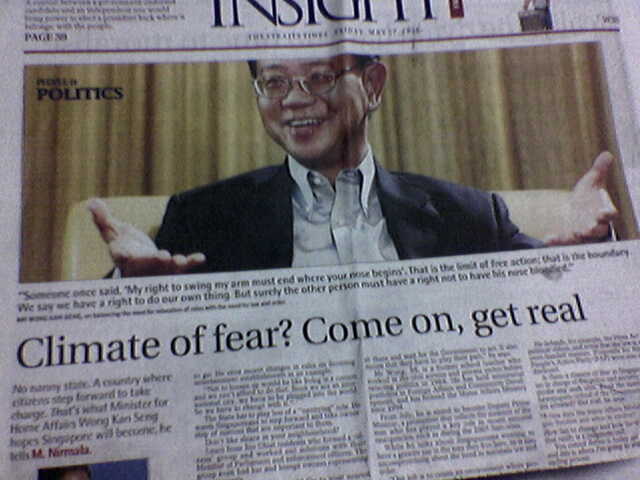
No climate of fear here, says Minister for Home Affairs


Straits Times, Insight, May 27, 2005 Posted by Hello

Bar-top dancing and loosening up, mosquito breeding and active citizenry, political videos and the rule of law - these were some of the topics covered by Home Affairs Minister Wong Kan Seng in this interview with the Straits Times published on May 27, 2005.

Climate of fear? Come on, get real

No nanny state. A country where citizens step forward to take charge. That's what Home Affairs Wong Kan Seng hopes Singapore will become, he tells M. Nirmala.

MR WONG Kan Seng often comes across as a tough-talking minister, which isn't surprising given his portfolio. The Minister for Home Affairs is responsible for law and enforcement to deal with crooks, drug addicts, terrorists and illegal immigrants.

During the interview in his office, however, he is expansive, even pensive, sharing his views on how the relationship between the State and the Citizen is developing.

Belying his reputation for being a "hardliner" in Cabinet, Mr Wong argues that some restrictions have to go. He cites recent changes in rules on licensing entertainment establishments as an example.

"Not to loosen up would be like living in a cocoon and we can't afford to do that. Since we are an international city, we have to be plugged into the world. So we have to change with it."

The State has to play less of a "nannying" role. He wants Singapore to step forward and take ownership of matters that are important to them.

Don't like sleaze in your neighbourhood?

Learn from the Joo Chiat residents who formed a citizens' group and worked out solutions with their Member of Parliament and enforcement officers. The group even had bar and lounge owners representing their interests.

Fearful of terrorist attack? Go to your nearest residents' committee and pick up the Emergency Handbook. It is packed with information on how to survive a tsunami disaster or a terrorist attack.

The days of the Government hand-holding citizens in all aspects of life are numbered, he reckons.

He cites the fight against dengue fever as an example.

In July, all residents of landed homes will receive a packet of insecticide in their mail as part of a dengue fever prevention kit. "If the people themselves don't stir to do something for themselves in keeping out mosquito breeding, then who will do it for them? The environment officer can't be there every day to check their flower pots and their vases. It is not possible.

"That's where you talk about an active citizenry. An active citizenry doesn't mean that the people just sit there and wait for the Government to act. It also means that they have to play their part," he says.

Mr Wong, 58, is a former school teacher who worked in the civil service and private sector before entering politics in 1984. He has held ministerial portfolios in Foreign Affairs and Community Development, and has helmed the Home Affairs Ministry since 1994.

From July, he is slated to become Deputy Prime Minister, a promotion that reflects the measure of the man who has played a key role in recent national emergencies, such as during the 2003 Sars crisis.

While he talks about Singaporeans wanting to have a greater say in the way they live here, he is also uncompromising about the need to maintain law and order.

"Our job is to create an environment where people will feel safe to work here, to live here, to bring up their children and have the freedom to walk the streets at any time without being afraid of getting mugged or getting drugs pushed in their face," he says.

Investors also welcome an orderly environment, he adds.

The challenge, he says, is how much freedom to allow while maintaining sufficient order and control.

"Someone once said,'My right to swing my arm must end where the nose begins'. That is the limit of free action; that is the boundary.

"We say we have a right to do our own thing. But surely the other person must have the right not to have his nose bloodied," he reasons.

He defends, for example, the Films Act which bans political videos, and notes that the law is applied in an even-handed manner. Proposals for films about the People's Action Party (PAP) were also shot down, he disclosed.

Is there a climate of fear in Singapore? The minister in charge of the police and security agencies pooh-poohs any such idea. Read the many articles in the newspaper critical of the Government. Are the writers arrested? Get real, he says.

How does the Home Affairs Ministry decide when to give freedom and when to control?

How fast to change and how far to go in opening, that really is a judgment call.

You cannot define it today and say this is the rule and this is where I'm going to stop. Change is an unending process.

We have to wait, watch, monitor and we have to relax. Then we have to moderate as we learn from each step that we make along the way. And that's how we've been managing.

What are some examples?

Bar-top dancing is the most cited example.

Another example is the way we license these entertainment joints and the bars. We now have class licensing.

That means if you operate a licence to provide for this kind of entertainment, we have a general set of conditions. If you follow them, then it's okay.

Then we need to come to you only when there's a violation of some of these conditions. We will tell you that you have breached them and we will give you a chance to improve.

It is similar to the traffic demerit scheme. We say there's a certain demerit point beyond which your licence will be restricted. So we give people more choices.

What about areas which are not so clear-cut?

You have to wait and see what are the situations because you cannot anticipate every situation.

No point working on hypothetical situations when we are not confronted with them.

But there will be new situations all the time that will test where the limits are. Then we look at it and say, "Yes, are we too restrictive or should we therefore now loosen up?"

Singaporeans on the one hand are being asked to be open and express their views and feelings. But on the other hand, the police have called up film-maker Martyn See over a documentary on opposition politician Chee Soon Juan. Is there a conflict or contradiction here?

No, there is no conflict.

A political video is not a good means of reaching out to the people and engaging them and explaining rational policies.

Political videos, by their very nature, will be political, will be biased and, therefore, will not be able to allow the listener or the viewer to see a whole range of arguments.

So that is why many years ago, a Bill was passed to amend the Films Act to disallow political videos. And this law doesn't just apply to opposition parties or to Martyn See. The law applies to the PAP, too.

Last year, when we had our 50th anniversary celebrations, there were many ideas about doing a video on the party's achievements.

But in the end, even though the idea was very good, we did not proceed with it.

And the Women's Wing also wanted to produce a video about its work in the last 10 years and we said "no".

So the law is even-handed and it is applied to everyone.

Where we have laws, we must enforce them. We must not make a mockery of the law.

Does the law apply to television stations that put out interviews and programmes on PAP ministers?

That is not a political video. That's a broadcaster and a content provider doing a job.

It is done in other places.

The minister is explaining himself, his policies and how he wants Singapore to move ahead.

Opposition parties and many Singaporeans believe that there is a climate of fear. This prevents people from wanting to speak up or stand for elections. What is your response?

You read the newspapers. People write long commentaries, punchy articles that are highly critical of government policies. Is there fear?

People appear in forums and dialogues and ask questions. Is there fear?

What is the consequence of saying something that is challenged? Is the consequence being locked up in jail, disappearing in the middle of the night and you don't come back?

Get real. Come on, we live in the real world in Singapore.

END

Minister warns freedom is dangerous

"We do ourselves a great disservice if we import unthinkingly and wholesale fashionable and hollow abstractions. Democracy, human rights and press freedom do not exist in a vacuum. By themselves, these concepts do not guarantee development and progress...So do not believe those few Singaporeans who tell you that with democracy, human rights and press freedom a hundred flowers will bloom and Singapore will prosper."

- Wong Kan Seng, 2001

Sunday, May 22, 2005

The Films Act - Are you frightened yet?

The Films Act of Singapore seems to be scripted by a group of brilliant horror story writers. Difference is, the horror is REAL. The spooks DO show up in your house.

Every night when I fall asleep, Section 34 of the Films Act hangs like the Sword of Damocles above me.

And do you own any "obscene" films at home? It may apply to you too.

Search and seizure of unlawful films

34. —(1) Any Deputy or Assistant Commissioner of Police, Assistant Superintendent of Police or any Censor, Deputy or Assistant Censor or Inspector of Films, if satisfied upon written information and after such further inquiry as he thinks necessary that any person has in his possession any obscene film or party political film, may without warrant, with such assistance and by such force as is necessary, by night or by day, enter and search any place where he has reason to believe the film is kept, seize the film and any equipment used in the exhibition, making or reproduction of the film and take into custody any person reasonably believed to be in possession thereof.
[10/98]

(2) Any film, and any equipment used in the exhibition, making or reproduction of the film, in respect of which any person has been convicted under section 29, 30, 31 or 33 shall be forfeited and shall be destroyed or otherwise disposed of in such manner as the Minister may direct.

_______________________________________________________________________________

Section 34 is not the only provision in the Films Act that empowers the police to raid your homes. If you are in possession of any uncensored, unlicensed or unauthorised films in your premises, the following will apply.

Penalty for possession, exhibition or distribution of uncensored films
21.
—(1) Any person who —

(a) has in his possession;

(b) exhibits or distributes; or

(c) reproduces,

any film without a valid certificate, approving the exhibition of the film, shall be guilty of an offence and shall be liable on conviction —

(i) in respect of an offence under paragraph (a), to a fine of not less than $100 for each such film that he had in his possession (but not to exceed in the aggregate $20,000); and

(ii) in respect of an offence under paragraph (b) or (c), to a fine of not less than $500 for each such film he had exhibited, distributed or reproduced, as the case may be (but not to exceed in the aggregate $40,000) or to imprisonment for a term not exceeding 6 months or to both.

(2) Any Censor and any Deputy or Assistant Censor and any Inspector of Films may at all reasonable times enter any place in which any film is kept or is being or is about to be exhibited and may examine the film, and if on such examination he has reasonable grounds for believing that an offence under this section has been or is about to be committed in respect of the film he may seize the film and any equipment used in the commission of the offence.

___________________________________________________________

All local filmmakers should be made aware of Section 12.


Films made in Singapore to be deposited in approved warehouse
12. —(1) The owner of any film made in Singapore shall, within 7 days after the making of the film, deposit the film in a warehouse approved for this purpose by the Board.
(2) Any person who fails to deposit the film in accordance with subsection (1) shall be guilty of an offence and shall be liable on conviction to a fine not exceeding $5,000.

___________________________________________________________________________

And what happens when you don't deposit your film in the warehouse?

Search for unauthorised films and arrest of persons
23.
—(1) Whenever a Deputy or an Assistant Commissioner of Police or an Assistant Superintendent of Police is satisfied upon written information and after any further inquiry which he may think necessary that any film —

(a) which has not been —

(i) deposited in an approved warehouse as required by section 12 or 13;

(ii) returned to the Board as required by section 14 (4); or

(iii) approved for exhibition under section 15 or 26 (4);

(b) in respect of which the certificate issued therefor has ceased to be valid under section 20; or

(c) which has been altered in any way after a certificate in respect of the film was issued,

has been or is being exhibited or kept in any place, he may issue a warrant directed to any police officer to enter and search that place and seize the film and to take into custody any person reasonably believed to be guilty of an offence by reason of failure to deposit or to return the film or by reason of such possession or exhibition. [10/98]

(2) A Deputy or an Assistant Commissioner of Police or an Assistant Superintendent of Police may without warrant, with such assistance and by such force as is necessary, by night or by day, himself do what he may authorise any police officer to do under subsection (1) in either of the following cases:

(a) if he has personal knowledge of such facts as satisfy him that there are sufficient grounds for a search;

(b) if he receives information orally in such circumstances that the object of a search would in his opinion be defeated by the delay necessary for reducing the information to writing except that the name and address of the person giving the information is known to or ascertained by him before he acts upon the information.

______________________________________________________________________


Politics or Porn? Which one is safer?

Do you know that the penalties for making party political films is heavier than that of pornograpghy?

Possession of obscene films
30. —(1) Any person who has in his possession any obscene film shall be guilty of an offence and shall be liable on conviction to a fine of not less than $500 for each such film he had in his possession (but not to exceed in the aggregate $20,000) or to imprisonment for a term not exceeding 6 months or to both.
[10/98]

(2) Any person who has in his possession any obscene film knowing or having reasonable cause to believe the film to be obscene shall be guilty of an offence and shall be liable on conviction —

(a) to a fine of not less than $10,000 but not more than $50,000 or to imprisonment for a term not exceeding 12 months or to both; and

Advertising obscene films
31. —(1) Any person who, for the purposes of distributing or exhibiting any obscene film to any other person, advertises the film by any means shall be guilty of an offence and shall be liable on conviction to a fine of not less than $2,000 but not more than $5,000 or to imprisonment for a term not exceeding 6 months or to both.
[10/98]

(2) Any person who, for the purposes of distributing or exhibiting any obscene film to any other person, advertises the film by any means knowing or having reasonable cause to believe the film to be obscene shall be guilty of an offence and shall be liable on conviction —

(a) to a fine of not less than $10,000 but not more than $50,000 or to imprisonment for a term not exceeding 12 months or to both; and


(a) to a fine of $1,000 for each such film in his possession (but not to exceed in the aggregate $40,000) or to imprisonment for a term not exceeding 12 months or to both;


Making, distribution and exhibition of party political films
33. Any person who —

(a) imports any party political film;

(b) makes or reproduces any party political film;

(c) distributes, or has in his possession for the purposes of distributing, to any other person any party political film; or

(d) exhibits, or has in his possession for the purposes of exhibiting, to any other person any party political film,

knowing or having reasonable cause to believe the film to be a party political film shall be guilty of an offence and shall be liable on conviction to a fine not exceeding $100,000 or to imprisonment for a term not exceeding 2 years.

_______________________________________________________________

But even in the heart of darkness, there's a glimmer of light. They provide exemptions.

Exemptions
40.
—(1) This Act shall not apply to —

(a) any film sponsored by the Government;

(b) any film, not being an obscene film or a party political film or any feature, commercial, documentary or overseas television serial film, which is made by an individual and is not intended for distribution or public exhibition; and

(c) any film reproduced from local television programmes and is not intended for distribution or public exhibition.
[10/98]

(2) The Minister may, subject to such conditions as he thinks fit, exempt any person or class of persons or any film or class of films from all or any of the provisions of this Act.

(3) An exemption granted under this section may be withdrawn at any time.

Tuesday, May 17, 2005

Interview over but investigation will go on

Last night (16 May 2005) between 2100 to 2220 hrs, the police interview took place on the 3rd level of the Cantonment Police Complex. The mood was relaxed and cordial. ASP Chan Peng Khuang asked some 50 questions, mostly pertaining to the making of Singapore Rebel such as

- Who conceptualised it? Who produced it? Who shot it? Who edited it? Who funded it? How much was spent? What was the objective of the film? Who else was involved in the production? What camera was used? Who shot the Istana arrest scene? How long did I take to make it?

There were also questions pertaining to the distribution of the film such as

- Who did you give copies to? Who put up the film on the internet? Are you still in possession of any copies?

Qustions pertaining to Chee Soon Juan and partisan politics were few such as

- Is Dr Chee a personal friend of yours? Where did you film the interviews? How did you appraoch Dr Chee to make the appointment? Are you a member of any political party in Singapore? Where did you film Mr JB Jeyaratnam?

Questions about this blog were also asked such as

- When did I start this blog? What is the purpose of this blog?

Other questions include

- What is your highest academic qualification? How much do you earn per month? Do you contribute to CPF? Do you own a computer? Do you have a production house?

More importantly, I was finally informed of the reason for this police investigation.

ASP Chan : "I'm informing you that the MDA (Media Development Authority) has on April 11 lodged a police report alleging that Singapore Rebel is a party political film. Do you have anyhing to say to that?"

At the end of the interview, I asked what is going to happen from here on. He replied that investigations will continue and that I may be asked to go for another interview. When asked if the police would raid my house to confiscate my tapes, he said investigations will go on.

Saturday, May 14, 2005


Scene from Singapore Rebel Posted by Hello

AMNESTY INTERNATIONAL USA FILM FESTIVAL 2005
West Hollywood,

Singapore Rebel
Director: Martyn See Tong Ming
Documentary. 2005. Singapore. 26 min. English.

The film has just been withdrawn from the Singapore International Film Festival because of government censorship. We are proud to host the World Premiere and to support freedom of expression for artists worldwide.

Often cited as the economic miracle of the Far East, Singapore looks every bit like the paragon of the rich Asian nation. Beneath its gleaming façade, however, lies a citizenry that has been governed by the same political party for 46 years.

No act inspires more fear and foreboding in Singaporean society than an open confrontation with its government. Yet, one citizen has taken it upon himself to do just that. Singapore Rebel chronicles the tribulations of opposition activist Dr. Chee Soon Juan from his initial overcoming of fear to his acts of civil disobedience.

NEW ZEALAND HUMAN RIGHTS FILM FESTIVAL 2005

Singapore Rebel
26 minutes, Singapore

This is the film Singapore’s censorship board doesn’t want people to see. It’s the story of opposition politician Chee Soon Juan, who has been imprisoned twice for championing democratic change in the tightlycontrolled city state. The censors declared it a “party political film” and it was pulled from last month’s Singapore International Film Festival line-up after the director was warned he could face two years in jail if the screening went ahead. Directed by Martyn See.

S'pore says politically motivated movies 'undesirable'

ASSOCIATED PRESS
May 14, 2005
SINGAPORE

THE Singapore government said Saturday, May 14, politically motivated films were "an undesirable medium" to debate issues, as a documentary filmmaker faces possible charges over a movie about an opposition politician.
Martyn See is under investigation for Singapore Rebel, a 26-minute movie about Chee Soon Juan, a frequent critic of the government. Police said See may have violated the Films Act for knowingly distributing or exhibiting a "party political film."

He could be fined up to S$100,000 (US$60,606; €46,200) or imprisoned as long as two years if he's tried and convicted.

"Party political films are disallowed because they are an undesirable medium for political debate in Singapore," the Ministry of Information's communications director K. Bhavani said in an open letter published in the local Straits Times newspaper Saturday.

"They can present political issues in a sensational manner, evoking emotional rather than rational reactions," Bhavani said. "There remains ample opportunity for political parties and their supporters to express their opinions."

Bhavani's letter was an apparent reaction to See's yet-unscreened movie, and a letter from a group of Singapore filmmakers who castigated the country's laws, which appear to ban any movie criticizing government policy.

See made his maiden film independently and said he wanted to "chronicle the civil disobedience acts of Chee Soon Juan."

Chee currently faces bankruptcy after he was ordered to pay S$500,000 (US$303,000) to Singapore's former prime ministers, Lee Kuan Yew and Goh Chok Tong, for defaming them during an election campaign in 2001.

Singapore Rebel was earlier yanked from the Singapore International Film Festival - one of the country's showcase events to promote itself as an arts hub.

But See said his movie will be screened at other venues later this month - the New Zealand Human Rights Film Festival and the Amnesty International Film Festival in Hollywood.

Singapore, a wealthy Southeast Asian city-state, is widely criticized for its tight controls on political activity and the media.

Thursday, May 12, 2005

Filmmakers seek clarification of film act

Published in the Straits Times forum, May 11 2005

We are a group of Singaporean filmmakers who would like to seek clarification from the authorities regarding the application of the Film Act, and in particular the 1998 amendment regarding "party political films."

It is our understanding that the 1998 amendment to the Film Act deems it an offence to make, distribute or exhibit "party political films."

Such films are defined as any film that "contains wholly or partly any matter which is intended or likely to affect voting in any election or national referendum in Singapore," or one that "contains wholly or partly either partisan or biased references to or comments on any political matter."

Under this Act, it appears that there is a ban on work in which we intend to
state or imply a stand on current government policy, regardless of what that stand is.

So far, we have observed that two locally made films featuring opposition politicians, namely ³Singapore Rebel² (2005) or ³Vision of Persistence² (2001) have been forced to withdraw from the Singapore International Film Festival or risk $100,000 fine or two years in prison for the filmmakers.

Were these films asked to be withdrawn because they were deemed to contain ³partisan or biased references² or because they contained comments ³on any political matter²?

We ask because as filmmakers, we feel that almost anything could be construed as a comment on a political matter. Further, how do we assess whether something is a political matter? Any subject, no matter how innocuous, could become a political matter depending on the circumstances, and we could easily find ourselves inadvertently contravening the Act.

Similarly, we require some guidance on what constitutes ³bias², after all, all works of art are the expression of the artist¹s opinion, which may favour a particular viewpoint or argument over another. Are filmmakers expected not to render any opinion at all to be considered neutral?

For instance, it is open to interpretation whether Jack Neo's film "I Not Stupid," which is a clear critique of the Singapore education system, or Tan Pin Pin's "Moving House," which appears to be a critique of the grave exhumation policy in Singapore, may be judged to have fallen afoul of the Act.

We feel that the current state of the legislation poses unintended dangers for sincere filmmakers, and would be grateful if the authorities could issue a formal explanation clarifying the application of this law.

It would be a waste to spend resources making a work only to find that it is
unlawful because it has inadvertently run afoul of the Film Act.

Filmmakers seek to clarify boundaries

Reuters
May 11, 2005
SINGAPORE

SINGAPORE came under pressure from filmmakers on Wednesday, May 11, to clarify laws on political films after police called in for questioning the director of a film on an opposition leader.
In a letter published in Singapore's Straits Times newspaper, filmmaker Tan Pin Pin, on behalf of 10 colleagues, sought clarification on the Films Act, which says it is an offence to produce, distribute or exhibit "party political films".

"We ask because, as filmmakers, we feel that almost anything could be construed as a comment on a political matter," Tan's letter said.

Under provisions introduced to the Films Act in 1998, anyone involved in producing or distributing "party political films" -- including those containing commentaries on government policies -- can be fined up to S$100,000 (US$60,860) or jailed up to two years.

"How do we assess whether something is a political matter?" Tan added.

"Any subject, no matter how innocuous, could become a political matter depending on the circumstances, and we could easily find ourselves contravening the Act inadvertently."

The letter was published after Martyn See, a 36-year-old Singapore filmmaker, was asked by police this week to come in for questioning on May 16 regarding his film Singapore Rebel on prominent opposition leader Chee Soon Juan.

See withdrew the documentary from the city-state's annual film festival in March under pressure from government censors, who told festival organisers the work violated the Films Act.

In 2002, a documentary about veteran opposition politician J.B. Jeyaretnam was pulled out from the film festival after its filmmakers were told it breached the act.

Opposition politicians have said the Films Act stifles political debate in the city-state, which has been ruled by the People's Action Party since independence in 1965. Its 84-member Parliament has only two opposition members.

International free-press advocates have repeatedly criticised Singapore for its tight media control.

The government bans non-commercial private ownership of satellite dishes. Films and TV shows are routinely censored for sex and violence.

The government says a high degree of control over public debate and the media is needed to maintain law and order.

The film at the heart of the controversy focuses on the life of Chee Soon Juan, who lost in January a three-year legal battle against defamation charges brought by Singapore's founding prime minister, Lee Kuan Yew, and his successor.

The US State Department, in its February annual report, sharply criticised Singapore for using libel suits to intimidate the opposition, saying the threat inhibits opposition politics and has led to a culture of self-censorship in the media.

Wednesday, May 11, 2005

Media watch groups respond to police investigation

SINGAPORE: Filmmaker under investigation for banned documentary

May 10, 2005 ­ The Committee to Protect Journalists is deeply concerned about the police investigation of independent documentary filmmaker Martyn See who is being questioned under Singapore's stringent Films Act.

On May 6, Assistant Superintendent of Police Chan Peng Khuang called See to inform him that police had received a copy of his film "Singapore Rebel" and had initiated an investigation, according to an account that See posted on his Web log yesterday. Chan did not elaborate on the reasons for the investigation, or any charges that might apply.

Police told international reporters that See is being investigated under the country's Films Act, which bans "party political" films. Making or distributing such a film—which can be defined as anything containing partisan references or commentary—is punishable by a fine of up to $100,000 or two years in jail."Singapore Rebel" chronicles the civil disobedience of opposition activist Dr. Chee Soon Juan.

See will report to the police on Monday, May 16, he told reporters.

In an effort to avoid an investigation, See withdrew his film from the Singapore International Film Festival after the Board of Film Censors told festival director Philip Cheah on March 11 that the film was objectionable under the Films Act. Cheah was "advised" to inform See to withdraw his film "whereby the matter would be dropped, failing which, the full extent of the law would apply," wrote festival director Lesley Ho in an email to See. The film has not yet had a public screening anywhere in the world.

"Singapore authorities' harassment of Martyn See and censorship of a film that merely documents political opposition is unacceptable," said CPJ Executive Director Ann Cooper. "We urge the government to call off this investigation and allow See to continue his work."

Singapore continues to hound film-maker

11 May 2005
Source: Southeast Asian Press Alliance (SEAPA)

Singaporean filmmaker Martyn See has been invited for questioning by the police, news agencies have reported, two months after his documentary on a Singaporean oppositionist was forced out of a film-festival in the city-state.


See, 36, told Reuters that he is expected to present himself before the country’s police on 16 May. The filmmaker said he expects to be questioned about “Singapore Rebel”, his film on Chee Soon Juan, leader of the Singapore Democratic Party.

The Agence France Presse said See was being probed under the Films Act pertaining to "party political" films. If convicted of violating the Films Act, See could be jailed for two years or fined up to 100,000 Singapore dollars (61,340 US dollars).
See had pulled his documentary from the Singapore's International Film Festival in March after government censors advised him that the film was flaunting laws against political films.

Despite its economic strength and high standard of living, Singapore remains a highly restricted country in terms of political and speech rights. The city-state’s rulers are notorious for intimidating both local and foreign media with financially crippling libel and defamation suits.

Most recently, even Singaporean bloggers have been spooked by threats of defamation stemming from comments made about A*STAR, a government-related research agency. A Singapore student shut down his blog and apologised “unreservedly” after officials of A*STAR threatened to file a defamation suit.

The subject of See’s documentary, Chee himself is facing bankruptcy proceedings in Singapore after being sued for defamation by Singapore's two former premiers, Lee Kuan Yew and Goh Chok Tong, in line with speeches he made while campaigning for a parliamentary post in 2001. A Singaporean court ordered him to pay the former prime ministers 500,000 Singapore dollars (approximately 304,000 US dollars).

Filmmaker called in for questioning, under investigation

Country/Topic: Singapore
Date: 11 May 2005
Source: Southeast Asian Press Alliance (SEAPA)
Person(s): Martyn See
Target(s): other
Type(s) of violation(s): harassed , legal action
Urgency: Threat
(SEAPA/IFEX) - Singaporean filmmaker Martyn See has been invited for questioning by the police, news agencies have reported, two months after his documentary on a Singaporean opposition figure was forced out of a film festival in the city-state.


See, 36, told Reuters that he is expected to present himself before the country's police on 16 May 2005. The filmmaker said he expects to be questioned about "Singapore Rebel", his film on Chee Soon Juan, leader of the Singapore Democratic Party.

The Agence France-Presse news agency said See was being probed under the Films Act pertaining to "party political" films. If convicted of violating the Films Act, See could be jailed for two years or fined up to 100,000 Singapore dollars (approx. US$60,800).

See had pulled his documentary from Singapore's International Film Festival in March after government censors advised him that the film was flaunting laws against political films.

BACKGROUND:
Despite its economic strength and high standard of living, Singapore remains a highly restricted country in terms of political and speech rights. The city-state's rulers are notorious for intimidating both local and foreign media with financially crippling libel and defamation suits.

Most recently, even Singaporean bloggers have been scared by threats of defamation stemming from comments made about A*STAR, a government-related research agency. A Singapore student shut down his blog and apologised "unreservedly" after officials of A*STAR threatened to file a defamation suit (see IFEX alerts of 6 and 2 May 2005).

The subject of See's documentary, Chee himself is facing bankruptcy proceedings in Singapore after being sued for defamation by Singapore's two former premiers, Lee Kuan Yew and Goh Chok Tong, in line with speeches he made while campaigning for a parliamentary post in 2001. A Singaporean court ordered him to pay the former prime ministers 500,000 Singapore dollars (approx. US$304,000).

Tuesday, May 10, 2005

Newswires on police probe

Singapore film maker faces police investigation

SINGAPORE, May 10 (Reuters) - A Singapore film maker, who made a documentary about an opposition politician that was withdrawn from the city state's film festival this year, said on Tuesday he had been asked to come for questioning by police.
Martyn See, 36, told Reuters the police asked him to present himself for an interview on May 16 to discuss his film about Chee Soon Juan, leader of the Singapore Democratic Party, one of several small political parties in the city-state.

"I'm worried. I've not even told my mum. How do I tell my mum that I'm under investigation for making a short video that has no sex, no violence, no foul language," See said.

Police spokeswoman Siow Cheng Cheng told Reuters police were investigating the case under the Films Act but declined to elaborate and did not confirm that See had been asked to come in.

The Films Act bars the making and distribution of "party political films", which is punishable with fines and imprisonment.

See withdrew his 26-minute film "Singapore Rebel" from the Singapore International Film Festival in March after the Singapore Board of Film Censors told festival organisers that the film was objectionable under the law.

"I assumed the matter was dropped, so this came as a great surprise to me that they should call me now for the investigation," See said.

Opposition politician Chee told Reuters that the police move to question See was not surprising and that the government's recent calls for more openness were just rhetoric.

"I think it's a cruel joke that the government on the one hand wants people to speak up, and the minute people begin to do things that are not to their liking, they start intimidating, they start harassing, they start threatening," he said.

Prime Minister Lee Hsien Loong has loosened some rules on free speech since taking power last year, but few are willing to test so-called "out of bounds" markers on what cannot be publicly discussed -- especially when it comes to politics.

In January, Chee lost a three-year legal battle against defamation charges brought by the city-state's founding prime minister, Lee Kuan Yew, and his successor Goh Chok Tong.

Last year, Singapore film maker Royston Tan's movie "Cut", a 13-minute satire on state censorship, stirred a storm of criticism in parliament.

Promoters and major cinemas shunned the film, which is about a cinema buff who bursts into a rant about film cuts during a chance encounter with a censorship board official.

Tan's first full-length feature, "15", revolving around drugs and delinquency, won international plaudits in 2003 but was heavily censored at home. A state TV company abruptly shelved plans for a documentary on Tan after he released "Cut".

The government says a high degree of control over public debate and the media is needed to maintain law and order.


Singapore police probe film-maker over political documentary
Tue May 10, 2:56 AM ET

SINGAPORE (AFP) - A Singaporean film-maker is under investigation for making a documentary about an opposition politician, police said, two months after the movie was banned locally for its political content.

police spokeswoman told AFP Martyn See's short film, Singapore Rebel, about vocal opposition politician Chee Soon Juan, was being probed under the Films Act pertaining to "party political" films.

If convicted of violating the Films Act, See could be jailed for two years or fined up to 100,000 Singapore dollars (61,340 US dollars).

See withdrew the film from Singapore's International Film Festival in March under pressure from the government's censors, who informed him that it was in breach of the act.

The film has since been lauded internationally and is due to be screened at two human rights film festivals this month, one held by Amnesty in the United States and another in New Zealand.

See told AFP on Tuesday police had asked him to present himself for questioning, and he was due to meet investigators on Monday next week.

See said police told him they were investigating him over the film's political content, but no more.

"Basically all they said was that the film was politically related, and because I was the maker, therefore I had to be questioned," he said.

See said he had no political agenda in making the film, and insisted he chose to focus on Chee "only in order to understand why political opposition in Singapore is marginalised".

Chee, 42, is facing bankruptcy after the High Court ordered him to pay 500,000 Singapore dollars for defaming Singapore's two former premiers, Lee Kuan Yew and Goh Chok Tong.

International human rights groups regularly criticise the People's Action Party, which has ruled Singapore since independence in 1965 and holds all but two elected seats in parliament, for its intolerance to dissent.

They accuse the government of placing strict controls on the media and using defamation laws to curb any criticism.

On its website, the Amnesty International Film Festival in West Hollywood says Singapore Rebel "has just been withdrawn from the Singapore International Film Festival because of government censorship".

"We are proud to host the World Premiere and to support freedom of expression for artists worldwide," the site says.

Monday, May 09, 2005

Interview with police postponed (but they want to move it along "fast")

9th May 2005, 1745hrs - ASP Chan called me after we spoke some two hours earlier (read below) to say that he really needed to conduct the interview as soon as possible. Why the hurry? And how does it benefit me to speed things up in such a manner? He didn't say but only asked (politely, as usual) for an earlier date which I then fixed for Monday, 16th May at 2100hrs at the Central Police Station.

ASP Chan thanked me again for the rescheduling.

Earlier ...

9th May 2005, 1420hrs - I decided to call ASP Chan Peng Khuang (should be 'Khuang', not 'Kuang') to postpone the interview which were orginally scheduled for tomorrow at 7pm.

I reached him on his moblie (yes, he gave me his mobile number in previous call). Here is an excerpt of the exchange.

See : ASP Chan please?

Chan : Speaking.

See : Ya this is See Tong Ming,. the guy..

Chan : Ya ya, Mr See.

See : Are you back from holiday already?

Chan : I'm back in Singapore already.

See : I'm very sorry because of heavy work commitment, I don't think I can make it tomorrow so we have to reschedule the meeting.

Chan : When is your convenient date?

See : Not in the next two weeks because I'll be busy. Would it be possible at the end of the month? Somewhere on the 27th ...

Chan : You working as what ah?

See : Freelance video.

Chan : Oh, freelance videoing.

See : Ya, so I have an added project today. Would it be possible end of the month?

Chan : End of the month is too late.

See : Too late?

Chan : Too late because I want to finish this thing fast you see.

See : Oh, you want to finish this thing fast?

Chan : Ya, it'd be better if we actually can finish it fast.

See : Ohh ... right now I'm not even sure, like, what or who you are investigating?

Chan : About the film. Because you are the maker of the film.

See : Ya.

(I deleted a section of the conversation here as I think that it might affect the investigation if it is made public. Sorry, I'm just being kiasi.)

See : OK, and will it take very long?

Chan : Maybe two hours.

See : Am I allowed to bring any audio recording equipment?

Chan : Eh no.

See : Not allowed ah?

Chan : No, not allowed.

See : But I can write down your questions right?

Chan : You can take notes, no problem.

See : Check with me again next Wednesday or Thursday.

Chan : Thanks for calling.

See : Ok bye.

Chan : Bye

(End)

Saturday, May 07, 2005


Scene from Singapore Rebel

Film on CSJ now under police probe

12pm, 6 May 2005 - I received a call on my mobile from Assistant Superintendent Chan Peng Kuang from the Central Police Station informing me that the police had obtained a copy of 'Singapore Rebel' and is in the process of "investigation" although he did not disclose on what charge.

In a civil and almost apologetic tone, he asked if we could meet on Tuesday 10 of May. I replied that I was working that day and asked to meet tomorrow morning (7 may 2005) instead. He then replied that he would be overseas and would make time for the "interview" at my convenience. So the date is fixed for the "interview" on Tuesday at 7pm at the Central Police Station on Cantonment Road.

He asked too if the Singapore International Film Festival has acknowledgement slips to verify my submission of 'Singapore Rebel' for the short film competition. And then added another query as to whether other person(s) were involved in the production process. After I replied that both answers were negative, he expressed relief at the answer to his second question, to which I can only venture that his relief stems from the thought that he doesn't need to interview anyone else but me.

'Singapore Rebel' is a chroncle of opposition figure Dr Chee Soon Juan. I had withdrawn the film from the SIFF on March 11 after a phone call from its director Lesley Ho. At no point did I hear from the Board of Film Censors or from any department of the Government. This is my first direct contact with the authorities since the withdrawal.

Email me at singapore_rebel@yahoo.com (Need all the advice I can get)

Martyn See

Thursday, May 05, 2005

Speak up ... But get your lawyers ready


"Speak up even if it jars, Vivian tells youths"


- Straits Times quoting Minister Vivian Balakrishnan, Jan 5 2005

"'Well, you have the Internet - put up a website. You know how to put up a website? If you don't, I know a friend who can help you."
- MM Lee Kuan Yew in reply to a charge by student Jamie Han that channels to offer different views 'were either directly or indirectly controlled by the Government', Straits Times, Feb 1 2005


A*Star confirms warning to student over defamatory blog
By Wong Siew Ying, Channel NewsAsia

SINGAPORE : A*Star (Agency for Science, Technology and Research) confirmed it had warned a Singapore student of legal consequences over a public blog containing defamatory statements.

On Wednesday, Channel NewsAsia broke a story about how the Singapore student, who is pursuing his Masters degree in the United States, shut down his blog after he was threatened with legal action by A*Star.

Chen Jiahao was a former Public Service Commission scholar.

A*Star, in its response to Channel NewsAsia, said it found the public blog contained defamatory statements.

It also said it had the responsibility to protect its reputation and also that of Singapore.

So it warned the blogger of legal consequences unless the objectionable statements were removed and an acceptable apology published.

A*Star also said it welcomed a diversity of views in all media, but the statements made in the blog "went way beyond fair comment". - CNA


Student forced to shut down blog after libel threat

Singapore 28 April 2005

Reporters Without Borders today expressed support for a student from Singapore forced to shut down his blog on 26 April for fear of a libel action by the head of a government body and warned that "such intimidation could make the country's blogs as timid and obedient as the traditional media."

"Threatening a libel suit is an effective way to silence criticism and this case highlights the lack of free expression in Singapore, which is among the 20 lowest-scoring countries in our worldwide press freedom index," it said. "We especially support bloggers because they often exercise a freedom not seen in the rest of a country's media.

The threat of prosecution came from Philip Yeo, chairman of the government's Agency for Science, Technology and Research (A*STAR), which grants research scholarships, who claimed it was libelled in a blog by Jiahao Chen, a Singapore citizen currently studying in the United States. Writing under the pseudonym of Acid Flask, he criticised several government policies, including the A*STAR scholarship system and Yeo's justifications of them. He also agreed to his remarks being reproduced in the Electric New Paper. Yeo sent him several e-mails demanding that he delete all blogs mentioning him or A*STAR and threatening legal action if he did not.

A few days later, Acid Flask shut down the blog and posted a message of apology to Yeo in its place. Other Singapore blogs that had reproduced the remarks quickly afterwards posted apologies or themselves closed down.

Sunday, April 17, 2005

A legal analysis of 'Party Political Films'

Singapore Legal Mumbo Jumbo Demystified
Providing a legal perspective to bloggers' commentary on the social, economic & political issues of Singapore.


Party Political Films
Over at Singabloodypore, Steven McDermott wrote about the Singapore Rebel, a movie about Chee Soon Juan, a well-known opposition figure in Singapore.

Martyn See, the maker of Singapore Rebel, has withdrawn the movie from Singapore's annual film festival, after the government warned him its political content could land him in jail. This is because the censorship board apparently viewed the film as a "party political film".

I hereby demystify the legal mumbo jumbo:-

In 1998, the Films Act was amended to introduce the concept of "party political films". (Prior to that, the only other category of films that the Films Act specifically referred to by subject-matter was "obscene films". But that's another story). Essentially, no one is allowed to import, make, reproduce or exhibit any party political film. That means any film:

1. which is an advertisement made by or for any political party in Singapore, or any organisation whose focus is mainly on Singapore's politics; or

2. which is made by any person and which is directed towards any political end in Singapore.


In turn, the phrase "directed towards any political end in Singapore" is further defined as follows:

For the purposes of this Act, a film is directed towards a political end in Singapore if the film —

(a) contains wholly or partly any matter which is intended or likely to affect voting in any election or national referendum in Singapore; or

(b) contains wholly or partly either partisan or biased references to or comments on any political matter, including but not limited to any of the following:

(i) an election or a national referendum in Singapore;

(ii) a candidate or group of candidates in an election;

(iii) an issue submitted or otherwise before electors in an election or a national referendum in Singapore;

(iv) the Government or a previous Government or the opposition to the Government or previous Government;

(v) a Member of Parliament;

(vi) a current policy of the Government or an issue of public controversy in Singapore; or

(vii) a political party in Singapore or any body whose objects relate wholly or mainly to politics in Singapore, or any branch of such party or body.


Note the magic words "including but not limited to". This means that you don't necessarily have to fall into the examples listed from (i) to (vii) to run foul of the law. As long as you make a film that comments on any political matter (even if not mentioned in the (i)-to(vii) list) , you have made a party political film and you have committed a crime.

Note also the legal definition of film under the Films Act. "Film" isn't limited to the kind of show you typically associate with a film festival or a trip to a Golden Village cinema. Under the Films Act, "film" means:

(a) any cinematograph film;

(b) any video recording, including a video recording that is designed for use wholly or principally as a game;

(c) any other material record or thing on which is recorded or stored for immediate or future retrieval any information that, by the use of any computer or electronic device, is capable of being reproduced or displayed as wholly or partly visual moving pictures,

and includes any part of a film, and any copy or part of a copy of the whole or any part of a film


Conceivably, any itsy-bitsy piece of video recording, for example, even 7 seconds of comedic footage showing Balakrishnan hanging out in a gay bar, could be a party political film. And it would be a criminal offence to make such a video.

Waitaminit - I hear you say. Then how can TCS ever even feature PAP politicians on the 9 o'clock news without technically committing an offence?

Ah. The clever folks in Parliament already thought of that. So they snuck in this clever little provision:

For the avoidance of doubt, any film which is made solely for the purpose of ... reporting of current events is not a party political film.

Well then - I hear you say. Apart from the news, the PAP won't be allowed to use film media to spread any of its own messages. Ha!"

Oh please. They aren't always that bright, but they aren't that dumb. Those little problems are all taken care of. (It's really quite easy to make laws exactly the way you want them to be, if you hold 79 out of 81 seats in Parliament). Section 40 of the Films Act says:

"This Act shall not apply to any film sponsored by the Government."

That is, any film sponsored by the Singapore government is perfectly fine, even if it contains obscene material or explicit political content. And as if that wasn't enough, they also put this in the Act:

"The Minister may, subject to such conditions as he thinks fit, exempt any person or class of persons or any film or class of films from all or any of the provisions of this Act."

So any film can be exempted if the Minister likes the film. In other words, even if a film is bursting with political messages, the Minister can still allow the film to be imported, sold, distributed and exhibited - no problems whatsoever - as long as the Minister likes those political messages.

On the other hand, what do you think are the chances of any PAP Minister liking Martyn See's film? Heh.

posted by Gilbert Koh at 4/13/2005 02:02:00 PM

Wednesday, April 13, 2005

Confusing – this gag on critical films

This report was published in TODAY on 13th April 2005.

Clear rules needed if local film industry is to thrive
Siew Kum Hong

The 18th Singapore International Film Festival (SIFF) opens tomorrow, promising yet another line-up of cutting-edge films. It comes soon after the recent Singapore Film Week, where a number of made-in-Singapore films were screened in London.
.
It might, therefore, appear that the film scene in Singapore is alive and well. But then again, maybe not, bearing in mind that a local film-maker had to withdraw his short film from the SIFF after the Media Development Authority (MDA) classified it as a "party political film".
.
It is an offence under the Films Act to make, distribute or exhibit party political films. Such films include, among others, work that "contains wholly or partly either partisan or biased references to or comments on any political matter, including ?a current policy of the Government or an issue of public controversy in Singapore".
.
What is noteworthy is that this is a blanket ban, unlike the normal regime for film censorship, where there is a tiered rating system with the possibility of cuts for objectionable content.
.
When these provisions were introduced in 1998, opposition and nominated MPs had criticised them as being so broad as to cover all films commenting on local political issues.
.
Even PAP MP Dr Yaacob Ibrahim felt the provisions could have been "clearer and more precise". NMP Zulkifli Baharudin described them as "sweeping and vague". NMP Claire Chiang pointed out the danger of "giving unnecessarily broad powers to bureaucrats who will want to err on the side of caution and end up banning any social commentary here".
.
It seems that Ms Chiang may have been proven right.
.
Last month, Mr Martyn See's short, Singapore Rebel, was classified by the MDA as a party political film, and they advised the SIFF organisers to ask Mr See to withdraw it, failing which "the full extent of the law would apply".
.
Mr See duly withdrew his film on opposition politician Chee Soon Juan.
.
This is not the first time it has happened. In 2002, four lecturers from Ngee Ann Polytechnic submitted a documentary titled A Vision of Persistence about opposition politician J B Jeyaretnam, to the SIFF. They withdrew it when told it was a party political film.
.
The stated rationale for these provisions in the Films Act was to prevent American-style political commercials taking root here, which would distort issues and hamper serious debate.
.
Fair enough. Yet, the actual words used in the statute seem to go beyond that, to the extent that any film that makes a stand on a local political or social issue, regardless of its treatment, would fall foul. But which film-maker worth his salt would make a film about an issue and not set out his stand?
.
The MDA is only doing its job in enforcing the law as it stands, but it should explain the basis for its classifications. For instance, it should explain why Jack Neo's much feted I Not Stupid, which was one long critique of Singapore's streaming policy, was felt not to contain biased references to or comments on a current policy of the Government, and hence was not classified as a party political film.
.
Another example would be Mr Royston Tan's Cut. This satire on the MDA's censorship policies was described as an "unbecoming attempt to undermine the standing of a public institution". But it was not classified as a party political film. Instead, it went through the normal film licensing processes, was rated PG and passed without cuts, and allowed to open last year's SIFF.
.
The MDA's present practice of referring to a film as a party political film leaves a lot to be desired.
.
More importantly, the wording of the Films Act itself, if not its rationale, needs to be reconsidered.
.
The Government is, on the one hand, pushing hard to develop a media and film industry in Singapore, and also encouraging youths to speak up and be socially and politically engaged.
.
On the other hand, the law circumscribes the ability of youths to use a medium that appeals to them, to express their thoughts. This inconsistency is hard to reconcile.
.
At the end of the day, we all want a thriving local film industry. We want people to be active and engaged, to speak up and be heard. We want clear rules that are equally enforced and seen as being equally enforced.
.
So, let's all work towards those common goals.
.
The writer is a lawyer commenting in his personal capacity. Do you have a view on this? Email us at
.
news@newstoday.com.sg

Sunday, April 10, 2005

Which other country legislate a ban on political films?

Pop Quiz : What are the top three search results on google when you type 'ban political film'?

Answer : Articles on Singapore's ban on political films. The other top search results on 'ban political film' reveal a pretty even contest between Singapore's ban on political films and the controversy surrounding Michael Moore's Fahrenheit 9-11 (which enjoyed a successful commercial run in Singapore cinemas last year).

Another illuminating result is the review of Iranian director Mohsen Makhmalbaf's The Silence and The Door which were screened at the SIFF in 2000. It contains an account of how Iran bans political films...

The Silence and The Door, two films by Mohsen Makhmalbaf by Richard Phillips, 27 April 2000

To fully appreciate Iranian films it is necessary to have some understanding of the difficult conditions in which they have been produced. In Iran virtually every aspect of film production and distribution is under government control and has been for most of the industry's history. The first decrees outlawing political films were issued in 1950 and under Shah Mohammed Reza Pahlavi, who came to power in a CIA-organised military coup in 1953, films critical of the regime or those with explicit references to poverty and the disadvantaged were censored or banned outright.

Following the overthrow of the Shah in 1979, Ayatollah Ruhollah Khomeini's Islamic regime tightened censorship and imposed strict religious control over film content. Islamic fanatics torched many cinemas, 2,000 films were cut or banned outright and some filmmakers were indicted on charges of “corrupting the public”.

Under current law, films cannot directly criticise the government or make political exposures of social conditions. Men and women cannot touch each other in movies unless married or related and women must observe Islamic dress codes...

What is a 'party political film?'

Saturday, April 09, 2005

'UP CLOSE' on CNA not 'Party Political Films'

UP CLOSE with ChannelNewsAsia

UP CLOSE takes a behind-the-scenes look at five Cabinet Ministers at work and spends time with them at their regular haunts.

The first 4 episodes let viewers get up close with these Ministers and get to know them better. The series also finds out what these Ministers do to experience up close the lives of the Singaporeans in order to get a taste of the real issues of concern, and see for themselves what truly matters to these people.

The concluding episode of UP CLOSE on Thursday 5 May, 8pm - Up Close with the Prime Minister - features Prime Minister Lee Hsien Loong in a special forum where he engages in a frank discussion with a group of Singaporeans on the Singapore that they want.

More about each episode >>

Episode 1 - What's up?
Dr Vivian Balakrishnan
TX: 7 April 2005, Thursday 8pm (Sin/HK time)
This episode looks at the stewardship by Minister Vivian Balakrishnan of a generation growing up in a country ready-made for the good life.

"What's Up?" paints portraits of a new leadership seeking the pulse of a new citizenry. The Minister's mission is told through the themes in his vision to give youth space, assure the disadvantaged of a place and empower the marginalised to run the race.

Episode 2 - Open Up
Mr Tharman Shanmugaratnam
TX: 14 April 2005, Thursday 8pm (Sin/HK time)
Open Up gives the Minister the platform to demonstrate how he will go about making sure Singapore's new education ideals are achieved, how he addresses the concerns of parents, teachers and students alike on the ground, and in the process, give a sense of the beliefs and personality of the man leading the charge for the Republic's education "revolution".

Episode 3 - Step Up
Dr Ng Eng Hen and Mr Lim Swee Say
TX: 21 April 2005, Thursday 8pm (Sin/HK time)
There is no such thing as an iron rice bowl, so Singaporeans are often told. A lesson all Singaporeans have had to learn to live with, now more so than ever, in this new phase of economic development.

Step Up is a documentary about the changing of mindsets. Workers have to continually upgrade their skills. And, jobs have to be found for workers whose skills are now outdated. This episode traces how government, unions and employers think "out-of the box", re-designing existing jobs so that Singaporeans are proud to enter into them.


Episode 4 - Shape Up
Mr Khaw Boon Wan
TX: 28 April 2005, Thursday 8pm (Sin/HK time)
Singapore's healthcare system is a topic close to every Singaporean's heart. With an ageing population, greater demand for the latest medical technologies and drugs, Singaporeans will have to spend more on healthcare.

Since Minister Khaw Boon Wan took over as chief at the Ministry of Health in August 2003, he has listed as one of his major priorities, the raising of the standard of healthcare while keeping costs affordable.

"Shape Up" will guide the viewer through the new healthcare directives, and provide some insights into the thought processes as well as what motivates and inspires the man with the task at hand.

Episode 5 - "Up close with the Prime Minister"
TX: 5 May 2005, Thursday 8pm (Sin/HK)
In this special forum, Prime Minister Lee Hsien Loong engages a group of Singaporeans in a discussion on the Singapore that they want.

Opportunities mean different things to different people. In Singapore, where can the hopes come from? What do people think about themselves and Singapore? What do they hope for the future of Singapore?

What is a 'party political film?'

"In the wrong hands film can have a powerful impact" - George Yeo

Singapore's censorhips laws of 1998

International Press Institute report on Singapore 1998

In the first months of 1998, the government took further steps to help the censors in their hard work with media technology, including widening its definition of "publication" and streamlining its various censorship bodies. Singapore’s government never hid its view that media censorship is necessary to protect moral values and maintain internal security, and so also announced that it didn’t want to exempt the media of the IT age. In order to execute this, they announced in February that they were pulling various media censorship and licensing bodies into one unit to make life easier for importers and others, partly "in response to the advances in technology".

It also expanded provisions of its act regulating "obscene" films to include new technologies like compact discs, digital video discs, electronic mail; and made similar changes in its publication act, expanding the definition of "publication" to include CD-ROMs, sound recording, pictures and drawings generated by computer graphics. Finally, a law was implemented banning political parties from making films and videos.

Several members of parliament criticised the move to ban parties from making videos or buying television time. Media regulations are generally widely accepted in Singapore in the belief that they are rooted in the nation’s history of racial and religious divisions. Singapore was formed by competing ethnic groups, playing against each other, and riots ensued. There is, therefore, a deep feeling of justification for regulation to restrict the press to avoid violence.

But the ban on political parties making videos was seen as a political manoeuvre by the leadership in power to weaken the opposition. Information and Art Minister George Yeo, however, dismissed objections, arguing that their "intention is to keep political debates in Singapore serious and not have them become like the selling of soap. In the wrong hands film can have a powerful impact," as he told parliament. Asked about the new regulations expanding censorship to new technologies, Yeo said: "It is not our objective to increase the level of censorship in Singapore. Just maintaining the existing level of censorship is difficult enough."

Parliament bans political party films by Washington Post. Feb 27, 1998.

Bill too sweeping and vague, say MPs by Straits Times Feb 28, 1998

A ban on political film and video sparks debate By AsiaWeek / Singapore

Minister Yeo on OB markers and Internet

"When the law on political videos was enacted, we could not confine it to political parties, because then the obvious way to get around it was to get a friendly non-party organisation to produce the video.

Therefore, we had to extend the law to include those whose purposes are obviously political even though they are not political parties. At the same time, it was obviously not in our interest to disallow all videos which covered political topics.

This then created an ambiguity in the position which is left to the Films Appeal Committee to settle. There was much debate in Parliament about whether this ambiguity could not be better defined. Well, we should if we could."

- Former Information and the Arts Minister George Yeo


What is a 'party political film?'

Sunday, April 03, 2005

We have freedom of speech, says Singapore's top filmmaker

Published in the Straits Times, Saturday April 2, 2005

I Not Stupid opens film week in London

Film-maker Jack Neo quizzed on Singapore censorship after screening

by NEO HUI MIN
Straits Times
Europe Bureau in London

First, celebrity chef Jamie Oliver attracted attention with his television expose of the state of British school meals. Now, it is Singaporean film-maker Jack Neo - who shook up Singaporeans' attitude to the education system with his movie I Not Stupid - who is catching the eye here, among those interested.

His award-winning film opened the Singapore Season Film Week at the Barbican Cinema here yesterday. It is the first time it is being shown in England.

The film-maker faced a host of questions after the screening. Britons asked how he managed to get his film past the censors, given that there were criticisms of the Government, if he practised self-censorship and how the movie was received.

Neo pointed out that of the seven movies he had made, only one had received one or two cuts.

"People said I'm lucky, but I think it's the right timing. These issues (raised in the film) are being discussed everyday in the newspapers. So they are not new," he said.

Throwing a glance to Senior Minister of State for Information, Communications and the Arts Balaji Sadasivan, Neo noted that he "did not get any bad comments from the Government" about the movie. Most people found it funny, he added.

"And why did they find it funny? It's because it' true," he said to laughter from the audience, including Dr Balaji.

"People say Singapore has no freedom of speech, and in my films, I have said a lot of things, but I'm still here," he said.

The problem with Singaporeans is: "Sometimes the Government doesn't say don't do this and that. But we play safe. Now the Government is trying very hard to tell the people to please say something."

The Government's attitude had changed, he said, and Singaporeans are now encouraged to speak out for themselves.

A member of the audience then asked: "Is caning still practised as shown in the movie?" Neo replied that some schools still have public caning.

He added: "Our country also has the cane and it's very effective. Some gangsters told me that they don't mind going to jail but they are scared of being caned." That quip met with laughter.

Neo says he knows this as he is spending time with inmates as research for his next film, which will feature life in prison.

He said he hoped for commercial release of I Not Stupid in Britain. It is "doing well" in Singapore and Hong Kong, he said, and a TV series of the movie had been sold to satellite television.

The Singapore Film Week at the Barbican is part of the Singapore Season festival, the first concerted effort by government agencies to promote Singapore arts and culture overseas. It also marks the first time that Singapore films are being screened overseas on such a scale - although previously, individual movies have been brought to foreign screens on a smaller scale.

During the Singapore Uncovered programme in London last year, for instance, two of Royston Tan's short films, 15 and Cut, and Eric Khoo's full-length feature 12 Storeys were screened.

12 Storeys is one of the eight movies that will be shown during this film week. The others include Khoo's Mee Pok Man, Forever Fever by Glen Goei, Chicken Rice War by CheeK, Eating Air by Kelvin Tong and Jasmine Ng, Rice Rhapsody by Kenneth Bi, as well as Homerun, also by Neo.

Dr Balaji launched the Singapore Chinese Orchestra debut performance last night. He will travel to Newcastle for the orchestra's performace at the Sage Gateshead.

Sunday, March 27, 2005

Threat-Alert-Singapore : SEAPA/IFEX

Threat-Alert-Singapore
22 March 2005

Director withdraws documentary from festival on government "advice"

Country/Topic: Singapore
Date: 23 March 2005
Source: Southeast Asian Press Alliance (SEAPA)
Person(s): Martyn See
Target(s):
Type(s) of violation(s):
Urgency: Threat
(SEAPA/IFEX) - Threats of imprisonment and crippling fines have prompted a Singaporean filmmaker to pull his movie from Singapore's annual film festival.


News reports on 22 March 2005 said director Martyn See's documentary about Singaporean opposition leader Chee Soon Juan was deemed too political by the city-state's Board of Film Censors. The board informed the filmmaker that he would face jail time, as well as a fine of up to S$100,000 (approx. US$61,300), should he screen his 26-minute film in public.

The Associated Press, quoting the "Straits Times", said See's short film centered on the "civil disobedience" and travails of Chee, a government critic who in 2001 was himself ordered to pay S$500,000 (approx. US$304,000) to Singapore's founder Lee Kuan Yew, and former leader Goh Chok Tong.

Chee's case stemmed from a defamation action based on speeches he made when he campaigned for a parliamentary post in 2001. Chee, secretary-general of the Singapore Democratic Party, has so far been unable to pay the penalty he is facing and bankruptcy proceedings - which would ban him from political involvement for years - are currently pending.

The Associated Press said that apart from warning See, the censor board also advised the Singapore Film Festival organisers against including the young director's controversial film in their calendar.

The "Straits Times" noted that under Singaporean law, local films that "contain wholly or partly either partisan or biased references to or comments on any political matter" are subject to a ban. The Associated Press said they tried unsuccessfully to get a statement from See and festival organisers.

BACKGROUND:
Despite its economic strength, Singapore has one of the strictest regimes for controlling news, opinion and information in Southeast Asia. All mass media in the city-state are under government influence and the nation's leaders have routinely sued critics, journalists, and even international media giants to discourage any criticism of the government or its leaders.

Singapore also regularly bans movies, the Associated Press noted, citing the need "to maintain ethnic and religious harmony in the Southeast Asian country of 4 million."


MORE INFORMATION:

For further information, contact Kulachada Chaipipat at SEAPA, 538/1 Samsen Road, Dusit, Bangkok, 10300 Thailand, tel/fax: +662 243 5579, e-mail: seapa@seapabkk.org, Internet: http://www.seapabkk.org

Thursday, March 24, 2005

Censors block Royston Tan's short film "15"

The much-anticipated Royston Tan's short film retrospective at the Alliance Francaise this weekend suffered a blow when its organiser's were told that "15" has been blocked by the Board of Film Censors. And this despite the fact that the short film had premiered at the 2002 Singapore International Film Festival and has since been available on the internet.

"15", an elegy to teenage delinquents in Singapore, is arguably Royston's best-known short film. It was to become the precursor to his controversial feature-length debut of the same title which suffered 27 cuts.

When I spoke to Royston last week about this apparent U-turn in censorship ruling, he said the SIFF screening in 2002 was granted on a "special permit". No reasons were given by the censors for this latest ban.

For inforamtion on the retrospective, go to
http://www.sgfilm.com/blog/