Friday, June 24, 2005

Malaysia to hold Human Rights Film Festival


Freedom Film Festival, Kuala Lumpur, Jul 6 - 9, 2005 Posted by Hello

While Singapore bans political films, Malaysia will host a film festival dedicated entirely to the promotion of human rights and freedom of expression.

KOMAS, a non-governmental organisation, is organising the 2005 Freedom Film Fest in Kuala Lumpur from 6th to 9th of July. Some 38 short films, mainly from independent South-east Asian filmmakers, will be screened. The range of subject matter is diverse - themes of child trafficking and labour, state corruption, environmantal activism, atrocities in Burma, AIDS sufferers, youth movements, the investigation of murdered activist Munir Said, poverty, tsunami aftermath - all of which will get their airing in the 4 day festival. Singapore Rebel will close the festival, and is preceeded by a film about ex-detainees of Malaysia's Internal Security Act (imagine a Singaporean filmmaker attempting that!)

Freedom Film Fest Screenings 2005
Dates: July 6 to 10 2005
Venue: The Actors Studio @ Bangsar Shopping Complex

Entry by invitation, please call Kathlyin at 03-79685415 or 013-2634105 for your invite.

KOMAS is a community communications center and video production organisation based in Kuala Lumpur. For the last 10 years, KOMAS has been providing training workshops in creative use of traditional and modern media, exploring and situating the perennial issues of cultural diversity, freedom of expression, social justice, human understanding and solidarity.

Tuesday, June 21, 2005

Go ahead, film whatever you want, says CNA

Showcase your vision for Singapore in video clip
By Farah Abdul Rahim, Channel NewsAsia

SINGAPORE: What's your vision for the future of Singapore?

You can air your ideas on Channel NewsAsia.

As part of the nation's 40th birthday celebrations, Channel NewsAsia is inviting you to make your own one-minute home-video to showcase your hopes for the nation.

Your videos could be aired on Channel NewsAsia.

40 of the best entries will be chosen to make up a special 10-minute programme before National Day.

Others will be hosted on a dedicated website so you can view it online.

A three-part documentary called "The Singapore I Want" - which will look at the country's future - will also be telecast.

To make this a truly national project, very few limits have been imposed on the themes for the entries.

Melvin Yong, MediaCorp News executive editor, said: "Let your imagination run wild. It can be people dear to you, what you enjoy doing at work, in school or at your leisure time, anything at all.

"What we're going to do with those entries, of course, is to assemble a whole montage of pictures to create a Singapore video, if you like, to show what it's to be a Singaporean, and develop and show the future of Singapore through these pictures.

"We hope to assemble a montage of pictures such that we can tell the story of Singapore, the hope and aspirations of the people for this place they call home."

What Melvin Yong didn't tell you are the fine prints of the terms and conditions for the submission of your one minute video

Here are clauses 12c and 15

(12c) Each participant expressly waives all rights which the participant may acquire or have under the provisions of the Copyright Act of the Republic of Singapore (and any subsequent enactment or amendments thereto) and any other moral and/or performers' rights which the participant may have or be entitled under any legislation now existing or in the future enacted in any part of the world.

(15) These terms and conditions shall be governed by and construed in accordance with the laws of Singapore and the participants submit irrevocably to the jurisdiction of the courts of Singapore.

Filmmaker under police investigation

What are 'party political films?' Why are they banned in Singapore?

The Films Act - Are you frightened yet?

Monday, June 20, 2005

Filmmakers to seek Govt's clarification on 'political' films

Singapore Gaga, a local media favourite at this year's Singapore International Film Festival, has been invited for screening at the prestigious Rotterdam Film Festival. Meanwhile, director Tan Pin Pin and other filmmakers are planning to seek from the Media Development Authority clearer guidelines on what constitutes a 'party political film' . I am currently under police investigation for making such a film.

Both Singapore Gaga and internet soccer film Tak Giu has been lauded by the local media for their humorous expose of the Singaporean ethos. Tak Giu has been singled out as "radical stuff" and an illustration of how filmmakers can still question authorities without breaching the Films Act. (Get the hint, Mr Martyn See? You can still make art without getting into trouble with the law.)

Herein lies the paradox of the making political films in Singapore.

"Biased" political films are banned because the legislators in Government claim that politics in Singapore should not be trivialised. Yet, filmmakers who want to tackle serious socio-political issues are expected to lace their work with humour, satire and slapstick just so the Government can allow their work to be shown.

By the way, I am one of the editors of Singapore Gaga. You can watch it at the Substation Arts Centre from July 1 - 3.

Posted: 20 June 2005 1924 hrs
Local film to be screened at Rotterdam Film Festival
By Joanne Leow, Channel NewsAsia

SINGAPORE: It's a film that has a cast of thousands - and they're all Singaporeans. Tan Pin Pin's "Singapore Gaga", a bittersweet documentary on life in Singapore, played to standing-room-only audiences when it made its world premiere at this year's Singapore Film Festival.

And it moved one European film festival organiser so much that he immediately reserved a slot for it at next year's Rotterdam International Film Festival.

But making "Singapore Gaga" had not been easy.

It's all about the sights and sounds of Singapore that we take for granted.

From dialect news readers from MediaCorp Radio to eccentric buskers plying their trade, "Singapore Gaga" has it all - it even reveals why recorders were used for music curriculum in Singapore instead of harmonicas.

All this comes together in an hour-long film on the frustrations and joys about what it means to be a Singaporean.

Director Tan Pin Pin said:
"I was trying very hard to find a side of Singapore that I love and enjoy and I found that in people I have passed by every day on my way to work.

"And, using performances and sounds was really just a portal to enter into that world, that really murky world, bittersweet world of being a Singaporean."

Household name and ventriloquist Victor Khoo felt it was an honour to be part of the project.

He said: "Charlie to me, is to Singaporeans what I think Mickey Mouse is to Americans. A lot of Singaporeans grew up with Charlie and I felt it was about time that Charlie was recognised."

Like most local film makers, Pin Pin faced some challenges when it came to funding 'Singapore Gaga'.

The film cost about $100,000 to put together.

She said there were other constraints that she was worried about when she was making the film.

She hired a lawyer right from the start to make sure that she wouldn't run afoul of Singapore's Film Act, which forbids films of a political nature.

She said: "There is a culture of self-censorship. But I think our duty as artists and film makers is to deal with it in our own hearts and minds and not actually to let it overwhelm us."

"That film is also about normal people talking about what they feel about Singapore, which could also be perceived as being political. So potentially I could be unable to have this film shown," she added.

Pin Pin also said: "So if there was anything that could support film makers, is to sort of take that guillotine off our backs. That would be really helpful.

"I'm sure that when you see it, you'll really enjoy it and you will think that it's actually harmless. But when you're actually making it, dealing with the nuts and bolts of it, dealing with every frame, you're actually making very deliberate choices, and unnecessary ones, I feel."

Pin Pin is working with other film makers to ask the Media Development Authority for clearer guidelines on what constitutes a political film.

They hope Members of Parliament will also bring this up in Parliament.

"Singapore Gaga" will be screened at the Substation in early July and there are plans to release it commercially later this year. - CNA/ir

Local film makers go "GaGa" in battle to present alternative Singapore

Agence France Presse
June 20, 2005
SINGAPORE

IN the official version of Singapore presented by the nation's political leaders and tourism authorities, there are no women in wheelchairs who beg at train stations by singing haunting, hypnotic tunes.

The Southeast Asian city-state, famous for the "economic miracle" that transformed it from third-world status to first in a generation, is sold to the world as a shoppers' paradise, a high-tech hub and a land of no civil dissent.

The nation's mainstream media, under strict instructions from the People's Action Party that has ruled since independence 40 years ago, rarely deviate from the relentlessly upbeat theme, and life, it seems, is a dream.

A new film, however, offers an alternative, melancholic image of Singapore that documents the lives of a diverse group of proud citizens who share a common burden of having become lost and neglected amid the nation's material progress.

In Singapore GaGa, a woman missing most of her teeth sits in a wheelchair and sings in a beautiful voice a plea to the commuters walking past: "Uncle, Aunty, one dollar, one dollar, buy my tissues ... one dollar, one dollar".

In another scene, an elderly man who is a minor celebrity for his busking at subway stations recalls the time police forced him to the ground and moved to handcuff him for performing without a license. "I am a national treasure," he says repeatedly.

Other people featured include an exquisitely talented harmonica player who has been long-resigned to the government's insistence to teach the banal recorder in schools, and a group of community news readers who lament the fading use of Chinese dialects in favour of the official English and Mandarin.

"The primary theme is a sense of yearning to belong ... to be acknowledged," the film's director and producer, Tan Pin Pin, tells AFP in an interview after a screening for the local and foreign press last week.

The other theme, Tan says, is a "sense of being neglected, abandoned".

"In the process of putting this together, this theme emerged ... these people are coping with being neglected in different ways."

Tan, a 36-year-old honours graduate from Britain's prestigious Oxford University, is part of a small band of independent film makers in Singapore who continually struggle against the government's efforts to stop controversial issues from being aired in public.

Amendments to the Film Act in 1998 mean people who make "political" films can be jailed for two years, while strict censorship laws have for decades filtered out other so-called controversial issues such as sex, race, religion and national security.

One of Tan's early films, a three-minute effort from 1998 called Lurve Me Now that explored the fantasies of Barbie dolls, remains banned apparently because of its sexual references.

But, with Singapore GaGa, Tan has cleverly explored issues the government does not necessarily want aired by using subtlety, humour and pathos. Tan even earned a "PG" -- or parental guidance -- endorsement for the film from the government's censors.

"It's very hard to make anything critical in Singapore. You have to say something without actually saying it. So it's a sort of shadow dance that I sometimes find myself playing," she says.

"I find that making documentaries in this way, where there are many levels, is a way of being able to continue to make films in Singapore. Because doing anything more explicit may invite more questions."

And while the mainstream press such as the Straits Times newspaper have given her film rave reviews for being "quirky" and "striking a chord with every strata of society", others have appreciated the film for deeper political angles.

"GaGa is subversive in a warped patriotic gentle loving way, or rather, it's patriotic in a gently subversive way, i don't know, just don't let THEM know," writes one Singaporean in an entry posted on the film's official website.

Tan emphasises that there is no "enemy" she is trying to challenge. "It's not us against them," Tan says in reference to the government, adding that she has turned the restrictions into a positive.

"It actually makes my films better. You are constantly trying to add subtext to a film. The process of adding subtext or layers makes it a much richer work," she says.

But Tan admits that at times she is overwhelmed by not being able to fully express herself.

"What's most difficult for me is dealing with how not to censor myself when it has become such an automatic reaction. I have to sit down and tell myself: 'don't do that, don't do that (self-censor)'," she tells reporters after the press screening.

Other high-profile Singaporean filmmakers who have adopted more confrontational approaches have suffered accordingly.

Video editor Martyn See is under police investigation for making an unapproved "political" short film, Singapore Rebel about opposition politician Chee Soon Juan.

The film portrays Chee, a marginalised figure in Singapore politics who rarely receives positive coverage in the traditional press and has never been voted into parliament, as a loving family man who is eloquent, well-educated and courageous.

If convicted of violating the Films Act, See could be fined up to S$100,000 (US$61,000) as well as jailed for two years.

Another film maker to have run afoul of the law is Royston Tan, a 20-something director who has won more than 35 international and local awards and was last year named by Time magazine as an Asian "Hero" for his work.

Royston Tan's 2003 feature film about Singapore's gangland culture, 15, suffered 27 cuts at the hands of the censors over concerns of it being a national security threat.

In response, Royston Tan made a 13-minute film last year that became a cult hit called Cut, which lampooned the government's censorship policies and the head of the censorship board -- but managed to avoid being cut itself.

In 2001, a 15-minute film about long-time opposition politician J.B Jeyaretnam, Vision of Persistence, by three lecturers at the local Ngee Ann Polytechnic was also banned because of its political content.

Meanwhile, Tan Pin Pin is continuing to win wide acclaim for Singapore GaGa.

The film, which played to a standing-room only audience at the Singapore International Film Festival in April, will be screened at a local arthouse in July and the Rotterdam International Film Festival in Jaunuary next year.

Friday, June 17, 2005

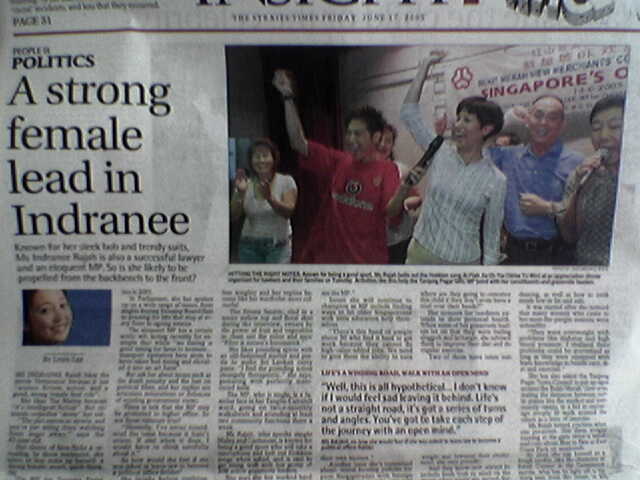
Our thinking has been coloured by our past, says MP


Straits Times, Insight, June 17 2005 Posted by Hello

Ms Indranee Rajah, a Member of Parliament for the ruling People's Action Party, invokes the spectre of Singapore's political history, more specifically the racial riots and the communist threat, to justify the current ban on "party political films."

The ban is legislated in Section 33 of the Films Act and was passed by Parliament in 1998. Like Mr Wong Kan Seng in a previous interview, Ms Rajah chose to focus the ban on films made for political parties, and failed to address the fact that Section 33 is a law that prohibits all films that make "biased" references to "political" and "controversial" issues of the day. Would a film, for example, made to address the ills of having casinos in Singapore be considered a 'political film'? Would another film, one that attacks government policies such as healthcare, education, detention without trial etc, be considered unlawful too?

Still, from both Mr Wong's and Ms Rajah's reasoning, we can draw some assumptions about Singaporeans' level of maturity (of lack thereof).

That Singaporeans are NOT MATURE enough to watch "biased" films made about political parties, members of political parties or any "political" or "controversial" subject matter. It is believed that by watching such films, Singaporeans will form biased opinions about political matters and this may degenerate into political buffoonery, or worse, stir unnecessary emotions which may lead to a cacophony of mindless arguments, social unrest, anarchy and destruction.

That Singaporeans are MATURE enough to watch films about government ministers explaining policies like "terrorism and health," even if these films are biased, as Singaporeans who watched these films will become enlightened and this will move the country forward in peace, progress and prosperity.

Excerpt of the Straits Times interview with Ms Indranee Rajah

Was the parliamentary committee consulted when Martyn See's film was banned under the Films Act? Do you think this will scare young people off from creative ventures for fear that they are overstepping boundaries?

"No. That was an operational decision made by the police. I guess they clearly felt the film fell squarely within what is prohibited.

I hope that it won't stifle talent. It's a difficult balance to strike. You have to see it in the context of our own political history. You remember the racial riots and communism. Our thinking has been coloured by our past. You don't want things that would unnecessarily stir emotions.

But you also do want a critically thinking population who are keen to comment on issues. The question is how to strike a balance? I don't think there is a fixed answer. Much of it depends on how it's implemented, but I do hope that notwithstanding this banning of See's film, that Singaporeans will still feel free to express their views."

Under the Films Act, which bans political films, TV broadcasts and newspaper interviews of ministers are deemed non-political. But videos of opposition politician Chee Soon Juan, Young PAP and PAP Women's Wing achievements are political. Do you buy that explanation?

"It's a valid explanation. There is a distinction between the Government and a political party, although people often mix the two up in the Singapore context, because all our ministers are members of the PAP. But the Government is not the same as a party.

The Films Act disallows the making of party political films. That is defined as one that advertises or promotes a political party, or a film that is made and directed towards any political end in Singapore.

However, a minister speaking to the media about his ministries' policies like terrorism, or health, for example, is talking about government policy, not party policy. So that is permissible.

It would be quite different if the same minister made a video clip to try and solicit donations for the PAP, for example.

That would be clearly political and would have nothing to do with his ministry or the Government. We are careful to maintain that distinction.

(End of excerpt)

"I make no apologies that the PAP is the Government and the Government is the PAP."
- PM Lee Kuan Yew, 1982, Petir (the PAP party publication)
(Quote found in parties and Politics' by Hussin Mutalib)

Tuesday, June 14, 2005


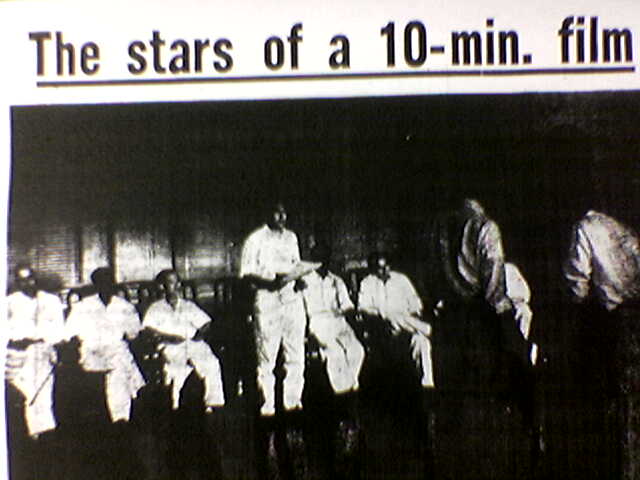
Singapore's first political film, Straits Times, June 11, 1959 Posted by Hello

STRAITS TIMES, June 11, 1959 (page 16)

SINGAPORE, Wed - Singapore's Prime Minister, Mr Lee Kuan Yew, and his eight Cabinet colleagues are stars of a new film which will be shown before the end of this week.

The film - to introduce the new Cabinet - is being produced by Cathay Keris Films. It was ordered by the Minister for Culture.

The Ministers were filmed "on location" yesterday in the City Hall's committee room for the film, directed by Mr. Tom Hodge, chief of the film company.

The film with a running time of about 10 minutes is expected to be screened at all Singapore cinemas, said Mr. G.G. Thomson, the Director of Information Services.

The Straits Times picture shows (from left): Mr K.M. Byrne, Inche Ahmad Ibrahim, Dr. Toh Chin Chye, Mr. Lee Kuan Yew, Mr. Ong Eng Guan, Dr. Goh Keng Swee

Friday, June 10, 2005

Repeat the mantra - 'Singapore is opening up'..'Singapore is opening up'..'Sin..

"The Government will pull back from being all things to all citizens. This is so not only in minor municipal issues, but in some far-reaching ones too. For example on questions of public morality and decency, we are increasingly guided by the consensus of views in the community. We will give weight to minority views, but we cannot move only when the last man or the most conservative person is willing to move. Otherwise we would be restricting the options open to many others in our society, and stifling the diversity that we need to be an open, cosmopolitan people. We would eventually atrophy."

- PM Lee Hsien Loong, 6 Jan 2004

"To say ‘no’ after worldwide publicity for a year, Singapore will be sending out the wrong signal, that we want to stay put, to remain the same old Singapore, a neat and tidy place with no chewing gum, no smoking in air conditioned places, no this, no that, - not a fun place. The old model on which I worked was to create a first world city in a third world region - clean, green, efficient, a pleasant, healthy and wholesome society, safe and secure for everyone. These virtues are no longer sufficient. Now we have also to be an economically vibrant and an exciting city to visit, with top class symphony orchestras, concerts, drama, plays, artists and singers and popular entertainment. These are the lifestyles international professionals and executives seek. We want the companies who manage these entertainment troupes to include Singapore on their tour of cities around the world."

- MM Lee Kuan Yew on integrated resorts in Singapore, Parliament, 19 Apr 2005


Dear all,

Just an update on developments regarding the police investigations on Singapore Rebel.

Well, there is none. The police has not called me since the last interview on May 16.

And while I entertain in my own mind some possible reasons for the delay, made even more perplexing since they had hurried me for the first interview, I have been more intrigued lately by a spate of events which has led me to believe that Singapore is now caught in a moral dilemma.

We want to relax, to loosen up, to be cosmopolitan, to build casinos, to host topless revues, to be the London of the east. Yet, at the same time, we want to be seen as a country that upholds high moral values. As such, we continue to ban gay concerts and parties, risque pictues in fashion magazines, 'biased' political films and anything which is "contrary to public interest."

What constitutes "public interest" is itself a contention which can be discussed some other time.

But what must strike any visitor to this island is how Singapore balances its clean, wholesome image with a seemingly new missionary zeal to embrace pop culture,mavericks, bohemians, rock n'roll and anything that is "with it."

It makes for a pretty schizophrenic situation. Take these examples.

- We ban a drawing of a sex orgy in Benetton's Colors magazine but allow our bloggers to pose nude on the internet, and our own celebrities to go braless on the covers of FHM, Maxim, etc.

- We ban nude pictures and sex publications but we have one of the highest percentage of internet users who surf the web purely for pornography.

- We ban Christian pop duo Jason and DeMarco for promoting a gay lifestyle but proudly hosted Elton John and Boy George, two of the world's biggest gay icons.

- We ban foreigners from 'meddling' in Singapore politics but allow foreigners to run our casinos, helm our GLCs, make recommendations to our wages and compete for jobs here.

- We ban Singaporeans from staging protests but allow foreigners to stage theirs at next year's IMF/World Bank meeting.

- We ban gay parties but allows gay spas to sprout all over town. (Did I hear anyone say there are no sexual activities in these spas?)

- We ban 'unnatural' (or gay) sex but allow gays to work in the civil service.

- We ban crusading journalism but allow our journalists to petition the Chinese government for a fair trial of detained correspondent Ching Cheong. For the record, six people were detained in Singapore under the ISA in 1997/98 on spying charges. Their names were never disclosed.

- We ban foreigners from criticising our system but cite foreigners when they praise our system.

- We ban adult videos but allow the documentary Inside Deep Throat to be shown in our cinemas. In other words, we are not allowed to watch Deep Throat but we are allowed to watch a documentary made about it.

- We heavily censored local filmmaker Royston's Tan's teen gang film '15' but allowed a much more violent Young And Dangerous (HK) and City of God (Brazil) to be shown with minimal cuts.

But all things considered, Singapore has indeed opened up in some ways. For example, we can now shop from ten shopping malls instead of one; we can now afford to travel to places further than Malaysia for our holidays; our students have a lot more choices in education; we have invented more ways to spend and invest our money.

Culturally, too, there appears to be some loosening up - there are more nudity on cinema screens, more bar-top dancing in the pubs, more cacophony of advertising campaigns on the streets.

Still, when the mantra of 'Singapore is opening up' is repeated too often, we sometimes confuse consumer freedom with the civil rights to freedom of speech, assembly, association and media.

But first, what exactly constitutes an 'open society?' And here, no one described it better than Singapore's founding father Lee Kuan Yew.

_____________________________________________________________________________

"Let us get down to fundamentals. Is this an open, or is this a closed society? Is it a society where men can preach ideas - novel, unorthodox, heresies, to established churches and established governments - where there is a constant contest for men's hearts and minds on the basis of what is right, of what is just, of what is in the national interests, or is it a closed society where the mass media - the newspapers, the journals, publications, TV, radio - either bound by sound or by sight, or both sound and sight, men's minds are fed with a constant drone of sycophantic support for a particular orthodox political philosophy? That is the first question we asked ourselves. I would like to see minds stimulated and debate provoked, and truth refined and crystallized out of the conflict of different evidence and views. I, therefore, welcome every and any opportunity of a chance to agree, or to dissent, in order that out of thesis comes synthesis - thesis, anti-major premise, anti-premise, synthesis, so we progress... I welcome every opportunity to meet members of the opposition, and so do members of my party, over the radio, over the television, university forums, public rallies. We never run away from the open encounter. If your ideas, your views cannot stand the challenge of criticism then they are too fragile and not sturdy enough to last. I am talking of the principle of the open society, the open debate, ideas, not intimidation, persuasion not coercion... Sir, the basic fundamentals we asked ourselves...is whether the duties of the Minister of Information and Broadcasting are to produce closed minds or open minds, because these instruments - the mass media, the TV, the radio - can produce either the open minds receptive to ideas and ideals, a democratic system of life, or closed and limited. But I know that the open debate is a painful process for closed minds...But let me make this point: that 5 million adult minds in Malaysia cannot be closed - definitely not in the lifetime of the people in authority. It is not possible because whatever the faults of the colonial system, and there are many...they generated the open mind, the inquiring mind."

- Lee Kuan Yew Dec 18, 1964 Malaysian Parliamentary Debates

______________________________________________________________________________

Yes, Singapore has made incremental changes in opening up society. But sometimes we take one step forward only to take two steps back.

Take these examples.

- 50 years ago, Singapore was home to a thriving movie industry. Back then, the Shaw Brothers and Cathay Keris studios were churning out blockbusters for audiences in Asia. In the last ten years, we made only an average of three to four local feature films a year, as the rest of Asia have surged ahead in movie-making technology, creativity and marketing.

- 40 years ago, Singapore had a vibrant pop music scene. Bands like The Quests were hitting the top of Asian charts. Today, the English-language pop and rock music scene is barely breathing, struggling even to get onto the airwaves of their country's own radio stations.

- 50 years ago, Singapore had a dozen or so newspapers that were mostly independent. Views were freely expressed from the Left, from the Right, from centre, to a largely illiterate population. Today, even with a largely educated citizenry, our press freedom is ranked 147th - the most locked-down domestic media amongst developed nations.

- 20 years ago, Singaporeans had more chances to exercise their votes simply beacuse we had more opposition candidates. The last GE2001 saw the worse participation by the opposition since the Barisan boycott of 1968. Two or three elections from now, Singaporeans' right of universal suffrage will be forfeited, as the opposition may be rendered extinct.

- 17 years ago, the NTUC held a mass demonstration against U.S. interference in Singapore politics. Today, the government bans all forms of protests and demonstrations.

- 10 to 15 years ago, we could watch live proceedings of parliamentary debates on television. There were also televised select committee hearings on the Law Society, Elected President, Shared Values and so on. Today, we get only edited snippets of parliamentary debates on the nightly news bulletins. Open political debates on TV has become a thing of the past.

- For 4 years running, the gays, lesbians and party-goers of Asia could congregate in Sentosa for the annual Nation party. Just this week, the police slapped a ban on it.

- 10 years ago, there were no laws banning the making of 'biased' political films. Today, I am under police investigation.

Friday, May 27, 2005

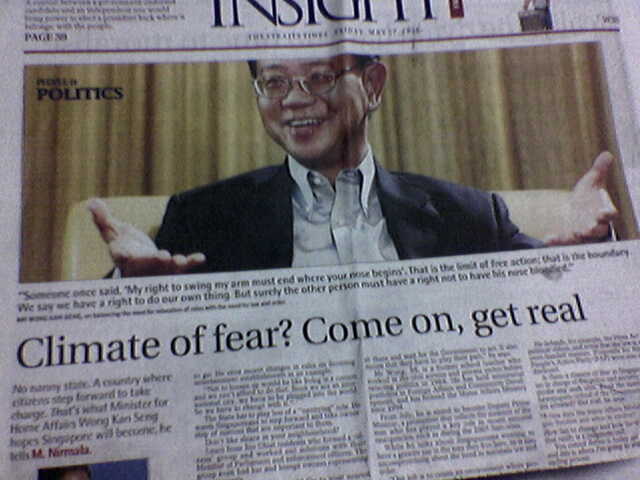
No climate of fear here, says Minister for Home Affairs


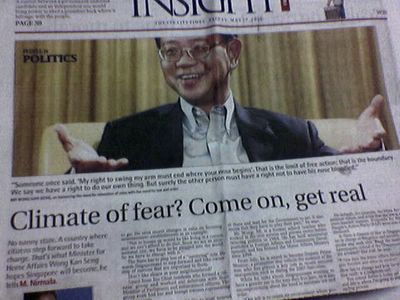
Straits Times, Insight, May 27, 2005 Posted by Hello

Bar-top dancing and loosening up, mosquito breeding and active citizenry, political videos and the rule of law - these were some of the topics covered by Home Affairs Minister Wong Kan Seng in this interview with the Straits Times published on May 27, 2005.

Climate of fear? Come on, get real

No nanny state. A country where citizens step forward to take charge. That's what Home Affairs Wong Kan Seng hopes Singapore will become, he tells M. Nirmala.

MR WONG Kan Seng often comes across as a tough-talking minister, which isn't surprising given his portfolio. The Minister for Home Affairs is responsible for law and enforcement to deal with crooks, drug addicts, terrorists and illegal immigrants.

During the interview in his office, however, he is expansive, even pensive, sharing his views on how the relationship between the State and the Citizen is developing.

Belying his reputation for being a "hardliner" in Cabinet, Mr Wong argues that some restrictions have to go. He cites recent changes in rules on licensing entertainment establishments as an example.

"Not to loosen up would be like living in a cocoon and we can't afford to do that. Since we are an international city, we have to be plugged into the world. So we have to change with it."

The State has to play less of a "nannying" role. He wants Singapore to step forward and take ownership of matters that are important to them.

Don't like sleaze in your neighbourhood?

Learn from the Joo Chiat residents who formed a citizens' group and worked out solutions with their Member of Parliament and enforcement officers. The group even had bar and lounge owners representing their interests.

Fearful of terrorist attack? Go to your nearest residents' committee and pick up the Emergency Handbook. It is packed with information on how to survive a tsunami disaster or a terrorist attack.

The days of the Government hand-holding citizens in all aspects of life are numbered, he reckons.

He cites the fight against dengue fever as an example.

In July, all residents of landed homes will receive a packet of insecticide in their mail as part of a dengue fever prevention kit. "If the people themselves don't stir to do something for themselves in keeping out mosquito breeding, then who will do it for them? The environment officer can't be there every day to check their flower pots and their vases. It is not possible.

"That's where you talk about an active citizenry. An active citizenry doesn't mean that the people just sit there and wait for the Government to act. It also means that they have to play their part," he says.

Mr Wong, 58, is a former school teacher who worked in the civil service and private sector before entering politics in 1984. He has held ministerial portfolios in Foreign Affairs and Community Development, and has helmed the Home Affairs Ministry since 1994.

From July, he is slated to become Deputy Prime Minister, a promotion that reflects the measure of the man who has played a key role in recent national emergencies, such as during the 2003 Sars crisis.

While he talks about Singaporeans wanting to have a greater say in the way they live here, he is also uncompromising about the need to maintain law and order.

"Our job is to create an environment where people will feel safe to work here, to live here, to bring up their children and have the freedom to walk the streets at any time without being afraid of getting mugged or getting drugs pushed in their face," he says.

Investors also welcome an orderly environment, he adds.

The challenge, he says, is how much freedom to allow while maintaining sufficient order and control.

"Someone once said,'My right to swing my arm must end where the nose begins'. That is the limit of free action; that is the boundary.

"We say we have a right to do our own thing. But surely the other person must have the right not to have his nose bloodied," he reasons.

He defends, for example, the Films Act which bans political videos, and notes that the law is applied in an even-handed manner. Proposals for films about the People's Action Party (PAP) were also shot down, he disclosed.

Is there a climate of fear in Singapore? The minister in charge of the police and security agencies pooh-poohs any such idea. Read the many articles in the newspaper critical of the Government. Are the writers arrested? Get real, he says.

How does the Home Affairs Ministry decide when to give freedom and when to control?

How fast to change and how far to go in opening, that really is a judgment call.

You cannot define it today and say this is the rule and this is where I'm going to stop. Change is an unending process.

We have to wait, watch, monitor and we have to relax. Then we have to moderate as we learn from each step that we make along the way. And that's how we've been managing.

What are some examples?

Bar-top dancing is the most cited example.

Another example is the way we license these entertainment joints and the bars. We now have class licensing.

That means if you operate a licence to provide for this kind of entertainment, we have a general set of conditions. If you follow them, then it's okay.

Then we need to come to you only when there's a violation of some of these conditions. We will tell you that you have breached them and we will give you a chance to improve.

It is similar to the traffic demerit scheme. We say there's a certain demerit point beyond which your licence will be restricted. So we give people more choices.

What about areas which are not so clear-cut?

You have to wait and see what are the situations because you cannot anticipate every situation.

No point working on hypothetical situations when we are not confronted with them.

But there will be new situations all the time that will test where the limits are. Then we look at it and say, "Yes, are we too restrictive or should we therefore now loosen up?"

Singaporeans on the one hand are being asked to be open and express their views and feelings. But on the other hand, the police have called up film-maker Martyn See over a documentary on opposition politician Chee Soon Juan. Is there a conflict or contradiction here?

No, there is no conflict.

A political video is not a good means of reaching out to the people and engaging them and explaining rational policies.

Political videos, by their very nature, will be political, will be biased and, therefore, will not be able to allow the listener or the viewer to see a whole range of arguments.

So that is why many years ago, a Bill was passed to amend the Films Act to disallow political videos. And this law doesn't just apply to opposition parties or to Martyn See. The law applies to the PAP, too.

Last year, when we had our 50th anniversary celebrations, there were many ideas about doing a video on the party's achievements.

But in the end, even though the idea was very good, we did not proceed with it.

And the Women's Wing also wanted to produce a video about its work in the last 10 years and we said "no".

So the law is even-handed and it is applied to everyone.

Where we have laws, we must enforce them. We must not make a mockery of the law.

Does the law apply to television stations that put out interviews and programmes on PAP ministers?

That is not a political video. That's a broadcaster and a content provider doing a job.

It is done in other places.

The minister is explaining himself, his policies and how he wants Singapore to move ahead.

Opposition parties and many Singaporeans believe that there is a climate of fear. This prevents people from wanting to speak up or stand for elections. What is your response?

You read the newspapers. People write long commentaries, punchy articles that are highly critical of government policies. Is there fear?

People appear in forums and dialogues and ask questions. Is there fear?

What is the consequence of saying something that is challenged? Is the consequence being locked up in jail, disappearing in the middle of the night and you don't come back?

Get real. Come on, we live in the real world in Singapore.

END

Minister warns freedom is dangerous

"We do ourselves a great disservice if we import unthinkingly and wholesale fashionable and hollow abstractions. Democracy, human rights and press freedom do not exist in a vacuum. By themselves, these concepts do not guarantee development and progress...So do not believe those few Singaporeans who tell you that with democracy, human rights and press freedom a hundred flowers will bloom and Singapore will prosper."

- Wong Kan Seng, 2001

Sunday, May 22, 2005

The Films Act - Are you frightened yet?

The Films Act of Singapore seems to be scripted by a group of brilliant horror story writers. Difference is, the horror is REAL. The spooks DO show up in your house.

Every night when I fall asleep, Section 34 of the Films Act hangs like the Sword of Damocles above me.

And do you own any "obscene" films at home? It may apply to you too.

Search and seizure of unlawful films

34. —(1) Any Deputy or Assistant Commissioner of Police, Assistant Superintendent of Police or any Censor, Deputy or Assistant Censor or Inspector of Films, if satisfied upon written information and after such further inquiry as he thinks necessary that any person has in his possession any obscene film or party political film, may without warrant, with such assistance and by such force as is necessary, by night or by day, enter and search any place where he has reason to believe the film is kept, seize the film and any equipment used in the exhibition, making or reproduction of the film and take into custody any person reasonably believed to be in possession thereof.
[10/98]

(2) Any film, and any equipment used in the exhibition, making or reproduction of the film, in respect of which any person has been convicted under section 29, 30, 31 or 33 shall be forfeited and shall be destroyed or otherwise disposed of in such manner as the Minister may direct.

_______________________________________________________________________________

Section 34 is not the only provision in the Films Act that empowers the police to raid your homes. If you are in possession of any uncensored, unlicensed or unauthorised films in your premises, the following will apply.

Penalty for possession, exhibition or distribution of uncensored films
21.
—(1) Any person who —

(a) has in his possession;

(b) exhibits or distributes; or

(c) reproduces,

any film without a valid certificate, approving the exhibition of the film, shall be guilty of an offence and shall be liable on conviction —

(i) in respect of an offence under paragraph (a), to a fine of not less than $100 for each such film that he had in his possession (but not to exceed in the aggregate $20,000); and

(ii) in respect of an offence under paragraph (b) or (c), to a fine of not less than $500 for each such film he had exhibited, distributed or reproduced, as the case may be (but not to exceed in the aggregate $40,000) or to imprisonment for a term not exceeding 6 months or to both.

(2) Any Censor and any Deputy or Assistant Censor and any Inspector of Films may at all reasonable times enter any place in which any film is kept or is being or is about to be exhibited and may examine the film, and if on such examination he has reasonable grounds for believing that an offence under this section has been or is about to be committed in respect of the film he may seize the film and any equipment used in the commission of the offence.

___________________________________________________________

All local filmmakers should be made aware of Section 12.


Films made in Singapore to be deposited in approved warehouse
12. —(1) The owner of any film made in Singapore shall, within 7 days after the making of the film, deposit the film in a warehouse approved for this purpose by the Board.
(2) Any person who fails to deposit the film in accordance with subsection (1) shall be guilty of an offence and shall be liable on conviction to a fine not exceeding $5,000.

___________________________________________________________________________

And what happens when you don't deposit your film in the warehouse?

Search for unauthorised films and arrest of persons
23.
—(1) Whenever a Deputy or an Assistant Commissioner of Police or an Assistant Superintendent of Police is satisfied upon written information and after any further inquiry which he may think necessary that any film —

(a) which has not been —

(i) deposited in an approved warehouse as required by section 12 or 13;

(ii) returned to the Board as required by section 14 (4); or

(iii) approved for exhibition under section 15 or 26 (4);

(b) in respect of which the certificate issued therefor has ceased to be valid under section 20; or

(c) which has been altered in any way after a certificate in respect of the film was issued,

has been or is being exhibited or kept in any place, he may issue a warrant directed to any police officer to enter and search that place and seize the film and to take into custody any person reasonably believed to be guilty of an offence by reason of failure to deposit or to return the film or by reason of such possession or exhibition. [10/98]

(2) A Deputy or an Assistant Commissioner of Police or an Assistant Superintendent of Police may without warrant, with such assistance and by such force as is necessary, by night or by day, himself do what he may authorise any police officer to do under subsection (1) in either of the following cases:

(a) if he has personal knowledge of such facts as satisfy him that there are sufficient grounds for a search;

(b) if he receives information orally in such circumstances that the object of a search would in his opinion be defeated by the delay necessary for reducing the information to writing except that the name and address of the person giving the information is known to or ascertained by him before he acts upon the information.

______________________________________________________________________


Politics or Porn? Which one is safer?

Do you know that the penalties for making party political films is heavier than that of pornograpghy?

Possession of obscene films
30. —(1) Any person who has in his possession any obscene film shall be guilty of an offence and shall be liable on conviction to a fine of not less than $500 for each such film he had in his possession (but not to exceed in the aggregate $20,000) or to imprisonment for a term not exceeding 6 months or to both.
[10/98]

(2) Any person who has in his possession any obscene film knowing or having reasonable cause to believe the film to be obscene shall be guilty of an offence and shall be liable on conviction —

(a) to a fine of not less than $10,000 but not more than $50,000 or to imprisonment for a term not exceeding 12 months or to both; and

Advertising obscene films
31. —(1) Any person who, for the purposes of distributing or exhibiting any obscene film to any other person, advertises the film by any means shall be guilty of an offence and shall be liable on conviction to a fine of not less than $2,000 but not more than $5,000 or to imprisonment for a term not exceeding 6 months or to both.
[10/98]

(2) Any person who, for the purposes of distributing or exhibiting any obscene film to any other person, advertises the film by any means knowing or having reasonable cause to believe the film to be obscene shall be guilty of an offence and shall be liable on conviction —

(a) to a fine of not less than $10,000 but not more than $50,000 or to imprisonment for a term not exceeding 12 months or to both; and


(a) to a fine of $1,000 for each such film in his possession (but not to exceed in the aggregate $40,000) or to imprisonment for a term not exceeding 12 months or to both;


Making, distribution and exhibition of party political films
33. Any person who —

(a) imports any party political film;

(b) makes or reproduces any party political film;

(c) distributes, or has in his possession for the purposes of distributing, to any other person any party political film; or

(d) exhibits, or has in his possession for the purposes of exhibiting, to any other person any party political film,

knowing or having reasonable cause to believe the film to be a party political film shall be guilty of an offence and shall be liable on conviction to a fine not exceeding $100,000 or to imprisonment for a term not exceeding 2 years.

_______________________________________________________________

But even in the heart of darkness, there's a glimmer of light. They provide exemptions.

Exemptions
40.
—(1) This Act shall not apply to —

(a) any film sponsored by the Government;

(b) any film, not being an obscene film or a party political film or any feature, commercial, documentary or overseas television serial film, which is made by an individual and is not intended for distribution or public exhibition; and

(c) any film reproduced from local television programmes and is not intended for distribution or public exhibition.
[10/98]

(2) The Minister may, subject to such conditions as he thinks fit, exempt any person or class of persons or any film or class of films from all or any of the provisions of this Act.

(3) An exemption granted under this section may be withdrawn at any time.

Tuesday, May 17, 2005

Interview over but investigation will go on

Last night (16 May 2005) between 2100 to 2220 hrs, the police interview took place on the 3rd level of the Cantonment Police Complex. The mood was relaxed and cordial. ASP Chan Peng Khuang asked some 50 questions, mostly pertaining to the making of Singapore Rebel such as

- Who conceptualised it? Who produced it? Who shot it? Who edited it? Who funded it? How much was spent? What was the objective of the film? Who else was involved in the production? What camera was used? Who shot the Istana arrest scene? How long did I take to make it?

There were also questions pertaining to the distribution of the film such as

- Who did you give copies to? Who put up the film on the internet? Are you still in possession of any copies?

Qustions pertaining to Chee Soon Juan and partisan politics were few such as

- Is Dr Chee a personal friend of yours? Where did you film the interviews? How did you appraoch Dr Chee to make the appointment? Are you a member of any political party in Singapore? Where did you film Mr JB Jeyaratnam?

Questions about this blog were also asked such as

- When did I start this blog? What is the purpose of this blog?

Other questions include

- What is your highest academic qualification? How much do you earn per month? Do you contribute to CPF? Do you own a computer? Do you have a production house?

More importantly, I was finally informed of the reason for this police investigation.

ASP Chan : "I'm informing you that the MDA (Media Development Authority) has on April 11 lodged a police report alleging that Singapore Rebel is a party political film. Do you have anyhing to say to that?"

At the end of the interview, I asked what is going to happen from here on. He replied that investigations will continue and that I may be asked to go for another interview. When asked if the police would raid my house to confiscate my tapes, he said investigations will go on.

Saturday, May 14, 2005


Scene from Singapore Rebel Posted by Hello

AMNESTY INTERNATIONAL USA FILM FESTIVAL 2005
West Hollywood,

Singapore Rebel
Director: Martyn See Tong Ming
Documentary. 2005. Singapore. 26 min. English.

The film has just been withdrawn from the Singapore International Film Festival because of government censorship. We are proud to host the World Premiere and to support freedom of expression for artists worldwide.

Often cited as the economic miracle of the Far East, Singapore looks every bit like the paragon of the rich Asian nation. Beneath its gleaming façade, however, lies a citizenry that has been governed by the same political party for 46 years.

No act inspires more fear and foreboding in Singaporean society than an open confrontation with its government. Yet, one citizen has taken it upon himself to do just that. Singapore Rebel chronicles the tribulations of opposition activist Dr. Chee Soon Juan from his initial overcoming of fear to his acts of civil disobedience.

NEW ZEALAND HUMAN RIGHTS FILM FESTIVAL 2005

Singapore Rebel
26 minutes, Singapore

This is the film Singapore’s censorship board doesn’t want people to see. It’s the story of opposition politician Chee Soon Juan, who has been imprisoned twice for championing democratic change in the tightlycontrolled city state. The censors declared it a “party political film” and it was pulled from last month’s Singapore International Film Festival line-up after the director was warned he could face two years in jail if the screening went ahead. Directed by Martyn See.

S'pore says politically motivated movies 'undesirable'

ASSOCIATED PRESS
May 14, 2005
SINGAPORE

THE Singapore government said Saturday, May 14, politically motivated films were "an undesirable medium" to debate issues, as a documentary filmmaker faces possible charges over a movie about an opposition politician.
Martyn See is under investigation for Singapore Rebel, a 26-minute movie about Chee Soon Juan, a frequent critic of the government. Police said See may have violated the Films Act for knowingly distributing or exhibiting a "party political film."

He could be fined up to S$100,000 (US$60,606; €46,200) or imprisoned as long as two years if he's tried and convicted.

"Party political films are disallowed because they are an undesirable medium for political debate in Singapore," the Ministry of Information's communications director K. Bhavani said in an open letter published in the local Straits Times newspaper Saturday.

"They can present political issues in a sensational manner, evoking emotional rather than rational reactions," Bhavani said. "There remains ample opportunity for political parties and their supporters to express their opinions."

Bhavani's letter was an apparent reaction to See's yet-unscreened movie, and a letter from a group of Singapore filmmakers who castigated the country's laws, which appear to ban any movie criticizing government policy.

See made his maiden film independently and said he wanted to "chronicle the civil disobedience acts of Chee Soon Juan."

Chee currently faces bankruptcy after he was ordered to pay S$500,000 (US$303,000) to Singapore's former prime ministers, Lee Kuan Yew and Goh Chok Tong, for defaming them during an election campaign in 2001.

Singapore Rebel was earlier yanked from the Singapore International Film Festival - one of the country's showcase events to promote itself as an arts hub.

But See said his movie will be screened at other venues later this month - the New Zealand Human Rights Film Festival and the Amnesty International Film Festival in Hollywood.

Singapore, a wealthy Southeast Asian city-state, is widely criticized for its tight controls on political activity and the media.

Thursday, May 12, 2005

Filmmakers seek clarification of film act

Published in the Straits Times forum, May 11 2005

We are a group of Singaporean filmmakers who would like to seek clarification from the authorities regarding the application of the Film Act, and in particular the 1998 amendment regarding "party political films."

It is our understanding that the 1998 amendment to the Film Act deems it an offence to make, distribute or exhibit "party political films."

Such films are defined as any film that "contains wholly or partly any matter which is intended or likely to affect voting in any election or national referendum in Singapore," or one that "contains wholly or partly either partisan or biased references to or comments on any political matter."

Under this Act, it appears that there is a ban on work in which we intend to
state or imply a stand on current government policy, regardless of what that stand is.

So far, we have observed that two locally made films featuring opposition politicians, namely ³Singapore Rebel² (2005) or ³Vision of Persistence² (2001) have been forced to withdraw from the Singapore International Film Festival or risk $100,000 fine or two years in prison for the filmmakers.

Were these films asked to be withdrawn because they were deemed to contain ³partisan or biased references² or because they contained comments ³on any political matter²?

We ask because as filmmakers, we feel that almost anything could be construed as a comment on a political matter. Further, how do we assess whether something is a political matter? Any subject, no matter how innocuous, could become a political matter depending on the circumstances, and we could easily find ourselves inadvertently contravening the Act.

Similarly, we require some guidance on what constitutes ³bias², after all, all works of art are the expression of the artist¹s opinion, which may favour a particular viewpoint or argument over another. Are filmmakers expected not to render any opinion at all to be considered neutral?

For instance, it is open to interpretation whether Jack Neo's film "I Not Stupid," which is a clear critique of the Singapore education system, or Tan Pin Pin's "Moving House," which appears to be a critique of the grave exhumation policy in Singapore, may be judged to have fallen afoul of the Act.

We feel that the current state of the legislation poses unintended dangers for sincere filmmakers, and would be grateful if the authorities could issue a formal explanation clarifying the application of this law.

It would be a waste to spend resources making a work only to find that it is
unlawful because it has inadvertently run afoul of the Film Act.

Filmmakers seek to clarify boundaries

Reuters
May 11, 2005
SINGAPORE

SINGAPORE came under pressure from filmmakers on Wednesday, May 11, to clarify laws on political films after police called in for questioning the director of a film on an opposition leader.
In a letter published in Singapore's Straits Times newspaper, filmmaker Tan Pin Pin, on behalf of 10 colleagues, sought clarification on the Films Act, which says it is an offence to produce, distribute or exhibit "party political films".

"We ask because, as filmmakers, we feel that almost anything could be construed as a comment on a political matter," Tan's letter said.

Under provisions introduced to the Films Act in 1998, anyone involved in producing or distributing "party political films" -- including those containing commentaries on government policies -- can be fined up to S$100,000 (US$60,860) or jailed up to two years.

"How do we assess whether something is a political matter?" Tan added.

"Any subject, no matter how innocuous, could become a political matter depending on the circumstances, and we could easily find ourselves contravening the Act inadvertently."

The letter was published after Martyn See, a 36-year-old Singapore filmmaker, was asked by police this week to come in for questioning on May 16 regarding his film Singapore Rebel on prominent opposition leader Chee Soon Juan.

See withdrew the documentary from the city-state's annual film festival in March under pressure from government censors, who told festival organisers the work violated the Films Act.

In 2002, a documentary about veteran opposition politician J.B. Jeyaretnam was pulled out from the film festival after its filmmakers were told it breached the act.

Opposition politicians have said the Films Act stifles political debate in the city-state, which has been ruled by the People's Action Party since independence in 1965. Its 84-member Parliament has only two opposition members.

International free-press advocates have repeatedly criticised Singapore for its tight media control.

The government bans non-commercial private ownership of satellite dishes. Films and TV shows are routinely censored for sex and violence.

The government says a high degree of control over public debate and the media is needed to maintain law and order.

The film at the heart of the controversy focuses on the life of Chee Soon Juan, who lost in January a three-year legal battle against defamation charges brought by Singapore's founding prime minister, Lee Kuan Yew, and his successor.

The US State Department, in its February annual report, sharply criticised Singapore for using libel suits to intimidate the opposition, saying the threat inhibits opposition politics and has led to a culture of self-censorship in the media.

Wednesday, May 11, 2005

Media watch groups respond to police investigation

SINGAPORE: Filmmaker under investigation for banned documentary

May 10, 2005 ­ The Committee to Protect Journalists is deeply concerned about the police investigation of independent documentary filmmaker Martyn See who is being questioned under Singapore's stringent Films Act.

On May 6, Assistant Superintendent of Police Chan Peng Khuang called See to inform him that police had received a copy of his film "Singapore Rebel" and had initiated an investigation, according to an account that See posted on his Web log yesterday. Chan did not elaborate on the reasons for the investigation, or any charges that might apply.

Police told international reporters that See is being investigated under the country's Films Act, which bans "party political" films. Making or distributing such a film—which can be defined as anything containing partisan references or commentary—is punishable by a fine of up to $100,000 or two years in jail."Singapore Rebel" chronicles the civil disobedience of opposition activist Dr. Chee Soon Juan.

See will report to the police on Monday, May 16, he told reporters.

In an effort to avoid an investigation, See withdrew his film from the Singapore International Film Festival after the Board of Film Censors told festival director Philip Cheah on March 11 that the film was objectionable under the Films Act. Cheah was "advised" to inform See to withdraw his film "whereby the matter would be dropped, failing which, the full extent of the law would apply," wrote festival director Lesley Ho in an email to See. The film has not yet had a public screening anywhere in the world.

"Singapore authorities' harassment of Martyn See and censorship of a film that merely documents political opposition is unacceptable," said CPJ Executive Director Ann Cooper. "We urge the government to call off this investigation and allow See to continue his work."

Singapore continues to hound film-maker

11 May 2005
Source: Southeast Asian Press Alliance (SEAPA)

Singaporean filmmaker Martyn See has been invited for questioning by the police, news agencies have reported, two months after his documentary on a Singaporean oppositionist was forced out of a film-festival in the city-state.


See, 36, told Reuters that he is expected to present himself before the country’s police on 16 May. The filmmaker said he expects to be questioned about “Singapore Rebel”, his film on Chee Soon Juan, leader of the Singapore Democratic Party.

The Agence France Presse said See was being probed under the Films Act pertaining to "party political" films. If convicted of violating the Films Act, See could be jailed for two years or fined up to 100,000 Singapore dollars (61,340 US dollars).
See had pulled his documentary from the Singapore's International Film Festival in March after government censors advised him that the film was flaunting laws against political films.

Despite its economic strength and high standard of living, Singapore remains a highly restricted country in terms of political and speech rights. The city-state’s rulers are notorious for intimidating both local and foreign media with financially crippling libel and defamation suits.

Most recently, even Singaporean bloggers have been spooked by threats of defamation stemming from comments made about A*STAR, a government-related research agency. A Singapore student shut down his blog and apologised “unreservedly” after officials of A*STAR threatened to file a defamation suit.

The subject of See’s documentary, Chee himself is facing bankruptcy proceedings in Singapore after being sued for defamation by Singapore's two former premiers, Lee Kuan Yew and Goh Chok Tong, in line with speeches he made while campaigning for a parliamentary post in 2001. A Singaporean court ordered him to pay the former prime ministers 500,000 Singapore dollars (approximately 304,000 US dollars).

Filmmaker called in for questioning, under investigation

Country/Topic: Singapore
Date: 11 May 2005
Source: Southeast Asian Press Alliance (SEAPA)
Person(s): Martyn See
Target(s): other
Type(s) of violation(s): harassed , legal action
Urgency: Threat
(SEAPA/IFEX) - Singaporean filmmaker Martyn See has been invited for questioning by the police, news agencies have reported, two months after his documentary on a Singaporean opposition figure was forced out of a film festival in the city-state.


See, 36, told Reuters that he is expected to present himself before the country's police on 16 May 2005. The filmmaker said he expects to be questioned about "Singapore Rebel", his film on Chee Soon Juan, leader of the Singapore Democratic Party.

The Agence France-Presse news agency said See was being probed under the Films Act pertaining to "party political" films. If convicted of violating the Films Act, See could be jailed for two years or fined up to 100,000 Singapore dollars (approx. US$60,800).

See had pulled his documentary from Singapore's International Film Festival in March after government censors advised him that the film was flaunting laws against political films.

BACKGROUND:
Despite its economic strength and high standard of living, Singapore remains a highly restricted country in terms of political and speech rights. The city-state's rulers are notorious for intimidating both local and foreign media with financially crippling libel and defamation suits.

Most recently, even Singaporean bloggers have been scared by threats of defamation stemming from comments made about A*STAR, a government-related research agency. A Singapore student shut down his blog and apologised "unreservedly" after officials of A*STAR threatened to file a defamation suit (see IFEX alerts of 6 and 2 May 2005).

The subject of See's documentary, Chee himself is facing bankruptcy proceedings in Singapore after being sued for defamation by Singapore's two former premiers, Lee Kuan Yew and Goh Chok Tong, in line with speeches he made while campaigning for a parliamentary post in 2001. A Singaporean court ordered him to pay the former prime ministers 500,000 Singapore dollars (approx. US$304,000).

Tuesday, May 10, 2005

Newswires on police probe

Singapore film maker faces police investigation

SINGAPORE, May 10 (Reuters) - A Singapore film maker, who made a documentary about an opposition politician that was withdrawn from the city state's film festival this year, said on Tuesday he had been asked to come for questioning by police.
Martyn See, 36, told Reuters the police asked him to present himself for an interview on May 16 to discuss his film about Chee Soon Juan, leader of the Singapore Democratic Party, one of several small political parties in the city-state.

"I'm worried. I've not even told my mum. How do I tell my mum that I'm under investigation for making a short video that has no sex, no violence, no foul language," See said.

Police spokeswoman Siow Cheng Cheng told Reuters police were investigating the case under the Films Act but declined to elaborate and did not confirm that See had been asked to come in.

The Films Act bars the making and distribution of "party political films", which is punishable with fines and imprisonment.

See withdrew his 26-minute film "Singapore Rebel" from the Singapore International Film Festival in March after the Singapore Board of Film Censors told festival organisers that the film was objectionable under the law.

"I assumed the matter was dropped, so this came as a great surprise to me that they should call me now for the investigation," See said.

Opposition politician Chee told Reuters that the police move to question See was not surprising and that the government's recent calls for more openness were just rhetoric.

"I think it's a cruel joke that the government on the one hand wants people to speak up, and the minute people begin to do things that are not to their liking, they start intimidating, they start harassing, they start threatening," he said.

Prime Minister Lee Hsien Loong has loosened some rules on free speech since taking power last year, but few are willing to test so-called "out of bounds" markers on what cannot be publicly discussed -- especially when it comes to politics.

In January, Chee lost a three-year legal battle against defamation charges brought by the city-state's founding prime minister, Lee Kuan Yew, and his successor Goh Chok Tong.

Last year, Singapore film maker Royston Tan's movie "Cut", a 13-minute satire on state censorship, stirred a storm of criticism in parliament.

Promoters and major cinemas shunned the film, which is about a cinema buff who bursts into a rant about film cuts during a chance encounter with a censorship board official.

Tan's first full-length feature, "15", revolving around drugs and delinquency, won international plaudits in 2003 but was heavily censored at home. A state TV company abruptly shelved plans for a documentary on Tan after he released "Cut".

The government says a high degree of control over public debate and the media is needed to maintain law and order.


Singapore police probe film-maker over political documentary
Tue May 10, 2:56 AM ET

SINGAPORE (AFP) - A Singaporean film-maker is under investigation for making a documentary about an opposition politician, police said, two months after the movie was banned locally for its political content.

police spokeswoman told AFP Martyn See's short film, Singapore Rebel, about vocal opposition politician Chee Soon Juan, was being probed under the Films Act pertaining to "party political" films.

If convicted of violating the Films Act, See could be jailed for two years or fined up to 100,000 Singapore dollars (61,340 US dollars).

See withdrew the film from Singapore's International Film Festival in March under pressure from the government's censors, who informed him that it was in breach of the act.

The film has since been lauded internationally and is due to be screened at two human rights film festivals this month, one held by Amnesty in the United States and another in New Zealand.

See told AFP on Tuesday police had asked him to present himself for questioning, and he was due to meet investigators on Monday next week.

See said police told him they were investigating him over the film's political content, but no more.

"Basically all they said was that the film was politically related, and because I was the maker, therefore I had to be questioned," he said.

See said he had no political agenda in making the film, and insisted he chose to focus on Chee "only in order to understand why political opposition in Singapore is marginalised".

Chee, 42, is facing bankruptcy after the High Court ordered him to pay 500,000 Singapore dollars for defaming Singapore's two former premiers, Lee Kuan Yew and Goh Chok Tong.

International human rights groups regularly criticise the People's Action Party, which has ruled Singapore since independence in 1965 and holds all but two elected seats in parliament, for its intolerance to dissent.

They accuse the government of placing strict controls on the media and using defamation laws to curb any criticism.

On its website, the Amnesty International Film Festival in West Hollywood says Singapore Rebel "has just been withdrawn from the Singapore International Film Festival because of government censorship".

"We are proud to host the World Premiere and to support freedom of expression for artists worldwide," the site says.

Monday, May 09, 2005

Interview with police postponed (but they want to move it along "fast")

9th May 2005, 1745hrs - ASP Chan called me after we spoke some two hours earlier (read below) to say that he really needed to conduct the interview as soon as possible. Why the hurry? And how does it benefit me to speed things up in such a manner? He didn't say but only asked (politely, as usual) for an earlier date which I then fixed for Monday, 16th May at 2100hrs at the Central Police Station.

ASP Chan thanked me again for the rescheduling.

Earlier ...

9th May 2005, 1420hrs - I decided to call ASP Chan Peng Khuang (should be 'Khuang', not 'Kuang') to postpone the interview which were orginally scheduled for tomorrow at 7pm.

I reached him on his moblie (yes, he gave me his mobile number in previous call). Here is an excerpt of the exchange.

See : ASP Chan please?

Chan : Speaking.

See : Ya this is See Tong Ming,. the guy..

Chan : Ya ya, Mr See.

See : Are you back from holiday already?

Chan : I'm back in Singapore already.

See : I'm very sorry because of heavy work commitment, I don't think I can make it tomorrow so we have to reschedule the meeting.

Chan : When is your convenient date?

See : Not in the next two weeks because I'll be busy. Would it be possible at the end of the month? Somewhere on the 27th ...

Chan : You working as what ah?

See : Freelance video.

Chan : Oh, freelance videoing.

See : Ya, so I have an added project today. Would it be possible end of the month?

Chan : End of the month is too late.

See : Too late?

Chan : Too late because I want to finish this thing fast you see.

See : Oh, you want to finish this thing fast?

Chan : Ya, it'd be better if we actually can finish it fast.

See : Ohh ... right now I'm not even sure, like, what or who you are investigating?

Chan : About the film. Because you are the maker of the film.

See : Ya.

(I deleted a section of the conversation here as I think that it might affect the investigation if it is made public. Sorry, I'm just being kiasi.)

See : OK, and will it take very long?

Chan : Maybe two hours.

See : Am I allowed to bring any audio recording equipment?

Chan : Eh no.

See : Not allowed ah?

Chan : No, not allowed.

See : But I can write down your questions right?

Chan : You can take notes, no problem.

See : Check with me again next Wednesday or Thursday.

Chan : Thanks for calling.

See : Ok bye.

Chan : Bye

(End)

Saturday, May 07, 2005


Scene from Singapore Rebel

Film on CSJ now under police probe

12pm, 6 May 2005 - I received a call on my mobile from Assistant Superintendent Chan Peng Kuang from the Central Police Station informing me that the police had obtained a copy of 'Singapore Rebel' and is in the process of "investigation" although he did not disclose on what charge.

In a civil and almost apologetic tone, he asked if we could meet on Tuesday 10 of May. I replied that I was working that day and asked to meet tomorrow morning (7 may 2005) instead. He then replied that he would be overseas and would make time for the "interview" at my convenience. So the date is fixed for the "interview" on Tuesday at 7pm at the Central Police Station on Cantonment Road.

He asked too if the Singapore International Film Festival has acknowledgement slips to verify my submission of 'Singapore Rebel' for the short film competition. And then added another query as to whether other person(s) were involved in the production process. After I replied that both answers were negative, he expressed relief at the answer to his second question, to which I can only venture that his relief stems from the thought that he doesn't need to interview anyone else but me.

'Singapore Rebel' is a chroncle of opposition figure Dr Chee Soon Juan. I had withdrawn the film from the SIFF on March 11 after a phone call from its director Lesley Ho. At no point did I hear from the Board of Film Censors or from any department of the Government. This is my first direct contact with the authorities since the withdrawal.

Email me at singapore_rebel@yahoo.com (Need all the advice I can get)

Martyn See

Thursday, May 05, 2005

Speak up ... But get your lawyers ready


"Speak up even if it jars, Vivian tells youths"


- Straits Times quoting Minister Vivian Balakrishnan, Jan 5 2005

"'Well, you have the Internet - put up a website. You know how to put up a website? If you don't, I know a friend who can help you."
- MM Lee Kuan Yew in reply to a charge by student Jamie Han that channels to offer different views 'were either directly or indirectly controlled by the Government', Straits Times, Feb 1 2005


A*Star confirms warning to student over defamatory blog
By Wong Siew Ying, Channel NewsAsia

SINGAPORE : A*Star (Agency for Science, Technology and Research) confirmed it had warned a Singapore student of legal consequences over a public blog containing defamatory statements.

On Wednesday, Channel NewsAsia broke a story about how the Singapore student, who is pursuing his Masters degree in the United States, shut down his blog after he was threatened with legal action by A*Star.

Chen Jiahao was a former Public Service Commission scholar.

A*Star, in its response to Channel NewsAsia, said it found the public blog contained defamatory statements.

It also said it had the responsibility to protect its reputation and also that of Singapore.

So it warned the blogger of legal consequences unless the objectionable statements were removed and an acceptable apology published.

A*Star also said it welcomed a diversity of views in all media, but the statements made in the blog "went way beyond fair comment". - CNA


Student forced to shut down blog after libel threat

Singapore 28 April 2005

Reporters Without Borders today expressed support for a student from Singapore forced to shut down his blog on 26 April for fear of a libel action by the head of a government body and warned that "such intimidation could make the country's blogs as timid and obedient as the traditional media."

"Threatening a libel suit is an effective way to silence criticism and this case highlights the lack of free expression in Singapore, which is among the 20 lowest-scoring countries in our worldwide press freedom index," it said. "We especially support bloggers because they often exercise a freedom not seen in the rest of a country's media.

The threat of prosecution came from Philip Yeo, chairman of the government's Agency for Science, Technology and Research (A*STAR), which grants research scholarships, who claimed it was libelled in a blog by Jiahao Chen, a Singapore citizen currently studying in the United States. Writing under the pseudonym of Acid Flask, he criticised several government policies, including the A*STAR scholarship system and Yeo's justifications of them. He also agreed to his remarks being reproduced in the Electric New Paper. Yeo sent him several e-mails demanding that he delete all blogs mentioning him or A*STAR and threatening legal action if he did not.

A few days later, Acid Flask shut down the blog and posted a message of apology to Yeo in its place. Other Singapore blogs that had reproduced the remarks quickly afterwards posted apologies or themselves closed down.

Sunday, April 17, 2005

A legal analysis of 'Party Political Films'

Singapore Legal Mumbo Jumbo Demystified
Providing a legal perspective to bloggers' commentary on the social, economic & political issues of Singapore.


Party Political Films
Over at Singabloodypore, Steven McDermott wrote about the Singapore Rebel, a movie about Chee Soon Juan, a well-known opposition figure in Singapore.

Martyn See, the maker of Singapore Rebel, has withdrawn the movie from Singapore's annual film festival, after the government warned him its political content could land him in jail. This is because the censorship board apparently viewed the film as a "party political film".

I hereby demystify the legal mumbo jumbo:-

In 1998, the Films Act was amended to introduce the concept of "party political films". (Prior to that, the only other category of films that the Films Act specifically referred to by subject-matter was "obscene films". But that's another story). Essentially, no one is allowed to import, make, reproduce or exhibit any party political film. That means any film:

1. which is an advertisement made by or for any political party in Singapore, or any organisation whose focus is mainly on Singapore's politics; or

2. which is made by any person and which is directed towards any political end in Singapore.


In turn, the phrase "directed towards any political end in Singapore" is further defined as follows:

For the purposes of this Act, a film is directed towards a political end in Singapore if the film —

(a) contains wholly or partly any matter which is intended or likely to affect voting in any election or national referendum in Singapore; or

(b) contains wholly or partly either partisan or biased references to or comments on any political matter, including but not limited to any of the following:

(i) an election or a national referendum in Singapore;

(ii) a candidate or group of candidates in an election;

(iii) an issue submitted or otherwise before electors in an election or a national referendum in Singapore;

(iv) the Government or a previous Government or the opposition to the Government or previous Government;

(v) a Member of Parliament;

(vi) a current policy of the Government or an issue of public controversy in Singapore; or

(vii) a political party in Singapore or any body whose objects relate wholly or mainly to politics in Singapore, or any branch of such party or body.


Note the magic words "including but not limited to". This means that you don't necessarily have to fall into the examples listed from (i) to (vii) to run foul of the law. As long as you make a film that comments on any political matter (even if not mentioned in the (i)-to(vii) list) , you have made a party political film and you have committed a crime.

Note also the legal definition of film under the Films Act. "Film" isn't limited to the kind of show you typically associate with a film festival or a trip to a Golden Village cinema. Under the Films Act, "film" means:

(a) any cinematograph film;

(b) any video recording, including a video recording that is designed for use wholly or principally as a game;

(c) any other material record or thing on which is recorded or stored for immediate or future retrieval any information that, by the use of any computer or electronic device, is capable of being reproduced or displayed as wholly or partly visual moving pictures,

and includes any part of a film, and any copy or part of a copy of the whole or any part of a film


Conceivably, any itsy-bitsy piece of video recording, for example, even 7 seconds of comedic footage showing Balakrishnan hanging out in a gay bar, could be a party political film. And it would be a criminal offence to make such a video.

Waitaminit - I hear you say. Then how can TCS ever even feature PAP politicians on the 9 o'clock news without technically committing an offence?

Ah. The clever folks in Parliament already thought of that. So they snuck in this clever little provision:

For the avoidance of doubt, any film which is made solely for the purpose of ... reporting of current events is not a party political film.

Well then - I hear you say. Apart from the news, the PAP won't be allowed to use film media to spread any of its own messages. Ha!"

Oh please. They aren't always that bright, but they aren't that dumb. Those little problems are all taken care of. (It's really quite easy to make laws exactly the way you want them to be, if you hold 79 out of 81 seats in Parliament). Section 40 of the Films Act says:

"This Act shall not apply to any film sponsored by the Government."

That is, any film sponsored by the Singapore government is perfectly fine, even if it contains obscene material or explicit political content. And as if that wasn't enough, they also put this in the Act:

"The Minister may, subject to such conditions as he thinks fit, exempt any person or class of persons or any film or class of films from all or any of the provisions of this Act."

So any film can be exempted if the Minister likes the film. In other words, even if a film is bursting with political messages, the Minister can still allow the film to be imported, sold, distributed and exhibited - no problems whatsoever - as long as the Minister likes those political messages.

On the other hand, what do you think are the chances of any PAP Minister liking Martyn See's film? Heh.

posted by Gilbert Koh at 4/13/2005 02:02:00 PM