Wednesday, May 31, 2006

In Singapore, a censor's cuts and sensibilities

By Sara Webb | May 31, 2006

SINGAPORE (Reuters) - Singapore's chief censor, Amy Chua, says she loves human interest films -- the kind where the humble protagonist succeeds against all odds.
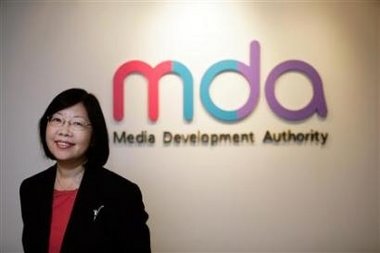


"Erin Brockovich," "Billy Elliot" and "Million Dollar Baby" are among her favorites. "Cut," in which Singapore director Royston Tan settled a score with the censors for mutilating one of his films, is not.

In "Cut," a film buff chases a frumpy censor as she wheels her cart down a supermarket aisle, and reels off a string of films which the bureaucrat had snipped -- from "Lost in Translation" to "Titanic." "Cut" itself, first shown in 2004, was not censored.

"This film misrepresents the Board of Film Censors (BFC) because we are portrayed as being "scissors-happy" when this is far from the truth," Chua, the BFC's chairwoman, told Reuters. "I'd prefer if we are viewed as classifiers rather than censors.

The film won a following among cineastes in the city-state, where an outing to the cinema often used to be memorable not so much for the film itself as for the jerky edits excising bare breasts, sex scenes and obscenities.

"'Cut' is a plea from the Singapore film industry," said Tan.

However, Singapore's long-standing stranglehold over content is being eroded thanks to technology, now that many films can be downloaded for free over the Internet.

Two years ago, following a review of censorship practices, Singapore revised its classification of films and videos, giving a wider range of ratings. Now there is a category for viewers over 18 years old, in addition to existing ones for 16-plus and 21-plus. Now there is less need to cut "adult" scenes as a film can be rated for a mature audience.

NUDES AND PRUDES

"Censorship is a reflection of a country's social norms and values," said Chua, a demure woman in her 50s who is in charge of content for film, video, broadcast and publications at the information ministry's Media Development Authority (MDA).

"In Scandinavia full nudity (on screen) might not be a problem, but if we had full nudity, parents would complain."

The censors' vetting of videos brought into the country for personal use may be eliminated next, Chua said.

The addition of the category for over 18s gave viewers more choice while protecting younger audiences, she said. As a result, films that deal with controversial issues -- at least for Singapore -- can be seen in cinemas.

The city-state officially outlaws gay sex.

Wong Kar-Wai's gay love story "Happy Together" was shown first at a film festival but was not allowed for commercial distribution under the old rating system.

But award-winning "Brokeback Mountain," based on Annie Proulx's story about two gay cowboys, was shown uncut this year.

"It didn't really glorify homosexuality as a lifestyle, and scenes were tastefully shot," said Chua who, as head of the BFC, reviews controversial films such as "Brokeback Mountain" and "Kinsey," which is based on the life of sex researcher Alfred Kinsey.

But Tan, the Singaporean director, ran afoul of censors with his film about local youth gangs: "15" had 27 cuts for offensive language, violence and gang chants which the authorities feared might incite violence and glorify gang culture.

SEX, VIOLENCE AND POLITICS

Singapore's sensitivities extend beyond sex, violence and swear words to political, racial and religious issues, reflecting more than four decades of one-party rule and a population mix of ethnic Chinese, Malays and Indians.

The People's Action Party, which has dominated politics since independence in 1965, has repeatedly used defamation lawsuits against opposition politicians. In the run-up to the May 6 general election, the government warned Singaporeans against posting political commentary in blogs and podcasts.

Last year, Singaporean film director Martyn See had to withdraw his documentary on opposition politician Chee Soon Juan from a film festival. See was then questioned by police, who confiscated copies of the film as well as his film equipment.

"Political subjects can be treated in a film. It's how you treat it, whether it's balanced," said Chua who spent most of her career at Singapore's state broadcaster making documentaries and managing programing.

The Ministry of Information, Communications and the Arts (MICA) said last year that "party political films are disallowed because they are an undesirable medium for political debate in Singapore." MICA said "the ban here is only on films which deal with political issues in a partisan manner."

The See saga prompted a member of the public, Kelvin Lau Jit Hwee, to write to a local newspaper pointing out that the state-owned broadcaster had screened a series about government leaders: Could they also have violated regulations and face investigation by police, he asked.

The government said the series did not breach the Films Act "as the discussions were conducted in a non-partisan manner."

"Things have improved, but it's often a case of two steps forward, one step back," said poet and writer Felix Cheong.

Friday, May 12, 2006

Exiled dissident Tan Wah Piow on Singapore elections


Singapore: New regime, old authority?
Yong Kai Ping and Kuek Ser Kuang Keng
Malaysiakini
May 6, 06

Is Singapore opening up under the new administration of Lee Hsien Loong? Are the new casinos a sign of greater freedom? Will the Singapore elections promise any breakthrough for democracy in Singapore?

For one of Singapore's most renowned dissident, Tan Wah Piow, the new regime under Prime Minister Lee Hsien Loong is experimenting with a slightly more liberal agenda to counter the cynicism among the young, but party politics is still very much under strict control.

According to Tan, the whole political process in Singapore is so "sterile" that nobody will challenge the state's authority unless the state feels there is a need to loosen up a bit for their own interest.

"In Singapore, they will give you the basic rights if only when they feel is good for them," Tan told malaysiakini while visiting friends in Kuala Lumpur last week.

Tan's 'infamy' stems from his student activism heydays at the National University of Singapore (NUS) during the 70s where he was jailed eight months for "inciting riots".

Fearing for his safety, Tan fled Singapore in 1975 and sought asylum in United Kingdom. Later he was admitted to Oxford and studied law. Currently holding a UK passport, Tan is a leading human rights lawyer in London.

Tan spoke extensively on Singapore's coming general election which takes place today. The People's Action Party (PAP) was denied a walk-over victory as in previous elections and now having to contest for 47 out of 84 parliamentary seats, an unprecedented event since 1988.

Q: How do you view the new administration under Lee Hsien Loong?

A: I don't see anything new in terms of mindset. They have made it illegal to campaign via blogging and text messaging during the elections.

Lee Hsien Loong tries to look as though he is giving the opposition a fighting chance. But why they need to take that kind of action against Chee Soon Juan (who was bankrupted for defamation by the government and thus not eligible to contest) if they want to show themselves as being democratic?

The message that you sent to the population is "don't mess around with us." That is the most serious consequence to Singapore's political culture.

It is reported that Lee Hsien Loong wants to wipe out all the opposition in the coming elections to gain a stronger mandate.

Goh Chok Tong's lost four seats when he first led PAP into an election. The second time, he lost two. It is not a question of losing the elections, but the percentage of votes obtained. The benchmark Hsien Loong will be judged on is probably Goh's first elections.


I think he will have to win with less than four opposition seats. However people say that the PAP is now fielding more professionals and they have also implemented the group representation constituencies (GRC) system. To win one (constituency) is already very difficult for the opposition, let alone a GRC.

Probably what they are most afraid of will be the active cynicism, the attitude of "I don't care, you will get in but I will dissociate with you" among the younger generation.

You can praise your own regime by whatever way, people just 'switch-off'. It means the justification for nation building is difficult for them. They won't identify with the party and the state, if I have to leave, I will leave (through migration).

So you think the PAP can't capture the people's attention? But there have been efforts since the 80's to get the people to be involved.

What they are doing appears to be extremely progressive in getting more public participation. There are a lot of those institutions for the old and young but the underlying motive behind is still the hegemony of one party, which is what distorts the whole process.

If you challenge the decision of the state, you will be accused of all kinds of things. They will undermine you before you start. The moment they smell that you have the opposition tendency, they will mark you and if you are really an oppositionist, then you will get into serious problems. If you exist as an individual, they can tolerate you as a eccentric, tolerate in the sense that they won't put you in jail. The moment they sense (you are) organising, then you are in deep trouble.

You don't think the regime is more open now? They are allowing gambling.

That is the neo-liberal economic philosophy, which needs not necessary involve political liberalism. I hope people are not misinterpreting this.

They are experimenting a bit of this and that, but that absolute control is undeniable.

Do you think they are experimenting with political liberalism?

I can't say they are exactly the same as the Lee Kuan Yew's regime, they are experimenting a slightly more liberal agenda but the party politics is still under very much direct control and monitoring.

They will never cease using the Internal Security Department (ISD) to monitor the opposition. I think once an instrument of the state is used to monitor the opposition to serve the ruling party, and not for national security, you can't call such a system democratic.

But why?

They need to respond to the demand of the younger generation, to address the perception that they (PAP) are intolerant and so on. They need to demonstrate that the government is open-minded and tolerant of dissent.


I suppose that is why the senior Lee (Kuan Yew) wanted to test the younger generation's disappointment. The (televised) debate among Kuan Yew and the youths ended up as (a debate) on whether it is right to be disrespectful (to Kuan Yew), but that is not the issue.

So do you still pin the hope on the younger generation?

I think in every political process, they still need new ideas. The youths seem more distracted and show more concern for materialism than political ideals. Singapore wanted to use, although not overtly, Israel as a model to harden national consensus and the sense of national survival.

But I think that is a different context because Israel is very different from Singapore in terms of ethnicity, religion and so on. You can't copy the whole model, the idealism and the sense of nationalism, The urgency is not there.

The whole justification that Singapore can't have democratic space is that you are surrounded, and thus adopting a kind of 'under siege' mentality. You might get some support in the early period but not in this age. I can always pack up and go, then come back to Singapore as a visitor.

There is definitely a close political culture and historical link between Singapore and Malaysia. It is better for us to emphasise on our common destiny instead of differences. Is it by coincidence that the younger generation did not feel any affinity for Malaysia or is it the consequences of the way the Singapore state handles the relationship. I think Singaporeans will know more about Europe or Australia or those places where the culture is alien compared to Malaysia. We have to ask ourselves, is this healthy? Can Singapore's long term destiny be completely independent from Malaysia?

You think Malaysians have the same misunderstanding towards Singaporeans?

If you study in Britain, then you will know how people in the campus look at Singaporeans. There is the impression that they are arrogant, does not have that kind of maturity to understand the differences and disparity; and that they always think they are more sophisticated. In UK campuses, the 'kiasu' mentality is alive and kicking.


Malaysian Chinese may see Singapore as a heaven for career, and really, Singapore, I must say, is very well managed. (But) that cannot be a justification for the restraints in giving political rights. I think Singapore is effective because it has a powerful state intervention apparatus which is far better than any industrialised country.

Someone told me that the government is giving more publicity to the opposition. Apparently Lee Hsien Long is trying to appear to have a clean fight so that they can enjoy a more convincing win. And PAP will win convincingly again.

The whole political process in Singapore is so sterile that nobody will challenge the state's authority unless the state feels there is the need to relax a bit for their interest. In Singapore, they will give you the basic rights if only when they feel is good for them. That's why I can never agree with them.

Thursday, April 13, 2006

Censors say Zahari's 17 Years rated PG, but film fest cancelled screening

A new development has suddenly clouded yesterday's cancellation of the scheduled screening of Zahari's 17 Years as a non-finalist short film entry at the Singapore International Film Festival.

According to a local journalist, the censors confirmed today that Zahari's 17 Years was passed with a PG rating last week. Yet, when I spoke to a festival staff yesterday, he said the screening was cancelled as the censors has yet to authorise the screening.

Somebody bungled. You go figure.

All public screenings of films and videos in Singapore require a permit from the Board of Film Censors. According to its website, exceptions are made for "educational videos, documentaries, programmes for children and pre-1966 movies."

Zahari's 17 Years is my second self-directed film - after Singapore Rebel, for which I am still undergoing police investigations for violating section 33 of the Films Act which prohibits films which contain "either partisan or biased references to or comments on any political matter."

Recently, we have seen a run of documentaries and events highlighting Singapore's political past.
In December, government-linked companies sponsored the "History of Singapore", a three-hour extravaganza on Discovery Channel which had included interviews with former political detainee Fong Swee Suan and veteran opposition leader JB Jeyaretnam.

The recent demise of PAP old guard S. Rajaratnam also precipitated a telethon of tributes on ChannelNewsAsia, sparking a renewed interest in Singapore's post-independence history.

On February 26, a forum entitled Detention-Writing-Healing was held at the Esplanade. Speaking for the first time in public, ex-political detainees Tan Jing Quee and Michael Fernandez described to a packed audience on their experiences under detention without trial. Said Zahari was invited to speak at the same forum but he did not travel due to health concerns.


S'pore International Film Festival hosts political films

The following films will be screened in this year's program, except the last (which due an unsolved gaffe, was not screened).


The Last Communist
Director: Amir Muhammad
Country: Malaysia
Loosely based on the autobiography of Chin Peng, the legendary Malayan communist guerrilla leader, the film tells of the little-known role of the Communist Party of Malaya towards the dissolution of British rule in the country. It features lives of people in present-day Sitiawan, Chin Peng's birthplace in Perak, Malaysia and interviews with Malaysian communists currently living in exile in southern Thailand. Filled with songs and dance routines, the film is an unusual pop cultural document of Malaysian history.


GIE
Director: Riri Riza
Country: Indonesia
Idealist, teacher, writer, rebel and a central yet unknown political activist in the 60s, the darkest era of Indonesian history - that is who Chinese-Indonesian Soe Hok-Gie is. Even as the people around him adjust to Suharto's new regime, he continues to fight. His uncompromising idealism drives those close to him away - his friends and the woman he loves. Awarded the Hubert Bals Fund of the International Film Festival Rotterdam for its content and artistic value and winner of the Best Movie at the 2005 Indonesian Film.


Garuda's Deadly Upgrade
Director: Lexy Rambadeta/David O'Shea
Country: Australia / Indonesia
The death and murder of Munir Said Thalib, Indonesia's leading human rights activist convulsed Indonesian society leading to allegations of military and intelligence involvement. In Garuda's Deadly Upgrade, employing interviews with Suciwati, Munir's wife, and colleagues, Lexy Rambadeta and David O'Shea give an eerie but at times haunting account of the activist's last moments before he boarded Garuda Airlines, Indonesia's national carrier, bound for the Netherlands, and who died on board of arsenic poisoning.


Bush's Brain
Director: Joseph Mealey / Michael Shoob
Country: USA
The explosive documentary Bush's Brain suggests that George W. Bush would never have been president without Karl Rove, the President's closest advisor. Rove is the man known as "Bush's Brain", the most powerful political figure America has never heard of, the Wizard of Oz behind the curtain of today's Presidential politics. Based on the best-selling book by journalists James Moore and Wayne Slater, Bush's Brain chronicles Rove's history of political chicanery and dirty tricks.


Chinese Villagers' DV Documentaries On Village-Level Democracy
Director: Various
Country: China
This film is a collection of 10 short documentary films made by amateur filmmakers from around China. The film explores the experience of democracy by giving a rare glimpse of lives in rural China and the changing dynamics of village structure and governance. The effort is a project under the EU-China Training Programme on Village Governance and the first of its kind to be produced in China.


Waking Up The Nation
Director: Agostino Imondi
Country: Australia / Germany
A group of Australians concerned about the constant media reports of human rights violations against asylum seekers in Australia's immigration detention centres decides to embark on a two-month /12,000 kilometre journey around the country to visit as many detainees as possible, to raise awareness as well as to expose some of the mistreatments.


To Die For
Director: Andibachtiar Yusuf
Country: Indonesia
In Indonesia, in political elections, most people don't know what they should vote for. But there are some people who really know what they should vote for and die for it.


Terlena - Breaking of a Nation
Director: Andre Vltchek
Country: Indonesia
Documentary about a nation that still believes the propaganda created by one general and his army. This film gives voice to those silenced during the dictatorship of Soeharto, and takes an in-depth look both on a cultural and personal level.


Migrant Workers Are Not Terrorists!
Director: Jouni Hokkanen/Simojukka Ruippo
Country: Finland
Christian was a member of the communist party in Germany, but was kicked out because he was too radical. Now the veteran agitator tries to start a revolution in Seoul. During the day he protests outdoors for migrant rights, in the night he sleeps in a tent at Myeong-dong, the Korean equivalent of Times Square.


The Russell Tribunal
Director: Staffan Lamm
Country: Sweden
Stockholm, 1967: With participants including Jean-Paul Sartre, the Russell Tribunal investigates US war crimes in Vietnam. Victims of the war are called to witness. Today, from a distance of more than 35 years, the director reflects on his old footage from the tribunal, as well as some never been seen before.


Zahari's 17 Years
Director: Martyn See
Country: Singapore
In the early hours of 2nd February 1963, security police in Singapore launched Operation Coldstore - the mass arrests and detention of more than a hundred leaders and activists of political parties, trade unions and student movements, for their alleged involvement in "leftist" or "communist" activities. One of those arrested was former newspaper editor Said Zahari, who had been appointed the leader of an opposition party just three hours earlier.

Monday, April 10, 2006

Zahari's 17 Years awaiting approval from censors

Zahari's 17 Years is now before the Board of Film Censorhip, awaiting clearance for screening as a non-finalist entry of the Singapore International Film Festival short film competition. It is one of two short film entries yet to be given a rating by the authorities.

Subject to clearance, Zahari's 17 Years is scheduled to be screened at the following.

4pm, April 16 Sunday
Goethe-Institut
163 Penang Road, #05-01
Winsland House 2


I am optmistic it will pass the cut. Reason is here.


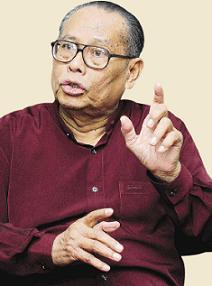
Said Zahari, a former leftist activist, shows his latest memoir in front of his books collection at his home in Kuala Lumpur, Malaysia, Saturday, March 25, 2006. Said Zahari, who was arrested in 1963 and detained without trial by Singaporean authorities for 17 years has written a memoir detailing his experiences as a political prisoner and hopes the book will provide a different perspective of the political events that shaped Singapore's road to independence in 1965 and its first decades of nationhood. (AP Photo/Andy Wong)


Former political prisoner says he's not bitter despite 17 years in
Singaporean detention


By GILLIAN WONG
Associated Press Writer

Apr 8, 2006

SINGAPORE (AP) - In the twilight of his life, a former leftist activist who was arrested in 1963 on suspicion of plotting violent acts and detained without trial for 17 years says he bears no ill will toward Singapore.

"I don't have this sense of vengeance, or feel bitter about what happened to me. Singapore is my country, I love it," said Said Zahari, an ailing 78-year-old who lives in Malaysia. "I only wish that it will become a more open society."

Said also wants young Singaporeans to get another perspective on the often tumultuous events that shaped the road to independence in 1965 and Singapore's first decades of nationhood under the ruling People's Action Party.

The party, gearing up for parliamentary elections soon, still dominates. Lee Kuan Yew, the man who led the party at the time of Said's arrest, remains a powerful force in politics. He transformed Singapore into a regional center for finance and manufacturing, while maintaining a tight grip on society and politics.

Said has written a memoir about life as a political prisoner. A Malaysian publisher will launch the English-language version of the book in Malaysia next month.

Said wants his book to be distributed in Singapore, and a previous political memoir by him is available in at least one Singaporean bookstore and the national library. In a statement, A.R. Madeei, assistant director of publications at the state Media Development Authority, said Said's book, like all imported publications, would be "subject to the laws of the land."

Such laws include prohibitions on publications deemed objectionable on moral, racial or religious grounds, or detrimental to Singapore's national interests.

"The book deals mostly with our lives in prison, those political detainees arrested together with me, and others following that," Said said in a telephone interview from Malaysia.

He said some detainees were beaten and deprived of sleep for days, and that he and other inmates held a three-month hunger strike.

"I wanted the younger generation of Singapore to know the other side of history," he said.

Singapore's longest-serving political prisoner, Chia Thye Poh, was jailed without trial for 23 years from 1966 for alleged communist activities. International human rights groups often protested the detention.

The Home Affairs Ministry had no comment about Said.

British colonizers gave self-government to Singapore in 1959. In the early 1960s, authorities arrested left-wing politicians, trade unionists and Chinese students involved in strikes and rallies, accusing them of being violent subversives planning a communist state.

Said was detained on Feb. 2, 1963, hours after he was appointed president of a left-wing party.

Singapore, which was planning a merger with what later became Malaysia, said the swoop was aimed at individuals threatening to use violence to sabotage the proposed amalgamation. The detainees were jailed under a colonial-era law allowing detention without trial.

Said, who denied the accusations, was held for years, sometimes in solitary confinement, after the merger failed in 1965 and Singapore became independent.

"In solitary confinement, you're deprived of everything. You don't know if it's morning or noon or night, and you've no one to talk to for days, weeks and months," he said.

"So I talked to myself, as if I was dictating to a tape recorder, about my life, about what I did. By doing so, I had relief of the tension in my mind."

He also missed the birth of his youngest daughter and when his wife had breast cancer.

"Those were the days when I felt so horrible to see things happening outside, things happening to my wife that I couldn't do anything about," said Said, his voice low and gravelly.

Said was released in 1979, at age 51. A stroke in 1992 left him reliant on a walking stick and prompted his move to Malaysia, where his children had relocated.

There, he began his memoirs. The new book, entitled "The Long Nightmare: My 17 Years in Lee Kuan Yew's Prison," is the second installment of a planned trilogy he is writing in the book-lined study of his home in Subang Jaya, near Kuala Lumpur.

"In some ways it is sad that young Singaporeans don't know who he is, largely because of the way the history of Singapore post-1965 has been a history of the victors," said Chua Beng Huat, a sociologist at the National University of Singapore.


Young S'poreans need to know more about post-1965 history: PM Lee

By Joanne Leow, Channel NewsAsia

SINGAPORE : More needs to be done to educate young Singaporeans about Singapore's founding fathers and its post-independence history, says Prime Minister Lee Hsien Loong.

Speaking at the 25th anniversary of Raffles Junior College and the official opening of its new campus in Bishan, he said this was one way to help young Singaporeans stay committed to Singapore.

One of the top junior colleges in Singapore, RJC has produced many top students and high flyers.

And with its spanking new premises and independent status, it wants to create more opportunities for its students..

PM Lee said: "But RJC's mission is not just to produce brilliant students who can compete with the best in the world. More importantly, RJC must also nurture a leadership team for Singapore - students who are committed to Singapore and their fellow Singaporeans, because they have benefited from the system, and have a genuine desire to give back to society and make a difference in the lives of others."

The Prime Minister says he hopes all young Singaporeans will get a better sense of their country's history.

In fact, the syllabi in History and Social Studies is being updated to teach the younger generation more about Singapore's founding fathers and its tumultuous post-independence past.

Mr Lee said: "We now have a lacuna, a gap, in the generation of Singaporeans who were too young to know our pioneering leaders first-hand and, at the same time, too old to have learnt the modern syllabus. Hence when Mr Rajaratnam passed away recently, many Singaporeans in their 30s and younger admitted they knew little about who he was and what he had done."

In fact, it was only in the last 6 years that more post-independence history was taught.

This was because the government felt that more time need to have passed to allow for an objective, historical perspective of the events which happened. - CNA/ch

Tuesday, April 04, 2006

Spot the difference - Communist China vs democratic Singapore


Link


China detains documentary filmmaker

31 Mar 2006 15:37:03 EST
CBC Arts

Chinese authorities say they are a holding a documentary filmmaker because he committed a crime but are refusing to give any other details.

Wu Hao has been in police custody in Beijing since Feb. 22. His sister, Wu Na, says she found out Thursday that her brother is being held in relation to a crime but authorities will not allow her to visit him.

"They told me there was no way I can see him," Wu Na said in a telephone interview to the Associated Press. "I'm really shocked at this development. This is a place that's administered by law and yet they can't tell me anything."

She says police have told her that her brother's case is "secret."

Wu Hao spent 12 years living in the U.S. before returning to China in 2004 to make documentaries. The 32-year-old filmmaker's first documentary, Beijing or Bust, dealt with young U.S.-born Chinese living in Beijing.

He had been making a documentary about unregistered Christian churches in China and also participating in a hunger strike to protest the way political dissidents are treated before his mysterious arrest.

Prior to that, the filmmaker had met with Gao Zhisheng, a Beijing lawyer who launched a symbolic hunger strike in February to protest violence against political dissidents. Thousands of others joined the hunger strike campaign and at least 10 of those people have been detained by police or disappeared, according to Gao.

Human rights groups and media watchdogs including the Committee to Protect Journalists (CPJ) and Reporters Without Borders, also called for Wu Hao's immediate release.

"Wu Hao is the sort of courageous and thoughtful journalist China needs," said Ann Cooper, CPJ's executive director, in a statement.

The CPJ says editing equipment and videotapes were confiscated from the filmmaker's apartment in Beijing two days after he disappeared. It wasn't until a full week later that officials at the Beijing Public Security Bureau contacted Wu Na to tell her that her brother - who she thought had disappeared - was being investigated.

"The Chinese government really shoots itself in the foot by detaining people like Hao," Wu Na said in a statement published through the CPJ.


Singapore film-maker questioned by police over movie on rebel
(AFP)

22 March 2006

SINGAPORE - A Singapore film-maker says he has been questioned again by police over his documentary about an opposition politician.


Martyn See told the Foreign Correspondents Association that he was questioned for about 30 minutes on Monday over his short documentary Singapore Rebel about Chee Soon Juan, secretary-general of the Singapore Democratic Party. See's Singapore Rebel has been classified by local censors as having violated the Films Act because of its political content.

The Films Act bans political advertising using films or videos, as well as movies directed towards any political end such as promoting political parties.

See has not been charged but the maximum penalty for making a political film is two years in jail or a $61,850 fine.

"It's arbitrary, the way they term a political film, what constitutes a political film," See said. "Until today I’ve not been told why Singapore Rebel is a political film."

Chinese blogs face restrictions

The Chinese government has announced plans to police web forums, chat rooms and blogs alongside other websites.
Websites in China have long been required to be officially registered.

The authorities are now determined that blogs should also be brought under state control.

Press advocacy group Reporters without Borders said the initiative would "enable those in power to control online news and information much more effectively".

Private bloggers must register the full identity of the person responsible for the sites, the Chinese Ministry of Information Industry (MII) said.

Commercial publishers and advertisers can face fines of up to one million yuan (£66,000) if they fail to register.

All blogs and websites must be registered by 30 June.

'Don't bother'

The authorities hope to push the most outspoken online sites to migrate abroad where they will become inaccessible to those inside China because of the Chinese filtering systems
Reporters Without Borders

"The internet has profited many people but it also has brought many problems, such as sex, violence and feudal superstitions and other harmful information that has seriously poisoned people's spirits," said a statement on the MII website, explaining why the new rules were necessary.

It has developed a system which will monitor sites in real time and search each web address for its registration number. Any that are not registered will be reported back to the Ministry, the statement said.

Blogs are often used in countries where freedom of speech is limited as a way of speaking out against the ruling power.

The new rules could be devastating for bloggers who do not toe the Chinese Communist party line, said Reporters Without Borders.

"Those who continue to publish under their real names on sites hosted in China will either have to avoid political subjects or just relay the Communist Party's propaganda," the organisation said.

"The authorities hope to push the most outspoken online sites to migrate abroad where they will become inaccessible to those inside China because of the Chinese filtering systems," it added.

Known as the Great Firewall, the filtering system used by the Chinese government is not entirely unbreachable; for every new restriction and technical door that it slams shut, the Chinese people find a hack, a workaround or an entirely new way of communicating.

According to official figures, about 75% of sites have already complied with the new procedure.

In May, many bloggers received e-mails telling them to register or face having their blogs declared illegal.

But one anonymous China-based blogger told Reporters Without Borders that when he phoned the MII to register he was told not to bother because "there was no chance of an independent blog getting permission to publish".

Singapore bans podcasting during elections and warns political bloggers

Political debate on the Internet could fuel "dangerous discourse" in Singapore, the city-state's government said on Monday, warning that Singaporeans who post political commentary on Web sites could face prosecution.

Speaking in parliament, Senior Minister of State Balaji Sadasivan said anyone using the Internet to "persistently propagate, promote or circulate political issues" about Singapore during election periods was breaking the law.

Singapore Prime Minister Lee Hsien Loong, whose People's Action Party has dominated politics in the city-state since its independence in 1965, is widely expected to call early elections in the coming months.

"In a free-for-all Internet environment, where there are no rules, political debate could easily degenerate into an unhealthy, unreliable and dangerous discourse, flush with rumors and distortions to mislead and confuse the public," Sadasivan said.

The tiny island-republic's laws require political parties and individuals to register if they want to post political content on the Net.

Print media in Singapore are tightly controlled, but the Internet is rife with Web sites that discuss Singapore politics, from the critical newsgroup Sg-review to the comical Talkingcock.com and blogs such as Singabloodypore and Yawningbread.

It is not clear whether any of these sites has registered with the government.

While Sadasivan said the government's approach was to take "a light touch" in regulating the Internet, political activists have complained that the rules are too broadly defined, preventing an open debate. Sadasivan said a change of the law was ruled out.

The rules also apply to "podcasting," an increasingly popular medium through which audio files are made available for download on the Internet, allowing Web surfers to listen to them at their convenience.

Last year, opposition politician Chee Soon Juan launched a podcast on the Singapore Democratic Party's Web site in an attempt to reach a wider audience and bypass the pro-government media.

Monday, March 06, 2006

Year of the Political Films

Yeah, but try making one in Singapore ...


Nominee for Best Documentary, 2006 Oscars

Street Fight is a chronicle of a rough and dirty Mayoral campaign in Newark, NJ that pitted the young reformer and Rhodes scholar Cory Booker against the old-style political machine of incumbant Sharpe James. The film is currently touring with the Human Rights Watch International Film Festival with upcoming screenings in Berkely, Philadelphia, and Cincinnati.


Nominee for Best Orginal Screenplay, 2006 Oscars
George Clooney, Best Supporting Actor, 2006 Oscars

Syrianna is political thriller that unfolds against the intrigue of the global oil industry. From the players brokering back-room deals in Washington to the men toiling in the oil fields of the Persian Gulf, the film's multiple storylines weave together to illuminate the human consequences of the fierce pursuit of wealth and power.


Nominee for Best Adapted Screenplay, 2006 Oscars
Rachael Weisz, Best Supporting Actress, 2006 Oscars

Adapted from the novel by John le Carre, The Constant Gardener is a romantic thriller that sweeps audiences along one man's emotional and global journey to uncover the truth behind a personal loss and a worldwide pharmaceutical conspiracy.


Nominee for Best Director and Best Film, 2006 Oscars


The world was watching in 1972 as 11 Israeli athletes were murdered at the Munich Olympics. This is the story of what happened next. Based on the true story of the Black September aftermath, Munich is about the five men chosen to eliminate the ones responsible for that fateful day


Nominee for Best Director and Best Film, 2006 Oscars

Good Night, And Good Luck chronicles the real-life conflict between television newsman Edward R. Murrow and Senator Joseph McCarthy and the House Un-American Activities Committee. Murrow, and his dedicated staff defy corporate and sponsorship pressures to examine the lies and scaremongering tactics perpetrated by McCarthy during his communist witch-hunts. In this climate of fear and reprisal, the CBS crew carries on and their tenacity will prove historic and monumental.


Nominee for Best Foreign Langauge Film, 2006 Oscars

Paradise Now is about two Palestinian men preparing for a suicide attack in Israel.


HOLLYWOOD GETS REAL

Sunday, March 5, 2006

By JIM BECKERMAN
STAFF WRITER


The biggest upset of this year's Oscar race may have already happened.

"March of the Penguins," a documentary about the child-rearing habits of Antarctic fowl, has grossed more domestically -- as of Tuesday ($77 million) -- than any of the five films nominated for best picture: "Brokeback Mountain" ($75.4 million), "Crash" ($55.4 million), "Munich" ($46.1 million), "Good Night, and Good Luck" ($30.3 million) and "Capote" ($23.4 million).

"Penguins," which leads this year's pack of Oscar nominees for best documentary feature, may portend much -- beyond the obvious fact that everyone loves a bird in a tuxedo.

It suggests that documentary film -- until recently a category on par with "best sound design" in terms of audience interest -- is fast coming of age.

"I think there's obviously a big appetite of Americans who want to understand the world in greater depth than they get in their television news or newspapers," says Thom Powers, who programs documentaries for Toronto International Film Festival.

"Penguins" is the obvious Oscar front-runner in a year that also includes such worthy documentaries as "Enron: The Smartest Guys in the Room," "Murderball," "Darwin's Nightmare" and "Street Fight."

But "Penguins" is also in many ways an oddity, not unlike the flightless bird it documents.

It played in 2,506 theaters domestically -- as opposed to the 97 theaters that played "Murderball" and the 80 to 100 that played "Darwin's Nightmare," much more typical numbers for a documentary film. It was distributed by a major Hollywood player -- Warner -- as opposed to independents like THINKfilm ("Murderball") and International Film Circuit ("Darwin's Nightmare").

It also had a G-rated family appeal that none of the other documentaries -- for that matter, none of the fictional features -- could match.

"It's a movie you can take the whole family to," Powers says. "It's beautifully shot, and it's hard to compete with the cuteness of penguins."

Films like "Penguins," reaching beyond the standard documentary audience, have given the whole genre a shot in the arm. Since 2002, the stock of the Best Documentary Feature category has steadily risen -- fueled by a handful of films that, for one reason or another, have captured the public imagination.

There was "Spellbound," "Bowling for Columbine" and "Winged Migration" in 2002. Then came "Capturing the Friedmans" in 2003 and "Super Size Me" in 2004 -- also the year of "Fahrenheit 9/11," which, while not nominated, grossed more than any recent documentary ($119 million).

"I think we live in pretty serious times, and I think in serious times people are interested in issues," says Fred Simon, executive producer for the Center for Independent Documentaries, based in Boston.

Several of this year's nominees are clearly "issue" movies.

"Enron: The Smartest Guys in the Room," by Alex Gibney of Summit, gives an in-depth look at the predatory mega-company whose crooked dealings (and connections to the Bush administration) are still front-page news.

"Darwin's Nightmare," by Hubert Sauper, is about a predatory fish -- the Nile perch -- that has colonized and destroyed Africa's Lake Victoria. Much as, the film argues, the Europeans who introduced it have colonized and destroyed Africa.

"Street Fight," by another Summit native, Marshall Curry, is a look at the down-and-dirty politicking in Newark's mayoral race four years ago, in which five-term Mayor Sharpe James swift-boated newcomer Corey Booker using every smear in the book.

The two other films might be considered "feel good" documentaries.

"Murderball," by Dana Adam Shapiro and Henry Alex Rubin, about quadriplegics whose particularly brutal form of wheelchair rugby has become an international sport, is arguably upbeat in a thrash-metal way.

And then there are those penguins -- whose tender nurturing of their offspring through a brutal Antarctic summer has so touched audiences.

The schism between the two kinds of documentaries -- upbeat vs. downbeat, "feel good" vs. investigative or propagandistic -- is as old as the documentary film itself.

As far back as the 1920s, Hollywood documentaries like Robert Flaherty's 1922 "Nanook of the North" (about the struggles of an Eskimo family) and Merian C. Cooper's 1925 "Grass" (about migrating Iranian tribesmen) captured a large audience by telling simple stories of exotic peoples -- without sermonizing. This is the tradition to which 1950s Disney documentaries like "The Living Desert," National Geographic specials and ultimately "March of the Penguins," belongs.

But early on, others saw the potential of documentaries to expose abuses, right wrongs and plead causes. Films like Pare Lorenz's 1934 "The Plow That Broke the Plains" (about the dust bowl) and Herbert J. Biberman's 1954 "Salt of the Earth" (about the abuse of mine workers) paved the way for Michael Moore and for films like "Darwin's Nightmare" and "Enron" -- all miles away, both geographically and spiritually, from those cute little emperor penguins.

" 'Penguins' comes out of a completely different genre than the other films," Powers says. "It comes out of the natural history genre, the kind of films that National Geographic made famous. In a better world for documentary filmmakers, there would be more than one category of award, something that would put 'March of the Penguins' against other natural history films. It's a completely different kind of filmmaking."

Apart from the pure luck that brought movies like "Penguins" and "Fahrenheit" to audiences at exactly the right time, several other things have converged to create what amounts to a documentary renaissance.

One is the sheer number of documentary films being made right now, thanks to digital video.

"To give you an idea of the cost differential here: A 10-minute roll of film costs about $300 to purchase and process," Powers says. "So that's $300 for every 10 minutes. A 60-minute videotape costs $8."

That's pretty much how "Street Fight" came about, for instance. Marshall Curry had never made a documentary when he decided to cover the James vs. Booker mayoral race in Newark with his new digital video camera.

"I just bought a camera and convinced the Booker people to let me film their campaign," he says. "I began shooting in January of 2002 and finished in May. It took me three years to edit after that."

The reduced production costs have not only allowed more people to make documentaries, but it has allowed them to make better ones -- by staying with a story longer, Powers says.

"It results in a much richer story," Powers says. "Take 'Murderball' or 'Street Fight,' for examples. What makes those films so satisfying is the really rich narrative that comes out of hanging around for a long time, for every minute you can."

The other thing is the audience itself: starved for solid news and in-depth information in a sound-bite world.

"Enron: The Smartest Guys in the Room" goes into the Enron scandal with a depth and detail that no news broadcast or "60 Minutes" expose could match.

"People are more interested in examining things they're concerned about," Simon says. "I think documentaries are a natural way to do that."

Friday, February 17, 2006

Families of political detainees : An account

The best years of Singapore's economic development were also the darkest, politically.

From independence in 1965 to the double-digit growths of the 1980s, dozens, perhaps hundreds, of political detainees remained incarcerated in Singapore's prisons, without trial. While very little is known about the lives of political detainees in Singapore, even more overlooked are the families of these detainees.

Below is a rare account by Salamah bte Abdul Wahab, the wife of political detainee Said Zahari, on how she struggled to raise her family, in the absence of her husband and father of her four children, for 17 years.

The interview was recorded by Michael Fernandez in Malaysia a few years ago. An ex-detainee himself, Mr Fernandez told me recently that among the hardships faced by families of political detainees, the family of Said Zahari had probably suffered the most.

Salamah passed away on December 29, 2004.

The Scars of Detention
By Michael Fernandez


Said Zahari and Salamah at their 40th Anniversary in 1995


In July 1961, the Utusan Melayu staff went on strike in Kuala Lumpur and Singapore when UMNO wanted to control its editorial policy. Said Zahari ,its editor-in-chief, not only lost his job but also was banned from entering Malaya by the Tunku.

It was lifted by Dr.Mahathir Mohamed in 1989 when he was a Singapore citizen. For the next one and a half years during this politically ferment period he gave seminars and talks to various civic groups - students, media, and trade unions.

I knew Said Zahari's family quite well; I was able to have a frank exchange of views and information a few weeks ago at their home (Subang Jaya USJ).The whole family was there: Said and his wife Salamah, their eldest son, Roesman older daughter, Rismawati, Norman, and the youngest, Noorlinda and also most of the grandchildren.

During the early hours of the morning of 2nd Feb 1963, a team of Internal Security Officers in Singapore led by ASP Hashim arrested Said Zahari. About 120 leftwing activists were also detained in the Operation Cold Store. Salamah bte Abdul Wahab, the wife of Said, whose kids Roesman (6 years), Rismawati (5), Norman (3) who was adopted by Salamah's sister (he was not around), and the youngest, to be born a few months later, was perhaps kicking her mother's womb in protest against the ISD officers. On seeing the silent tears of Salamah, ASP Hashim tried to comfort her : "Don't worry, cik Salamah, we are taking Encik Said...only for a while."

Thereafter, Salamah was always looking through the main door everyday for a taxi or a car to stop and let out Said. Three days went by, no sign of Said;. A week past, and still no sign of her husband. She tried to pacify her two older children saying, "Bapak would be back soon. He is away on work!"


It was not until three weeks later that she was allowed to see him for a brief 20 minutes in the Central Police Station lock-up in Singapore. She was upset with ASP Hashim for his "for a while" statement, a fellow Malay and a Muslim. She felt there was no need for him to lie to her. She found it difficult to forgive.

MF: I believe that while Said was working, you never went to work. You stayed at home to look after your husband and children. What did you do?

Salamah: For the first nearly six years, we lived with my parents in Singapore. My father Abdul Wahab, a well-known jockey/trainer, had a few houses in Singapore, KL, Ipoh and Penang. We hardly experienced any difficulties. The children went to school regularly. Little Linda was going to K.G. II Chinese Medium, and some of Said's political friends came regularly to the house to help Linda in her studies, particularly Chinese.

MF: After your parents moved out to live in KL, what did you do to earn a living?

Salamah : I sold hawkers food. At that time, Roesman (15) and Rismawati (14) had only a vague idea that their father was a "political detainee". They could not understand its true meaning. For that matter, I too have only a hazy idea of what "political detainee" meant. At times, both Roesman and Risma used to grumble. Because their father was cooped up in prison, they had to do a lot of chores which Bapak should or would have done.


They had to get up very early at 5.00 am, cut vegetables, wash the fish including the ikan bilis, boil and cut the eggs, wash and cut the banana leaves, boil the rice and other little chores. But the grumpiest part of their daily routine was rushing back to the hawker stall at Kallang Place immediately after school in order to help wash up and pack up the pots and pans. In those days it was not easy to get a trishaw to go home. On the way, I used to drop at the Geylang Serai market to buy the groceries for the following day. Both Roesman and Risma had to come back to the market to carry the things back home. Thus the children had very little time to study or play with other children of their age. It was tough for them and I must admit that quite often for small mistakes, I used to cane them. I vented all my frustrations on them. And if the beating was at night, the older ones used to run out of the house and the next victim was the smallest, Linda!

At this point, Linda, who was seated on the floor leaning against her mother's lap, gestured to me the beatings she used to get! The whole family burst out laughing at her precise gestures.

It was on these occasions that I longed for my husband to be beside me to comfort me, to advise me what to do, to lighten my aching burden of responsibilities, to help me rest from these daily increasing problems which were taking a heavy toll on my nerves. And I often had splitting headaches .

Many a time I felt like giving up in despair, but every time I thought of doing that, the thought of facing Said after that was the shame I could not think about. But what kept me going was the promise I made to Said when he teasingly asked me once and I replied rather heroically," I'll carry on somehow, don't worry."

MF: You had an operation at the Singapore General Hospital. When was it ,Salamah, Is it ok to talk about it? I hope its not too painful to dwell on it.

Salamah: No. It is a bit painful still to recall. Yes, it was one of the darkest trials of my life. It was in June 1968. I was lying semi-conscious in the hospital after my operation to remove my cancerous breast. In my heart I really wished that the operation would free me from this cruel world. When I was admitted, our family friend, Dr Beatrice Chen, a kidney specialist, and wife of Dr Lim Hock Siew, a fellow detainee with my husband, did not tell me that I had cancer, that my breast was to be removed! I heard the truth from Said's mouth when he was brought to the Hospital, escorted by two Internal Security Officers.

CONFLICT WITH THE AUTHORITIES

During the Interview, Salamah related a few incidents she could remember vividly.

On one occasion, the Internal Security Officers at the weekly family visit in Changi Prison introduced a rule not to allow more than two people at a time. Salamah brought her two older children, Roesman and Rismawati. They would not allow Risma in. It was a human tug-of-war between Salamah on one side and an ISD officer on other side. The little Risma provided herself as the "rope". Salamah shouted and cursed them for their inhuman behaviour, till they gave up in despair and cancelled the "rule of two only."

Another rule they introduced was not to allow detainees to receive cooked food from home except on festive occasions like Chinese New Year, Deepavali, Hari Raya Puasa and Hari Raya Haji. On a Hari Raya Puasa occasion, the ISD officers wanted to cut up the ketupat (steamed rice in a thatched-leafy container) into several pieces for "security" reasons. Salamah protested and scolded them. "These are for human beings to eat, not for animals!", she lashed out at them. When she angrily picked up the bunch of ketupat to throw at them, they relented and gave in. They even wanted to cut up the chicken in the chicken-curry. Her outburst was so furious that they gave up but warned her that it was the last time she would get away with it.

She was also unhappy with the Singapore authorities for discriminating her. Though she was born in KL, she lived most of her life in Singapore. She studied in the Methodist Girl's School in Singapore. In 1968, when she applied for a hawker's licence to sell food, the Government turned it down, saying she was a Malaysian. She had to rent a stall to sell food. Quite often, the stall-owners got into trouble if they were not around whenever the health officer came to inspect the stalls.

CONFLICTS WITH THE RELATIVES

Perhaps the most heart-rending trauma that Salamah, the wife of Said Zahari, experienced was from the relatives of both sides - hers and his. When the newspapers were howling mad at Said's friendship with the Brunei rebel leader Azahari and his friendship with Lim Chin Siong, Mahadeva and others, Salamah came under increasing pressure from the relatives. They often hinted unkind words; sneered at her helplessness; poked fun at her children about their absent father; made snide remarks about her freedom from her husband.

Salamah related to me an incident that took place in her mother's house in late 1968 when her parents were preparing to move to KL permanently. It was a few months after her cancer operation and just after she started selling food at a hawker's stall. Salamah's mother invited Said's mother, some of his brothers and his sister for a kendoori (a Malay feast) in her mother's house. Apart from her parents, her sisters and a couple of her brothers were also present.


It was a rare occasion that Salamah witnessed. When all were assembled in the hall, Said's mother asked her about the food business. When she told her it was "susah"(difficult), she added, "memang-lah" (of course, it was difficult).

Said's mother continued, "Did you tell Said it was tough?" When Salamah didn't answer, Said's mother shouted, "Tell me ,why didn't you tell him? Why didn't you ask him to come out? To look after you and his children? Why?"

"I have never seen Said's mother so angry", Salamah recounted to me.

"I answered rather meekly, 'I didn't want to upset Said unduly'.

She lashed out again, "What rubbish are you talking?"

Then a female voice, who shall remain unnamed ,said, in an even tone, "Listen, we all wish you and the children a good life. You can't have that by selling hawker's food. You must persuade, no, force him to come out. If he is stubborn, give him an ultimatum and then divorce him and get married again. You are still young!"

Then several voices murmured, "betul!" (true) .

I couldn't take it any more. Then I shouted, "I can't do that!"

Then her own mother also added, "It's for your own good."

Then another female voice shouted sarcastically, "She doesn't want to ask Said to come out because she can be free to do what she wants."

These cruel words pierced her like stab wounds. Covering her tearful eyes, Salamah ran out of the house, wanted to escape from everybody and everything. She went behind the house and just sobbed and cried her heart out.

Their words were certainly cruel, but were they malicious? Or were they uttered out of genuine concern for her and her chidren? Salamah cursed her husband within her heart for putting her through such malicious attacks, but she recovered soon enough to take comfort in her passionate love for her husband. Their heartless words only strengthened her love for her husband, and faith in Allah, and
she prayed hard for greater patience and strength to bear these and more tribulations.

THE CHILDREN

A few weeks ago, I interviewed Said Zahari, his wife Salamah, his four children and most of his 16 grandchildren who were there, and whom Said described as his "only wealth", at his small terrace house in USJ, Subang Jaya, KL.

Roesman, 44, was a tower of strength to his mother and his brother and two sisters. Though he could not understand at first why bapak(father) was sitting in prison while he and his sisters toiled with his mother to support the family. Gradually when he understood that bapak was struggling even in prison to fight for social justice, he adopted his father's ideals as his own and tried to live up to it as the loyal son of Said Zahari. Roesman studied law at a private college in KL but had to abandon it halfway in order to go back to Singapore to help his mother sell food. He worked hard to support his mother, lived as an example to his brother and sisters, later to his wife and his two daughters of whose achievements he's justly proud.

Rismawati, literary-minded like her father, was the letter-writer for the family. She used to give her father all the news of the family in her weekly letters. With her husband, she runs a kindergarten and childcare centre.

Norman Noordin alias Norman Said was adopted by his mother's older sister, a nurse, Saliah, who married Dr. Raja Ahmad Noordin (now Tan Sri Raja Ahmad Noordin) . He was educated in the UK and US. He's now a senior executive in a private firm. Norman lives near his natural parents and visits them regularly.

Noorlinda, the baby of the family, has six children of her own to look after. However she refuses to have a maid even though her engineer husband advised her to have one. She was in her mother's womb when papa was arrested in 1963. She had no feeling for her father until very recently. Though she's 38, she told a human Rights Convention in KL, when she was only 12, in 1975, the ISD officers in Singapore never allowed her father to touch her or cuddle her, and that she could only speak to her father over the phone whenever she visited him in prison. She grew up a stranger to her father.

Said's two eldest grand-daughters (Roesman's) are Shirin and Shauna, both in their late teens, told me that, "toh (grand-dad) has been and will always be our role model". Shirin just completed her Diploma in Mass Communication and likely to follow her grandfather's footsteps, and Shauna is entering International Islamic University to study law. Both are not only lovely-looking but are very bright, particularly very skilful in English language. They had their early education in Singapore.

Conclusion:


Who sacrificed and suffered the most? For the family and for the country: Was it Said Zahari the husband, or Salamah, the wife?

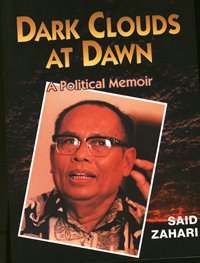
It is obvious, as Said Zahari himself stated in his dedication to the book Dark Clouds At Dawn (A Political Memoir) that her "sacrifices and sufferings were a thousand times more than mine" . The real heroine in this tragic story is Salamah.

Why did she sacrifice the man she loved so passionately to Changi Prison, the husband on whom her children and she depended, the father of her young kids? Was it for some personal glory or for some financial reward? Or for some high position in society? She went through this trauma for 17 years, for what?

Some would call her a "fool", some others would merely "pity" her, and very few would really support her unwavering stand. Was the sacrifices and suffering she went through only for the love of her husband? Was it anything to do with Said Zahari's ideal of democracy, social justice and press freedom which is still a burning issue?

I asked Salamah (now 65): Have all the wounds you received, both physical and emotional from various sources, been healed ever since Said lost his editorship job in 1961?

She hesitated for a moment, frowned and knit her eyebrows and said slowly and deliberately,"Most of them have healed. But the big scars like the one on my breast will never heal...Would be permanent scars to remind both of us what we went through together."

Michael Fernandez.

(The writer, in Singapore, has been a long-time family friend of Said Zahari and was with him in the Changi Prison in Singapore)


Said Zahari and Michael Fernandez will be speaking at Detention-Writing-Healing on 26 February, 3pm at the Esplanade Recital Studio.

Sunday, February 12, 2006

Heady days of newspapers and politics

Catching up with... Said Zahari: Heady days of newspapers and politics

WAN HAMIDI HAMID
Feb 12
New Sunday Times


In 1961, a young, idealistic chief editor led a strike in Kuala Lumpur trying to avert Umno's takeover of Utusan Melayu. Banned from Malaya, he returned to Singapore where two years later he was detained without trial for 17 years. Former chief editor Said Zahari tells his story to WAN HAMIDI HAMID.

HE must be one of the unluckiest political leaders alive. Less than four hours after he became chairman of opposition party Partai Rakyat Singapura, Said Zahari was arrested.

Said was among more than a hundred detained in Singapore's crackdown on the opposition under Operation Cold Store.

He was held without trial for 17 years. Chia Thye Poh, who spent 27 years in detention, was the longest-serving political detainee in Singapore. (My note : Chia spent a total of 32 years under ISA)

Now 78, Said is probably better remembered in Malaysia than in Singapore for his key role in a historical event here.

He led the journalists and staff of the Utusan Melayu to strike for 91 days in 1961, fighting to keep the newspaper free and independent of political control.

Towards the end of the strike, Said returned to Singapore for a short visit. That was when then Prime Minister Tunku Abdul Rahman declared him persona non grata, barring him from returning to Malaya.

He spent the next two years in politics in Singapore before Special Branch officers came knocking in the early hours of Feb 2, 1963.

Operation Cold Store crippled the opposition in Singapore.

At the time, he thought he would get out soon.

"I never expected I would spend such a long time as a political prisoner," said the ever-smiling Said.

He recently published a second volume of memoirs, on his long detention. Dalam Ribuan Mimpi Gelisah (The Long Nightmare). He had earlier written Meniti Lautan Gelora which was published in 2001.

When he joined Utusan Melayu in Singapore in 1951, the region was in turmoil. Like other Malay journalists of the time, Said was heavily influenced by Sukarno’s struggle for Indonesian independence from the Dutch.

"He proved that we could oust the colonialists and rule our own country."

Said acknowledged he had been drawn to the People's Action Party when it was formed in 1954.

He got to know its young leaders - Lee Kuan Yew, Devan Nair - and fellow journalist A. Samad Ismail. Said found PAP more progressive than others of the time.

It was also the year Utusan sent the Singapore-born Said to Kuala Lumpur to become its news editor.

Pro-Umno even then, Utusan supported the Alliance in the first council elections in 1955 "because Umno was fighting for independence".

After Independence, Utusan continued to press the new Malayan Government for land for farmers and workers' rights.

The Tunku was unhappy with criticism that Umno was continuing to protect the interests of the British, who still decided defence, foreign and economic policies.

"Tunku even called me for a one-on-one discussion. I argued that Utusan fights for the Malays, especially the poor Malays."

Many Umno leaders wanted Utusan to become its mouthpiece, but the editorial leadership stuck to its guns. When Said was made chief editor in 1959, the brewing crisis deepened, leading to the strike.

When he could not return to Malaysia, the new Utusan management under Umno control washed their hands off him.

"As you know, it was the shortest political career for me," he said.

He believes PAP founder Lee thought he would be a political threat.

"That's why after failing to obtain any confession from me, during my eighth year in detention, Lee declared publicly that I was a communist.

"That was a lie. (It was) to discredit me and my colleagues for believing in Malayan nationalism, for totally opposing any form of colonialism.

"I know what is nationalism, what is communism. I read Marx, Mao and other works on the economy and politics. I read the Quran and the Hadith.

"I believe Islam is much more than a political philosophy and it surpasses ideologies such as communism, and Islam is definitely the best for me."

He didn’t sound bitter at the interview, but in his latest book, he described Lee as vicious, arrogant and ruthless.

In 1979, Said was released at the age of 54, and joined wife Salamah to start a new life.

"I was too old for mainstream journalism and politics was extremely different from what it used to be."

In 1989, the Malaysian Government revoked Tunku’s order. In 1994, he came back and has not returned to Singapore since. (My note : Said made short trips to Singapore after 1994, but has not crossed the causeway since the launch of Dark Clouds At Dawn in 2001. He remains a Singapore citizen.)

Said, who suffered a stroke in 1992, is now writing his third book on his memoirs of his journalistic and extremely short political life before he turns 80.

"After that, God-willing, I want to write about my best friend and companion, my wife Salamah who passed away a year ago."

He lives alone but is always in the company of his daughter and her children. He walks with the aid of a walking stick, both legs weak from the stroke.

After finishing the book on his wife, he hopes to write on Malaysia-Singapore politics, seen through the eyes of a journalist.

"I can only write. That's all I know and will continue to do," he said.

He attends seminars and conferences to talk about journalism and politics, and Press freedom.

Comparing journalism today with that of his time, he said: "The attributes are different. It is unfair to compare them. During my time, no political parties controlled the Press.

"My advice to journalists today is that if you can do a little bit, just do that little bit. It's better than not doing anything."


--------------------------------------------------------------------------------


MEMORABLE JOURNEY

1928 - Born, Singapore

Early 1940s - Tanglin Malay School, Singapore

1942 - Japanese military invaded Singapore

1944 - Joined Japanese Teachers Training College, Singapore

1945 - Japanese surrendered; end of World War Two

1947 - Sat for Senior Cambridge examination

1951 - Joined Utusan Melayu, Singapore

1954 - Sent to Utusan Melayu Kuala Lumpur bureau as News Editor

1959 - Appointed Utusan Melayu Chief Editor, Kuala Lumpur

1961 - Led the Utusan strike, Kuala Lumpur

1961 - Declared by Tunku Abdul Rahman as persona non grata ; barred from entering Malaya 1963 — Elected chairman of Partai Rakyat Singapura; arrested under Preservation of Public Security Ordinance

1963-1979 - Detained without trial as political prisoner, Singapore

1989 - Malaysian Government revokes persona non grata order

1994 - Moved to Malaysia with family

1996-1999 - Fellow of Universiti Kebangsaan Malaysia

2001 - First memoir Meniti Lautan Gelora published; English version Dark Clouds at Dawn published in Kuala Lumpur

2002 - Chinese version of Meniti Lautan Gelora launched in Hong Kong

2004 December - Wife Salamah Abdul Wahab dies

2006 February - Second volume of memoirs, Dalam Ribuan Mimpi Gelisah, published in Kuala Lumpur

Monday, January 16, 2006

Mahathir may launch Said Zahari's book

Ex-top editor re-lives days in detention

James Wong Wing On
MALAYSIAKINI
Jan 9, 06 12:49pm

The second part of the memoirs of former Utusan Melayu editor-in-chief Said Zahari will be published in Bahasa Malaysia, Chinese and English.

It is believed that the publication will be launched by former premier Dr Mahathir Mohamad in Kuala Lumpur soon.

The first part, Dalam Ribuan Mimpi Gelisah: Memoir Said Zahari, was translated into two other languages in 2001, with the English title being Dark Clouds at Dawn.

Singapore-born Said, now 77, was among the longest detained political prisoners of the Lee Kuan Yew government.

On Feb 2, 1962, he was held under the Preservation of Public Security Ordinance based on allegations that he was a communist and an agent of Indonesia. It was in the wake of a controversial strike he had organised among Utusan journalists against the takeover by Umno.

However, up to the time of his release in August 1979 at the age of 54, he was never charged or tried in a court of law. He spent a total of 17 years in detention - about a quarter of his life. Human rights watchdog Amnesty International declared him a 'prisoner of conscience'.

In the forthcoming publication, Said will formally call Lee (photo) an "Anglo-American pawn" (tali-barut Anglo-Amerika) and accuse him of acting on behalf of the "neo-colonial" political, economic and strategic interests of Britain and the United States in Southeast Asia during the Cold War.

Said will also tell his version of history of the anti-colonial struggles in Singapore and Peninsular Malaya as well as other parts of Southeast Asia, including Sarawak, Brunei, Indonesia and Vietnam.

Details of detention

The 265-page memoirs detail his life and experiences while under detention, including being interrogated by the Special Branch and being held in solitary confinement.

He will relate the physical and psychological tortures inflicted on fellow detainees like Lim Chin Siong, and the mental illnesses that some suffered as a result of torture.

While under detention, Said learnt the Chinese language from fellow detainees who were once student leaders of the now defunct Nanyang University.

Said will also reveal that, over the past few years, he has visited several top leaders of the Communist Party of Malaya such as Abdullah CD, Chin Peng, Rashid Maidin, Suriani Abdullah (Eng Ming Ching) and Abu Samah Mohamad Kassim in southern Thailand to conduct his research into the historical background of Malaya and Singapore in the 1950s and 1960s.

He also had a long-standing intellectual relationship with the late Dr Alijah Gordon, an American who passionately supported the Palestinian cause of national liberation.

On the current situation in Malaysia, Said expresses strong empathy with former deputy premier Anwar Ibrahim and calls him a "statesman". However, he is also critical of some aspects of Anwar's style of political workings since being released from prison in September 2004.

Said calls for a reconciliation between Mahathir and Anwar, well as for the abolition of the Internal Security Act which allows for indefinite detention without trial.

The author is best known for leading a three-month strike by journalists and other employees in 1961, at then independent Utusan Melayu in Kuala Lumpur. As its editor-in-chief, he was opposed to the takeover of the newspaper by Umno.

While Said was visiting the newspaper’s Singapore office, Malaysian premier Tunku Abdul Rahman declared him persona non grata and banned his re-entry into Malaya.

The order was revoked on May 26, 1989 by Mahathir and Said's family moved to Malaysia in 1994.

Two years later, Said was appointed a guest writer by Universiti Kebangsaan Malaysia. In 2003, he was made a Resident Writer of official national security online publication Buletin Malaysia.

______________________________________________________________________

Books on ISA by Singaporean authors


To Catch A Tartar by Francis T. Seow
Published in 1994, copies of the book mysteriously disappeared from the shelves of Select Books at Tanglin Shopping Centre days after they arrived. It has never surfaced in any bookstore or library in Singapore since then.


To Be Free by Dr Chee Soon Juan

Apart from Select Books, no other bookstore in Singapore would dare carry this title. However, it is available for loan in most public libraries. The author has been prosecuted and fined for hawking the book on the streets.


Dark Clouds At Dawn by Said Zahari

Said Zahari launched his first book in 2001, alongside Comet In The Sky : Lim Chin Siong in History

Both titles are still available at Select Books.

Pak Said, as he is affectionately known in Malaysia, will launch The Long Nightmare : 17 Years in Lee Kuan Yew's Prison in Malaysia next month. Expect the book to meet the same fate as Francis Seow's To Catch A Tartar.

Tuesday, January 10, 2006

Said Zahari and ex-detainees to speak at arts forum


Straits Times,Jan 7, 2006
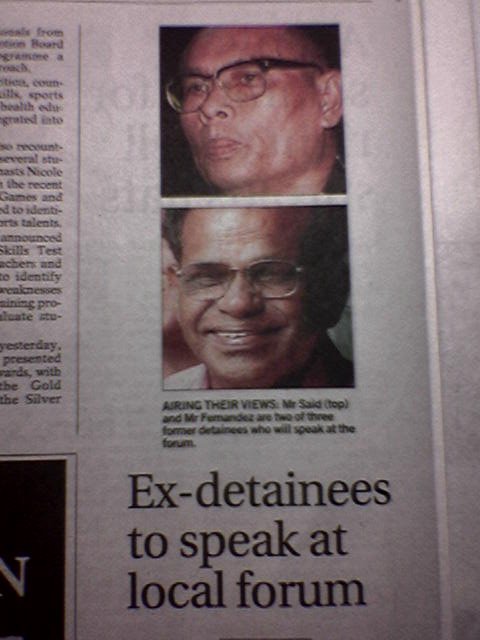
Ex-detainees to speak at local forum

By Ken Kwek

FORMER journalist and opposition figure Said Zahari is among a group of former political detainees who will speak at an arts forum next month.

Organised by The Necessary Stage, the forum on Feb 26 is part of the Singapore Fringe Festival.

The other speakers include two other ex-detainees, lawyer Tan Jing Quee and
former trade unionist Michael Fernandez. Also on the panel is playwright Robert Yeo, who wrote Changi, a tragic drama about political detention in which the lead character was inspired by Mr Fernandez.

They will take part in a discussion entitled 'Detention - Writing -
Healing'.

Mr Fernandez, 71, who was detained from 1964 to 1973 on suspicion of being a communist, said the forum was not a platform to argue his case politically or to refute the charges previously made against him.

'It is simply an occasion for healing, for sharing one's experience with a younger generation of Singaporeans who weren't around during those tumultuous years.'

Mr Said, 77, a Singapore citizen with Permanent Resident status in Malaysia, said he was 'rather surprised' to be invited to a public forum to air his views in Singapore, given his criticism of issues such as the Internal Security Act, which gives the Government powers of detention without trial.

'Such an event would not have taken place in the country even five years ago,' said Mr Said, who is now an academic in Kuala Lumpur. 'Perhaps there is a slightly more open political climate now,' he added.

The former editor of the Malay newspaper Utusan Melayu was also president of opposition party Parti Rakyat Singapura. In 1963, he was arrested in Operation Cold Store, a government security operation which saw 111 left-wing politicians and trade unionists being nabbed for suspected subversive activities.

He was released in 1979 at age 51 and became editor of the economic journal Asia Research Bulletin. He moved to Kuala Lumpur in 1992 and took up a fellowship four years later at the Universiti Kebangsaan Malaysia. The first volume of his memoirs Dark Clouds At Dawn was published in 2001. The second installment will hit Malaysian bookstores next month.

He is also the subject of a new film by local filmmaker Martyn See, titled Zahari's 17 Years.

Mr See, 36, has not decided when or where he will premiere his 50-minute film, but said he hoped it would not suffer the same fate as his last film.

Singapore Rebel, about opposition leader Chee Soon Juan's clashes with the Government, was deemed an illegal 'party political film' and banned by the Board of Film Censors last March.

Of his new film, Mr See said: 'Most Singaporeans, especially those from the younger generation, don't know who Said is. But his story is relevant, and offers an important if different view of Singapore's history.'


Today Weekend, January 7, 2006


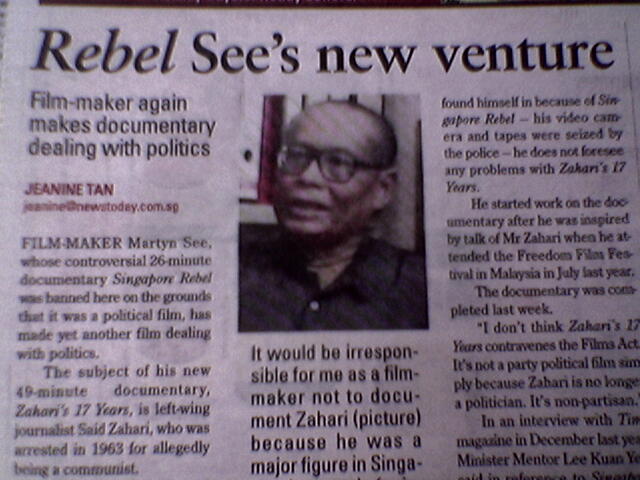
Rebel See's new venture

Film-maker again makes documentary dealing with politics

Jeanine Tan
jeanine@newstoday.com.sg

FILM-MAKER Martyn See, whose controversial 26-minute documentary Singapore Rebel was banned here on the grounds that it was a political film, has made yet another film dealing with politics.
.
The subject of his new 49-minute documentary, Zahari's 17 Years, is left-wing journalist Said Zahari, who was arrested in 1963 for allegedly being a communist.
.
Mr Zahari, 78, was detained without trial for 17 years in Singapore. Prior to his arrest, he had been banished from Malaysia for being a part of a strike involving Malaysian newspaper Utusan Melayu.
.
A Singapore citizen, he now lives in Kuala Lumpur.
.
"It would be irresponsible for me as a film-maker not to document Zahari because he was a major figure in Singapore's struggle for independence.
.
"He is a living document of the leftist struggle for independence," Mr See, 37, told Today.
.
"Zahari's story is an alternative take on the history of Singapore that was presented in the Discovery Channel's The History of Singapore."
.
Despite the trouble Mr See found himself in because of Singapore Rebel - his video camera and tapes were seized by the police - he does not foresee any problems with Zahari's 17 Years.
.
He started work on the documentary after he was inspired by talk of Mr Zahari when he attended the Freedom Film Festival in Malaysia in July last year.
.
The documentary was completed last week.
.
"I don't think Zahari's 17 Years contravenes the Films Act. It's not a party political film simply because Zahari is no longer a politician. It's non-partisan."
.
In an interview with Time magazine in December last year, Minister Mentor Lee Kuan Yew said in reference to Singapore Rebel, which chronicles opposition politician Chee Soon Juan's political activities: "Well, if you had asked me, I would have said, to hell with it.
.
"But the censor, the enforcer, he will continue until he is told the law has changed. And it will change ... "
.
"The making of Zahari's 17 Years wasn't intentional, the subject matter just came up.
.
"I find myself drawn to people who struggle against the odds."

Friday, January 06, 2006

Zahari's 17 Years - a new film by Martyn See


Zahari's 17 Years Running time : 49 min

Synopsis

In the early hours of 2nd February 1963, security police in Singapore launched Operation Coldstore - the mass arrests and detention of more than a hundred leaders and activists of political parties, trade unions and student movements, for their alleged involvement in "leftist" or "communist" activities. One of those arrested was former newspaper editor Said Zahari, who had been appointed the leader of an opposition party just three hours earlier. A staunch anti-colonialist, Zahari had assumed that the mass arrests, set against the backdrop of Singapore's struggle for independence, was no more than yet another turn of event in a politically volatile era. Freedom for him and the others, it seemed, would be secured once Singapore gained full independence. On 9th of August 1965, by way of its separation from Malaysia, Singapore finally gained full independence and sovereignty. And as the republic embarked on a determined quest for economic prosperity, it dawned on Zahari that his new-found Singaporean citizenship did not accord him freedom. By the time he was released in 1979, he had spent a total of 17 years in detention without trial. He now holds the distinction of being the second longest-serving political detainee in Singapore after Chia Thye Poh. Ex-detainees of the Internal Security Act, which allows for indefinite detention without trial, are often reluctant to publicise their experiences. Zahari's 17 Years marks the first time that an ex-political detainee has broken his silence on film. Said Zahari's upcoming book, entitled "The Long Nightmare - 17 Years in Lee Kuan Yew's Prison", is the second volume of his trilogy of memoirs which recount his experiences in detention and the anti-colonial struggles of his generation. Director
Zahari's 17 Years is directed, shot and edited by Martyn See. Martyn See is currently undergoing police investigation for his first film, 'Singapore Rebel', which has been banned by the Singapore authorities for violating the Films Act pertaining to political films. If convicted, he faced a maximum sentence of two years imprisonment or a S$100,000 fine. __________________________________________________________________

Excerpt from the Straits Times round-up of political news stories in 2005, published on 31st Dec 2005 Political expression: Speaking up This year has been a year of white elephants, a silent banner/T-shirt protest and a documentary on an opposition politician. The results so far: Several police investigations and a warning, leading to criticism of a clampdown on political expression. Will similar attempts be made next year? Insight is betting on it. The warnings may dissuade some would-be "protesters" but there will be others tempted to push the boundaries to see if the Government will honour its promise to open up. When that happens, it will certainly spark more debate. Businessman Ong Yang Peng, 59, is one of many who are still bristling over the Case of the White Elephants. He says: "Freedom of political expression is the primary means for Singaporeans to feel ownership of their country...If they have no hand in determining the future of the country, how do they feel a sense of ownership?" He wants the Public Entertainment Act to be amended or even scrapped, to give room for "creativity". The Government has said it would reviewed the Films Act, which had caused film-maker Martyn See's documentary on opposition leader Chee Soon Juan to be banned and confiscated by the police. Singapore Rebel was defined as a "party political film", but Minister Mentor Lee Kuan Yew had said he would not objected to it. No date has been set for the reviewing of the Films Act, but Mr See looks set to revive the debate over whether it is too limiting. He has made another political documentary about an opposition figure: Mr Said Zahari, the former president of opposition party Partai Rakyat Singapura. Now aged 77, Mr Said was detained for 17 years after he was arrested in 1963 on suspicion of being a communist. Says MP Amy Khor of moves to open up: "We really have no choice... With growing affluence and education come the aspirations of the people to have a bigger say in the manner in which their country is governed, and to exercise their democratic rights beyond the ballot box, and in the arena of shaping public policy."