Censorship: What's the way forward?
By Loh Chee Kong,
TODAY Posted: 27 April 2007
SINGAPORE: The decision by the Ministry of Information, Communications and the Arts — and its use, for the first time, of the Minister's discretionary powers — to ban a film based on the arrest and detention of a former journalist and politician throws up a number of questions.
Why ban the film, Zahari's 17 Years, when it was passed with a PG rating not once but twice last year, to be screened at the Singapore International Film Festival and the Substation's Asian Film Symposium?
Neither organiser screened the film and it was reported that the Media Development Authority had told the Substation that the film may include defamatory content.
Why ban the film when the memoirs of Mr Said Zahari, a former editor of the Malay language newspaper Utusan Melayu and president of Parti Rakyat Singapura, are available in bookshops here?
As the 77-year-old told AFP: "What I said in the movie I have already said in my book, and much, much more."
Why create unnecessary curiosity and drive people online to watch the film, which has already found its way on to the Internet?
In today's wired world, it is more likely than not, the ban will be ineffective and counter-productive. Minister Mentor Lee Kuan Yew said as much recently: Censorship in the Internet age "makes no sense".
Indeed, a movie has a wider and more evocative reach than a book, since voice, motion, drama and images do tend to have a bigger impact on shaping the minds of audiences — which is why different rules must apply to different media, especially on issues that could get the viewers worked up.
I saw the film before the ban. It gave an account of Mr Said's arrest and detention days — including his recollection of taking Chinese lessons from a fellow detainee. He said he was not a foreign agent, nor a communist sympathiser. He also spoke critically about Mr Lee, when asked for his take on why he was detained.
Mica said that the film gives a "distorted and misleading" portrayal of Mr Said's arrest and detention and "could undermine public confidence in the Government". The film, it added, was "an attempt (by Mr Said) to "exculpate himself from his past involvement in communist front activities against the interests of Singapore".
Most Singaporeans recognise a good government — and a flat lie for that matter — when they see one. If the authorities were worried about whether the audience would be discerning enough to separate the wheat from the chaff, they could have given the film a higher classification rating.
If the intention was to send an unequivocal message, there are better ways to do so, including a rebuttal of the false accusations.
The Government has every right to take a stand against what it feels is a distorted account. If it felt that an open rebuttal would raise the film's profile unnecessarily — which it has inadvertently already done with the ban — the authorities could impose, as a condition for screening, a "government advisory" at the start or end of the film, to refute any misleading statements.
Actually, this was a great opportunity for the Government to engage Singaporeans on an important part of the country's history.
The tumultuous period from the '50s right through the '70s, with its backdrop of riots and demonstrations, can arguably be described as the defining period of nationhood.
These events, which were openly documented by newspapers, shaped the Republic's relatively short but no less rich history.
Yet, our school children do not get a good grasp of these events from our history textbooks — the same sources that described the '50s Hock Lee bus riots as having been primarily fuelled by dissatisfaction with long work hours and low pay.
Some researchers and historians have offered other possible reasons for the riots, such as anti-colonial sentiments and instigation by pro-communist quarters.
It is not that these accounts are not available here. One can go to the Internet, visit libraries and bookshops, attend forums — like the one held last year by former political detainees Messrs Tan Jing Quee and Michael Fernandez — or even get second-hand accounts from their parents or grandparents, to piece together this important chapter of the Singapore story.
Censorship is a double-edged sword, especially in today's YouTube world, where privacy is constantly under threat.
Allow anything and everything and you are likely to have an uncontrollable situation on your hands. Cut and censor and you will have a population hungry for the forbidden fruit.
So, how do we move forward?
Engage Singaporeans, let contrarian views find their voice and challenge the views of those who have different accounts.
The Government took a rare and bold move to debate ministerial salaries openly in Parliament, although it was not duty-bound to do so. Singaporeans wrote in to newspapers to give their views, not all of them agreeing with the Government.
Censorship deserves a similar airing. I can't think of a better way forward. - TODAY
----------------------------------------------
Further readings
Digging into foundations is mischief
Defending the national scripture
Now S'pore copies M'sia: Bans another film
Saturday, April 28, 2007


Tuesday, April 24, 2007
RSF urges Singapore to lift ban
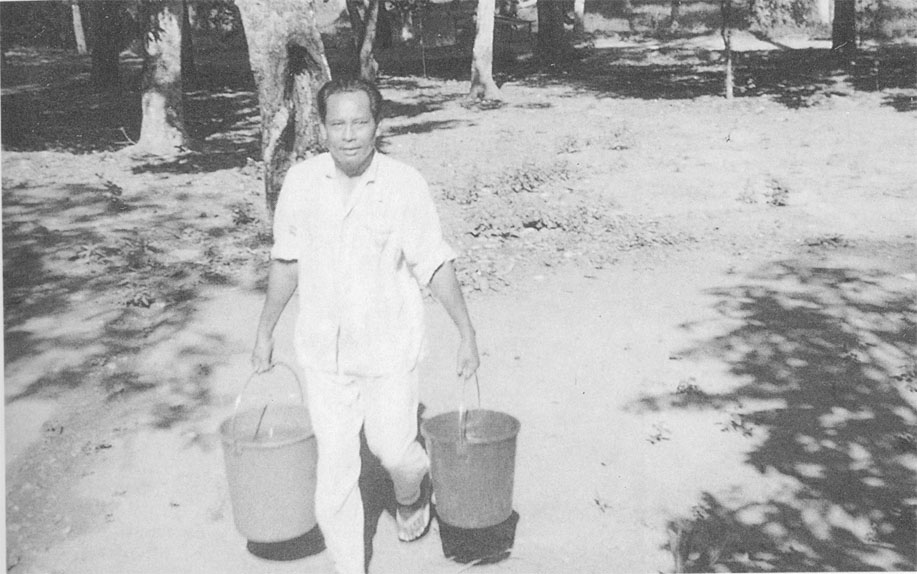 Said Zahari in forced exile on Pulau Ubin, 1979
SINGAPORE, April 24, 2007 (AFP) - A press freedom group called Tuesday for Singapore to reverse its ban on a film about a former political detainee.
Paris-based Reporters Without Borders (RSF) said the ban was "another authoritarian measure violating press freedom" in the city-state. Singapore banned the film on former detainee Said Zahari, calling it a"misleading and distorted portrayal" of his detention which could undermine confidence in the government.
The film "Zahari's 17 Years" was directed by Singaporean filmmaker Martyn See, who had earlier been investigated by police for making a film on opposition leader Chee Soon Juan.
"The ban on See's film must be lifted," RSF said in a statement.
"This act of censorship is all the more inappropriate and ridiculous as his films are available on websites," it said.
"We call for the liberalisation of the censorship and internal security laws that deprive Singaporeans of an environment favourable to free speech."
Singapore's ministry of information said See's film "gives a distorted and
misleading portrayal of Zahari's arrest and detention under the Internal Security Act in 1963."
It called the film "an attempt to exculpate himself from his past involvement in communist united front activities against the interest of Singapore."
In the film, the elderly self-exiled journalist, poet and author reflects on his 17 years in detention.
Singapore has often been criticised by human rights and media groups for maintaining strict political controls despite its rapid economic modernisation.
But the government says the strict laws are necessary to maintain law and order -- a pillar of the country's economic prosperity.
On Friday, producers of a Singapore film about a man and boy struggling with their mutual sexual desire said they had withdrawn it from public screening at the city-state's film festival.
The decision to withdraw "Solos" came after Singapore censors made three cuts to scenes depicting homosexual and group sex, the Singapore International Film Festival (SIFF) told AFP.
----------------------------------------
RSF's Press Release
AP report
Monday, April 23, 2007
All this censorship makes no sense : MM Lee
What are we to make of these uncharacteristically liberal remarks from the founding father? With champagne-popping optimism or heaps of salt? You go figure.

Minister says gay sex should be legal
Singapore must remain cosmopolitan to survive: MM Lee
A cold, hard reality check

Minister says gay sex should be legal
Singapore must remain cosmopolitan to survive: MM Lee
A cold, hard reality check
Sunday, April 22, 2007
'Zahari's 17 Years' now online
It has to happen when a film gets banned after more than a year in circulation.
The full 49 minutes of 'Zahari's 17 Years' is now available for viewing on Google Video. (Updated to youtube) I hereby declare that it wasn't uploaded by me as I've surrendered my remaining master copy to the censors on 11 April. Prime suspects should include festival organisers, film buffs, academics, historians, journalists, ex-detainees, all and sundry who may have seen the film or even possessed copies of it at one time or another.
Of course I can't direct you to the link as I will then be culpable of distributing a prohibited film which does carry a jail term. It first appeared in one of the 'Local Voices' blogs on the right column of this page.
Meanwhile you can watch this ITN news clip of the ban which features a rare appearance by former student leader Tan Wah Piow, a political exile residing in UK.
The full 49 minutes of 'Zahari's 17 Years' is now available for viewing on Google Video. (Updated to youtube) I hereby declare that it wasn't uploaded by me as I've surrendered my remaining master copy to the censors on 11 April. Prime suspects should include festival organisers, film buffs, academics, historians, journalists, ex-detainees, all and sundry who may have seen the film or even possessed copies of it at one time or another.
Of course I can't direct you to the link as I will then be culpable of distributing a prohibited film which does carry a jail term. It first appeared in one of the 'Local Voices' blogs on the right column of this page.
Meanwhile you can watch this ITN news clip of the ban which features a rare appearance by former student leader Tan Wah Piow, a political exile residing in UK.
Saturday, April 21, 2007
Film ban strange, says Said Zahari
Wong Yeen Fern
Malaysiakini
Apr 11, 07 3:31pm
Ex-political detainee Said Zahari is surprised by the Singapore government’s decision to ban a documentary film entitled Zahari’s 17 years directed by Martyn See.
 Said, who is the former editor-in-chief of Utusan Melayu, said the main reason could be that Singapore does not want its younger generation to know the political history of the state during the 50s and 60s.
“The (Singapore) government is afraid that more and more people will know about the nation’s history,” he added when contacted today.
However, Said, who was detained for 17 years, also said the move to ban the film was surprising because it has been around for the past one year.
He said the film has been distributed in many countries and it is strange why the Singapore government decided to ban it now.
Among others, the film has been screened in Malaysia and Canada.
“I have not seen the (Singapore) government’s statement but I don’t understand why they want to ban it only now?” he asked.
According to Said, what he had revealed during the 50-minute film was just a minor portion of what he had written in his book Dark Clouds at Daw published in Malaysia in 2001.
Security threat
A Reuters report yesterday stated that Singapore’s Ministry of Information, Communications and Arts had banned the film because it went against public interest.
 “The film gives a distorted and misleading portrayal of Said’s arrest and detention under the Internal Security Act (of Singapore),” said the ministry.
It claimed that the film was an attempt by Said “to exculpate himself from his past involvement in communist united front activities against the interests of Singapore.”
The ministry said the film had to be banned because it posed a security threat as it sought to undermine public confidence in the government.
The film’s director has been asked to turn over all copies of the film by Singapore’s Media Development Authority.
Previously, See was investigated by the Singapore police after he produced a documentary about opposition leader Chee Soon Juan in 2005.
Government bans film on journalist detained without trial for 17 years
Country/Topic: Singapore
Date: 20 April 2007
Source: Southeast Asian Press Alliance (SEAPA)
Person(s): Martyn See, Said Zahari
Target(s): other
Type(s) of violation(s): banned
Urgency: Threat
(SEAPA/IFEX) - The Singapore government has banned an independent film about a former top journalist and political activist who was held without trial for 17 years in the island republic, deeming the documentary to be "against public interests".
"Zahari's 17 years" by local filmmaker Martyn See is a 49-minute interview with Said Zahari about his arrest and subsequent detention under the draconian Internal Security Act in 1963.
In a statement on 10 April 2007, the Ministry of Information, Communications and the Arts announced the ban under the Film Act, saying the documentary was an attempt by Said "to exculpate himself from his past involvement in communist united front activities against the interests of Singapore".
"The government will not allow people who had posed a security threat to the country in the past to exploit the use of films to purvey a false and distorted portrayal of their past actions and detention by the government," the ministry said, adding that this may "undermine public confidence in the government."
However, Said's political memoir, "Dark Clouds at Dawn", on which the film interview is based, is available in local stores. Said is most famed for staging a three-month strike against a political takeover of the then-leading nationalist newspaper, "Utusan Melayu", of which he was editor-in-chief in 1961. He failed to prevent the takeover, but earned a place in the history of Malaysia and Singapore for leading the first and, until today, only journalists' strike over the principle of press freedom.
"Zahari's 17 years" is not listed in the Media Development Authority's database of classified films, although reportedly given a PG (parental guidance required) rating twice in 2006, when it was submitted for screening at the Singapore International Film Festival in January and a film symposium in August. On both occasions, the film was never screened, with no reasons given. An application for an exhibition licence in January 2007 was abandoned midway, and the ban followed three months later.
As the ban covers exhibition, possession and distribution of the film, See surrendered his master copy to the censors on 11 April. However, the film can be viewed at: (Do a search on google video - Martyn)
This is the second documentary by See to be banned. In 2005, police investigated him for 15 months after he produced "Singapore Rebel", which documents the trials and tribulations of opposition leader Dr Chee Soon Juan, who has been imprisoned repeatedly for exercising his right to free speech and sued for defaming present and past prime ministers (see IFEX alerts of 26 September, 31 August, 11 May and 23 March 2005).
Bizzare ban on Pak Said film in Harry's S'pore
Taken off the blog of Malaysian journalist James Wong Wing-On
Those who have read Singapore's former PM and SM, MM Lee Kuan Yew's memoirs know for sure that the name of Said Zahari never appears as a historical record, let alone the reason or reasons for his 17-year detention without trial under Lee's premiership. Now, according to the Ministry of Information, Communication and Arts of Singapore which has recently banned a made-in-Singapore historical documentary about Said Zahari, the latter was allegedly involved in what is said to be "communist united front activities against the interests of Singapore". However, my friend Amir Muhammad's films Lelaki Komunist Terakhir and Apa Khabar Orang Kampung which documents the stories of self-identified hardcore and real communists like Chin Peng, Abdullah C.D, Suriani Abdullah, Abu Samah and other can still be screened and watched publicly in Singapore. Said Zahari, the trilingual former editor-in-chief of Utusan Melayu whose computer was stolen from his Subang house together with the manuscript of the last installment of his trilogical memoirs during last year's Christmas vacation, of course, now lives in Malaysia as my cherished neighbour, good friend and esteemed sifu .
Malaysiakini
Apr 11, 07 3:31pm
Ex-political detainee Said Zahari is surprised by the Singapore government’s decision to ban a documentary film entitled Zahari’s 17 years directed by Martyn See.
 Said, who is the former editor-in-chief of Utusan Melayu, said the main reason could be that Singapore does not want its younger generation to know the political history of the state during the 50s and 60s.
“The (Singapore) government is afraid that more and more people will know about the nation’s history,” he added when contacted today.
However, Said, who was detained for 17 years, also said the move to ban the film was surprising because it has been around for the past one year.
He said the film has been distributed in many countries and it is strange why the Singapore government decided to ban it now.
Among others, the film has been screened in Malaysia and Canada.
“I have not seen the (Singapore) government’s statement but I don’t understand why they want to ban it only now?” he asked.
According to Said, what he had revealed during the 50-minute film was just a minor portion of what he had written in his book Dark Clouds at Daw published in Malaysia in 2001.
Security threat
A Reuters report yesterday stated that Singapore’s Ministry of Information, Communications and Arts had banned the film because it went against public interest.
 “The film gives a distorted and misleading portrayal of Said’s arrest and detention under the Internal Security Act (of Singapore),” said the ministry.
It claimed that the film was an attempt by Said “to exculpate himself from his past involvement in communist united front activities against the interests of Singapore.”
The ministry said the film had to be banned because it posed a security threat as it sought to undermine public confidence in the government.
The film’s director has been asked to turn over all copies of the film by Singapore’s Media Development Authority.
Previously, See was investigated by the Singapore police after he produced a documentary about opposition leader Chee Soon Juan in 2005.
Government bans film on journalist detained without trial for 17 years
Country/Topic: Singapore
Date: 20 April 2007
Source: Southeast Asian Press Alliance (SEAPA)
Person(s): Martyn See, Said Zahari
Target(s): other
Type(s) of violation(s): banned
Urgency: Threat
(SEAPA/IFEX) - The Singapore government has banned an independent film about a former top journalist and political activist who was held without trial for 17 years in the island republic, deeming the documentary to be "against public interests".
"Zahari's 17 years" by local filmmaker Martyn See is a 49-minute interview with Said Zahari about his arrest and subsequent detention under the draconian Internal Security Act in 1963.
In a statement on 10 April 2007, the Ministry of Information, Communications and the Arts announced the ban under the Film Act, saying the documentary was an attempt by Said "to exculpate himself from his past involvement in communist united front activities against the interests of Singapore".
"The government will not allow people who had posed a security threat to the country in the past to exploit the use of films to purvey a false and distorted portrayal of their past actions and detention by the government," the ministry said, adding that this may "undermine public confidence in the government."
However, Said's political memoir, "Dark Clouds at Dawn", on which the film interview is based, is available in local stores. Said is most famed for staging a three-month strike against a political takeover of the then-leading nationalist newspaper, "Utusan Melayu", of which he was editor-in-chief in 1961. He failed to prevent the takeover, but earned a place in the history of Malaysia and Singapore for leading the first and, until today, only journalists' strike over the principle of press freedom.
"Zahari's 17 years" is not listed in the Media Development Authority's database of classified films, although reportedly given a PG (parental guidance required) rating twice in 2006, when it was submitted for screening at the Singapore International Film Festival in January and a film symposium in August. On both occasions, the film was never screened, with no reasons given. An application for an exhibition licence in January 2007 was abandoned midway, and the ban followed three months later.
As the ban covers exhibition, possession and distribution of the film, See surrendered his master copy to the censors on 11 April. However, the film can be viewed at: (Do a search on google video - Martyn)
This is the second documentary by See to be banned. In 2005, police investigated him for 15 months after he produced "Singapore Rebel", which documents the trials and tribulations of opposition leader Dr Chee Soon Juan, who has been imprisoned repeatedly for exercising his right to free speech and sued for defaming present and past prime ministers (see IFEX alerts of 26 September, 31 August, 11 May and 23 March 2005).
Bizzare ban on Pak Said film in Harry's S'pore
Taken off the blog of Malaysian journalist James Wong Wing-On
Those who have read Singapore's former PM and SM, MM Lee Kuan Yew's memoirs know for sure that the name of Said Zahari never appears as a historical record, let alone the reason or reasons for his 17-year detention without trial under Lee's premiership. Now, according to the Ministry of Information, Communication and Arts of Singapore which has recently banned a made-in-Singapore historical documentary about Said Zahari, the latter was allegedly involved in what is said to be "communist united front activities against the interests of Singapore". However, my friend Amir Muhammad's films Lelaki Komunist Terakhir and Apa Khabar Orang Kampung which documents the stories of self-identified hardcore and real communists like Chin Peng, Abdullah C.D, Suriani Abdullah, Abu Samah and other can still be screened and watched publicly in Singapore. Said Zahari, the trilingual former editor-in-chief of Utusan Melayu whose computer was stolen from his Subang house together with the manuscript of the last installment of his trilogical memoirs during last year's Christmas vacation, of course, now lives in Malaysia as my cherished neighbour, good friend and esteemed sifu .
Tuesday, April 10, 2007
Zahari's 17 Years - rated PG by censors, banned by Minister


The above documents were delivered to my home this afternoon. One is a public statement while the other is a letter specifically addressed to me.
Both documents basically dictated the same message - that as of April 12 2007, the film 'Zahari's 17 Years' will attain the same illicit status in Singapore as a copy of Playboy or FEER. Anyone caught in possession or distribution of the material will be liable on conviction to a fine or imprisonment. The public statement did not spell out the penalties but the letter to me most certainly hit home the point.
The public statement also made no mention of the fact that the Minister himself has banned the film under Section 35(1) of the Films Act, which basically accords absolute discretionary powers to one person to decide if a film is suitable for public viewing. This is unlike the case of 'Singapore Rebel', which was deemed to have violated Section 33 which bans political films with "biased references". I was told by a Straits Times reporter earlier that this marks the first time that Section 35 has been evoked to ban a film.
Further, in the public statement, it said that I had submitted the film for classification, as if it was the first submission. Indeed, I had gone to the Board of Film Censors on January 11 this year, but it wasn't for the purpose of classification. I was there to make an application to obtain an exhibition licence to screen the film. I was made to understand that a film passed by the censors does not entail a licence to screen it publicly. A separate permit is required.
Here it gets a little screwy.
'Zahari's 17 Years' was first submitted to the Board of Film Censors by the Singapore International Film Festival around March of 2006. Information obtained from MDA by journalists at Today and ZaoBao indicated that the film had been passed clean with a Parental Guidance (PG) rating. Yet, the SIFF did not screen it, and has refused to disclose any reason for the no-show.

Then the Asian Film Archive decided to make another application to screen the film as part of the Substation's 6th Asian Film Symposium in September. Again the film was passed clean with a PG rating (see document on the left). But again the festival organisers withdrew the film with no official explanation.
It was on the premise that the film had already been cleared twice by the censors that I decided to apply for an exhibition licence on January 11, only to be slapped, three months later, with yet another ban.
The Government has shown itself incapable of engaging in any kind of open dialogue on its dark history of detentions without trial. It has refused to acknowlege the fact that the ISA has been used in many instances to achieve its political ends. And interestingly, despite its regurgitation of Said Zahari as a former security threat, the international press continues to tag him a former "political detainee".
__________________________________________________________
Singapore bans documentary about former political prisoner
Tanalee Smith
Published: Tuesday, April 10, 2007
SINGAPORE (AP) - Singapore said Tuesday it would ban a documentary about the 17-year detention of a former leftist activist because its "distorted and misleading" portrayal of the events could undermine confidence in the government.
"Zahari's 17 Years" is a 49-minute interview with Said Zahari, who was arrested in 1963 on suspicion of plotting violent acts and detained without trial for 17 years. Said, 78, now lives in Malaysia.
The Ministry of Information, Communication and the Arts, which vets all films before release, said in a statement that the film was an attempt to clear Said of his involvement in activities against Singapore.
"The government will not allow people who had posed a security threat to the country in the past, to exploit the use of films to purvey a false and distorted portrayal of their past actions and detention by the government. This could undermine public confidence in the government."
Filmmaker Martyn See, who was under investigation last year for a documentary about an opposition leader, said he was surprised by the ban. He said the film, produced at the end of 2005, had been approved twice last year with a PG rating. When it was not shown at the 2006 Singapore International Film Festival, as he expected, See applied for an exhibition licence to screen it publicly.
"I don't know what changed. Maybe different people with different views watched it this time," See told The Associated Press. "I based my questions to Said on his first book, which is sold in Singapore. So what is in the film is not something the government didn't know."
He said he had been ordered by the censorship board to surrender all copies of the film by Wednesday afternoon.
Said, contacted by telephone at his home in Malaysia, was shocked to hear of the ban. He said he had already accepted an invitation to come to Singapore next month to give a speech at the film's screening by a university film institute.
"This is very funny. I don't understand why they would ban it at all. What I said in the movie I have already said in my book, and much, much more," he told AP. "That was 40 years ago. Is the government still afraid?"
"I feel sorry for Singaporeans who have not been given a chance to see the other side of Singapore history, particularly the 1960s and '70s. It's not fair," he said.
Said's detention came in the early years after British colonizers gave self-government to Singapore in 1959. In the early 1960s, authorities arrested left-wing politicians, trade unionists and Chinese students involved in strikes and rallies, accusing them of being violent subversives planning a communist state.
Said was detained on Feb. 2, 1963, hours after he was appointed president of a left-wing party.
Singapore, which was planning a merger with what later became Malaysia, said the swoop was aimed at individuals threatening to use violence to sabotage the proposed amalgamation. The detainees were jailed under the colonial-era Internal Security Act, which allows for arrest without charge and indefinite detention without trial.
Said, who denied the accusations, was held for years, sometimes in solitary confinement, after the merger failed in 1965 and Singapore became independent.
He was released in 1979, at age 51. A stroke in 1992 left him reliant on a walking stick and prompted his move to Malaysia, where his children had relocated.
The banning of "Zahari's 17 Years" under the Film Act prohibits exhibition, possession and distribution of the film.
The film's director, See, was investigated by police last year concerning a documentary he made about an opposition leader. He was given a "stern warning" but could have faced prison time or a fine if convicted of knowingly producing and distributing a "party political film."
That film, "Singapore Rebel," was screened at film festivals in New Zealand and the United States, but not in Singapore.
Amnesty International criticized Singapore for that case against See, saying the city-state was stifling artistic freedom and preventing citizens from expressing dissenting views.
Singapore authorities tightly restrict media and political speech, moves that regularly draw criticism from international human rights groups. Prime Minister Lee Hsien Loong has acknowledged tensions over the regulations but defended them as necessary to maintain order.
Singapore bans film about ex-political detainee
Reuters
Tuesday, April 10, 2007; 9:05 AM
SINGAPORE (Reuters) - Singapore is banning a film about a former political detainee who was held for 17 years without trial to protect public interests, the government said.
The film "Zahari's 17 Years" about former journalist Said Zahari -- arrested in 1963 for suspected subversive activities, including communist sympathies -- will be banned because it is "against public interests," the Ministry of Information, Communications and the Arts said on Tuesday.
"The film gives a distorted and misleading portrayal of Said Zahari's arrest and detention under the Internal Security Act," the Ministry said in a statement.
"Zahari's 17 Years" is directed by local film director Martyn See, who was investigated by the Singapore police for a year after he produced a documentary about opposition leader Chee Soon Juan in 2005.
Singapore, which is frequently criticized by human rights groups for its restrictions on the opposition and media, bans political films that contain "biased references to or comments on any political matter."
See said he has been asked to turn over all copies of the banned film on Tuesday by Singapore's Media Development Authority, which has also rejected his application to screen it in the city-state.
"Zahari's 17 Years" is a 50-minute long interview with Zahari about his 17-year detention -- one of the longest in Singapore -- and the fear among former political detainees to talk about their experience, See said.
"The government is clearly not allowing history to be heard. It does not want to acknowledge the history of detention because it is an acute embarrassment," See said.
The film has been screened in film festivals in Malaysia and Canada, he said.
The Ministry said "Zahari's 17 Years" was an attempt by Zahari "to exculpate himself from his past involvement in communist united front activities against the interests of Singapore."
"The government will not allow people who had posed a security threat to the country in the past to exploit the use of films to purvey a false and distorted portrayal of their past actions and detention by the government," the ministry said, adding that this may "undermine public confidence in the government."
Thursday, April 05, 2007
Lee-fearing Nation
"Ordinary people do not fear the Internal Security Act as much as they fear that if they voice criticisms against the government they will be punished in ways that can directly affect their livelihoods. Shopkeepers and taxi-drivers worry their licences will be revoked, and businessmen whether big or small, have the same apprehension. Civil servants fear their independent views on public matters will deprive them of promotions or get them transfers to insignificant ministries or the ultimate punishment - loss of employment. The press fears. The police fears. The ISD (Internal Security Department) fears. The army fears. The PAP MPs fear. And the ministers fear...Everyone fears Lee."
- T.S. Selvan, author and former ISD officer
"Between being loved and being feared, I have always believed Machiavelli was right. If nobody is afraid of me, I'm meaningless."
- Lee Kuan Yew, Oct 6, 1997
 Lee's Legacy
Opinions of Lee in the country are many. More often than not they are a curiously alternating vocabulary of praise and criticism. As his talents and gifts are many and unusual, so are some of his defects. They tell on the way people view him when in their different moods. When people are angry, they forget his merits, and when are happy, they ignore his faults. He then becomes the only barrier between man and chaos. He is glorified to a point where it is said that since God has forgotten to endow the country with any natural resources, he redresses the oversight by giving Lee to the country.
Some are genuinely caught in a moral dilemma because as they condemn of some of his shortcomings they cannot easily overlook his outstanding contributions to their material well-being. He has not been a mindless despot like some of the Third World politicians. Some, however thankful they are, still find it hard to morally excuse him for treating his political opponents with an almost neurotic disapproval and condemnation. He is accused of binding everyone to his system while he himself stays out of it. Even the Godless think he plays God. But they do not say whether God is a dictator.
But what is the long and short of it? Where does Lee stand? Curiously, what will Lee himself think of his role as he continues to lead his flock? Will he be chuffed by his admirers' adulations? Will he be stung like Prometheus by the diatribes of his critics? Or does he have his hopes pinned on history's final judgement?
To look back. When the British finally left the island, the migrants invested Lee with the power of sovereignty and they expected this sovereignty to be used in their rights and interests. The migrants did not wish the bossy and holier-than-thou colonial type authority. That phase was over. It was time, the migrants rightly thought, to belong and identify, to participate and be counted. It was in recognition of this right that the Sahib had also returned the island to the people.
Lee took over. Democratic politics immediately became an irredeemable sin; a political perversion. An Easterner by upbringing and a Westerner by education, a Machiavellian by instincts and a Zarathustran by genes, he at once concluded that a state could neither be run on Judeo-Christian virtues nor by any airy-fairy Western liberal exhalations. He sought authority in the way the East and governments of all larger states had been ruled before the British, American and French revolutions. Lee must have also picked up some handy habits from his early partnership with the communists. Communism, which believes that the state is a divine idea, subsumes the complexities of human experience under a rigid collectivist and monolithic order - one single will, one single state, one single party rule. More importantly, the communists' faith in the grave philosophy of the end justifying the means became a lethal weapon in Lee's hands. Not to forget, once in power, the communists do not capitulate; they want to rule forever.
As soon as he took over he made his people recognise and accept without question the absolute sovereignty of the state which became synonymous with his own sovereignty. The man and machine became one. He smashed all threats to his power. As ends and means became entangled in his politics so were the problems of the state and his own became enmeshed into one and the same. He fustigated the communists, set the dogs on a free trade union movement, and closed the doors on a free press. The communalists and racists had to be flattened because they subverted the nation. Many of his political opponents were kicked around like dogs. Some yielded entirely and became his willing poodles. To his credit, there has never been an instance of political killing in three decades. When this fact was pointed out to a Westerner, a frequent visitor to the country, he said, "When you have detention without trial, your problems disappear very fast. You don't have to worry about wanting to make people disappear."
To sustain and legitimise his moral authority he constantly emphasised the weaknesses of man. He could call up at will historical precedents, imperatives, and cruel memories of a dark age. Unquestionably, he created a permanent sense of crisis. Again and again he went back to the question of the country's security: He warned of the shortage of natural resources and the smallness of the country. He reminded people of the divisive racial and linguistic pulls, and fretted nighmarishly of Humpty Dumpty going to pieces. To a migrant society without permanent security and without much education, these fears, real as they were, became dangerously real. So fearing the decay, and fearing Lee's Leviathan, they fearfully accepted his authority. Here it must be said that although Lee is a propagandist, he actually believes, one thinks, in what he says about the past and the calamitous history of the country. But if the purpose of the propaganda is to teach, it is also intended to sustain his own power.
Lee is completely and consumately absorbed with power, but no leader can continue to hold on as long as he has and be counted credible if he does not deliver. People in the end get tired of fine talk. When the masses get tired, no fear, no tyranny, can hold back the bursts. And this is where Lee is unequalled by many other authoritarian rulers. It is from his ability to pay well that most of his arrogance and invincibility stems which in turn moves his politics. As he made people fear his political ruthlessness, he also shared his extraordinary gifts as a professional businessman; a first-rate achiever. As fast as possible, he gave as much as possible. It was a bang-up job. A materialist, he believed that facts and figures shout louder than slogans.
As he continued to deliver, he also continued to erect comprehensive social policies, his Facts of Life, to consolidate society. He never tolerated state welfarism, never allowed self-indulgence, insisted on hard work, tabooed pornography, told parents to discipline their children, drilled the youths in the army, admonished the people to uphold the family system, kissed the jury system goodbye, ordered the police to administer proper justice to the criminals, hang the heavy peddlars of dope, campaigned for the people to bow their heads in courtesy, urged his people to take better aim in public toilets, and guide their saliva into a spittoon.
"I am often accused of interfering in the private lives of citizens. Yes, if I did not, had I not done that, we wouldn't be here today. And I say without the slightest remorse, that we wouldn't be here, we would not have made economic progress, if we had not intervened on very personal matters - who your neighbour is, how you live, the noise you make, how you spit, or what language you use. We decide what is right. Never mind what the people think."
- Prime Minister Lee Kuan Yew, Straits Times, 20 April 1987
 Lee-fearing society
In short, Lee has so far created from irrelevance a successful society where economic security and social order flourish. This in itself is an extraordinary tour de force but the setback to the system is the lack of political liberty. This appears to be Lee's biggest failure. Foreign critics are not quite out of touch with Singapore when they describe it as a "city of fear". The fear is real, and it is not just at the top-layer of people's feelings. It is deep. Worse, people are sometimes terrified out of their wits. Worse still, there is a lot of fear but no courage.
Ordinary people do not fear the Internal Security Act as much as they fear that if they voice criticisms against the government they will be punished in ways that can directly affect their livelihoods. Shopkeepers and taxi-drivers worry their licences will be revoked, and businessmen whether big or small, have the same apprehension. Civil servants fear their independent views on public matters will deprive them of promotions or get them transfers to insignificant ministries or the ultimate punishment - loss of employment. The press fears. The police fears. The ISD (Internal Security Department) fears. The army fears. The PAP MPs fear. And the ministers fear. No joke. Once in the mid 1980s, a senior civil servant went to discuss certain aspects of a policy decision with a minister. The minister said, more or less, that he was willing to say what he really thought about the decision but was reluctant to do so because it could be carried to the Old Man's ears. ...Everyone fears Lee.
The perception of fear is something that refuses to go away. More often than not some of these fearful people exaggerate (before they do this they look to the right, left, and over their shoulders) their self-importance and value by attributing their personal failures to having the guts (imagined, of course) to go against some of the government policies. As much as fear is real in the country, this group of self-important people is also real. Most of these people can be found predominantly among top civil servants, university lecturers and business elites.
Young yuppies who may have the inclination to go into opposition politics are hesitant because they, among other things, think that the government with its powerful machinery will rake up past indiscretions, however silly they are, and distort them into acute public embarrassment. We are here talking about PAP gutter politics. There is also the fear that the government will continue to hound them in the future through other means. The concern is valid because the record of the government is unhelpful to its image. On the other hand, some use this fear as a convenient excuse for not entering politics. Life, you must remember, is bountiful under Lee.
As fear threatens the people, something else is beginning to scare Lee and his government. The society is slightly more complex now than it had been a decade or two ago. Wide diffusion of English education, economic opportunities, the power of machine, social mobility, and exposure to other political viewpoints, are all conspiring to shape the political attitudes of the citizens. In other words, Lee's very success is working against him.
The young are particularly resentful of the way they are being governed : control, yet more control. Look, it is happening again, they sneer. They feel that the over-administration of the classroom suffocates creativity and individuality. They are gradually beginning to reject Lee and his moral prophecies because they suspect the perpetual hand of a controller yet again trying to manoeuvre his way through to increasing his own glory and power. Although they were born and bred under the PAP regime, they are beginning to break free like rebellious adolescents often do. Lee is not their king. Youth, with its idealism and energy, is Lee's greatest threat.
Nurturing indifference
How long can a government continue to suppress real discussion and be intolerant of mediocrity? How long could it avoid compassion and caring for the really under-privileged? How can a society hope to mature and progress if there is little political intelligence and awareness? Can political loyalty to the system be taken for granted when the people are suspicious that Lee and his party control all the rules of the game? Perhaps there is a question to ask: could Lee himself, presuming that he is an ordinary man (i.e. not a politician), live in such a society without being too constrained and unhappy? Could he bear to see his prime minister enjoying all the freedom while he is denied it?
The kind of political system that is found in the country is bound to nurture indifference. When the citizens, if the government so decides, can be arrested without the due process of law, it strikes fear. It erodes loyalty. The government urges the different races to be tolerant and to harmonise their relationships to build a nation together but its own intolerance of critics and differing viewpoints is seen as Double talk. The government is happy when the press, whether local or foreign, pleases it but comes down vindictively when it ceases to praise. When a foreign press criticises the government it is accused of involving itself in the political process but when its own citizens, those who think differently, question and challenge some of its policies, they are being put down for the very act of participation. For example, immediately after the 1984 general elections, the government seemingly opened up the system and invited discussion and feedback. When the Law Society of Singapore attempted to do just that (the Law Society sought to persuade the government to change its mind about the Amendment Acts to the Press, and it did not encourage the citizens to disobey or break the law - there is a big difference here) it was disgraced out of court. One of its members was kicked around like a ball. Can a system be thought of a great success when it brings unnecessary pain to others?
Lee's Singapore or the Singaporean's Singapore?
Why is Lee, given the intensity of his Superman vision, so obstinate in his heroism in not wanting to allow for real democratic changes? Power is just part of the explanation, though a good part of it. But more importantly, is Lee certain of his vision of the future? Will he be proven right and others wrong in the end?
Lee has no God but he cannot give up playing God. He will always think he is right. That is his destiny; his own star to follow. "If there are gods," exclaimed Zarathustra, "how could I bear to be not a god?"
His adversaries who do not like Lee and his politics and would like to see him go, will have a mountain of a task to crush him. Their Macbeth is not ripe for shaking, yet. And one thing appears certain. Whether you like him or not, Lee is a legend. If Raffles was the taker of Singapore, Lee certainly is the creator, and a better story to tell. For the moment one hesitates to place him alongside the other Asian greats - Gandhi, Nehru, Mao - although intellectually he could claim equal, if not better depth. Using a different scale, if one gives Pol Pot 1, Marcos 3, the late Sukarno 5, Tengku Abdul Rahman 7, Lee gets a 9. If either of the scales does not fit that must be because Lee is quite clearly in his own league.
Before Singaporeans reach their own decision on their most famous legend and his creation, are they themselves clear in what they want of society, of life? Do they think someone else could do a better job? With the same per capita income, jobs, houses, schools, hospitals, roads, snazzy cars, snappy clothes, but more democratic politics. What is their dream of an ultimate island? If people are inclined to accuse Lee of becoming an island unto himself, are they becoming an island unto themselves? Are they themselves naively prone to over-emphasise their own importance and wisdom (and I don't write this with any kind of sneer or cynicism) as Gibbon, the great historian, thought the Greeks did? Commenting on the Byzantium, Gibbon said: "Among the Greeks, all authority and wisdom were overbonne by the impetuous multitude, who mistook their rage for valour, their numbers for strength, and their fanaticism for the support and inspiration of Heaven."
Human societies appear hopelessly destined to a cyclic process of growth, decay and disintegration. But a good vision is said to change or delay this process to some extent. Without this vision a society perishes quickly and when that happens all the King's men could not put back Humpty Dumpty. The poetry will made short. It is a dance of death on a narrow wall.
On the first day that he took over the leadership of the island from the white man, on 3 June 1959, Lee told his semi-colonised people: "Once in a long while, in the history of a people there comes a moment of great change..." The change has come, but is not great. The quintessential Lee Kuan Yew's Singapore (it should not happen, but it does) must be turned into Singaporean's Singapore. We must hope for the real Lee Kuan Yew to emerge over a period of time.
- T.S. Selvan, 1990
Sunday, March 25, 2007
Singapore's libel laws - fixing dissidents and reaping dividends
Let us shake off this oppressive shroud of sycophancy and unquestioning homage to authority. For if we just drift along, we may get to a position where it is not only wrong to talk, but also wrong to think. History is full of chronicles of how a robust and hardy people will always triumph over adversity. In the end, it is those who have the guts, the endurance and the stamina, who will overcome all difficulties and come into their own.
- Lee Kuan Yew, New Year's Message 1965, exhorting the Malaysians to stand up to the Malaysian Federal government and be counted.
If we had considered them serious political figures, we would not have kept them politically alive for so long. We could have made them bankrupt earlier.
- Lee Kuan Yew, Straits Times, Sept 14 2003
Beyond Suspicion? The Singapore Judiciary
by Francis T. Seow
JUSTICE IN SINGAPORE is Janus-faced.
The Singapore courts - when adjudicating commercial cases between two contending parties where neither the authorities nor the political élite are involved or interested - may be relied upon to administer justice according to the law. In this regard, Singapore judges have an overall reputation for the integrity of their judgments. The enthusiastic reports of international organizations, such as the Geneva-based World Economic Forum or the Hongkong-based Political and Economic Risk Consultancy, have to be read subject to this important rider.
This book, however, is concerned with the other face of justice in Singapore: where these very same judges, sad to say, in politically-freighted cases have repeatedly demonstrated a singular facility at bending over backwards to render decisions favourable to the Singapore government and its leaders. Whereupon their judicial contortions have acquired an international notoriety that concerned human rights organizations, such as Amnesty International, the Geneva-based International Commission of Jurists, and latterly the Lawyers' Human Rights Watch Canada, were moved to send their legal representatives to Singapore to observe the trial proceedings herein at first hand. Their observations confirmed what many Singaporeans have known all along: that the political context of such cases invariably influence the judges in their decisions.
And yet, the Singapore judiciary was historically free and independent of the government of the day or any other controlling legal authority, until the ruling People's Action Party - with no viable political opposition to keep it balanced and in check - began insensibly to entrench itself in the body politic of the nation. In that time, Prime Minister Harry Lee Kuan Yew, now nominally senior minister but still the enduring éminence grise of the People's Action Party (PAP) government, systematically gained control over the courts, which he exercises currently through his judicial point man and great friend, Yong Pung How: the chief justice*. In addition, Lee appoints only politically correct lawyers as judges whose loyalty he ensures with princely remunerations - well over and above the comparable market rates for judges worldwide. Corruption often-times simulates many forms and disguises: paying obscenely high salaries and bonuses to judges is one, for they inevitably assume the gratifying form of monthly retainers by the government for loyal services rendered or to be rendered. Given that he who pays the piper calls the tune, it is virtually impossible for judges to do justice by the citizens when the state or its leaders are involved as litigants, as this narrative will amply demonstrate.
(* Yong Pung How has since stepped down from the judiciary. The current Chief Justice is the former attorney-general, Chan Sek Keong, appointed in April 2006)
Unlike previous defamation actions, the legal blitzkrieg herein - masterminded by Harry Lee Kuan Yew - was exceptional in the sheer number of PAP plaintiffs who retained in concert disparate law firms of high-priced lawyers and who, against valid objections and normal procedural laws, were allowed by the courts to maintain multiple lawsuits over the same matter against the defendants: lawyer and unsuccessful opposition candidate Tang Liang Hong, his wife, Teo Siew Har, and, ultimately, his defence counsel, J.B. Jeyaretnam, who was also then the secretary general of the opposition Workers' Party. The insidious purpose of this unusual legal manoeuvre was intended to overwhelm the resources in personnel and finances of the defendants, and of Tang in particular, and to hamper their defence - a manoeuvre that was patently obvious to the judges but who, chose to turn a Nelsonian eye on these legal shenanigans.
Lee used to assert that the judiciary must be protected against "unjust attacks and slurs," but in truth, it is he who has not only disfigured the pristine face of justice in Singapore but undermined its very foundation by politicizing it, as well as that of the legal profession. In the ensuing proceedings, counsel for Lee and the Prime Minister, Goh Chok Tong - Drew and Napier and Allen and Gledhill respectively - not to mention the lawyers for the other PAP plaintiffs, disgraced themselves and sullied the noble profession of the law by meekly allowing themselves to be led by their noses by the puppetmeister. In an attempt to win the case at all costs, they not only suppressed important evidence advantageous to Tang but concealed them from the presiding judge, Justice Chao Hick Tin. Nor did they take any steps to correct his [the judge's] misconception of the facts at the subsequent judgmental hearing, consequently ensuring that damages awarded against Tang would be humongous: thus perpetrating a travesty of justice by their studied silence. A classic case of the legal maxim, suppressio veri suggestio falsi - suppression of the truth is suggestion of the false. Given their seniority at the bar, they should have known better. Together with the staff of the Supreme Court registry, they manipulated the practice and procedure of the court and its docket to disadvantage the defendants at every turn in their obscene rush to judgment.
In a closed society where the government has a finger in almost every pie of business and commerce and controls every aspect of community life right down to sporting and even kindergarden activities, it makes sound commercial sense, if nothing else, to keep on its good side for its capacity to distribute lucrative contracts and work to the politically correct. In so far as the legal profession is concerned, the cornucopia of legal work dispensed by the government and its many linked companies was, and is, immense and lucrative. It is bread-and-butter work. It is understandably the aspiration of many law firms to be the chosen receptacle of such official favours. The defamation case or rather cases against Tang Liang Hong and his wife, Teo Siew Har - and the opposition Workers' Party leader, J.B. Jeyaretnam - bring into sharp focus the reluctance of Singapore lawyers to represent clients who are anathema to the puissant Lee and his government. Even so, this is Asian value at its rawest: one does not muddy the source of business or possible businesses by being a contrarian...
With the best will in the world, is it really conceivable for any judge in Singapore to decide a case against Harry Lee Kuan Yew and his PAP cohorts? Neither a wink nor a nod is necessary for a judge who values his position to decide in a certain way. Even if Lee's judicial point man has not intimated the correct decision to his judges, Lee has ensured their loyalty with magnanimous monthly salaries and allowances topping them up with generous yearly bonuses. To paraphrase Vladimir I. Denisov, a Gorbachev-era Soviet parliamentarian: given their princely pay, perks and privileges of office, no Singaporean judge would be mad enough to rule against Lee and his political confrères.
The PAP mouthpiece, the Straits Times, in its news coverage of the visit of Lord Woolf, the Master of the Rolls in England to Singapore, bragged that the visiting English judge was reportedly "especially struck how courts here have built a new legal culture which is highly efficient and technology-orientated. For example, he noted that while court cases here could be heard within six months, quite a few lawsuits in his country were still taking more than two years to be resolved. 'It is very impressive how Singapore courts are so efficient in managing cases and using IT.'" Lord Woolf was speaking, be it noted, on the mechanics of the courts system and not on the quality of justice! One should be able to separate the woods from the trees. The technology may be impressive but it is the administration of justice between people, and justice between individuals and state, and vice versa, that really matters ultimately.
The draconian Internal Security Act (ISA), Cap 143, which allows the arbitrary and indefinite detention of Lee's political opponents, dissidents and media critics, among others, is noticeably being relegated to the back burner, as the courts are increasingly being used to suppress critical comments and viewpoints through threats of defamation actions and the payment of huge damages and ultimately bankruptcy. Singapore has earned the dubious distinction of being a country whose leaders routinely use the libel laws as a weapon of repression. However, the courts cannot be freely resorted to, unless they are first made reliable tools of government: in other words, the judges chosen must be reliable. Tang's legal predicament with its scads of lawsuits, and by extension to that of his defence counsel and political colleague, J.B. Jeyaretnam, proves their political reliability, beyond peradventure.
The news media, in the rankling words of Harry Lee Kuan Yew, must be subordinated to "the overriding needs of Singapore, and to the primacy of purpose of [his] government," a feat he achieved with relative ease but at great cost to his international reputation and stature. The news media was subsequently reshaped into his subservient mouthpiece and that of his PAP government. The legal and judicial system is not too far behind. Once before, Dr. Joseph Goebbells, the Nazi minister of propaganda, dreamt of the same system of justice for the Third Reich where "justice must not become the mistress of the state, but must be the servant of state policy." But where Adolf Hitler and his enthusiastic minister of propaganda failed, Harry Lee Kuan Yew is succeeding. It is not an idle, but a terrifying prospect.
- Francis T. Seow
_______________________________________________________
A brief excerpt of a report to the International Commission of Jurists on the defamation trial of Goh Chok Tong v J.B. Jeyaretnam, 18-22 August 1997
Singapore's leadership has a long-standing reputation for using defamation actions as a mechanism for removing opposition members from the Singapore parliament: far from tolerating critical remarks (not even those spoken or written in the heat of an election campaign), Messrs Goh and Lee have been swift to commence actions, to succeed with them, and to obtain such unconsciously high damages (and costs) as to bankrupt their opponents.
The registrar of the high court of Singapore provided this observer with a printout of all defamation actions heard to completion in the jurisdiction since 1959 (when the People's Action Party first came to power). It shows the following:
Schedule of awards of damages in Singapore cases
- 1979 Lee Kuan Yew v Jeyaretnam S$ 130,000
- 1988 Lee Kuan Yew v Seow Khee Leng S$ 250,000
- 1989 Lee Kuan Yew v Jeyaretnam S$ 230,000
- 1989 Lee Kuan Yew v FEER S$ 230,000
- 1990 Lee Kuan Yew v Jeyaretnam S$ 260,000
- 1991 Lee Kuan Yew v Quek Teow Chuan S$ 200,000
- 1994 Lee Kuan Yew, his son and Goh Chok Tong v IHT S$ 650,000
- 1994 Lee Kuan Yew v IHT S$ 400,000
- 1994 Ernest Chew v Chee Soon Juan S$ 75,000
- 1994 Ow Soh Leng v Chee Soon Juan S$ 30,000
- 1994 Dr. S. Vasoo v Chee Soon Juan S$210,000
- 1994 Chiam See Tong v Xin Zhang Jiang Restaurant S$ 50,000
- 1995 Lee Kuan Yew v Vincour & Ors S$ 300,000
- 1995 Goh Chok Tong v Vincour & Ors S$ 350,000
- 1996 Lee Kuan Yew & son v Tang Liang Hong S$ 1,050,000
Actions by non-PAP politicians
- 1996 Company (imputation of incompetence) S$ 20,000
- 1995 Importer (imputation of bogus goods) S$ 100,000
- 1994 Bank (imputation of negligence) S$ 50,000
- 1992 Architect (imputation of fraud) S$ 60,000
- 1992 Architect (imputation of unethical conduct) S$ 45,000
- 1981 Lawyer (imputation of dishonesty) S$ 25,000
- 1969 Lawyer (imputation of insolvency) S$ 7,350
Mr. Jeyaretnam sued Mr. Goh Chok Tong in 1987 (imputation of trickery, defence of fair comment) and failed, the Workers' Party sued two PAP members, one the attorney general, in 1974 (imputation of accepting foreign funds, and subversion; defence of privilege) but failed.
Earlier in 1997, Goh Chok Tong and the ten plaintiffs in the present actions had sued Mr. Tang Liang Hong, another Workers' Party candidate, who had alleged they conspired to defame him. Mr. Tang fled the jurisdiction, stating that he feared for his life. In his absence, all eleven suits were heard and the plaintiffs won damages totalling S$5,825,000:
Goh Chok Tong awarded damages of S$600,000, S$450,000 and S$350,000 (Total: S$1.4 million)
Lee Kuan Yew awarded damages of S$550,000, S$400,000 and S$300,000 (Total: S$1.25 million)
Lee Hsien Loong (son) awarded damages of S$350,000
Tony Tan Keng Yam awarded damages of S$350,000
Lee Yock Suan awarded damages of S$300,000
Six other PAP members awarded damages damages of S$1,350,000 and S$1,075,000
The above mentioned cases, it should be remembered, are only those that went to verdict. Many others have been brought by PAP members and settled out of court. Few details of those are available.
One example of a settled case was reported to this observer by another defendent (an opposition election candidate). In an election speech, he spoke words to the effect of "Membership of the PAP is a wise career move." He was threatened with an action, and chose to apologise and pay S$200,000, rather than face what he regarded as an inevitable verdict, and a crippling order for costs. The defendent, a retired man, had to sell his home to pay S$200,000.
- Stuart Littlemore QC, October 1, 1997
Sunday, March 18, 2007
Detention of journalists and lawyers under the ISA
The detention without trial of journalists and lawyers during the 1970s is the focus of this concluding chapter of Amnesty International's report on Singapore, published in 1980.
(V) Professions in Singapore
Journalists
Amnesty International has been concerned for many years that journalists, newspaper editors and publishers who have been critical of government policy have been detained without trial in Singapore under the ISA. The best known case is that of Said Zahari, a former editor of Utusan Melayu, the leading Malay-language paper in Singapore in the early 1960s, who was detained for nearly 16 years without trial under the ISA and then spent another nine months in exile on the island of Pulau Ubin before his final release in August 1979.
The Singapore Government has consistently sought to curb press freedom in the Republic in a number of ways. In 1971, for instance, Prime Minister Lee Kuan Yew publicly forced an American bank in Singapore to foreclose on a newspaper, the Singapore Herald, which had been critical of the Government. Through the Printing Presses Ordinance every printing press in Singapore requires an annual licence from the Government, and the same is true for newspaper publisher. Moreover, through the Essential Information (Control of Publications and Safeguarding of Information) Regulations, the Government decides what is fit to print. The Government used this in 1969, for example, to prevent public discussion in the press of the Government decision to abolish trial by jury for capital offences. Under Section 20 of the ISA, the Minister of Home Affairs is also empowered to prohibit any publication, inter alia, which he qualifies as 'prejudicial to the national interest, public order, or security of Singapore'.
These instruments together with the frequent detention of journalists under the ISA have secured for Singapore an almost uncritical press. Thus, when detainee Chan Hock Hua died of cancer in March 1978, no newspaper in the Republic was willing to carry an obituary notice from his family.
The most draconian crackdown on the press occurred in May 1971, when in the space of a few weeks the Government detained four members of the staff of the Chinese-language newspaper Nanyang Siang Pau, including its editor, Shamsuddin Tung, and its former manager Lee Mau Seng, deported the editor of a new English-language daily, the Singapore Herald and closed down both the Herald and the Eastern Sun. The four staff members of Nanyang Siang Pau were accused of glamourizing the 'communist way of life', despite the fact that two of them had a long history of supporting the virulently anti-communist Kuomintang.
Despite these arrests, the Nanyang Siang Pau continued to publish and in January 1973 its managing director, Lee Eu Seng, was also arrested and detained under the ISA. The four senior members of staff arrested in 1971 were all released by the end of 1973 after making 'confessions' to secure their freedom. Lee Eu Seng himself was detained for five years without trial under the ISA before his release on 1 February 1978.
The former chief editor of the newspaper, Nanyang Siang Pau, Shamsuddin Tung, was rearrested in December 1976 during general elections in which he was a candidate for the United Front party. He was again detained under the ISA, allegedly exploiting communal issues, and remained in detention until 22 January 1979. As well as imposing on him the usual stringent conditions forced on an ex-detainee, the Government in October 1978 deprived Shamsuddin Tung of his Singapore citizenship under the Banishment Ordinance, thus making him a stateless person.
Further arrests of journalists took place in 1976-77 following the forced withdrawal of Singapore's People's Action Party (PAP) from the Socialist International. In June 1976, Hussein Jahidin and Azmi Mahmud of the Berita Harian Singapore were detained under the ISA. Within a short period both made 'confessions' that had attempted to slant their news in their journal in a manner critical of the Government. Their arrest was followed in February 1977 by that of Arun Senkuttuvan, Singapore correspondent of the Economist and the Financial Times. Some weeks later the arrest took place of the correspondent of the Far Eastern Economic Review in Singapore, Ho Kwon Ping.
Both journalists made televized 'confessions' within a month of their detention acknowledging government accusations that they had sought to defame the Government of Singapore by their reports. The editors of both the Financial Times and the Far Eastern Economic Review issued categorical statements that there was no cause for suspicion that the journalists had written in a slanted fashion and placing the 'confessions' in the context of continuous interrogation and the prospect of indefinite detention under the ISA. Both men were released on 29 April 1977. Arun Senkuttuvan was deprived of his citizenship while in detention.
The Legal Profession
The position of the judiciary and the legal profession generally in Singapore has been gravely undermined by the Government's use of its wide provisions for preventive detention. Those lawyers who have been active in defending political detainees have exposed themselves to harassment and the Government has not hesitated to include lawyers among its political detainees.
T T Rajah, a distinguished member of the Singapore Bar was imprisoned without trial under the ISA from June 1974 to December 1975. Since his release he has been hindered from the free practice of his profession as a result of restrictions imposed on him by the Government; in particular, he has been barred from taking any work in connection with political detainees under the ISA. Another lawyer, G Raman, who had also been active in assisting political detainees and had criticized the Government's human rights violations, was arrested under the ISA in February 1977 and detained until February 1978. On his release Mr Raman was barred from returning to the legal profession for two years and is, like T T Rajah, forbidden indefinitely to represent political detainees.
Lawyers who have sought to interview clients who are political detainees have frequently found themselves requested by security authorities to specify in advance those matters which they wish to discuss with their clients. When interviews do take place between lawyers and their clients these communications are never private but in fact take place via monitored telephone calls through a glass partition. During the initial 30 days' interrogation that all political detainees are subjected to, they are invariably refused access to a lawyer. In Amnesty International's experience, this greatly increases the likelihood of ill-treatment and torture of detainees.
- Amnesty International (1980)
---------------------------------------------------------------
THE AMNESTY INTERNATIONAL REPORT
Political detention in Singapore : Prisoner case histories
The ISA as a political tool
Life in Singapore's political prisons
Surviving long-term detention without trial
Detention of journalists and lawyers under the ISA
(V) Professions in Singapore
Journalists
Amnesty International has been concerned for many years that journalists, newspaper editors and publishers who have been critical of government policy have been detained without trial in Singapore under the ISA. The best known case is that of Said Zahari, a former editor of Utusan Melayu, the leading Malay-language paper in Singapore in the early 1960s, who was detained for nearly 16 years without trial under the ISA and then spent another nine months in exile on the island of Pulau Ubin before his final release in August 1979.
The Singapore Government has consistently sought to curb press freedom in the Republic in a number of ways. In 1971, for instance, Prime Minister Lee Kuan Yew publicly forced an American bank in Singapore to foreclose on a newspaper, the Singapore Herald, which had been critical of the Government. Through the Printing Presses Ordinance every printing press in Singapore requires an annual licence from the Government, and the same is true for newspaper publisher. Moreover, through the Essential Information (Control of Publications and Safeguarding of Information) Regulations, the Government decides what is fit to print. The Government used this in 1969, for example, to prevent public discussion in the press of the Government decision to abolish trial by jury for capital offences. Under Section 20 of the ISA, the Minister of Home Affairs is also empowered to prohibit any publication, inter alia, which he qualifies as 'prejudicial to the national interest, public order, or security of Singapore'.
These instruments together with the frequent detention of journalists under the ISA have secured for Singapore an almost uncritical press. Thus, when detainee Chan Hock Hua died of cancer in March 1978, no newspaper in the Republic was willing to carry an obituary notice from his family.
The most draconian crackdown on the press occurred in May 1971, when in the space of a few weeks the Government detained four members of the staff of the Chinese-language newspaper Nanyang Siang Pau, including its editor, Shamsuddin Tung, and its former manager Lee Mau Seng, deported the editor of a new English-language daily, the Singapore Herald and closed down both the Herald and the Eastern Sun. The four staff members of Nanyang Siang Pau were accused of glamourizing the 'communist way of life', despite the fact that two of them had a long history of supporting the virulently anti-communist Kuomintang.
Despite these arrests, the Nanyang Siang Pau continued to publish and in January 1973 its managing director, Lee Eu Seng, was also arrested and detained under the ISA. The four senior members of staff arrested in 1971 were all released by the end of 1973 after making 'confessions' to secure their freedom. Lee Eu Seng himself was detained for five years without trial under the ISA before his release on 1 February 1978.
The former chief editor of the newspaper, Nanyang Siang Pau, Shamsuddin Tung, was rearrested in December 1976 during general elections in which he was a candidate for the United Front party. He was again detained under the ISA, allegedly exploiting communal issues, and remained in detention until 22 January 1979. As well as imposing on him the usual stringent conditions forced on an ex-detainee, the Government in October 1978 deprived Shamsuddin Tung of his Singapore citizenship under the Banishment Ordinance, thus making him a stateless person.
Further arrests of journalists took place in 1976-77 following the forced withdrawal of Singapore's People's Action Party (PAP) from the Socialist International. In June 1976, Hussein Jahidin and Azmi Mahmud of the Berita Harian Singapore were detained under the ISA. Within a short period both made 'confessions' that had attempted to slant their news in their journal in a manner critical of the Government. Their arrest was followed in February 1977 by that of Arun Senkuttuvan, Singapore correspondent of the Economist and the Financial Times. Some weeks later the arrest took place of the correspondent of the Far Eastern Economic Review in Singapore, Ho Kwon Ping.
Both journalists made televized 'confessions' within a month of their detention acknowledging government accusations that they had sought to defame the Government of Singapore by their reports. The editors of both the Financial Times and the Far Eastern Economic Review issued categorical statements that there was no cause for suspicion that the journalists had written in a slanted fashion and placing the 'confessions' in the context of continuous interrogation and the prospect of indefinite detention under the ISA. Both men were released on 29 April 1977. Arun Senkuttuvan was deprived of his citizenship while in detention.
The Legal Profession
The position of the judiciary and the legal profession generally in Singapore has been gravely undermined by the Government's use of its wide provisions for preventive detention. Those lawyers who have been active in defending political detainees have exposed themselves to harassment and the Government has not hesitated to include lawyers among its political detainees.
T T Rajah, a distinguished member of the Singapore Bar was imprisoned without trial under the ISA from June 1974 to December 1975. Since his release he has been hindered from the free practice of his profession as a result of restrictions imposed on him by the Government; in particular, he has been barred from taking any work in connection with political detainees under the ISA. Another lawyer, G Raman, who had also been active in assisting political detainees and had criticized the Government's human rights violations, was arrested under the ISA in February 1977 and detained until February 1978. On his release Mr Raman was barred from returning to the legal profession for two years and is, like T T Rajah, forbidden indefinitely to represent political detainees.
Lawyers who have sought to interview clients who are political detainees have frequently found themselves requested by security authorities to specify in advance those matters which they wish to discuss with their clients. When interviews do take place between lawyers and their clients these communications are never private but in fact take place via monitored telephone calls through a glass partition. During the initial 30 days' interrogation that all political detainees are subjected to, they are invariably refused access to a lawyer. In Amnesty International's experience, this greatly increases the likelihood of ill-treatment and torture of detainees.
- Amnesty International (1980)
---------------------------------------------------------------
THE AMNESTY INTERNATIONAL REPORT
Political detention in Singapore : Prisoner case histories
The ISA as a political tool
Life in Singapore's political prisons
Surviving long-term detention without trial
Detention of journalists and lawyers under the ISA
Saturday, March 10, 2007
Surviving long-term detention without trial
In this fourth instalment of a report published in 1980 by Amnesty International, survivors of long-term political detention in Singapore recalled debilitating prison conditions, hunger strikes, physical torture and the death of one detainee shortly after release.
(IV) Long term detention
 Since May 1970 almost all long-term political prisoners in the Republic of Singapore have been detained in the Moon Crescent Detention Centre, a purpose-built political wing of Changi Prison, the main prison in the country. As we noted political detainees are frequently kept in solitary confinement for anything up to six months, either at Whitley Road Holding Centre or at other undisclosed Special Branch Holding Centres. Once a detainee is served with a detention order under Section 8 of the Internal Security Act, he is almost invariably transferred to the Moon Crescent Detention Centre.
The number of detainees currently held at Moon Crescent is at least 50. They are kept in isolated units of three to six men with no contact between the various units. Each small block of cells is surrounded by high walls, and exercise yards are very small. The cells themselves are also small, with very poor ventilation. There is no window. The cell door, which consists of bars only, opens into the corridor which is walled to the ceilings. Hence there is no through ventilation. Detainees are not allowed to have watches, clocks or calendars in their cells.
Prisoners are allowed to receive visitors once a week and to send one letter a week. Each prison visit lasts half-an-hour. Detainee and relative are separated from each other by a thick soundproof glass partition and can communicate with each other only by telephone. Prison warders are present throughout the visit and monitor the conversation. Visits are terminated abruptly if any mention is made of prison conditions. Prisoners are allowed out of their cells only between the hours of 6.30 to 10am, 12 noon to 2pm and 4pm to 7pm. Thus prisoners are confined in their cells for 15 and a half hours a day. Food is poor and only a limited supplement is allowed from families.
Prisoners at Moon Crescent Detention Centre have extremely limited access to lawyers. In part this is a reflection of the harassment of those members of the Singapore Bar who have been courageous enough to defend political prisoners, but it is also due to restrictions in force at Moon Crescent. The lawyer usually has to state specifically the purpose of the his visit, which is always under strict supervision by the Special Branch. Not even a passing mention of conditions of detention is allowed. Frequently requests by prisoners for visits by their lawyer are turned down or ignored by the prison authorities, and letters sent by detainees to their legal advisers often never reach their destination.
From time to time prisoners at Moon Crescent Detention Centre have protested over their conditions. In particular, two long hunger strikes took place in 1971 and 1978. In both cases the prison authorities responded with considerable brutality. In addition, the prisoners have traditionally staged a 36-hour hunger strike on 2 February every year to commemorate the anniversary of 'Operation Coldstore' on 2 February 1963. Two of the detainees arrested on that day - Dr Poh Soo Kai and Ho Piao - are still detained at Moon Crescent.
The hunger strike in 1970-71 arose over an attempt by the authorities to force the prisoners to do work, which the prisoners themselves rejected categorically on the grounds that they were political detainees. The hunger strike started on 16 December 1970. After it had been in progress for five days, the authorities started force-feeding a number of the detainees, including female prisoners. Several of the female detainees at Moon Crescent at the time made sworn complaints of ill-treatment afterwards before a magistrate. Those who made complaints were Law Leh Moi, Sim Teong Hiok, Wong Kui Inn, Toh Siew Tim, Liu Ah Kiang, Lee Yuen Tueng, Goh Peng Hua and Ng Noi Kee.
There have been occasions when prisoners have staged hunger strikes individually against injustices inflicted on them. For example in June 1972 Lim Hock Koon, younger brother of Dr Lim Hock Siew, staged a hunger strike in protest against a 'confession' allegedly made by him which the Government placed in several newspapers without his compliance.
In the last two years conditions at Moon Crescent Detention Centre have deteriorated considerably and the prisoners have staged several protests against the authorities' actions. Amnesty International has long been gravely concerned about the inadequacy of medical conditions at Moon Crescent and this concern has been increased by the death in March 1978 of Chan Hock Hua, a long-term prisoner at Moon Crescent, only 20 days after his release from prison.
Chan Hock Hua was arrested on 17 February 1971. He was initially detained at Whitley Road Holding Centre but was transferred to the top floor of the Central Police Station where he was kept under solitary confinement for two years. During long periods of interrogation at these two interrogation centres, he was frequently beaten and several times immersed in cold water. As a result of this treatment, he also complained in later years of severe rheumatism. In 1973 he was transferred to Moon Crescent.
During the next four years and more at Moon Crescent, Chan Hock Hua suffered frequently from ill-health, so much so that other prisoners complained about the inadequacy of the medical treatment he was receiving and urged the authorities to consider his early release on humaitarian grounds. In early 1978 his health deteriorated rapidly and caused considerable unease amongst his fellow-prisoners. As a result of their protests, on 13 March 1978 Chan Hock Hua was transferred from Moon Crescent to Singapore General Hospital. According to the doctors there, Chan was suffering from carcinoma hepatitis (cancer of the liver), and a few days later he was discharged from hospital because of the incurable nature of his illness. On 25 March, Chan's family took him to a private hospital, but the following day he died from his illness.
The tragic case of Chan Hock Hua illustrates in a striking way the serious shortcomings of medical attention at Moon Crescent. Moreover, Chan's family have repeatedly alleged that he was suffering in fact not from cancer of the liver but from a lacerated liver caused by beatings he had received in the early years of his detention.
The death of Chan Hock Hua caused considerable unrest amongst the detainees at Moon Crescent and led to a hunger strike on 30 March 1978. Some weeks later, in May, the prison authorities announced new regulations that further limited prison rations and restricted what prisoners could receive from their families. The official reason given by the authorities for restricting the supply of food that could be brought by relatives was that the measure was being implemented to prevent jealousies among detainees by equalizing the amount allowed in for each detainee. The prison authorities had also taken to closing up the little openings at the top of the walls of the tiny cells. The reason given for blocking up this minimal source of light and ventilation was that they wanted to prevent rain from getting in through these openings. These measures rendered conditions at Moon Crescent even more oppressive. The prisoners protested at these new measures by staging sit-down protests after each family visit. Two one-day hunger strikes also took place on 6 June and 17 July to emphasize the prisoners' discontent that the authorities were not even willing to discuss the new regulations. As a punishment for these strikes, family visits were curtalied completely and several prisoners moved to the punishment wing of Changi Prison. The punishment wing at Changi Prison is above the prison bakery and ovens, and groups of prisoners from Moon Crescent were kept in solitary confinement cells here for up to five days at a time. Among the detainees transferred there were Lee Tse Tong (detained since October 1963) and Pang Hee Fat. Two prisoners, Chai Chong and Chow Tien Pao, were beaten by three warders, whom they identified as Mak Tse Wah, C P Lim and Tan Kah Beng.
In August 1978 a dozen prisoners from Moon Cresecent were transferred to Whitley Road Holding Centre, where they were placed in solitary confinement and interrogated over long periods. Among those transferred were Chieu Tuan Sin. A number of them were also beaten. Among those assaulted were Chng Min Oh, Ho Koon Kiang, Chong Ming Jee and a female detainee, Cheng Nui. Two of the detainees, Chng Ming Jee and Ho Koon Kiang, began a hunger strike which resulted in their being hospitalized after 20 days and force-fed.
The prisoners transferred to Whitley Road Holding Centre were asked to sign statements, in return for which they were promised conditional release. Both Chng Min Oh and Ho Koon Kiang repeatedly refused to do this. During interrogation they were beaten, and Chng Min Oh had a bowl of urine poured over his head. Both men were kept in solitary confinement and were not allowed to leave their cells to wash or go to the toilet. They were interrogated for long periods in air-conditioned rooms. It was as a result of this treatment that they began their hunger strike.
For over a month during the hunger strike the families of Chng Min Oh and Ho Koon Kiang were denied visits. Chng Min Oh has experienced severe difficulties with hearing as a result of beatings he received at Whitley Road and was later transferred to Changi Prison Hospital. Chng Min Oh and Ho Koon Kiang were transferred back to Moon Cresecent Detention Centre only on 21 November 1978.
The inadequacy of medical conditions at Moon Cresecent in 1978 was further higlighted by the case of Lim Hock Koon. The younger brother of Dr Lim Hock Siew (detained since 1963), Lim Hock Koon has been detained without trial since 1971 under the ISA. In May 1978 he was found to be suffering from chronic high blood pressure. Six months later Lim Hock Koon suffered a stroke resulting in partial paralysis of his body. He has since been transferred to Changi Prison Hospital. Requests by his family that he be moved to an outside hospital for adequate treatment have been ignored. Moreover, Amnesty International has received information that even in hospital Lim Hock Koon has been subjected to renewed interrrogation and pressure to consider making a confession and recantation of his political views.
In late December 1978, another group of detainees at Moon Cresecent were transferred to the Whitley Road Holding Centre. Amnesty International received information that they were held in solitary confinement and were physically assaulted during interrogation. Amongst those transferred to Whitley Road was Ho Piao. For five months, until May 1979, Ho Piao was kept in solitary confinement at Whitley Road and subjected to repeated beatings, dousings with cold water and prolonged interrogation in an air-conditioned room. In a statement to his lawyer on 11 May 1979 at the Moon Cresecent Detention Centre, Ho Piao described his interrogation as follows:
Release of long-term detainees
The release of long-term detainees is governed by Section 10 of the Internal Security Act, which states that a detention order may be suspended at any time by decision of the Minister of Home Affairs. The Minister is also empowered to impose conditions on a released detainee, such as directing that he live as a specified residence, prohibiting overseas travel, requiring the ex-detainee to notify his movements to the police, prohibiting any participation in politics, and imposing a curfew on the ex-detainee.
In addition to the restrictions on released political prisoners authorized by Section 10 of the ISA, it is also common practice for the Singapore authorities to impose two other conditions: 1) that the ex-detainee not speak of conditions during his imprisonment; 2) that he become a member of the Ex-Detainees Association, a government-sponsored front organization consisting of former political prisoners who have made 'confessions' or recanted their political views.
In practice, not all these conditions are imposed on every released political prisoner. However, all former political detainees are denied the full restoration of their civil rights and are forced to live under very stringent conditions. Thus, for example, Shamsuddin Tung, former editor of the newspaper Nanyang Siang Pau, was released from detention on 22 January 1979. Under the conditions of his release, he may not leave Singapore, move his residence, or take part in political or public activities, and he is prohibited from associating with any former political prisoner except members of the Ex-Detainees Association. As we have noted earlier, the last restriction has been used by the Singapore authorities to prevent lawyers who have been imprisoned from defending or representing persons detained under the Internal Security Act.
On 8 November 1978 the Singapore Government 'conditionally released' from Moon Crescent Detention Centre two of its longest term political detainees, Dr Lim Hock Siew and Said Zahari, both of whom had spent nearly 16 years in prison without trial under the ISA. In addition to the restrictions mentioned above, the two men were exiled to two offshore islands, Dr Lim Hock Siew to Pulau Tekong and Said Zahari to Pulau Ubin. On 22 August 1979 Said Zahari was freed from his condition of exile and has been allowed to return to his home in Singapore. Dr Lim Hock Siew remains exiled on the island of Pulau Tekong, and Amnesty International continues to work for his full and unconditional release.
- Amnesty International (1980)
-----------------------------------------------------
THE AMNESTY INTERNATIONAL REPORT
Political detention in Singapore : Prisoner case histories
The ISA as a political tool
Life in Singapore's political prisons
Surviving long-term detention without trial
Detention of journalists and lawyers under the ISA
(IV) Long term detention
 Since May 1970 almost all long-term political prisoners in the Republic of Singapore have been detained in the Moon Crescent Detention Centre, a purpose-built political wing of Changi Prison, the main prison in the country. As we noted political detainees are frequently kept in solitary confinement for anything up to six months, either at Whitley Road Holding Centre or at other undisclosed Special Branch Holding Centres. Once a detainee is served with a detention order under Section 8 of the Internal Security Act, he is almost invariably transferred to the Moon Crescent Detention Centre.
The number of detainees currently held at Moon Crescent is at least 50. They are kept in isolated units of three to six men with no contact between the various units. Each small block of cells is surrounded by high walls, and exercise yards are very small. The cells themselves are also small, with very poor ventilation. There is no window. The cell door, which consists of bars only, opens into the corridor which is walled to the ceilings. Hence there is no through ventilation. Detainees are not allowed to have watches, clocks or calendars in their cells.
Prisoners are allowed to receive visitors once a week and to send one letter a week. Each prison visit lasts half-an-hour. Detainee and relative are separated from each other by a thick soundproof glass partition and can communicate with each other only by telephone. Prison warders are present throughout the visit and monitor the conversation. Visits are terminated abruptly if any mention is made of prison conditions. Prisoners are allowed out of their cells only between the hours of 6.30 to 10am, 12 noon to 2pm and 4pm to 7pm. Thus prisoners are confined in their cells for 15 and a half hours a day. Food is poor and only a limited supplement is allowed from families.
Prisoners at Moon Crescent Detention Centre have extremely limited access to lawyers. In part this is a reflection of the harassment of those members of the Singapore Bar who have been courageous enough to defend political prisoners, but it is also due to restrictions in force at Moon Crescent. The lawyer usually has to state specifically the purpose of the his visit, which is always under strict supervision by the Special Branch. Not even a passing mention of conditions of detention is allowed. Frequently requests by prisoners for visits by their lawyer are turned down or ignored by the prison authorities, and letters sent by detainees to their legal advisers often never reach their destination.
From time to time prisoners at Moon Crescent Detention Centre have protested over their conditions. In particular, two long hunger strikes took place in 1971 and 1978. In both cases the prison authorities responded with considerable brutality. In addition, the prisoners have traditionally staged a 36-hour hunger strike on 2 February every year to commemorate the anniversary of 'Operation Coldstore' on 2 February 1963. Two of the detainees arrested on that day - Dr Poh Soo Kai and Ho Piao - are still detained at Moon Crescent.
The hunger strike in 1970-71 arose over an attempt by the authorities to force the prisoners to do work, which the prisoners themselves rejected categorically on the grounds that they were political detainees. The hunger strike started on 16 December 1970. After it had been in progress for five days, the authorities started force-feeding a number of the detainees, including female prisoners. Several of the female detainees at Moon Crescent at the time made sworn complaints of ill-treatment afterwards before a magistrate. Those who made complaints were Law Leh Moi, Sim Teong Hiok, Wong Kui Inn, Toh Siew Tim, Liu Ah Kiang, Lee Yuen Tueng, Goh Peng Hua and Ng Noi Kee.
There have been occasions when prisoners have staged hunger strikes individually against injustices inflicted on them. For example in June 1972 Lim Hock Koon, younger brother of Dr Lim Hock Siew, staged a hunger strike in protest against a 'confession' allegedly made by him which the Government placed in several newspapers without his compliance.
In the last two years conditions at Moon Crescent Detention Centre have deteriorated considerably and the prisoners have staged several protests against the authorities' actions. Amnesty International has long been gravely concerned about the inadequacy of medical conditions at Moon Crescent and this concern has been increased by the death in March 1978 of Chan Hock Hua, a long-term prisoner at Moon Crescent, only 20 days after his release from prison.
Chan Hock Hua was arrested on 17 February 1971. He was initially detained at Whitley Road Holding Centre but was transferred to the top floor of the Central Police Station where he was kept under solitary confinement for two years. During long periods of interrogation at these two interrogation centres, he was frequently beaten and several times immersed in cold water. As a result of this treatment, he also complained in later years of severe rheumatism. In 1973 he was transferred to Moon Crescent.
During the next four years and more at Moon Crescent, Chan Hock Hua suffered frequently from ill-health, so much so that other prisoners complained about the inadequacy of the medical treatment he was receiving and urged the authorities to consider his early release on humaitarian grounds. In early 1978 his health deteriorated rapidly and caused considerable unease amongst his fellow-prisoners. As a result of their protests, on 13 March 1978 Chan Hock Hua was transferred from Moon Crescent to Singapore General Hospital. According to the doctors there, Chan was suffering from carcinoma hepatitis (cancer of the liver), and a few days later he was discharged from hospital because of the incurable nature of his illness. On 25 March, Chan's family took him to a private hospital, but the following day he died from his illness.
The tragic case of Chan Hock Hua illustrates in a striking way the serious shortcomings of medical attention at Moon Crescent. Moreover, Chan's family have repeatedly alleged that he was suffering in fact not from cancer of the liver but from a lacerated liver caused by beatings he had received in the early years of his detention.
The death of Chan Hock Hua caused considerable unrest amongst the detainees at Moon Crescent and led to a hunger strike on 30 March 1978. Some weeks later, in May, the prison authorities announced new regulations that further limited prison rations and restricted what prisoners could receive from their families. The official reason given by the authorities for restricting the supply of food that could be brought by relatives was that the measure was being implemented to prevent jealousies among detainees by equalizing the amount allowed in for each detainee. The prison authorities had also taken to closing up the little openings at the top of the walls of the tiny cells. The reason given for blocking up this minimal source of light and ventilation was that they wanted to prevent rain from getting in through these openings. These measures rendered conditions at Moon Crescent even more oppressive. The prisoners protested at these new measures by staging sit-down protests after each family visit. Two one-day hunger strikes also took place on 6 June and 17 July to emphasize the prisoners' discontent that the authorities were not even willing to discuss the new regulations. As a punishment for these strikes, family visits were curtalied completely and several prisoners moved to the punishment wing of Changi Prison. The punishment wing at Changi Prison is above the prison bakery and ovens, and groups of prisoners from Moon Crescent were kept in solitary confinement cells here for up to five days at a time. Among the detainees transferred there were Lee Tse Tong (detained since October 1963) and Pang Hee Fat. Two prisoners, Chai Chong and Chow Tien Pao, were beaten by three warders, whom they identified as Mak Tse Wah, C P Lim and Tan Kah Beng.
In August 1978 a dozen prisoners from Moon Cresecent were transferred to Whitley Road Holding Centre, where they were placed in solitary confinement and interrogated over long periods. Among those transferred were Chieu Tuan Sin. A number of them were also beaten. Among those assaulted were Chng Min Oh, Ho Koon Kiang, Chong Ming Jee and a female detainee, Cheng Nui. Two of the detainees, Chng Ming Jee and Ho Koon Kiang, began a hunger strike which resulted in their being hospitalized after 20 days and force-fed.
The prisoners transferred to Whitley Road Holding Centre were asked to sign statements, in return for which they were promised conditional release. Both Chng Min Oh and Ho Koon Kiang repeatedly refused to do this. During interrogation they were beaten, and Chng Min Oh had a bowl of urine poured over his head. Both men were kept in solitary confinement and were not allowed to leave their cells to wash or go to the toilet. They were interrogated for long periods in air-conditioned rooms. It was as a result of this treatment that they began their hunger strike.
For over a month during the hunger strike the families of Chng Min Oh and Ho Koon Kiang were denied visits. Chng Min Oh has experienced severe difficulties with hearing as a result of beatings he received at Whitley Road and was later transferred to Changi Prison Hospital. Chng Min Oh and Ho Koon Kiang were transferred back to Moon Cresecent Detention Centre only on 21 November 1978.
The inadequacy of medical conditions at Moon Cresecent in 1978 was further higlighted by the case of Lim Hock Koon. The younger brother of Dr Lim Hock Siew (detained since 1963), Lim Hock Koon has been detained without trial since 1971 under the ISA. In May 1978 he was found to be suffering from chronic high blood pressure. Six months later Lim Hock Koon suffered a stroke resulting in partial paralysis of his body. He has since been transferred to Changi Prison Hospital. Requests by his family that he be moved to an outside hospital for adequate treatment have been ignored. Moreover, Amnesty International has received information that even in hospital Lim Hock Koon has been subjected to renewed interrrogation and pressure to consider making a confession and recantation of his political views.
In late December 1978, another group of detainees at Moon Cresecent were transferred to the Whitley Road Holding Centre. Amnesty International received information that they were held in solitary confinement and were physically assaulted during interrogation. Amongst those transferred to Whitley Road was Ho Piao. For five months, until May 1979, Ho Piao was kept in solitary confinement at Whitley Road and subjected to repeated beatings, dousings with cold water and prolonged interrogation in an air-conditioned room. In a statement to his lawyer on 11 May 1979 at the Moon Cresecent Detention Centre, Ho Piao described his interrogation as follows:
'I was transferred from Moon Cresecent Prison to Whitley Holding Centre on 27 December 1978. The authorities forbade me from bringing along my personal effects and books. This is an abnormal measure. They took me by car from the clinic to an office, from there to an interrogation room, No. C9, and finally to room E4.
For the following few days, they interrogated me continuously and put me under solitary confinment. It was like being locked in a zoo. There was a small metal cap in the door, and the prison warders occasionally kept me under surveillance through the hole covered by the metal cap. This practice wholly contravenes the position of the 'International Law Committee' (translation) on solitary confinement.
On 8 April 1979, I was taken to an underground cubicle, C9, where they switched on the air-conditioner to full blast and directed the cold blast at my body. There were four people - I would recognized them. They handcuffed my hands behind my back, removed my clothes, and poured cold water over my body. I was numb. According to my calculation, they poured water over my body 46 times. The main person was Liu (translation). I was shivering and could not talk.
After eight hours, another batch came to torture me. I would recognize them. One of the four is Quan Tek Kee (translation) who is the main person.
This time they poured water over me for 18 times. After Quan left, another batch tortured me in the same manner. This time they poured cold water on me 132 times. Although I do not know the name of the chief in this batch, I would recognized him. He slapped me and one of them slapped me four times.
This whole day I was tied to a wooden chair. They pulled my hair, pressed my nose and poured water through my nose and mouth. They pressed my throat and hit my lower abdomen three times until I suffered spasmodic pain. They then tightened their grip on my hands, and pressed their fists against my abdomen until I could hardly breathe. My body was in pain, I could neither eat nor drink. They hit my ribs with their knuckles and one of them applied a karate chop to my chest. One of them threw me on the floor. They then poured water over me and hit my head.
They said, "This is how we treat animals. For the last 16 years, you did not get such treatment. This is an introductory gesture."
Their torture made my body feel like a corpse. I could not move. They pulled me up from the floor and tied me to the chair. Another group came to torture me. I would recognize them. They used the same method. They poured water over me 64 times. This torture went on for four days. I lost count of the number of times they poured water over me. My body was drenched and shivering. They shouted in my ears and prized open my eyes. I did not sleep or eat or drink for four days.
Not long after, a person came and introduced himself as director of the Political Bureau. He wanted me to accept the conditions proposed by the authorities on 17 January 1977. Of their three conditions, the main one stipulated that I could not involve myself in nor support the activities of the Communist United Front.
I would not forgo my political beliefs, and would resolutely wait for the change of the government policies towards myself and my friends.
Before long, an officer came and lifted my chin with his shoe. I would recognize him. Another person used a plastic cup to hit my forehead. The pain in my abdomen was beyond description, and it became numb and hard. There was a pain in my chest. One of the officers said, "This man is strange, when we poured water over him, he did not shiver. But when we stopped, he started to shiver.' During the process, he struck me continuously.
Two officers came to interrogate me. I vomited continuously. I felt my abdomen and chest burning. Occasionally I moaned. I felt that I was being carried away. When I awoke, I was on the bed in a prison room, E8. My body was in pain, my limbs were numb. I wanted to shit. I banged on the door and the warder opened it.'
Release of long-term detainees
The release of long-term detainees is governed by Section 10 of the Internal Security Act, which states that a detention order may be suspended at any time by decision of the Minister of Home Affairs. The Minister is also empowered to impose conditions on a released detainee, such as directing that he live as a specified residence, prohibiting overseas travel, requiring the ex-detainee to notify his movements to the police, prohibiting any participation in politics, and imposing a curfew on the ex-detainee.
In addition to the restrictions on released political prisoners authorized by Section 10 of the ISA, it is also common practice for the Singapore authorities to impose two other conditions: 1) that the ex-detainee not speak of conditions during his imprisonment; 2) that he become a member of the Ex-Detainees Association, a government-sponsored front organization consisting of former political prisoners who have made 'confessions' or recanted their political views.
In practice, not all these conditions are imposed on every released political prisoner. However, all former political detainees are denied the full restoration of their civil rights and are forced to live under very stringent conditions. Thus, for example, Shamsuddin Tung, former editor of the newspaper Nanyang Siang Pau, was released from detention on 22 January 1979. Under the conditions of his release, he may not leave Singapore, move his residence, or take part in political or public activities, and he is prohibited from associating with any former political prisoner except members of the Ex-Detainees Association. As we have noted earlier, the last restriction has been used by the Singapore authorities to prevent lawyers who have been imprisoned from defending or representing persons detained under the Internal Security Act.
On 8 November 1978 the Singapore Government 'conditionally released' from Moon Crescent Detention Centre two of its longest term political detainees, Dr Lim Hock Siew and Said Zahari, both of whom had spent nearly 16 years in prison without trial under the ISA. In addition to the restrictions mentioned above, the two men were exiled to two offshore islands, Dr Lim Hock Siew to Pulau Tekong and Said Zahari to Pulau Ubin. On 22 August 1979 Said Zahari was freed from his condition of exile and has been allowed to return to his home in Singapore. Dr Lim Hock Siew remains exiled on the island of Pulau Tekong, and Amnesty International continues to work for his full and unconditional release.
- Amnesty International (1980)
-----------------------------------------------------
THE AMNESTY INTERNATIONAL REPORT
Political detention in Singapore : Prisoner case histories
The ISA as a political tool
Life in Singapore's political prisons
Surviving long-term detention without trial
Detention of journalists and lawyers under the ISA
Thursday, March 01, 2007
Life in Singapore's political prisons
 Officially opened on 20 Mar 2002, the ISD Heritage Centre, which took three years to build, showcases the operational history of the Internal Security Department (ISD). The Centre was built as a training facility for ISD officers as well as others in the law enforcement and security community in the public service.
 Solitary confinement, beatings, electric shocks and threats to families - we're not talking about prisons in North Korea, or Abu Ghraib, but in Singapore's Whitley Road Detention Centre (same location as picture above) where such methods to extract confessions and recantations were allegedly used against political detainees during the 1970s, as documented by Amnesty International in a report published in 1980.
(lll) Methods of arrest, detention and interrogation
Through its Internal Security Act, the Government of the Republic of Singapore is endowed with extraordinary powers of arbitrary arrest and detention. These powers have been used extensively to detain students, workers, doctors, trade unionists, lawyers and journalists.
Arrest take place in nearly all cases late at night or early in the morning. The detained person is taken in a Black Maria to a Special Branch Holding Centre where he is kept in solitary confinement for 30 days' interrogation. The van might spend several hours circling the city before entering the interrogation centre through an underground entrance. The main Special Branch Interrogation Centre in Singapore is the Whitley Road Holding Centre. There are however other undisclosed Special Branch Centres. In most cases the interrogated person does not know where he is being held. Throughout the 30 days' interrogation the prisoner is not allowed access to a lawyer and in most cases is forbidden visits from his family contrary to the provisions of the United Nations Standard Minimum Rules for the Treatment of Prisoners. Indeed, frequently the family is not even informed of the arrest. The only human contact the detainee enjoys is with his interrogators. It is a matter of routine that all prisoners undergoing interrogation are denied such elementary necessities as spectacles, watch, soap, comb and towel.
On arrival at the centre the arrested person is forced to change into criminal prisoner's clothing and then taken directly to his cell, or in some cases, to the interrogation room. The cells are walled rooms, often underground, approximately 5' by 7' by 10' high with no windows and completely inadequate ventilation. Many ex-detainees complain of their cells being infested with mosquitoes. There are no blankets, mattress or pillows in the cell and the bed consists of a concrete coffin-like block, sometimes covered with wooden planks. Those prisoners who have been provided with blankets and mattress at a later stage of their detention complain of them being insect-infested and urine stained.
The lighting too is designed to increase the prisoner's discomfort. In most cases there is only a single 5-watt bulb kept burning 24 hours a day, so dim, in the words of one ex-detainee that 'I could barely see the lines on my hands'. In other cases a neon light is kept burning 24 hours a day in the cell. No reading material is allowed and detainees are forbidden to write to their relatives during interrogation. Even singing and speaking is forbidden in the cells. The sense of isolation and deprivation felt by the prisoner is enhanced by the Singapore Government's policy of recruiting Gurkha mercenary troops from Nepal as guards at both the Whitley Road Holding Centre and at the Moon Crescent Detention Centre. The Gurkhas speak neither Chinese, the first language of most of the detainees, nor Malay, and speak little English.
During the 30 days a detained person is held under Section 74, his routine alternates between long spells spent in solitary confinement and rigorous interrogation that may continue for as long as 72 hours, and in a few cases even longer. The interrogation is carried out by teams of interrogators who subject the detainee to a constant and merciless cross-examination that in many cases has led to mental breakdown and/or the ritual 'confession' sought by the Government. Amnesty International has established that prisoners have been subjected to serious ill-treatment and torture during this period.
The interrogation room is usually air-conditioned to a temperature of 50 degrees Fahrenheit and even higher in the hot and humid underground cells. 'X' is an ex-detainee interviewed by Amnesty International who was subjected to 72 hours' continuous interrogation after her arrest in 1977:
'The cold was indescribable. The Special Branch officers wore woollen jumpers and thick jackets. I thought I would never stop shivering. Indeed at one point I thought my heart was going to burst. By the third day, my lips had become very cracked with the cold. My watch had been taken away and I had no idea what time of day or night it was. It was like being in a nightmare. The worst thing was not knowing what would happen next.'
'I had a feeling after a while of extreme exhaustion. You were deprived of everything. Prisoners are forbidden to sing or talk in their cells. I tried to remember poems that I had learned at school and scolded myself that I could remember so few. It is the complete lack of contact with anything or anybody in the outside world that is so unbearable. I remember distinctly one unforgettable incident that I am sure kept me going during my detention. I had called the guard to ask to go to the toilet, and for some reason was taken to a different one from the usual one, which involved walking through a courtyard. As we walked through it, I could see that it was late evening and suddenly a leaf from a rain-tree blew onto the path. I remember thinking it was some kind of God-send and feeling so grateful that here was something from outside prison. I picked it up and kept it with me for the remainder of my time there. I can never convey how much that one thing meant.'
The complete isolation and deprivation that solitary confinement necessarily entail, combined with the long periods of interrogation, have an extremely debilitating effect on many prisoners. 'X' remembers again:
'The hours in the cell are very long. After a while, even the interrogation is something to look forward to because it at least breaks the monotony. It is a real effort to try and occupy your mind all the time. One tries to think of family and friends, and of songs and poems and of episodes in one's life, but after a while even this becomes difficult and pointless. There are moments when you think you will never have a creative thought about anything again.'
Other prisoners, particularly those from working class backgrounds, have been subjected to physical torture during interrogation. Beatings are all too common and a much used method of obtaining information is to continually douse the prisoner in cold water while he is being questioned in the air-conditioned interrogation room. In recent years, electric shock treatment has also been employed to torture prisoners, including female detainees. Prisoners in the Moon Crescent Detention Centre have from time to time been removed to Whitley Road Holding Centre for interrogation, where they have been subjected to ill-treatment and torture.
One case that has come to the attention of Amnesty International is that of Chai Chong, at the time of his arrest in 1976 an engineering graduate from the Singapore Polytechnic. During his interrogation at Whitley Road Holding Centre, Chai Chong was tortured by electric shock treatment as well as beaten several times. On other occasions he had filthy rags forced into his mouth and red ants placed on his mattress.
Conditions at Whitley Road Holding Centre have always been grim. The width of the cells in which the detainees are kept is only the span of a man's arms. The bed is little more than a cement block with, at best, some planks on top of it. Prisoners are allowed out of their cells for half-an-hour a day to go to the toilet and to wash.
Another detainee known to Amnesty International is Tan Kim Chong who was arrested on 9 April 1977. At the time of his arrest he was a worker in a textile factory. In clear breach of Section 74 of the ISA he was detained at Whitley Road Holding Centre in solitary confinement until 22 June 1977, more than two-and-a-half months after his arrest, before finally being moved to Moon Crescent Detention Centre. During interrogation he was frequently beaten and as a result lost several teeth. Yet another detainee arrested in 1976, Chieu Tuan Sin, also lost several teeth from beatings received during interrogation.
Ho Khoon Khoong, a political prisoner arrested in August 1976 and a construction worker by occupation, was likewise severely beaten during interrogation. He was several times doused in cold water and also had his genital organs beaten.
Pang Hee Fat, a detainee arrested in 1967, had his jaw broken as a result of beatings. He was released in 1973 but was rearrested on 14 July 1976, and was badly assaulted and ill-treated during his subsequent interrogation. He was questioned for periods of up to 12 hours at one time by a group of seven to eight Special Branch officers who assaulted him on numerous occasions. As a result he suffered bruises and vomited badly. Because of his ill-treatment he tried to commit suicide by banging his head against the cell wall. During one interrogation session at Whitley Road, Pang Hee Fat's wife, Wong Kui Inn, also a detainee, was brought in to see her husband being beaten. Wong Kui Inn was herself badly treated during interrogation and was subjected to dousing in cold water and electric shocks.
Some prisoners, as we have already indicated, have spent extremely long periods in solitary confinement. The lawyer, T T Rajah, was arrested on 20 June 1974 and spent the next six months in solitary confinement. He was taken from his home at 4 am by police car to the Central Police Station and placed in a cell. For the first 24 hours he received no food and although he is diabetic, his medication was taken away from him. The following day he was taken to Whitley Road Holding Centre where he was held in solitary confinement until December 1974. His cell measured only 6' x 8' x 12'. Ventilation was poor and there were no toilet facilities. He was not allowed to shower for the first ten days of his imprisonment there nor was he allowed exercise for the first months of his imprisonment. Periods of six months in solitary confinement after arrest are not unusual. Another known case is that of Chang Min Oh arrested on 3 August 1970. At the time of his arrest an active trade unionist and Chairman of the Goldsmiths' Association, Chng Min Oh, like T T Rajah, was imprisoned in solitary confinement at Whitley Road.
Solitary confinement and physical and psychological torture are not the only rigours that political prisoners in Singapore are forced to undergo. Threats are also made regarding prisoners' families and in a number of cases the wives of political detainees have been taken into custody. One example is the circumstances surrounding the arrest of Dr Poh Soo Kai.
Dr Poh Soo Kai is a former leader of the Barisan Sosialis (Socialist Front) who was detained without trial for ten years under the ISA, from 1963 to 1973. On 4 June 1976 he was rearrested by the Singapore Special Branch. His recorded statement follows:
'I left my house on 4.6.76 morning and as I was about to enter my car, a Chinese man who had parked his car sounded his horn. Another Chinese man came, showed me his warrant card and told me I was under arrest. No reasons were given and I did not ask for reasons. I had assumed that they were arresting me because of the publicity given in the papers about me in connection with the expulsion of the PAP from the Socialist International.
Then my house was searched. There was a large number of men who searched the place. They seized some articles from the house including letters, journals etc.
Then I was taken to the clinic. There a search was made and they took away some magazines including 'Problems of Communism' which is an American State Department publication. I was taken by car from the clinic blindfolded. I was taken for an approximately 10-minute drive and then taken to a cell. I did not know where it was.
I was left alone for the rest of the day after I had been interrogated for about two hours.
Early next morning I was awakened about 6.00 am and after a wash I was subjected to day-long interrogation until midnight. My interrogators worked in three shifts. The room was air-conditioned and the cold was quite uncomfortable. This routine had been a daily affair.
They have taken away my watch, my spectacles and I am not given reading materials.'
On 3 July 1976, after four weeks' interrogation from 8 am to 12 midnight, Dr Poh Soo Kai was served with a detention order alleging he supported 'Communist Front activities' and was transferred to Moon Crescent Detention Centre, where he remains in detention. Throughout his four weeks' interrogation Dr Poh Soo Kai was denied access to a lawyer. Dr Poh Soo Kai has now spent 14 of the last 17 years in prison without trial.
On 19 February 1977 Dr Poh Soo Kai's wife, Grace Poh, was also arrested by the Special Branch and taken blindfolded to the Whitley Road Holding Centre. Mrs Poh was detained in solitary confinement for 27 days at Whitley Road before being released. During this period she was questioned and interrogated, for long periods of several days in one session, by teams of Special Branch officers in air-conditioned rooms. At the same time Dr Poh Soo Kai, who was being held at Moon Crescent Detention Centre, was informed of his wife's arrest and detention. This was done in such a manner as to cause Dr Poh great distress and concern for his wife's fate with the aim of obtaining a 'confession' from him and a recantation of his political views. Mrs Poh, for her part, had never been active in politics. Her arrest was not publicly reported by the Government.
Such practices are not unusual in Singapore. We have already cited the case of detainee Pang Hee Fat, who was beaten in the presence of his wife Wong Kui Inn. Similar cases have also come to the attention of Amnesty International. In March 1977 Francis Khoo, a Singapore lawyer who had defended one of the accused in the Tan Wah Piow trial, left Singapore after the Special Branch had arrested four lawyers, all of whom, like Francis Khoo, had been active in human rights work. After he left the Republic, his wife, Dr Ang Swee Chai, was arrested at her hospital by ten Special Branch officers and subjected to rigorous interrogation at Whitley Road Holding Centre. She was later released and allowed to join her husband in England.
The Singapore security police, the Special Branch, have combined a number of the above techniques - physical and psychological torture, solitary confinement and threats to families - to obtain 'confessions' and 'recantations' from prisoners in recent years. Amnesty International believes the responsibility for proving the guilt of any individual lies with the Government, in accordance with generally accepted legal procedures. The use of these 'confessions', obtained by methods described above, can in no way be accepted as justification for preventive detention.
The Singapore Government has in recent years established as a virtual precondition for release that a 'confession' be made by the detainee, often though the Government-controlled media. These 'confessions' purport to supplement and justify the accusations and allegations the Government has made against the detainee, including statements relating to supposed illegal and subversive activities. The 'confessions' often implicate detainees' friends and associates, are are used by the Singapore Government as a pretext to arrest these people. Moreover they are used by the Government to justify its widespread use of preventive detention under the Internal Security Act.
In May 1976 the Singapore Government announced that it had arrested some 50 'communist suspects' since January that year. This announcement coincided with a 'confession' of involvement in alleged underground communist activities made on Singapore television by Madam Goh Lay Kuan, a well-known ballet teacher. The 'confession' of Madam Goh was used by the Singapore Government to justify its contention of a 'communist threat' to the island republic.
This 'confession' was made only days before the Socialist International was due to meet in London to discuss accusations from other member parties that Singapore was violating human rights by detaining political prisoners without trial.
After Singapore's People's Action Party (PAP) withdrew from the Socialist International, more arrests and 'confessions' followed. Many of those arrested were journalists, others were lawyers, students and businessmen. They were detained under the ISA until they agreed to make public confessions. During the televised proceedings, they stated that they were members of Communist or Marxist groupings and had worked against the best interests of the Republic but were now willing to denounce their past beliefs and actions. They were then cross-examined by Government selected inquisitors.
Such 'confessions' must be seen in the context of the threat of lifetime in detention without trial, the pressures of solitary confinement, physical and psychological torture and in some cases threats to families. It is in this context that one must evaluate 'confessions' made by well-known journalists of prominent newspapers such as the Financial Times (London) and the Far Eastern Economic Review, which we will examine in part five.
- Amnesty International (1980)
-----------------------------------------------------
THE AMNESTY INTERNATIONAL REPORT
Political detention in Singapore : Prisoner case histories
The ISA as a political tool
Life in Singapore's political prisons
Surviving long-term detention without trial
Detention of journalists and lawyers under the ISA
Subscribe to:
Posts (Atom)