Saturday August 27, 2005
Cops want to seize "Singapore Rebel"
Singapore investigates film
AP , SINGAPORE
Saturday, Aug 27, 2005
A film director who could face charges over his documentary about an opposition politician said yesterday that police have asked him to surrender all remaining copies of the film and the equipment used to make it.
Martyn See said authorities have also asked him to hand over shipping documents for Singapore Rebel, which he sent for screening at the New Zealand Human Rights Film Festival and the Amnesty International Film Festival in Hollywood earlier this year.
See said police questioned him for three hours on Thursday.
Police have said See may have broken the law by knowingly showing or distributing a "party political film." See could be imprisoned up to two years or fined up to S$100,000 (US$60,606) if convicted.
Singapore's government is trying to promote this ultramodern city-state as an Asian regional arts and media hub -- but its leaders have been widely criticized for their strict censorship policies and other controls on free speech.
Leaders argue that such regulations help maintain the stability that has turned Singapore into one of Asia's safest and wealthiest countries.
Singapore Rebel is about outspoken government critic Chee Soon Juan, who faces bankruptcy due to defamation lawsuits filed by former leaders Lee Kuan Yew and Goh Chok Tong.
The 26-minute film was pulled from this year's Singapore International Film Festival after organizers were warned that it may contain some politically sensitive material.
See said that an assistant police superintendent questioned him on Thursday about his political affiliations.
He said police also quizzed him about his online journal, and about how he had obtained archived newspaper articles posted on his Web site.
"The mood was relaxed until near the end of the interview, when I felt many questions were totally irrelevant to the making of Singapore Rebel," See said in an e-mail to The Associated Press.
The filmmaker agreed to surrender the video, documents and copies on Aug. 29 after he was informed that the items would be returned.
Singapore's government has called politically motivated films "an undesirable medium" to debate issues. See has said he made the film independently and is not an opposition member.
Police spokesman Victor Keong confirmed that investigators met See on Thursday.
He gave no further details, saying only that "investigations are ongoing."
Friday August 26, 6:34 PM
Singapore police asks filmmaker to turn in camera
SINGAPORE, Aug 26 (Reuters) - Singapore police have asked a filmmaker to surrender a video camera and tapes he used to make a documentary on opposition figure Chee Soon Juan as part of its investigation for possible breach of film laws.
Martyn See, a 36-year-old Singapore filmmaker, told Reuters the demand was made after he had been questioned for three hours at a police station on Thursday in connection with his film "Singapore Rebel".
See said on Friday it was the second time Singapore authorities interviewed him about the 26-minute documentary he withdrew from the city-state's annual film festival in March under pressure from government censors, who told festival organisers the work violated the Films Act.
"The questions were more political than last time and I think they were intended to find out about my political affiliation," he said, adding that while the talk took place in a relaxed atmosphere he would object to the request to hand in his camera.
"I don't mind them inspecting the camera but I need it back to do my work," he said.
See said the police officer had offered no explanation as to why they wanted the video camera.
A police spokesman declined to comment.
Under provisions introduced to the Films Act in 1998, anyone involved in producing or distributing "party political films" -- including those containing commentaries on government policies -- can be fined up to S$100,000 ($59,840) or jailed up to two years.
The film at the heart of the controversy focuses on the life of Chee Soon Juan, who lost in January a three-year legal battle against defamation charges brought by Singapore's founding prime minister, Lee Kuan Yew, and his successor.
In 2002, a documentary about veteran opposition politician J.B. Jeyaretnam was pulled from the film festival after its filmmakers were told it breached the act.
Opposition politicians have said the Films Act stifles political debate in the city-state, which has been ruled by the People's Action Party since independence in 1965. Its 84-member Parliament has only two opposition members.
Lee Hsien Loong, the eldest son of Lee Kuan Yew, took over as the island republic's third prime minister last year, promising greater openness and saying Singaporeans "should feel free to express diverse views...or simply be different".
International free-press advocates have repeatedly criticised Singapore for its tight media controls, such as a government ban of non-commercial private ownership of satellite dishes. Films and TV shows are routinely censored for sex and violence.
The government says a high degree of control over public debate and the media is needed to maintain law and order.
The U.S. State Department, in its February annual report, sharply criticised Singapore for using libel suits to intimidate the opposition, saying the threat inhibits opposition politics and has led to a culture of self-censorship in the media. ($1 = 1.671 Singapore dollar)
Film maker to surrender political documentary to police
Agence France Presse
August 28, 2005
SINGAPORE
A SINGAPOREAN film maker whose documentary about a local opposition politician was banned from being shown in the city-state said Sunday, Aug 28, he would surrender his tapes to police as part of an investigation.
Martyn See was questioned by police for the second time last Friday about his movie "Singapore Rebel" and asked to surrender his video camera and the six existing tapes used as part of the documentary's production, he told AFP.
"Their reasoning is that the movie is deemed by MDA (Media Development Authority) to be a party political film," said See, 36.
"I do not think that it is, though," he said.
See said the police had not given any indication if charges will be filed against him and he planned to comply with the order to surrender the six mini-DV tapes on Monday -- but not his video camera.
"I have an issue about the (video) camera so I have asked the lawyer to formally request that the camera be inspected on the spot and returned to me," See said.
"I need the camera for my work... I fail to see why the camera should be confiscated," he said.
Singapore has often been criticised by human rights groups for maintaining strict political controls despite its rapid modernisation since becoming a republic 40 years ago this month.
The MDA classified See's documentary about opposition politician Chee Soon Juan of the Singapore Democratic Party (SDP) as having violated the Films Act because of its political content, an accusation that the film maker rejects.
If convicted, See could be jailed for up to two years or fined up to S$100,000 (US$60,000).
"It is not a party political film in the sense that I did not make it on behalf of anybody but myself, and it does not contain any mention of SDP," See said.
The documentary was to further his understanding of the plight of opposition politicians, said See, who does not see himself as a political activist.
"I wanted to find out through Chee Soon Juan's experience why the Singapore opposition is marginalised.
"I consider myself a video documentalist of social and political issues," he said.
Chee, the most vocal opposition politician in Singapore, is facing bankruptcy after the High Court ordered him to pay S$500,000 (US$300,000) for defaming the city-state's two former premiers, Lee Kuan Yew and Goh Chok Tong.
Singapore has been ruled by the People's Action Party of founding father Lee since independence. His son Lee Hsien Loong promised to loosen political restrictions after taking over as prime minister a year ago from Goh Chok Tong.
The Straits Times, Aug 27, 2005
Chee film tapes, camera for cops
http://straitstimes.asia1.com.sg/sub/storyprintfriendly/0,5578,336968,00.html?
FREELANCE filmmaker Martyn See, 36, will surrender to the police on Monday tapes and a video camera used to film a documentary on opposition politician Chee Soon Juan.
He was interviewed at Central Police Station in Cantonment Road on Thursday evening for about three hours.
The police wanted him to hand over his video camera and also the tapes of Singapore Rebel, a 26-minute documentary on Dr Chee's political activities. This is the second time Mr See has been called in for questioning over the film. The first was in May.
His film was withdrawn from the Singapore International Film Festival in March, after he was told it violated the Films Act. The law bans the making or distribution of 'party political' films.
These include advertisements by political parties or other political organisations here, or films 'directed towards any political end in Singapore'. A police spokesman confirmed Thursday's interview but would not comment further on the investigation.
Mr See said that while the interviewer was cordial, he felt the questions were more 'politically skewed' compared to May's session and he admitted to being 'a little shaken up'. He posted some of the questions on his blogsite singaporerebel.
They include: 'Did you make any application to be a member of any political party in Singapore?' and 'Do you have any intention to do so?'
Mr See said he has agreed to surrender the tapes on Monday. But he has also asked a lawyer to write to the police saying that seizure of the camera is unnecessary.
'I still need it for my work,' he said last night.
Saturday, August 27, 2005


Thursday, August 25, 2005
Police to confiscate camera and tapes relating to 'S'pore Rebel'
This evening, I was again interviewed by the police regarding the making of my short video Singapore Rebel. The interview lasted about 3 hours and was conducted at the Cantonment Police Complex. The officer interviewing me was Assistant Superintendent Chan Peng Khuang. Again, the mood was relaxed until near the end of the interview when I felt many questions were totally irrelevant to the making of Singapore Rebel and I threatened to walk out. ASP Chan told me it is alright to refuse to answer questions which I deemed to be irrelevant. At the end of the interview came the cruncher that I was to surrender all tapes, courier invoices and even the video camera that were used for the filming of Singapore Rebel. I agreed to surrender them to him on Monday 29 August 2005.
Before the interview began, I asked ASP Chan : So I am here to answer further questions about the making of Singapore Rebel. Right?
ASP Chan : Yes
Here is a sample of some of the questions which totalled about 60.
When asked what inspired you to make this film, you claimed that political opposition in Singapore is marginalised. What do you mean by "marginalised?"
What in your opinion should the media do?
So you mean that the Singapore media is being unfair to political opposition?
You claimed that you took two and a half years to make the film. So is it normal for filmmakers to take such such a period to make a 26 minute film?
What sort of activities of Chee Soon Juan were you waiting that you think was worth shooting?
You mentioned that a friend of yours named Peter did the voiceover for the film? Is he contactable?
You mentioned that you edited the film on a friend's Macintosh laptop. Is he contactable?
How was the item (laptop) passed to you and how was it returned to him?
Did you save any of the footages in his computer?
Do you own a computer now?
There were some newspaper articles on your blog? How did you secure those articles?
In your film, there were footages of Chee Soon Juan making speeches at a election rally. Where did you secure the footage?
Did you duplicate the video before returning?
Why was the election rally audio muted?
When did you know that Singapore Rebel was classified a party political film?
I am informing you that Lesley Ho's (of Singapore International Film Festival) email dated March 2005 had mentioned that Philip (co-director of SIFF) was told that Singapore Rebel was objectionable pertaining to party political films. You were told that if you did not withdraw the film, the "full extent of the law" will apply. What do you have to say to that?
So you agree that at this stage when you read Lesley's email, you knew that Singapore Rebel was classified as a party political film?
Since you knew that the film "may have been" a party political film at that stage, why would you want to circulate the film to overseas film festivals?
Did you make any application to be a member of any political party in Singapore?
Do you have any intention to do so?
Can you recall participating in any activities organised by any political party in Singapore?
(Somewhere at this point of the interview, I told ASP Chan that I would walk out if questions continue along this line).
Did Chee Soon Juan direct you to do the filming on May Day (arrests of 2002)?
On 19th July, 2005, Chee Soon Juan and some members was speaking at Speakers Corner? Were you there to film the event? Who directed you to film the event?
On August 11, 2005, were you present in front of CPF Building when Chee Soon Juan and other SDP members gathered for a protest?
Did you contact Chee Soon Juan after the video interview on Singapore Rebel?
Are you still in contact with Chee Soon Juan now?
I do not want to go to your house. Are you able to produce to the police the following items?
1) Two remaining copies of Singapore Rebel
2) Receipts from courier services of you mailing the film to New Zealand and USA (as mentioned in your earlier statement)
3) The Samsung mini-DV camera you used to make Singapore Rebel, and
4) Any raw footages of Singapore Rebel before the editing.
I ask : When are you going to return them to me?
ASP Chan : On completion of the case. Won't be too long.
Tuesday, August 16, 2005
Next police interview on 25th August
My second date with the police over the making of Singapore Rebel will be held next Thursday on the 25th August at 6.30pm at the Cantonment Police Complex.
After the first interview, which had included queries about my academic qualifications, CPF contributions, PC ownership and brand of video camera used, I have no clue as to what further information they may need to know.
http://singaporerebel.blogspot.com/2005/05/interview-over-but-investigation-will.html
When is PM Lee giving his National Day Rally Speech?
Last year, he announced that police permits will be waived for indoor meetings. Perhaps in another effort to show that Singapore is truly "opening up," he will announce the abolition of Section 33 of the Films Act, and spare me the potential ignominy of a criminal record. And by that, Mediacorp will also be free to produce the long-awaited historical epic of Lee Kuan Yew and PAP.
Duh.
Tuesday, August 09, 2005
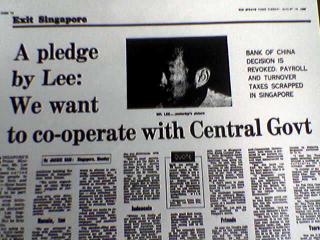
9 Aug 1965 - Suddenly, Singapore was out .. And gained independence
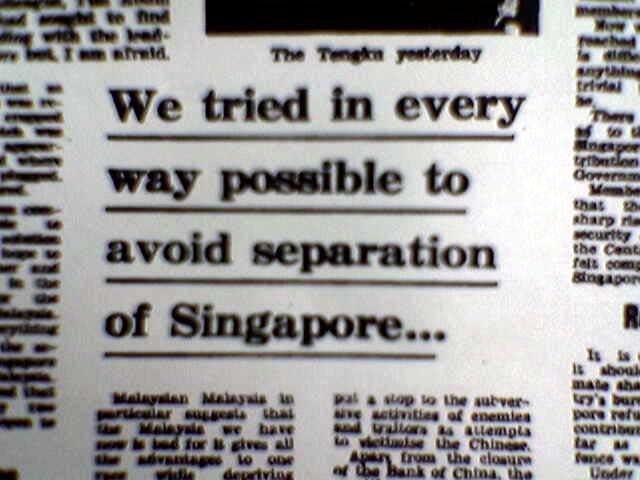
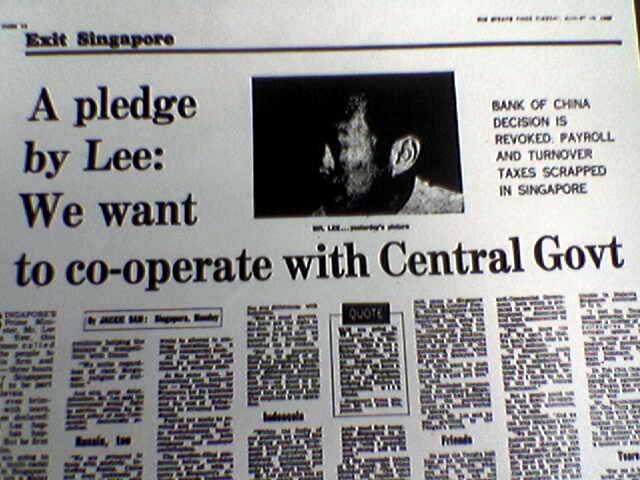
Today, on 9th August 2005, as Singaporeans celebrate 40 years of sovereignty and independence, it is worthwhile to note that 40 years ago on this day, the mood was anything but celebratory. Rather, according to these reports from the Straits Times, the Singapore Government had seemed more intent to publicise its mourning over the Separation than revelling in the formation of an independent nation.
Did the PAP really thought that Merger with Malaysia was feasible? Did Lee really harbour an ambition to be the Malaysia's Prime Minister? Was the concept of a Malaysian Malaysia a realistic one? Did Singapore earn its independence by virtue of its exit from from Malaysia? What exactly are we celebrating on National Day?
The full account of Singapore's road to independence has yet to be written. Through these excerpts from the press archives, I hope to have contributed a little in providing a fresher perspective than just the pomp and pageantry of National Day Parades.
Meanwhile, I still have a police investigation to worry about...
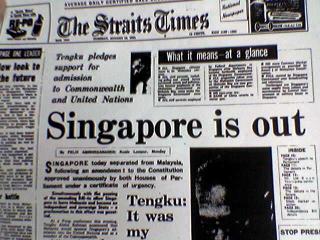
STRAITS TIMES, AUG 9 1965
Singapore today separated from Malaysia, following an amendment to the Constitution approved unanimously by both Houses of Parliament under a certificate of urgency.
Simultaneously with the passing of the amending Bill - to allow Singapore to leave Malaysia and become an independent and sovereign State - a proclamation to this effect was gazetted.
At a Press Conference this evening, Tengku Abdul Rahman annouced that Malaysia would sponsor Singapore's admission into the United Nations and as a member of the Commonwealth.
At his own press conference in Singapore, Mr Lee Kuan Yew called on his people to remain firm and calm. His eyes brimming with tears: "What has happened has happened. Everybody will have a place in Singapore and will continue helping the Malays in competition with UMNO."
Secret Signing
Today's dramatic turn follows the secret signing of the Independence of Singapore Agreement last Saturday by leaders of the two Governments.
THis document provides a treaty on external defence and mutual assistance between the two Governments and stipulates that:
BOTH GOVERNMENTS will establish a joint defence council for external defence and mutual assistance.
THE MALAYSIAN GOVERNMENT will give "reasonable and adequate" assistance for Singapore's external defence. In return, Singapore will contribute a "resaonable" number of units from its own armed forces.
THE MALAYSIAN GOVERNMENT will continue to maintain military bases within Singapore and will be permitted to use these bases for defence purposes.
NEITHER GOVERNMNTS will enter into any treaty or agreement with a foreign country which may be deterimental to the independence and defence of either.
Meanwhile, Singapore acted swiftly to establish itself as an independent State, completely unconnected with the mainland.
In the early hours of the morning, while Singapore slept, coded messages were being flashed to about 20 heads of Governments abroad - explaining the situation.
Mr Lee Kuan Yew stayed up all night to get these messages out. With him were most of his Cabinet colleagues who have had little sleep since the big break began on Saturday.
Early TV
Sharp on the hour, Radio Singapore went on the air to announce the separation.
Television came on at 4.30 pm, two hours ahead of schedule, with a telecast of the Prime Minister's press conference.
The news spread swiftly through the city after the radio annoucement. In a number of places, it was greeted with a thunderous explosion of fire-crackers.
Police patrols throughout the island were intensified. The force had been alerted two days before.
In a letter to the Commissioner of Police, Mr John Le Cain, Dated 7 Aug. Dato (Dr) Ismail bin Dato Haji Abdul Rahman, Malaysia's Minister of Home Affairs, had said :
"I herewith instruct you as from Aug. 9 1965 to take orders from Mr Lee Kuan Yew, Prime MInister of Singapore, in order to enable him to discharge his responsibility for the internal security of Singapore."
The same day, the Tengku also instructed Brigadier S.M. Alsagoff, Commander of the Singapore-based 4th Federal Infantry Brigade:
"In the absence of the Tun, I take full responsibility in giving you this instruction.
"As from Aug 9 1965, you are to take instructions from Mr Lee Kuan Yew, Prime Minister of Singapore, as he is now onward in charge of the defence and security of Singapore. Other orders will be issued in due course."
Meanwhile, all Malaysian flags fluttered down and were replaced by Singapore flags by noon.

Did the PAP really thought that Merger with Malaysia was feasible? Did Lee really harbour an ambition to be the Malaysia's Prime Minister? Was the concept of a Malaysian Malaysia a realistic one? Did Singapore earn its independence by virtue of its exit from from Malaysia? What exactly are we celebrating on National Day?
The full account of Singapore's road to independence has yet to be written. Through these excerpts from the press archives, I hope to have contributed a little in providing a fresher perspective than just the pomp and pageantry of National Day Parades.
Meanwhile, I still have a police investigation to worry about...
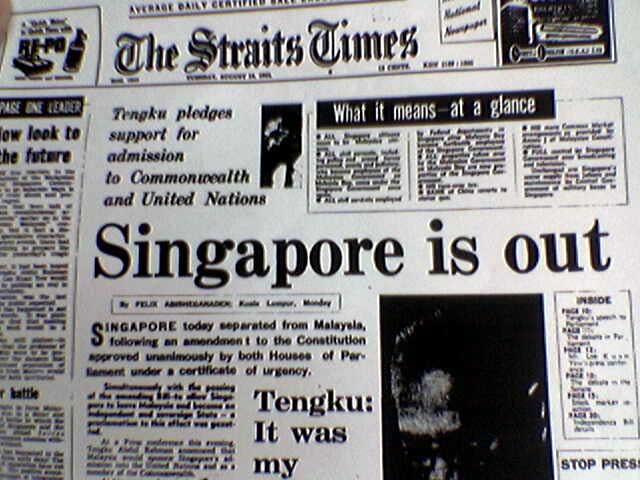
STRAITS TIMES, AUG 9 1965
Singapore today separated from Malaysia, following an amendment to the Constitution approved unanimously by both Houses of Parliament under a certificate of urgency.
Simultaneously with the passing of the amending Bill - to allow Singapore to leave Malaysia and become an independent and sovereign State - a proclamation to this effect was gazetted.
At a Press Conference this evening, Tengku Abdul Rahman annouced that Malaysia would sponsor Singapore's admission into the United Nations and as a member of the Commonwealth.
At his own press conference in Singapore, Mr Lee Kuan Yew called on his people to remain firm and calm. His eyes brimming with tears: "What has happened has happened. Everybody will have a place in Singapore and will continue helping the Malays in competition with UMNO."
Secret Signing
Today's dramatic turn follows the secret signing of the Independence of Singapore Agreement last Saturday by leaders of the two Governments.
THis document provides a treaty on external defence and mutual assistance between the two Governments and stipulates that:
BOTH GOVERNMENTS will establish a joint defence council for external defence and mutual assistance.
THE MALAYSIAN GOVERNMENT will give "reasonable and adequate" assistance for Singapore's external defence. In return, Singapore will contribute a "resaonable" number of units from its own armed forces.
THE MALAYSIAN GOVERNMENT will continue to maintain military bases within Singapore and will be permitted to use these bases for defence purposes.
NEITHER GOVERNMNTS will enter into any treaty or agreement with a foreign country which may be deterimental to the independence and defence of either.
Meanwhile, Singapore acted swiftly to establish itself as an independent State, completely unconnected with the mainland.
In the early hours of the morning, while Singapore slept, coded messages were being flashed to about 20 heads of Governments abroad - explaining the situation.
Mr Lee Kuan Yew stayed up all night to get these messages out. With him were most of his Cabinet colleagues who have had little sleep since the big break began on Saturday.
Early TV
Sharp on the hour, Radio Singapore went on the air to announce the separation.
Television came on at 4.30 pm, two hours ahead of schedule, with a telecast of the Prime Minister's press conference.
The news spread swiftly through the city after the radio annoucement. In a number of places, it was greeted with a thunderous explosion of fire-crackers.
Police patrols throughout the island were intensified. The force had been alerted two days before.
In a letter to the Commissioner of Police, Mr John Le Cain, Dated 7 Aug. Dato (Dr) Ismail bin Dato Haji Abdul Rahman, Malaysia's Minister of Home Affairs, had said :
"I herewith instruct you as from Aug. 9 1965 to take orders from Mr Lee Kuan Yew, Prime MInister of Singapore, in order to enable him to discharge his responsibility for the internal security of Singapore."
The same day, the Tengku also instructed Brigadier S.M. Alsagoff, Commander of the Singapore-based 4th Federal Infantry Brigade:
"In the absence of the Tun, I take full responsibility in giving you this instruction.
"As from Aug 9 1965, you are to take instructions from Mr Lee Kuan Yew, Prime Minister of Singapore, as he is now onward in charge of the defence and security of Singapore. Other orders will be issued in due course."
Meanwhile, all Malaysian flags fluttered down and were replaced by Singapore flags by noon.
Sunday, August 07, 2005
5 days before Separation ...
Part Xl of the retrospective on Singapore's road to independence
STRAITS TIMES, Aug 4 1965
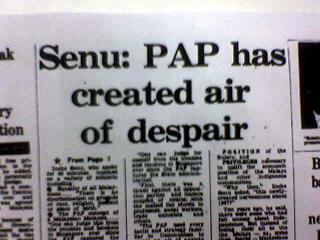
Examining the PAP concept of Malaysian Malaysia, Inche Senu said: "The PAP itself a shining example of what its Malaysian Malaysia stands for.
"One can judge for oneself the troubles and tensions in Singapore ever since the PAP captured the State administration.
"First there was a tirade against all opposition parties and leaders coupled, of course, with the mailed fist shown to professionals, social workers, trade unionists and others.
"The PAP used every tactic and strategy familiar to Communism to create an air of anxiety and despair among the people - then baited them into submission with promises of patronage and protection to those conforming.
'Twisted'
"Every legislative and administrative organ in the State was twisted to suit the polemics of the party and its ruling clique.
"Rivals and opponents were placted for a while with false promises of co-operation and ruthlessly weeded them out.
"Now the PAP has isolated itself that it fears its own shadow. Probably memories of its past misdeeds - arrests, liquidation and elimination of opposition by any means - are haunting its leadership so much that it is now convulsed with fear of retribution.
"Let me tell you this: If you are sincere about a Malaysian Malaysia, then do not betray the trust, however unknowingly placed in you, by the people of Singapore. Do not become heroes on someone else's blood."
Ten years ago, he said, there were some who had felt uneasy about independence. But instead of losing all to the Malays - as some then feared - Malaysians of all walks of life gained immensely through independence.
Inche Senu then referred to "threats" by Mr Lee Kuan Yew that if the Central Government did not yield to his interpretation of a Malaysian Malaysia, Britain, Australia and New Zealand may do some serious re-thinking about helping to defend Malaysia.
"First of all," Inche Senu said,"Mr Lee must know that the defence of Malaysia is primarily the responsibility of Malaysians themselves.
'Clarify' call
"Our Commonwealth allies are here by invitation of the Malaysian Government for the specific purpose of assisting in our external defence.
"Do Mr Lee's threats mean that the purpose of our allies in helping to defend our integrity is merely to prop up Mr Lee Kuan Yew and the PAP?
"I think they know better than to interfere in our internal affairs."
"Whoever is trying to implicate others in our local affairs is in fact betraying our national interests and may be considered by the people as a stooge of foreign powers."
STRAITS TIMES, Aug 4 1965
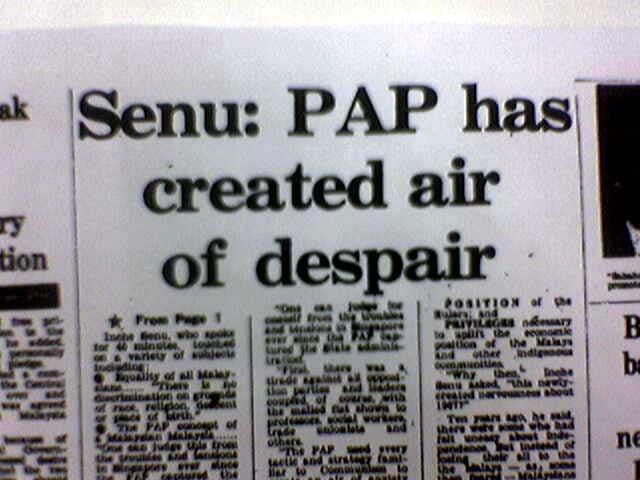
Examining the PAP concept of Malaysian Malaysia, Inche Senu said: "The PAP itself a shining example of what its Malaysian Malaysia stands for.
"One can judge for oneself the troubles and tensions in Singapore ever since the PAP captured the State administration.
"First there was a tirade against all opposition parties and leaders coupled, of course, with the mailed fist shown to professionals, social workers, trade unionists and others.
"The PAP used every tactic and strategy familiar to Communism to create an air of anxiety and despair among the people - then baited them into submission with promises of patronage and protection to those conforming.
'Twisted'
"Every legislative and administrative organ in the State was twisted to suit the polemics of the party and its ruling clique.
"Rivals and opponents were placted for a while with false promises of co-operation and ruthlessly weeded them out.
"Now the PAP has isolated itself that it fears its own shadow. Probably memories of its past misdeeds - arrests, liquidation and elimination of opposition by any means - are haunting its leadership so much that it is now convulsed with fear of retribution.
"Let me tell you this: If you are sincere about a Malaysian Malaysia, then do not betray the trust, however unknowingly placed in you, by the people of Singapore. Do not become heroes on someone else's blood."
Ten years ago, he said, there were some who had felt uneasy about independence. But instead of losing all to the Malays - as some then feared - Malaysians of all walks of life gained immensely through independence.
Inche Senu then referred to "threats" by Mr Lee Kuan Yew that if the Central Government did not yield to his interpretation of a Malaysian Malaysia, Britain, Australia and New Zealand may do some serious re-thinking about helping to defend Malaysia.
"First of all," Inche Senu said,"Mr Lee must know that the defence of Malaysia is primarily the responsibility of Malaysians themselves.
'Clarify' call
"Our Commonwealth allies are here by invitation of the Malaysian Government for the specific purpose of assisting in our external defence.
"Do Mr Lee's threats mean that the purpose of our allies in helping to defend our integrity is merely to prop up Mr Lee Kuan Yew and the PAP?
"I think they know better than to interfere in our internal affairs."
"Whoever is trying to implicate others in our local affairs is in fact betraying our national interests and may be considered by the people as a stooge of foreign powers."
Friday, August 05, 2005
Police investigation on Singapore Rebel resumes
Hi all,
Police Assistant Superintendent Chan Peng Kuang called me today, 5 August 1600 hours, to request for a second interview regarding the making of my short film Singapore Rebel.
The first interview was conducted on 16 May 2005 by the same officer.
http://singaporerebel.blogspot.com/2005/05/interview-over-but-investigation-will.html
I've told ASP Chan that I'll call him to arrange a date for the next interview.
UMNO 'extremists' may detain Lee, alleged PAP
Part X of the retrospective on Singapore's road to independence
STRAITS TIMES, June 8 1965
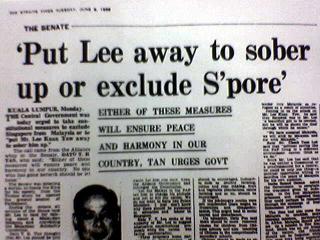
The Central Government was today urged to take consitutional measures to exclude Singapore from Malaysia or to "put Mr Lee Kuan Yew away to sober him up."
The call came from the Alliance whip in the Senate, Dato T.H. Tan, who said,"Either of these measures will ensure peace and harmony in our country. No one who has gone berserk should be let loose."
The Senate was debating a motion to thank the king for his speech from the Throne when he opened the present session of Parliament.
During the debate, all sections of the House took Mr Lee to task for talking about a Malaysian Malaysia and convening the Malaysian Solidarity Convention.
Dato T.H. Tan thought that Mr Lee should be told on no uncertain terms that Malaysia could do without Singapore.
Steps
If Mr Lee persisted in his "anti-Malay and his unpatriotic conduct", constitutional steps should be taken to separate Singapore.
Appealing to the public "not to follow Mr Lee", Dato Tan said,"There appears to be little doubt that Mr Lee through his words and deeds is stirring up emotions and causing dissension.
"The man must be stopped before irreparable harm is done. Mr Lee is trying to split the races here and to partition our country.
"It was on the basis of inter-racial unity that Tengku Abdul Rahman and his colleagues won independence for us. Now this very unity is being undermined."
"He added: "Let Mr Lee stew in the Communist soup bowl that is Singapore. If he does not think much of the Communists, then let us release Lim Chin Siong and other comrades and let us see how Mr Lee can stand up to them, face to face, man to man."
Inche Ahmad Haji Taff (Singapore) said Singapore's Prime Minister, Mr Lee Kuan Yew, was like a frog in a coconut shell.
Referring to his concept of a Malaysian Malaysia, Inche Ahmad sais: "Mr Lee is doing nothing except to irritate the feelings between the non-Malays and Malays."
He accused Mr Lee of trying to get rid of the Malay Rulers and the head of the nation.
"Mr Lee is trying to get rid of all Sultans and make this country a republic with himself as the president. Perhaps he is not satisfied with Islam being the State's religion."
He told the House: "Let Mr Lee spell out exactly what he wants. Let him show when the Alliance Government had infringed the Constitution.
"Let the Malays in the PAP tell him to change his attitude and not to kill our nation. We do not want to have two Prime Ministers."
Dato Dr Cheah Toon Lok said that "political parties like the PAP living in a different envirnment cannot think as we do."
Since Mr Lee has said that he was neither a Communist or a pro-Communist but a neutral, he could be only one thing - a political opportunist willing to sacrifice the peace of Malaysia for his own ambition.
Inche Saidon bin Kechut described Mr Lee as a "troublemaker with a hatred of the Malays and who wants to destroy them."
He was also greedy for power. "Not satisfied with being a dictator in Singapore he is now seeking to extend his power. He now wants to control the Central Goverment."
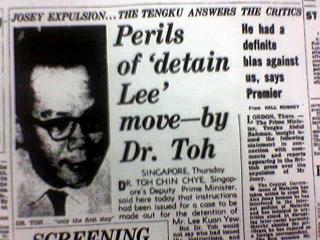
STRAITS TIMES, July 9 1965
Dr Toh Chin Chye, Singapore's Deputy Prime Minister, said here today that instructions had been issued for a case to be made out for the detention of Lee Kuan Yew.
But Dr Toh would not say who had issued the instructions, and to whom they had been issued.
At a press conrference in City Hall this afternoon, he said: "I personally do not wish to enlarge on the matter, but I would say that those in the Government who are responsible for such matters know that we know.
"It can rest at that."
Soilidly united
The press conference had been called to explain the Singapore Government's stand on the expulsion of free-lance journalist Mr Alex Josey and "attempts by extremists in the Alliance, particularly the UMNO," to have Mr Lee arrested.
With Mr Toh were the Minister for Law, Mr E.W. barker, and the Minister for National Development, Mr Lim Kim San.
Dr Toh opened the conference with the announcement that the entire Singapore Cabinet was solidly united on this matter.
'First step'
The expulsion of Mr Josey was only the first step towards the suppression of liberalism in Malaysia's political field, he said.
Then, reading from a prepared statement Dr Toh said: "If the Central Government continues to placate these extremist elements, further respressive measures must be taken which must lead to the break-up of Malaysia.
"Another demand was the arrest and detention of Mr Lee Kuan Yew."
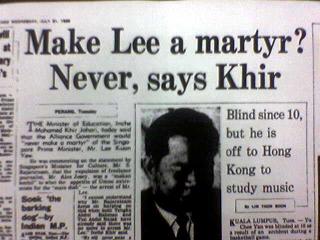
STRAITS TIMES, July 21 1965
The Minister of Education, Inche Mohammed Khir Johari, today said that the Allaince Government would "never make a martyr" of the Singapore Prime Minister, Mr Lee Kuan Yew.
He was commenting on a statement by Singapore's Minister for Culture, Mr S. Rajaratnam, that the expulsion of freelance journalist, Mr Alex Josey, was a "makan kechil" to whet the appetite of UMNO extremists for the "main dish" - the arrest of Mr Lee Kuan Yew.
"I cannot understand why Mr Rajaratnam keeps on harping on this when both Tengku Abdul Rahman and Tun Abdul Razak have already said there was no move to arrest Mr Lee," Inche Khir said.
"We will never make a martyr of the Singapore Prime Minister. All this hope of impending arrest exists only in the minds of the PAP leaders."

STRAITS TIMES, June 8 1965
The Central Government was today urged to take consitutional measures to exclude Singapore from Malaysia or to "put Mr Lee Kuan Yew away to sober him up."
The call came from the Alliance whip in the Senate, Dato T.H. Tan, who said,"Either of these measures will ensure peace and harmony in our country. No one who has gone berserk should be let loose."
The Senate was debating a motion to thank the king for his speech from the Throne when he opened the present session of Parliament.
During the debate, all sections of the House took Mr Lee to task for talking about a Malaysian Malaysia and convening the Malaysian Solidarity Convention.
Dato T.H. Tan thought that Mr Lee should be told on no uncertain terms that Malaysia could do without Singapore.
Steps
If Mr Lee persisted in his "anti-Malay and his unpatriotic conduct", constitutional steps should be taken to separate Singapore.
Appealing to the public "not to follow Mr Lee", Dato Tan said,"There appears to be little doubt that Mr Lee through his words and deeds is stirring up emotions and causing dissension.
"The man must be stopped before irreparable harm is done. Mr Lee is trying to split the races here and to partition our country.
"It was on the basis of inter-racial unity that Tengku Abdul Rahman and his colleagues won independence for us. Now this very unity is being undermined."
"He added: "Let Mr Lee stew in the Communist soup bowl that is Singapore. If he does not think much of the Communists, then let us release Lim Chin Siong and other comrades and let us see how Mr Lee can stand up to them, face to face, man to man."
Inche Ahmad Haji Taff (Singapore) said Singapore's Prime Minister, Mr Lee Kuan Yew, was like a frog in a coconut shell.
Referring to his concept of a Malaysian Malaysia, Inche Ahmad sais: "Mr Lee is doing nothing except to irritate the feelings between the non-Malays and Malays."
He accused Mr Lee of trying to get rid of the Malay Rulers and the head of the nation.
"Mr Lee is trying to get rid of all Sultans and make this country a republic with himself as the president. Perhaps he is not satisfied with Islam being the State's religion."
He told the House: "Let Mr Lee spell out exactly what he wants. Let him show when the Alliance Government had infringed the Constitution.
"Let the Malays in the PAP tell him to change his attitude and not to kill our nation. We do not want to have two Prime Ministers."
Dato Dr Cheah Toon Lok said that "political parties like the PAP living in a different envirnment cannot think as we do."
Since Mr Lee has said that he was neither a Communist or a pro-Communist but a neutral, he could be only one thing - a political opportunist willing to sacrifice the peace of Malaysia for his own ambition.
Inche Saidon bin Kechut described Mr Lee as a "troublemaker with a hatred of the Malays and who wants to destroy them."
He was also greedy for power. "Not satisfied with being a dictator in Singapore he is now seeking to extend his power. He now wants to control the Central Goverment."

STRAITS TIMES, July 9 1965
Dr Toh Chin Chye, Singapore's Deputy Prime Minister, said here today that instructions had been issued for a case to be made out for the detention of Lee Kuan Yew.
But Dr Toh would not say who had issued the instructions, and to whom they had been issued.
At a press conrference in City Hall this afternoon, he said: "I personally do not wish to enlarge on the matter, but I would say that those in the Government who are responsible for such matters know that we know.
"It can rest at that."
Soilidly united
The press conference had been called to explain the Singapore Government's stand on the expulsion of free-lance journalist Mr Alex Josey and "attempts by extremists in the Alliance, particularly the UMNO," to have Mr Lee arrested.
With Mr Toh were the Minister for Law, Mr E.W. barker, and the Minister for National Development, Mr Lim Kim San.
Dr Toh opened the conference with the announcement that the entire Singapore Cabinet was solidly united on this matter.
'First step'
The expulsion of Mr Josey was only the first step towards the suppression of liberalism in Malaysia's political field, he said.
Then, reading from a prepared statement Dr Toh said: "If the Central Government continues to placate these extremist elements, further respressive measures must be taken which must lead to the break-up of Malaysia.
"Another demand was the arrest and detention of Mr Lee Kuan Yew."
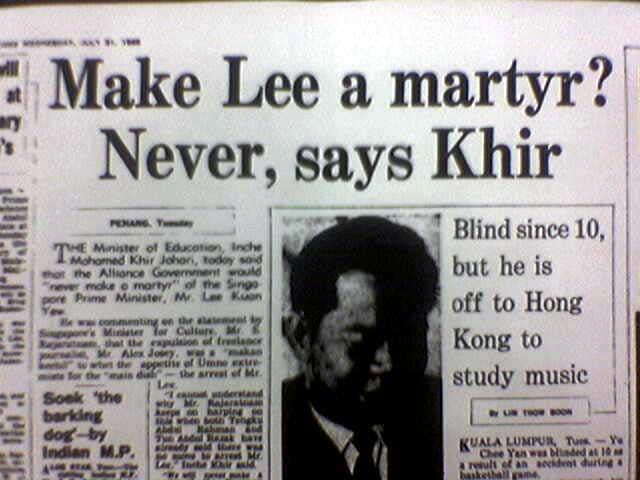
STRAITS TIMES, July 21 1965
The Minister of Education, Inche Mohammed Khir Johari, today said that the Allaince Government would "never make a martyr" of the Singapore Prime Minister, Mr Lee Kuan Yew.
He was commenting on a statement by Singapore's Minister for Culture, Mr S. Rajaratnam, that the expulsion of freelance journalist, Mr Alex Josey, was a "makan kechil" to whet the appetite of UMNO extremists for the "main dish" - the arrest of Mr Lee Kuan Yew.
"I cannot understand why Mr Rajaratnam keeps on harping on this when both Tengku Abdul Rahman and Tun Abdul Razak have already said there was no move to arrest Mr Lee," Inche Khir said.
"We will never make a martyr of the Singapore Prime Minister. All this hope of impending arrest exists only in the minds of the PAP leaders."
Lee branded a 'traitor', told to 'sit down, get out'
Part lX of the retrospective on Singapore's road to independence
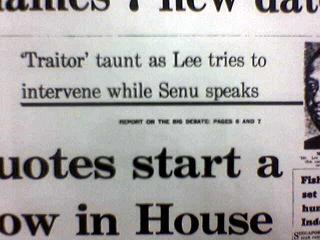
STRAITS TIMES, JUNE 2 1965
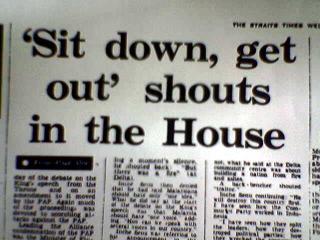
Shouts of "traitor," "sit down" and "get out" rang out in the House of Reprsentatives today when Singapore's Prime MInister, Mr Lee Kuan Yew, twice tried to interrupt a speech by the Minister of Information and Broadcasting, Inche Senu bin Abdul Rahman.
The first outburst occurred when Inche Senu read extracts of a speech Mr Lee had made in Singapore's Delta community centre on Sunday where he had spoken of building a "new nation out of ashes..."
Mr Lee rose to clarify his remarks, but was shouted down from all sections of the House. Looking appealingly at the Speaker, he said: "As you wish."
Inche Senu continued: "He wants to destroy this nation and build a new one..."
There were more noisy interruptions when Inche Senu read extracts from Mr Lee's speeches during his recent visit to Australia.
Yelled
In one speech, Mr Lee was quoted as having said that Tengku Abdul Rahman had made a "stupid, naive mistake" about the allocation of Parliamentary seats for Borneo.
Mr Lee got up. As one man, the backbenchers thumped their tables and yelled: "Sit down ... sit down ... traitor ... get out."
The Speaker, Dato C.M. Yusof, banged his gravel hard and in a raised voice said: "Will Honourable members stop shouting out loud and behaving in an unparliamentary way..."
Leading the Alliance condemnation of the PAP was the Minister of Finance, Mr Tan Siew Sin, who said that co-operation with the Singapore Government was out of the question as long as Mr Lee Kuan Yew remained Prime Minister.
Mr Tan described Mr Lee as the "greatest disruptive force in the entire history of Malaysia and Malaya."
He warned that Mr Lee's idea of partitioning Malaysia would only lead to bloodshed. He cited India and Cyprus as examples.
At 8.15 pm, Mr Lee - as mover of the amendment to the resolution to say "thank you" to the Yang di-Peruan Agong for his gracious speech from the Throne - asked be allowed to exercise his right of reply.
The Speaker told him there were two Central Government Ministers who wished to speak before him. But by the time Inche Senu and the Minister for Lands and Mines, Inche Rahman Ya'akub, had finished it was 9pm - time for the House to adjourn till Thursday.
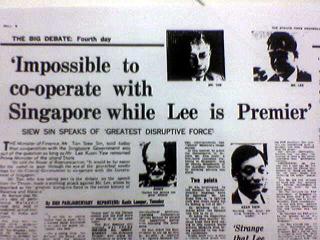
The Minister of Finance, Mr Tan Siew Sin, said today that co-operation with the Singapore Government was out of the question as long as Mr Lee Kuan Yew remained Prime Minister of the island State.
He told the House of Representatives: "It would be easier for the camel to pass through the eye of the proverbial needle than for the Central Government to co-operate with the Government of Singapore."
He warned that Mr Lee's idea of partitioning Malaysia would only lead to bloodshed, as had happened in India and Cyprus.
"Any man who can make these proposals "cooly and carefully," he said, "has boundless capacity for mischief.
"I say this in sorrow rather than in anger. Only a warped mind, frustrated in its quest for power, can support this idea.
"It is a warped mind which is prepared to sacrifice thousands of lives, to shed blood, in order to ensure that the owner of the mind achieves supreme power. That is the measure of Mr Lee Kuan Yew.
A pity
Mr Tan said: "It is terrible pity that this is so. It is a pity that differences are becoming so acute and so serious. I am convinced that not only should Malaysia be one but that human race itself should be one."
"In the last analysis, the interest of Malaysia is far more important than the interest of any political party, or even the interest of a single State.
STRAITS TIMES, JUNE 2 1965
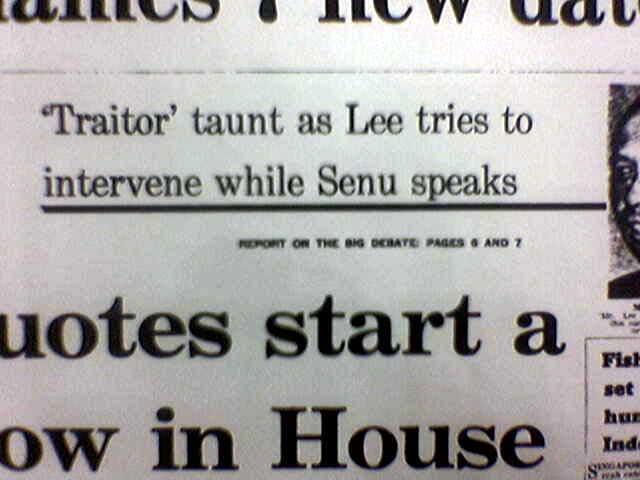
Shouts of "traitor," "sit down" and "get out" rang out in the House of Reprsentatives today when Singapore's Prime MInister, Mr Lee Kuan Yew, twice tried to interrupt a speech by the Minister of Information and Broadcasting, Inche Senu bin Abdul Rahman.
The first outburst occurred when Inche Senu read extracts of a speech Mr Lee had made in Singapore's Delta community centre on Sunday where he had spoken of building a "new nation out of ashes..."
Mr Lee rose to clarify his remarks, but was shouted down from all sections of the House. Looking appealingly at the Speaker, he said: "As you wish."
Inche Senu continued: "He wants to destroy this nation and build a new one..."
There were more noisy interruptions when Inche Senu read extracts from Mr Lee's speeches during his recent visit to Australia.
Yelled
In one speech, Mr Lee was quoted as having said that Tengku Abdul Rahman had made a "stupid, naive mistake" about the allocation of Parliamentary seats for Borneo.
Mr Lee got up. As one man, the backbenchers thumped their tables and yelled: "Sit down ... sit down ... traitor ... get out."
The Speaker, Dato C.M. Yusof, banged his gravel hard and in a raised voice said: "Will Honourable members stop shouting out loud and behaving in an unparliamentary way..."

Leading the Alliance condemnation of the PAP was the Minister of Finance, Mr Tan Siew Sin, who said that co-operation with the Singapore Government was out of the question as long as Mr Lee Kuan Yew remained Prime Minister.
Mr Tan described Mr Lee as the "greatest disruptive force in the entire history of Malaysia and Malaya."
He warned that Mr Lee's idea of partitioning Malaysia would only lead to bloodshed. He cited India and Cyprus as examples.
At 8.15 pm, Mr Lee - as mover of the amendment to the resolution to say "thank you" to the Yang di-Peruan Agong for his gracious speech from the Throne - asked be allowed to exercise his right of reply.
The Speaker told him there were two Central Government Ministers who wished to speak before him. But by the time Inche Senu and the Minister for Lands and Mines, Inche Rahman Ya'akub, had finished it was 9pm - time for the House to adjourn till Thursday.

The Minister of Finance, Mr Tan Siew Sin, said today that co-operation with the Singapore Government was out of the question as long as Mr Lee Kuan Yew remained Prime Minister of the island State.
He told the House of Representatives: "It would be easier for the camel to pass through the eye of the proverbial needle than for the Central Government to co-operate with the Government of Singapore."
He warned that Mr Lee's idea of partitioning Malaysia would only lead to bloodshed, as had happened in India and Cyprus.
"Any man who can make these proposals "cooly and carefully," he said, "has boundless capacity for mischief.
"I say this in sorrow rather than in anger. Only a warped mind, frustrated in its quest for power, can support this idea.
"It is a warped mind which is prepared to sacrifice thousands of lives, to shed blood, in order to ensure that the owner of the mind achieves supreme power. That is the measure of Mr Lee Kuan Yew.
A pity
Mr Tan said: "It is terrible pity that this is so. It is a pity that differences are becoming so acute and so serious. I am convinced that not only should Malaysia be one but that human race itself should be one."
"In the last analysis, the interest of Malaysia is far more important than the interest of any political party, or even the interest of a single State.
Wednesday, August 03, 2005
"PAP is using communal tactics"
Part Vlll of the retrospective on Singapore's road to independence
By June 1965, it had become clear that Singapore's Merger with Malaysia was about to collapse. In a last ditch attempt to shore up relations, PM Lee Kuan Yew proposed the possibilty of "partitioning" where States who had wanted a Malaysian Malaysia can run a system different from the Central Government's. It provoked an outcry in Malaysia's Parliament. Two and a half decades later, Chinese Premier Deng Xiapeng decreed the One Country Two Systems policy for China and Hong Kong. Lee was among the first to heap effusive praise for Deng's formula.

STRAITS TIMES, JUNE 1 1965
The People's Action Party has been spreading "fairy tales" about Malaysia overseas, the Minister for Home Affairs, Dato (Dr) Ismail bin dato Abdul Rahman, told the House of Representatives today.
He was countering PAP accusations in the House that the Central Government had failed to work towards a Malaysian Malaysia.
He told the House that in PAP "fairy tales" which foreign correspondents believed, Singapore's Prime Minister, Mr Lee Kuan Yew, had "twisted facts and arguments" to blacken and smear political opponents.
STRAITS TIMES, JUNE 1 1965
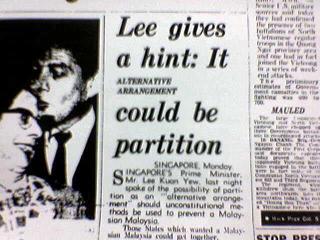
Singapore's Prime Minister, Mr Lee Kuan Yew, last night spoke of the possibility of partitioning as an "alternative arrangement" should unconstitutional methods be used to prevent a Malaysian Malaysia.
Those States which wanted a Malyasian Malaysia could get together.
He could think of three - Singapore, Sabah and Sarawak. Malacca and Penang were possibilities.
He said the present internal and international situation favoured an immediate decision on whether there was going to be a Malaysian Malaysia.
'Other ideas'
"Another resaon why it is necessary to decide now, not later on, is because it is easier for us, if they do not want a Malaysian Malaysia, to make alternative arrangements some other way," he said.
"The agreement in the Constitution must lead to a Malaysian Malaysia, and if they want to stop it they must use unconstitutional methods to stop it.
"So I say if they want to do that, do it now. It will be easier for us to make other alternative arrangements.
If Malays were daily exhorted to unite on the basis of race and not nation, in five years' time it would be very difficult to change the thinking on the ground.
Malaysian rule
Mr Lee said he did not want to talk too much about alternative constitutional arrangements.
He declared that Singapore had never agreed to Malay rule when it joined Malaysia. What it agreed to was Malaysian rule.
Talk that the people of Singapore were not accustomed to Malay rule, unlike the people of Kelantan and Trengganu, "was all bunkum."

STRAITS TIMES, JUNE 1 1965
The PAP was resurrecting the communal angle, Dato Ismail said, because the party was aware that this was an "effective weapon."
The Alliance had buried this question and was concentrating on building inter-racial harmony.
He described as untrue PAP claim that special privilges for the Malays only benefited capitalist Malays.
"Even if the Malays try hard to become millionaires, I do not think they will succeed. The odds are gainst them. They are not endowed as other Malaysians are in the ingenuity to acquire and accumulate wealth.
"The ratio in Government service benefits all sections of Malays who are qualified."
Referring to Mr Lee's charges that the allaince was creating a Malay Malaysia, dato Ismail said: "We Malay Malaysians, as the honourable Member from Singapore would like to call us, is not afraid of the truth."
He referred Mr Lee to the comparitively small number of Malays in commerce and industry, and the small number of Malays in the University of Malaya, and said:
"If Mr Lee adds up the strength and weakness of Malaysia, he cannot accuse the Malays of dominating Malaysia.
"With Indonesian confrontaion, the Malays cannot afford to dominate Malaysia without ruining this country."
Dato Ismail added: 'Like Dr Jekyll and Mr Hyde, the two images of the PAP cannot remain separate for long. The two must come together. The time for merging must come.
"The PAP is a party that shouts 'fire, fire' but commits arson."
He then paraphrased Abraham Lincoln: "You can fool some of the Malaysians all the time, all the Malaysians some of the time, but not all Malaysians all the time."
Saying that the Alliance had won independence for Malaya and helped Singapore gain independence, he added: "Surely, we can win the battle against the PAP."
In the battle to win the hearts and minds of the people, the Allaince would abide by democratic principles as long as the Opposition did likewsie."
MR CHIA THYE POH (Barisan Socialis - Singapore) took the PAP to task for "burying democracy" in Singapore by what he called "calculated steps."
He said Malaysia had not brought independence in the true sense of the term. Foreign troops were still in the land and more were coming in.
But apart from this, the PAP was the party which sought the friendship of the Allaince to fight and oppose one section of the Alliance during the last elections.
"Now the same PAP is fighting the Alliance in the open for its own ends.
"In the past, the PAP made friends and made use of the workers and students to gain power. Once they came into power they discarded them.
"In the past, they also made use of political opponents for their own ends. They now oppose all of them. What is the reason behind this whole plot?" he asked.
Mr Chia said there was no political democracy in Singapore because the PAP had banned all public rallies by the Barisan Socialis.
"The PAP, the devil, is now posing as an angel to this House. I ask that this be taken with a pinch of salt," he added.
By June 1965, it had become clear that Singapore's Merger with Malaysia was about to collapse. In a last ditch attempt to shore up relations, PM Lee Kuan Yew proposed the possibilty of "partitioning" where States who had wanted a Malaysian Malaysia can run a system different from the Central Government's. It provoked an outcry in Malaysia's Parliament. Two and a half decades later, Chinese Premier Deng Xiapeng decreed the One Country Two Systems policy for China and Hong Kong. Lee was among the first to heap effusive praise for Deng's formula.
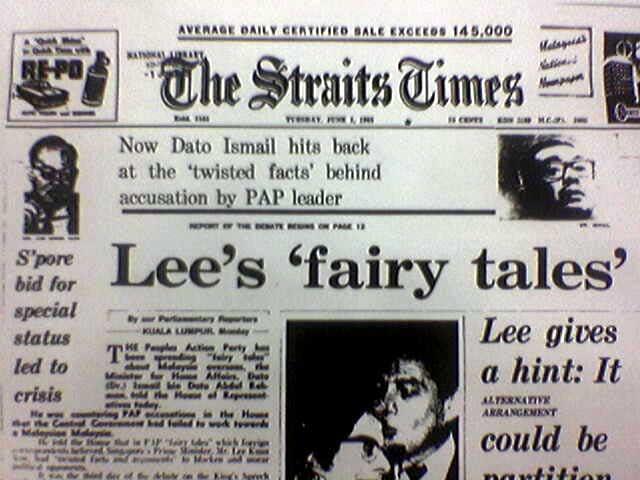
STRAITS TIMES, JUNE 1 1965
The People's Action Party has been spreading "fairy tales" about Malaysia overseas, the Minister for Home Affairs, Dato (Dr) Ismail bin dato Abdul Rahman, told the House of Representatives today.
He was countering PAP accusations in the House that the Central Government had failed to work towards a Malaysian Malaysia.
He told the House that in PAP "fairy tales" which foreign correspondents believed, Singapore's Prime Minister, Mr Lee Kuan Yew, had "twisted facts and arguments" to blacken and smear political opponents.

STRAITS TIMES, JUNE 1 1965
Singapore's Prime Minister, Mr Lee Kuan Yew, last night spoke of the possibility of partitioning as an "alternative arrangement" should unconstitutional methods be used to prevent a Malaysian Malaysia.
Those States which wanted a Malyasian Malaysia could get together.
He could think of three - Singapore, Sabah and Sarawak. Malacca and Penang were possibilities.
He said the present internal and international situation favoured an immediate decision on whether there was going to be a Malaysian Malaysia.
'Other ideas'
"Another resaon why it is necessary to decide now, not later on, is because it is easier for us, if they do not want a Malaysian Malaysia, to make alternative arrangements some other way," he said.
"The agreement in the Constitution must lead to a Malaysian Malaysia, and if they want to stop it they must use unconstitutional methods to stop it.
"So I say if they want to do that, do it now. It will be easier for us to make other alternative arrangements.
If Malays were daily exhorted to unite on the basis of race and not nation, in five years' time it would be very difficult to change the thinking on the ground.
Malaysian rule
Mr Lee said he did not want to talk too much about alternative constitutional arrangements.
He declared that Singapore had never agreed to Malay rule when it joined Malaysia. What it agreed to was Malaysian rule.
Talk that the people of Singapore were not accustomed to Malay rule, unlike the people of Kelantan and Trengganu, "was all bunkum."

STRAITS TIMES, JUNE 1 1965
The PAP was resurrecting the communal angle, Dato Ismail said, because the party was aware that this was an "effective weapon."
The Alliance had buried this question and was concentrating on building inter-racial harmony.
He described as untrue PAP claim that special privilges for the Malays only benefited capitalist Malays.
"Even if the Malays try hard to become millionaires, I do not think they will succeed. The odds are gainst them. They are not endowed as other Malaysians are in the ingenuity to acquire and accumulate wealth.
"The ratio in Government service benefits all sections of Malays who are qualified."
Referring to Mr Lee's charges that the allaince was creating a Malay Malaysia, dato Ismail said: "We Malay Malaysians, as the honourable Member from Singapore would like to call us, is not afraid of the truth."
He referred Mr Lee to the comparitively small number of Malays in commerce and industry, and the small number of Malays in the University of Malaya, and said:
"If Mr Lee adds up the strength and weakness of Malaysia, he cannot accuse the Malays of dominating Malaysia.
"With Indonesian confrontaion, the Malays cannot afford to dominate Malaysia without ruining this country."
Dato Ismail added: 'Like Dr Jekyll and Mr Hyde, the two images of the PAP cannot remain separate for long. The two must come together. The time for merging must come.
"The PAP is a party that shouts 'fire, fire' but commits arson."
He then paraphrased Abraham Lincoln: "You can fool some of the Malaysians all the time, all the Malaysians some of the time, but not all Malaysians all the time."
Saying that the Alliance had won independence for Malaya and helped Singapore gain independence, he added: "Surely, we can win the battle against the PAP."
In the battle to win the hearts and minds of the people, the Allaince would abide by democratic principles as long as the Opposition did likewsie."
MR CHIA THYE POH (Barisan Socialis - Singapore) took the PAP to task for "burying democracy" in Singapore by what he called "calculated steps."
He said Malaysia had not brought independence in the true sense of the term. Foreign troops were still in the land and more were coming in.
But apart from this, the PAP was the party which sought the friendship of the Allaince to fight and oppose one section of the Alliance during the last elections.
"Now the same PAP is fighting the Alliance in the open for its own ends.
"In the past, the PAP made friends and made use of the workers and students to gain power. Once they came into power they discarded them.
"In the past, they also made use of political opponents for their own ends. They now oppose all of them. What is the reason behind this whole plot?" he asked.
Mr Chia said there was no political democracy in Singapore because the PAP had banned all public rallies by the Barisan Socialis.
"The PAP, the devil, is now posing as an angel to this House. I ask that this be taken with a pinch of salt," he added.
Tuesday, August 02, 2005
UMNO members demanded detention of Lee Kuan Yew
Part Vll of the retrospective on Singapore's road to independence
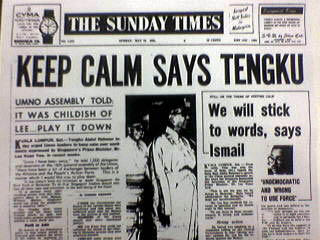
STRAITS TIMES, MAY 16 1965
Tengku Abdul Rahman today urged UMNO leaders to keep calm over sentiments expressed by Singapore's Prime Minister, Mr Lee Kuan Yew, in recent weeks.
"I often said before that my intention was to make Singapore the New York of Malaysia and in order to do that the Singapore leaders should confine all the time and attention to the well-being of Singapore.
"It is obvious that every right-thinking person and every business man feels that Singapore's place is with Malaya. Without Malaya, Singapore would not enjoy the prosperity that she is enjoying today."
Mr Lee Kuan Yew had even gone so far as to suggest that even the Malays were not indigenous people of this country.
This, of course, is rather childish because everyone knew that under the Constitution the Rulers of the various States were hereditary.
That alone was sufficient proof that the Malays were the natives of this country. To suggest that the Malays were not was to say that the English were not natives of England. ven before the arrival of teh Anglo-Saxons, the Celts had already been there!
It would be best for UMNO to play down communal politics.
Mr Lee could not influence the minds of the Chinese because the Chinese were practical-minded people. They knew what they wanted and got what they wanted and that's all they cared about., except of course, the Communist sympathisers who will never be satisfied until they can turn Malaysia into a third China.
Opportunities
The Chinese were given fullest opportunities to trade, to do business and to make money and also to take part in politics, education and culture.
In fact they owned three fourths of the economy of this country and most of the businesses.
We will stick to words, says Ismail
Keep calm. This was also the tenor of Dato (Dr) Ismail bin Haji Abdul Rahman's speech at the UMNO general assembly today when the delegates demand the detention of the Singapore Prime Minister, Mr Lee Kuan Yew.
"This is not the way we do things in Malaysia," Dato Ismail admonished the delegates. "We must act constitutionally."
"Mr Lee has confined his attacks to speeches and we should reply in like manner.
"To use force in these circumstances is wrong and undemocratic."
Strong Action
Dr Ismail was speaking on a resolution calling on the Central Government to take "strong action" against Mr Lee for his remarks against the Malays.
Dato Ismail said: "If Mr Lee uses force, I'll put him in detention. I have been given this power and will use it very carefully."
"If we are not careful, we will play into the hands of the PAP.
"We are a democratic nation and not a totalitarian one. We must show the world that we have the power and also believe in the practice of democracy.
"The only weapon we can use in the matter is to fight constitutionally and to persudae the Chinese and Indians not to believe the PAP and its leaders.
"If we can have the support of the Chinese and the Indians to gain our independence, then we can have their support to fight the PAP.
Mr Lee, Dato Ismail said, might be clever, but every clever person had a little foolishness and stupidity.
"He should know that no one can rule this country without the support of the Malays," Dato Ismail added.

STRAITS TIMES, MAY 23 1965
The Minister of Finance, Mr Tan Siew Sin, today warned the Chinese in Singapore of the futility of seceding from Malaysia.
"I would ask them to remember that Singapore cannot exist by itself. Even secession from Malaysia cannot eliminate the fact that less than 1.5 million Chinese there are surrounded by over a 100 million people of the Malay race in this part of the world.
"They have to come to terms with this fact of life and I think the Chinese are realistic enough to appreciate that this fact cannot be brushed away, whatever one may think and whatever one may wish."
The day a young Mahathir blasted Lee and PAP

STRAITS TIMES, MAY 27 1965
The big debate on yesterday's Speech from the Throne by the Yang di-Pertuan Agong opened in the House of Representatives today with a strong Government attack on Opposition parties and the trade union movement.
Dr Mahathir bin Mohammed (All-Kota Star Selatan), who moved the resolution to thank the King for his gracious speech, described the PAP as being pro-Chinese, Communist-orientated and positively anti-Malay.
He said,"The last item has been kept in limbo until lately, when for reasons of political strategy and in an attempt to win over the Chinese and foreign countries to its side, the PAP decided to come out in the open with this basic anti-Malay principle.
"Everyone must have noticed the change in PAP strategy. When the PAP first made overtures to the Malayan Government on the common market and merger, UMNO was never attacked.
Lee attacked
Dr Mahathir then charged the PAP with paying lip-service to the national language, while playing to chauvinist ideas by retaining multi-lingualism.
In education, national language schools were the worst treated.
In industry, the PAP policy, he charged, was to encourage Malays to become labourers, but Malays were not given facilities to invest as well.
Dr Mahathir said that the Singapore Prime Minister, Mr Lee Kuan Yew, having made little headway to win true Malaysians into the PAP camp, embarked on a "most unseeminly programme" to get countries friendly to Malaysia to use their influence and opinion to change the political adherence of Malaysians.
"The PAP leader does not want to be the Prime Minister of Malaysia, unless of course it is to the good of Malaysia, and he never missed an opportunity to emphasise that it would be good of Malaysia if he were the Prime Minister.
"Already Time magazine has dubbed Mr Lee as the man who can save Malaysia. Other American papers and journals have spoken in like vein. But the Australians and British, being more knowledgeable or more diplomatic, have not been so open.
"So Mr Lee embarked on his crusade to the south, to Australia and New Zealand, to garner Anzac opinion.
"Carefully organised and brilliantly conducted by the maestro himself, the progress of Mr Lee would have made Dr Goebbels feel like a rank amateur.

STRAITS TIMES, MAY 16 1965
Tengku Abdul Rahman today urged UMNO leaders to keep calm over sentiments expressed by Singapore's Prime Minister, Mr Lee Kuan Yew, in recent weeks.
"I often said before that my intention was to make Singapore the New York of Malaysia and in order to do that the Singapore leaders should confine all the time and attention to the well-being of Singapore.
"It is obvious that every right-thinking person and every business man feels that Singapore's place is with Malaya. Without Malaya, Singapore would not enjoy the prosperity that she is enjoying today."
Mr Lee Kuan Yew had even gone so far as to suggest that even the Malays were not indigenous people of this country.
This, of course, is rather childish because everyone knew that under the Constitution the Rulers of the various States were hereditary.
That alone was sufficient proof that the Malays were the natives of this country. To suggest that the Malays were not was to say that the English were not natives of England. ven before the arrival of teh Anglo-Saxons, the Celts had already been there!
It would be best for UMNO to play down communal politics.
Mr Lee could not influence the minds of the Chinese because the Chinese were practical-minded people. They knew what they wanted and got what they wanted and that's all they cared about., except of course, the Communist sympathisers who will never be satisfied until they can turn Malaysia into a third China.
Opportunities
The Chinese were given fullest opportunities to trade, to do business and to make money and also to take part in politics, education and culture.
In fact they owned three fourths of the economy of this country and most of the businesses.
We will stick to words, says Ismail
Keep calm. This was also the tenor of Dato (Dr) Ismail bin Haji Abdul Rahman's speech at the UMNO general assembly today when the delegates demand the detention of the Singapore Prime Minister, Mr Lee Kuan Yew.
"This is not the way we do things in Malaysia," Dato Ismail admonished the delegates. "We must act constitutionally."
"Mr Lee has confined his attacks to speeches and we should reply in like manner.
"To use force in these circumstances is wrong and undemocratic."
Strong Action
Dr Ismail was speaking on a resolution calling on the Central Government to take "strong action" against Mr Lee for his remarks against the Malays.
Dato Ismail said: "If Mr Lee uses force, I'll put him in detention. I have been given this power and will use it very carefully."
"If we are not careful, we will play into the hands of the PAP.
"We are a democratic nation and not a totalitarian one. We must show the world that we have the power and also believe in the practice of democracy.
"The only weapon we can use in the matter is to fight constitutionally and to persudae the Chinese and Indians not to believe the PAP and its leaders.
"If we can have the support of the Chinese and the Indians to gain our independence, then we can have their support to fight the PAP.
Mr Lee, Dato Ismail said, might be clever, but every clever person had a little foolishness and stupidity.
"He should know that no one can rule this country without the support of the Malays," Dato Ismail added.
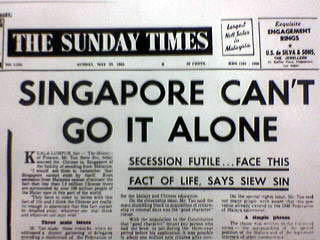
STRAITS TIMES, MAY 23 1965
The Minister of Finance, Mr Tan Siew Sin, today warned the Chinese in Singapore of the futility of seceding from Malaysia.
"I would ask them to remember that Singapore cannot exist by itself. Even secession from Malaysia cannot eliminate the fact that less than 1.5 million Chinese there are surrounded by over a 100 million people of the Malay race in this part of the world.
"They have to come to terms with this fact of life and I think the Chinese are realistic enough to appreciate that this fact cannot be brushed away, whatever one may think and whatever one may wish."
The day a young Mahathir blasted Lee and PAP
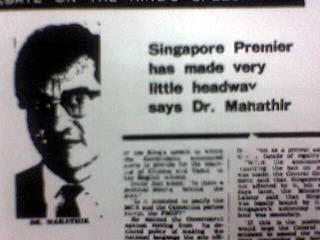
STRAITS TIMES, MAY 27 1965
The big debate on yesterday's Speech from the Throne by the Yang di-Pertuan Agong opened in the House of Representatives today with a strong Government attack on Opposition parties and the trade union movement.
Dr Mahathir bin Mohammed (All-Kota Star Selatan), who moved the resolution to thank the King for his gracious speech, described the PAP as being pro-Chinese, Communist-orientated and positively anti-Malay.
He said,"The last item has been kept in limbo until lately, when for reasons of political strategy and in an attempt to win over the Chinese and foreign countries to its side, the PAP decided to come out in the open with this basic anti-Malay principle.
"Everyone must have noticed the change in PAP strategy. When the PAP first made overtures to the Malayan Government on the common market and merger, UMNO was never attacked.
Lee attacked
Dr Mahathir then charged the PAP with paying lip-service to the national language, while playing to chauvinist ideas by retaining multi-lingualism.
In education, national language schools were the worst treated.
In industry, the PAP policy, he charged, was to encourage Malays to become labourers, but Malays were not given facilities to invest as well.
Dr Mahathir said that the Singapore Prime Minister, Mr Lee Kuan Yew, having made little headway to win true Malaysians into the PAP camp, embarked on a "most unseeminly programme" to get countries friendly to Malaysia to use their influence and opinion to change the political adherence of Malaysians.
"The PAP leader does not want to be the Prime Minister of Malaysia, unless of course it is to the good of Malaysia, and he never missed an opportunity to emphasise that it would be good of Malaysia if he were the Prime Minister.
"Already Time magazine has dubbed Mr Lee as the man who can save Malaysia. Other American papers and journals have spoken in like vein. But the Australians and British, being more knowledgeable or more diplomatic, have not been so open.
"So Mr Lee embarked on his crusade to the south, to Australia and New Zealand, to garner Anzac opinion.
"Carefully organised and brilliantly conducted by the maestro himself, the progress of Mr Lee would have made Dr Goebbels feel like a rank amateur.
Monday, August 01, 2005
Lee had ambitions to be PM of Malaysia, alleged UMNO
Part VI of the retrospective on Singapore's road to independence
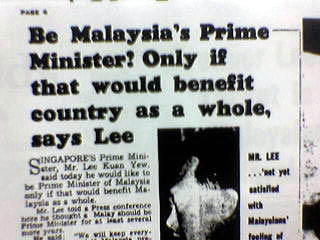
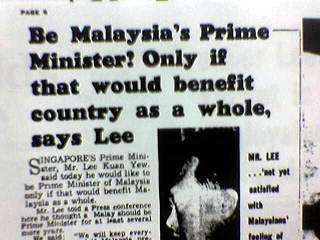 STRAITS TIMES, MAR 24 1965
SINGAPORE'S Prime Minister, Mr Lee Kuan Yew, said today he would like to be Prime Minister of Malysia only if that would benefit Malaysia as a whole.
Mr Lee told a Press conference here he thought a Malay should be Prime Minister for at least several more years.
He said: "We will keep everyone alarmed if Malaysia presents an international image of immigrant and indigenous stock able to find accomodation on a rational basis."
Asked to what extent Malaysians had a sense of national unity, Mr Lee said: "I am not satisfied with their feeling of nationalism.
"It will take some time to fuse four different entities, sometimes with conflicting interests."
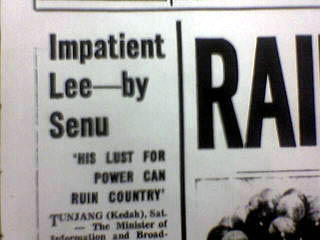
STRAITS TIMES, MAY 9 1965
The Minister of Information and Broadcasting, Inche Senu bin Abdul Rahman, said today that Mr Lee Kuan Yew's ambition to be Prime Minister of Malaysia could ruin the country.
Adressing members of the UMNO branch, Inche Senu said Mr Lee had humiliated the Malays by saying that no one race can say this is their native land.
"Mr Lee made an attempt to distort history," Inche Senu said, "and I wish to give him a piece of advice that whoever wants to contradict history or fight against the process of history will destroy himself in that process.
'Dangerous'
"What he really means by that remark is that Malays should have no special privileges or rights as duly constituted and agreed to him before the formation of Malaysia."
Describing this as a "dangerous political tactic, Inche Senu went on: "No one party can rule this country without the support of the Malays. Mr Lee know this.
"If you want to rule, they must have two things before them. First, they must co-operate with UMNO; second, they have to isolate, split and destroy the UMNO at every level."
"This can be done by instigating and dividing teh Malaysians. This is what Mr Lee attempted to do when he made such humiliating remarks."
Inche Senu the said that since teh alliance came into power, it did not have any trouble or conflict with the races in this country.
'Too Small'
"Now Mr Lee is impatient to be the Prime Minister of Malaysia. Singapore island is too small for him. "
"He thinks he is clever, but he forgets there are people in Malaysia who understand his manoeuvres. He is drunk with flattery, showered upon him by the foreign press."
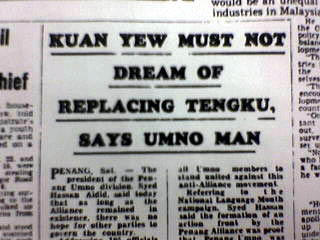
STRAITS TIMES, MAY 9 1965
The president of the Penang UMNO division, Syed Hassan Aidid, said today that as long as the Alliance remained in existence, there was no hope for other parties to govern the country.
"Even is Lee Kuan Yew feels that he is a smart man - smarter than Tengku Abdul Rahman - he must not dream of replacing the Tengku as leader of the Central Government," he said.
"As long as Mr Lee keeps on abusing the Malays, he can never hope to get any support from them and without this, he will never gain the reins of government."
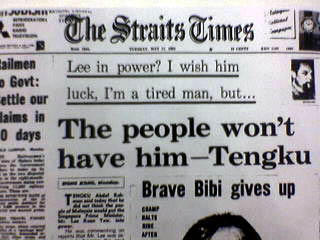
STRAITS TIMES, MAY 11 1965
Tengku Abdul Rahman said today that he did not think the people of Malaysia would put the Singapore Prime Minister, Mr Lee Kuan Yew, into power.
He was commenting on reports that Mr Lee was aspiring to be become the nect Prime Minister of Malaysia.
"I wish him good luck. I am a tired man," said the Tengku.
"If he succeeds, let him take over, but I don't think he can, as I'm sure the people of would not want to put him in power."
 STRAITS TIMES, MAR 24 1965
SINGAPORE'S Prime Minister, Mr Lee Kuan Yew, said today he would like to be Prime Minister of Malysia only if that would benefit Malaysia as a whole.
Mr Lee told a Press conference here he thought a Malay should be Prime Minister for at least several more years.
He said: "We will keep everyone alarmed if Malaysia presents an international image of immigrant and indigenous stock able to find accomodation on a rational basis."
Asked to what extent Malaysians had a sense of national unity, Mr Lee said: "I am not satisfied with their feeling of nationalism.
"It will take some time to fuse four different entities, sometimes with conflicting interests."

STRAITS TIMES, MAY 9 1965
The Minister of Information and Broadcasting, Inche Senu bin Abdul Rahman, said today that Mr Lee Kuan Yew's ambition to be Prime Minister of Malaysia could ruin the country.
Adressing members of the UMNO branch, Inche Senu said Mr Lee had humiliated the Malays by saying that no one race can say this is their native land.
"Mr Lee made an attempt to distort history," Inche Senu said, "and I wish to give him a piece of advice that whoever wants to contradict history or fight against the process of history will destroy himself in that process.
'Dangerous'
"What he really means by that remark is that Malays should have no special privileges or rights as duly constituted and agreed to him before the formation of Malaysia."
Describing this as a "dangerous political tactic, Inche Senu went on: "No one party can rule this country without the support of the Malays. Mr Lee know this.
"If you want to rule, they must have two things before them. First, they must co-operate with UMNO; second, they have to isolate, split and destroy the UMNO at every level."
"This can be done by instigating and dividing teh Malaysians. This is what Mr Lee attempted to do when he made such humiliating remarks."
Inche Senu the said that since teh alliance came into power, it did not have any trouble or conflict with the races in this country.
'Too Small'
"Now Mr Lee is impatient to be the Prime Minister of Malaysia. Singapore island is too small for him. "
"He thinks he is clever, but he forgets there are people in Malaysia who understand his manoeuvres. He is drunk with flattery, showered upon him by the foreign press."
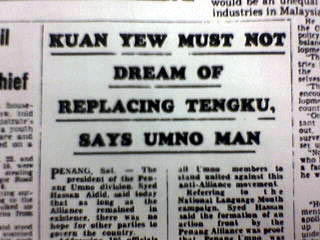
STRAITS TIMES, MAY 9 1965
The president of the Penang UMNO division, Syed Hassan Aidid, said today that as long as the Alliance remained in existence, there was no hope for other parties to govern the country.
"Even is Lee Kuan Yew feels that he is a smart man - smarter than Tengku Abdul Rahman - he must not dream of replacing the Tengku as leader of the Central Government," he said.
"As long as Mr Lee keeps on abusing the Malays, he can never hope to get any support from them and without this, he will never gain the reins of government."
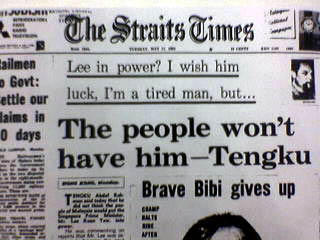
STRAITS TIMES, MAY 11 1965
Tengku Abdul Rahman said today that he did not think the people of Malaysia would put the Singapore Prime Minister, Mr Lee Kuan Yew, into power.
He was commenting on reports that Mr Lee was aspiring to be become the nect Prime Minister of Malaysia.
"I wish him good luck. I am a tired man," said the Tengku.
"If he succeeds, let him take over, but I don't think he can, as I'm sure the people of would not want to put him in power."
Friday, July 29, 2005
PAP locked horns with Malaysian Government
Part V of the retrospective on Singapore's road to independence
Accusations and counter-threats flew back and forth across the causeway in early 1965. At one point, it became all a little too much for Singapore's PM Lee Kuan Yew as he filed a libel writ against UMNO's Secretary-General.

STRAITS TIMES, FEB 15, 1965
The Federal Minister of Finance, Mr Tan Siew Sin, said today that one-party rule in Singapore had degenerated into "rule by fear."
"This is not a far-fetched statement," he said, when opening the MCA Sembawang ward branch.
Mr Tan, who is the national president of the MCA, said reports coming indicated that the fear of intimidation and victimisation by the ruling party "is prevalent among sections of the community."
"I myself have in my possession many number of anonoymous letters from civil servants telling me of this fear.
"They say that it is risky to be regarded as even a personal friend of a member of any Opposition party.
"Even among those who are not in the public service, this general atmosphere of fear persists.
"Businessmen who depend on Government patronage in the form of contracts for their livelihood speak in whispers when they have to criticise the Government.
"They maintain that the slightest hint of such association with a member of the Opposition, and this naturally includes the Alliance, would bring down upon their heads the kind of persecution at which the ruling party is so adept.
"Such a campaign would be waged with utter ruthlessness and venomous thoroughness one associates with totalitarian regimes imposed by the Communists, Nazis and Fascists prior to World War ll."
"This skill at using terror tactics is even more amazing when you consider that they are being wielded by a State Government whose major powers have been substantially curtailed since Malaysia Day."
Commenting on observation that the State Government of Singapore is an efficient government, Mr Tan said: "One of the most efficient governments in all history was the German Government headed by Hitler before World War ll.
"It is no consolation to have the most efficient government in the world ruling over you if all the time you live under the shadow of fear, the fear that if you should happen to displease someone in authority or even appear to displease someone in authority, that may be the end of yourself or those near and dear to you.
"In Singapore there is an atmosphere of unease and tension. This is due to the fact that politicians go out of their way to rouse mob passions. They create controversial issues even if there are none to worry about."
Mr Tan then spoke of the need for an effective and responsible opposition in Singapore "to point out to the Government its mistakes, and tell it when and where it has gone wrong."

STRAITS TIMES, FEB 23 1965
Singapore's Deputy Prime Minister Dr Toh Chin Chye declared last night that the island State could not be treated like Penang or Malacca "because it has its own historical development."
It may be true that teritorially Singapore is small but population-wise it is the biggest State in Malaysia," he said.
He said: "Furthermore, Singapore had its own commercial and economic importance even before it joined Malaysia.
"In these circumstances these circumstances trying to absorb Singapore into the orbit of the Central Government by treating it as a minor State is a mistake.
The PAP, he reiterated, had not been founded as a communal party but as a multi-racial party with a positive political philosophy. And it was on this basis that the party had succeeded for the last 10 years.

STRAITS TIMES, MAR 3 1965
Police have refused to grant permission for the People's Action Party branch here to hold a procession from the airport to its headquarters at Kampong Pantai tomorrow evening.
The procession had been planned to give the Singapore Prime Minister, Mr Lee Kuan Yew, a motorcade escort when he arrives by air from Kuala Lumpur to open the branch headquarters.
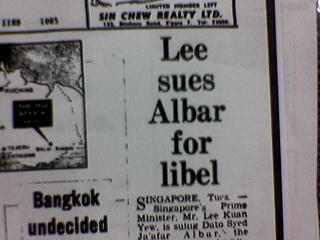
STRAITS TIMES, APR 28 1965
Singapore's Prime Minister Mr Lee Kuan Yew is suing Dato Syed Ja'afar Albar, the Secretary-General, for libel.
Two writs were titled in the High Court Registry early today by Graham Hill of Messrs. Rodyk and Davidson on behalf of Mr Lee.
In the first suit against the UMNO leader alone, the libel is alleged to have been contained in an open and undated letter from him to Mr Dennis Bloodworth, South-east Asia correspondent of the London Observer, on or about Aug 7 last year.
In the second suit against Dato Syed Ja'afar, the Utusan Melayu and its editor, Inche Melan bin Abdullah, the libellious statements are alleged to have been contained in two articles appearing in the Utusan Melayu on March 25, 1964 and last March 27.
According to the writ, the articles were headed: "Lee is accused of being an enemy of Malaysia and an agent of Indonesia. Walk over my dead body first - Albar," and "Albar accuses Kuan Yew of being an agent of the Communists."
In both suits, Mr Lee is claiming damages, costs and other or further relief as the court may see fit.
Accusations and counter-threats flew back and forth across the causeway in early 1965. At one point, it became all a little too much for Singapore's PM Lee Kuan Yew as he filed a libel writ against UMNO's Secretary-General.
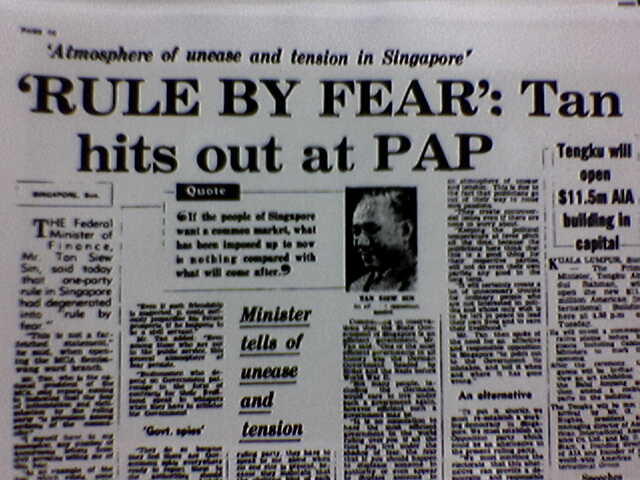
STRAITS TIMES, FEB 15, 1965
The Federal Minister of Finance, Mr Tan Siew Sin, said today that one-party rule in Singapore had degenerated into "rule by fear."
"This is not a far-fetched statement," he said, when opening the MCA Sembawang ward branch.
Mr Tan, who is the national president of the MCA, said reports coming indicated that the fear of intimidation and victimisation by the ruling party "is prevalent among sections of the community."
"I myself have in my possession many number of anonoymous letters from civil servants telling me of this fear.
"They say that it is risky to be regarded as even a personal friend of a member of any Opposition party.
"Even among those who are not in the public service, this general atmosphere of fear persists.
"Businessmen who depend on Government patronage in the form of contracts for their livelihood speak in whispers when they have to criticise the Government.
"They maintain that the slightest hint of such association with a member of the Opposition, and this naturally includes the Alliance, would bring down upon their heads the kind of persecution at which the ruling party is so adept.
"Such a campaign would be waged with utter ruthlessness and venomous thoroughness one associates with totalitarian regimes imposed by the Communists, Nazis and Fascists prior to World War ll."
"This skill at using terror tactics is even more amazing when you consider that they are being wielded by a State Government whose major powers have been substantially curtailed since Malaysia Day."
Commenting on observation that the State Government of Singapore is an efficient government, Mr Tan said: "One of the most efficient governments in all history was the German Government headed by Hitler before World War ll.
"It is no consolation to have the most efficient government in the world ruling over you if all the time you live under the shadow of fear, the fear that if you should happen to displease someone in authority or even appear to displease someone in authority, that may be the end of yourself or those near and dear to you.
"In Singapore there is an atmosphere of unease and tension. This is due to the fact that politicians go out of their way to rouse mob passions. They create controversial issues even if there are none to worry about."
Mr Tan then spoke of the need for an effective and responsible opposition in Singapore "to point out to the Government its mistakes, and tell it when and where it has gone wrong."
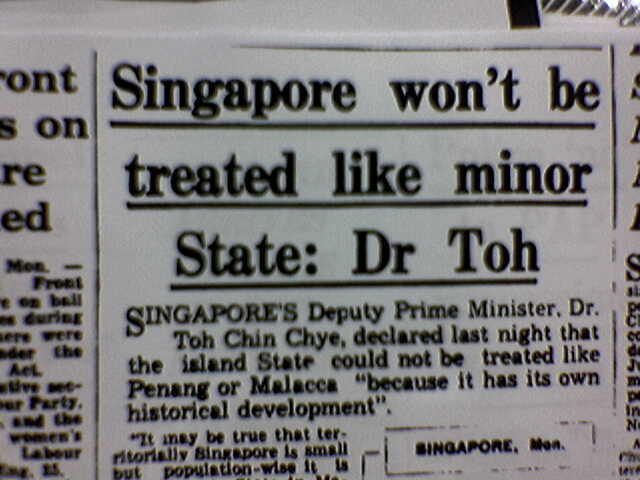
STRAITS TIMES, FEB 23 1965
Singapore's Deputy Prime Minister Dr Toh Chin Chye declared last night that the island State could not be treated like Penang or Malacca "because it has its own historical development."
It may be true that teritorially Singapore is small but population-wise it is the biggest State in Malaysia," he said.
He said: "Furthermore, Singapore had its own commercial and economic importance even before it joined Malaysia.
"In these circumstances these circumstances trying to absorb Singapore into the orbit of the Central Government by treating it as a minor State is a mistake.
The PAP, he reiterated, had not been founded as a communal party but as a multi-racial party with a positive political philosophy. And it was on this basis that the party had succeeded for the last 10 years.
STRAITS TIMES, MAR 3 1965
Police have refused to grant permission for the People's Action Party branch here to hold a procession from the airport to its headquarters at Kampong Pantai tomorrow evening.
The procession had been planned to give the Singapore Prime Minister, Mr Lee Kuan Yew, a motorcade escort when he arrives by air from Kuala Lumpur to open the branch headquarters.
STRAITS TIMES, APR 28 1965
Singapore's Prime Minister Mr Lee Kuan Yew is suing Dato Syed Ja'afar Albar, the Secretary-General, for libel.
Two writs were titled in the High Court Registry early today by Graham Hill of Messrs. Rodyk and Davidson on behalf of Mr Lee.
In the first suit against the UMNO leader alone, the libel is alleged to have been contained in an open and undated letter from him to Mr Dennis Bloodworth, South-east Asia correspondent of the London Observer, on or about Aug 7 last year.
In the second suit against Dato Syed Ja'afar, the Utusan Melayu and its editor, Inche Melan bin Abdullah, the libellious statements are alleged to have been contained in two articles appearing in the Utusan Melayu on March 25, 1964 and last March 27.
According to the writ, the articles were headed: "Lee is accused of being an enemy of Malaysia and an agent of Indonesia. Walk over my dead body first - Albar," and "Albar accuses Kuan Yew of being an agent of the Communists."
In both suits, Mr Lee is claiming damages, costs and other or further relief as the court may see fit.
Thursday, July 28, 2005
The day a bomb exploded on Orchard Road
Part lV of the retrospective on Singapore's road to independence
'Konfrontasi', the guerilla warfare that was waged by Indonesian President Soekarno against the Federation of Malaysia, hit Singapore with devastating impact on March 10, 1965. Prior to this attack, Indonesian saboteurs and infiltrators have been arrested in Johore and on Singapore shores, but this bomb blast in the MacDonald House has been etched into Singapore's post-colonial history as the probably the most brazen act of terrorism ever recorded.
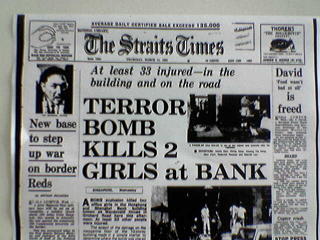
STRAITS TIMES, MAR 11 1965
A BOMB explosion killed two office girls in the Hongkong and Shanghai Bank building known as MacDonald House in Orcahrd Road here this afternoon. At least 33 other people were injured.
The extent of the damage on the mezzanine floor of the 10-storey building made it a simple matter to determine where the bomb was placed - near the lift.
An inner wall at this level was blasted inwards and collapsed in a mass of rubble into the bank on the ground floor.
Windows shattered
Killed immediately were Mrs Suzie Choo, 36, private secretary to the Bank Manager, and Miss Juliet Goh, 23, a filing clerk in the bank.
Many others - in the bank and on the road - fell like ninepins, many seriously injured.
Every window within a hundred yards was shattered, and almost every car immediately outside the building and across the car was damaged.
An Australian Trade Commission station wagon, parked near the entrace was flung on the road divider. (The offices of the Australian High Commission are immediately above the mezzanine floor.)
Two buried
The bomb exploded at 3.17 pm - just eight minutes before the Wearne Brothers' motor mechanics were due to gather by the side of the building for their tea break.
It is not known if the bomb had a timing device.
The explosion ripped off a lift door - but it was one of the inner walls on the mezzanin floor that took the full force of the blast.
On the other side of this wall was the correspondence office of the bank in which Mrs Choo and Miss Goh were working. Both were buried by rubble.
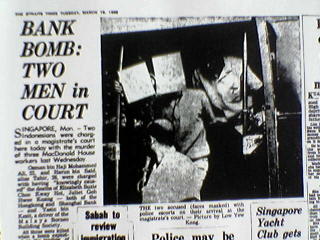
STRAITS TIMES MARCH 16 1965
Two Indonesians were charged in a magistrate's court here today with the murder of three MacDonald House workers last Wednesday.
Osman bin Haji Mohammed Ali, 22, and Harun bin Said alias Tahir, 26, were charged with having "knowingly caused" the deaths of Elizabeth Suzie Choo Kway Hoi, Juliet Goh Hwee Kuang - both of the Hongkong and Shanghai Bank - and Yasin bin Kesit, a driver of the Malaya Borneo Building Society.
All three were killed when a bomb exploded on the landing of the mezzanine floor of MacDonald House at 3.07 pm on Wednesday.
'Konfrontasi', the guerilla warfare that was waged by Indonesian President Soekarno against the Federation of Malaysia, hit Singapore with devastating impact on March 10, 1965. Prior to this attack, Indonesian saboteurs and infiltrators have been arrested in Johore and on Singapore shores, but this bomb blast in the MacDonald House has been etched into Singapore's post-colonial history as the probably the most brazen act of terrorism ever recorded.
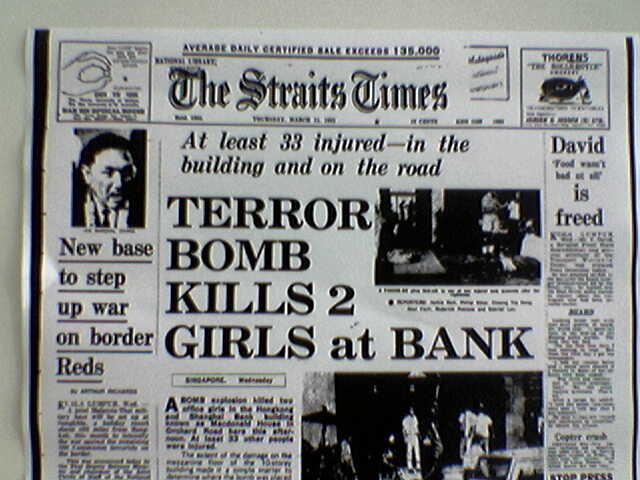
STRAITS TIMES, MAR 11 1965
A BOMB explosion killed two office girls in the Hongkong and Shanghai Bank building known as MacDonald House in Orcahrd Road here this afternoon. At least 33 other people were injured.
The extent of the damage on the mezzanine floor of the 10-storey building made it a simple matter to determine where the bomb was placed - near the lift.
An inner wall at this level was blasted inwards and collapsed in a mass of rubble into the bank on the ground floor.
Windows shattered
Killed immediately were Mrs Suzie Choo, 36, private secretary to the Bank Manager, and Miss Juliet Goh, 23, a filing clerk in the bank.
Many others - in the bank and on the road - fell like ninepins, many seriously injured.
Every window within a hundred yards was shattered, and almost every car immediately outside the building and across the car was damaged.
An Australian Trade Commission station wagon, parked near the entrace was flung on the road divider. (The offices of the Australian High Commission are immediately above the mezzanine floor.)
Two buried
The bomb exploded at 3.17 pm - just eight minutes before the Wearne Brothers' motor mechanics were due to gather by the side of the building for their tea break.
It is not known if the bomb had a timing device.
The explosion ripped off a lift door - but it was one of the inner walls on the mezzanin floor that took the full force of the blast.
On the other side of this wall was the correspondence office of the bank in which Mrs Choo and Miss Goh were working. Both were buried by rubble.
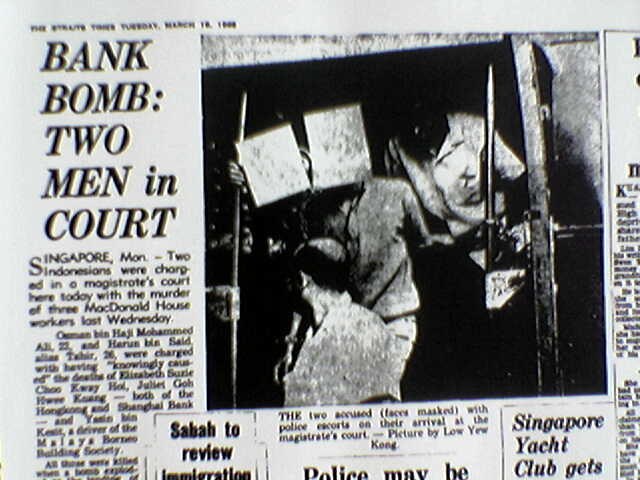
STRAITS TIMES MARCH 16 1965
Two Indonesians were charged in a magistrate's court here today with the murder of three MacDonald House workers last Wednesday.
Osman bin Haji Mohammed Ali, 22, and Harun bin Said alias Tahir, 26, were charged with having "knowingly caused" the deaths of Elizabeth Suzie Choo Kway Hoi, Juliet Goh Hwee Kuang - both of the Hongkong and Shanghai Bank - and Yasin bin Kesit, a driver of the Malaya Borneo Building Society.
All three were killed when a bomb exploded on the landing of the mezzanine floor of MacDonald House at 3.07 pm on Wednesday.
1964 - PAP accused of being "double-tongued" and "double-faced"
Part lll of the retrospective on Singapore's road to independence
Policies differences, personality clashes and power-tripping dogged the PAP's role as the opposition in Malaysia's Parliament. The Merger, celebrated just a year earlier, was resembling more like a marriage of convenience than a union of mutual trust and understanding.

STRAITS TIMES, DECEMBER 3 1964
The PAP came in for a series of attacks by Alliance back-benchers in Parliament today for its criticism of the turnover and payroll taxes announced last Wednesday by the Minister of Finance, Mr Tan Siew Sin.
The sharpest attack was delivered by Mr Lee San Choon (All Segamat) who accused the PAP of being two-faced.
He challenged PAP members to state publicly whether they had stood for the "haves" or "have nots."
Dealing with the budget, Inche Wan Abdul Kadir bin Ismail said the Straits Times had been publishing a lot of articles attacking the tax proposals. PAP speakers had also come to the House voicing the same views.
A voice in the Government back-benches was heard to exclaim: "Ban, ban the Straits Times."
Inche wan Abdul Kadir said he disagreed with the views expressed by the Straits Times and the PAP. The tax proposals, he said, were designed for the benefit of the ra'ayat.
If the PAP were champions of the middle-class, as they were now claiming, why did they cut the salaries of civil servants who belonged to the middle-class?
It claimed to champion the cause of the have-nots. But what had it done for the have-nots in Geylang Serai and Kampong Glam? he asked. He accused the PAP of being "double-tongued."
Inche Abdul Samad bin Ahmad (PMIP) stressed that the his party supported the budget. It had pledged to work with the Central Government in meeting confrontation.
He then launched into a strong attack on the PAP, which he described as "of the same colour" as the Barisan Socialis.
He recalled that Mr Lee Kuan Yew had met the "Plen" and asked why the Central Government had not arrested him.
Mr Lee San Choon, political secretary to the Finance Minister, said members of the Alliance were "honest and sincere" and did not have the ability to twist and distort facts like the PAP.
"We are not double-faced and we are unable to talk with different tongues in different places," he said.
"Unlike the PAP, we do not champion the cause of so-called socialism and at the same time advocate free enterprise.
"Unlike the PAP, we do not identify ourselves as leftists and give pioneer status to wholly owned Western capitalist organisations.
"Also, unlike the PAP, we do not attempt to secure support through class struggle."

Then, attacking Mr Lee Kuan Yew, he said the Singapore Premier "enjoys the most expensive millionaire's game - golf - washes down his westernised meals with expensive drinks, travels in expensive cars with 42 bodyguards, and has 21 secretaries to write his irresponsible speeches."
"At the same time," Mr Lee San Choon said, "he champions the so-called have-nots."
He added: "The PAP talks as if there is no confrontation. To them political power is all important. They are more interested in power politics than in serving the country."
Mr Lee recalled the days in 1959 when the PAP frightened away investors. Business fled from Singapore to the Federation and Hong Kong.
"After realising their mistake they declared they were not against capital. They fooled so many people that many people the PAP had changed for the better. Now we know.
"They are still wolves in sheep skin, their heart is the same. They are fighting the Barisan for political power, but ideologically they are the same."
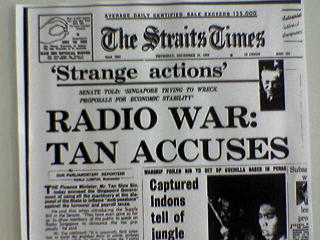
STRAITS TIMES, DEC 31 1964
The Finance Minister, Mr Tan Siew Sin, today accused the Singapore Government of using all the machinery at the disposal of the State to inflame "mob passions" against the turnover and payroll taxes.
He said this when introducing the Supply Bill in the Senate. "They have even gone so far as to allow members of the public to speak on Radio Singapore to denounce the tax proposals," he said.
Held responsible
"I should warn the Singapore Government that if this were to happen, they will be held responsible.
"These actions are indeed strange, coming from a Government which calls itself pro-Malaysia but which is doing everything it can do to wreck proposals that are designed to ensure the financial and economical stability of Malaysia in the face of growing commitments for defence and development which we now have to meet if we wish to survive."
Policies differences, personality clashes and power-tripping dogged the PAP's role as the opposition in Malaysia's Parliament. The Merger, celebrated just a year earlier, was resembling more like a marriage of convenience than a union of mutual trust and understanding.
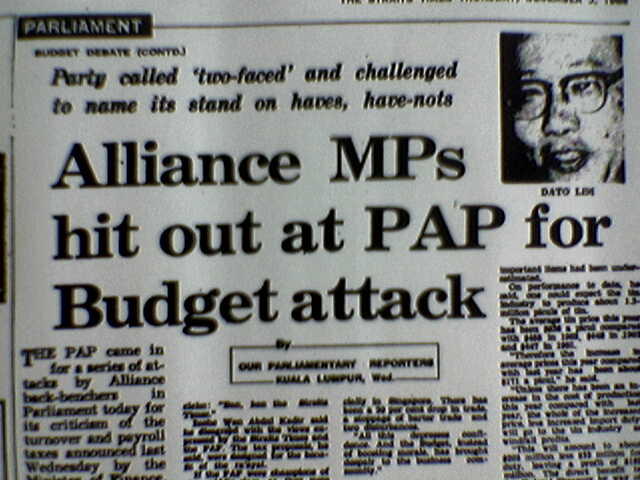
STRAITS TIMES, DECEMBER 3 1964
The PAP came in for a series of attacks by Alliance back-benchers in Parliament today for its criticism of the turnover and payroll taxes announced last Wednesday by the Minister of Finance, Mr Tan Siew Sin.
The sharpest attack was delivered by Mr Lee San Choon (All Segamat) who accused the PAP of being two-faced.
He challenged PAP members to state publicly whether they had stood for the "haves" or "have nots."
Dealing with the budget, Inche Wan Abdul Kadir bin Ismail said the Straits Times had been publishing a lot of articles attacking the tax proposals. PAP speakers had also come to the House voicing the same views.
A voice in the Government back-benches was heard to exclaim: "Ban, ban the Straits Times."
Inche wan Abdul Kadir said he disagreed with the views expressed by the Straits Times and the PAP. The tax proposals, he said, were designed for the benefit of the ra'ayat.
If the PAP were champions of the middle-class, as they were now claiming, why did they cut the salaries of civil servants who belonged to the middle-class?
It claimed to champion the cause of the have-nots. But what had it done for the have-nots in Geylang Serai and Kampong Glam? he asked. He accused the PAP of being "double-tongued."
Inche Abdul Samad bin Ahmad (PMIP) stressed that the his party supported the budget. It had pledged to work with the Central Government in meeting confrontation.
He then launched into a strong attack on the PAP, which he described as "of the same colour" as the Barisan Socialis.
He recalled that Mr Lee Kuan Yew had met the "Plen" and asked why the Central Government had not arrested him.
Mr Lee San Choon, political secretary to the Finance Minister, said members of the Alliance were "honest and sincere" and did not have the ability to twist and distort facts like the PAP.
"We are not double-faced and we are unable to talk with different tongues in different places," he said.
"Unlike the PAP, we do not champion the cause of so-called socialism and at the same time advocate free enterprise.
"Unlike the PAP, we do not identify ourselves as leftists and give pioneer status to wholly owned Western capitalist organisations.
"Also, unlike the PAP, we do not attempt to secure support through class struggle."
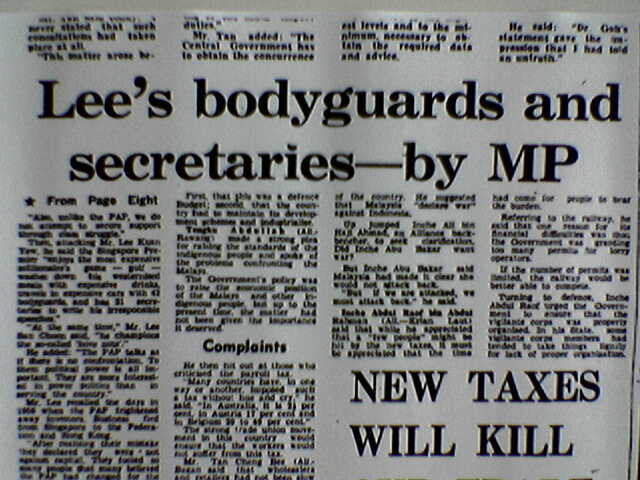
Then, attacking Mr Lee Kuan Yew, he said the Singapore Premier "enjoys the most expensive millionaire's game - golf - washes down his westernised meals with expensive drinks, travels in expensive cars with 42 bodyguards, and has 21 secretaries to write his irresponsible speeches."
"At the same time," Mr Lee San Choon said, "he champions the so-called have-nots."
He added: "The PAP talks as if there is no confrontation. To them political power is all important. They are more interested in power politics than in serving the country."
Mr Lee recalled the days in 1959 when the PAP frightened away investors. Business fled from Singapore to the Federation and Hong Kong.
"After realising their mistake they declared they were not against capital. They fooled so many people that many people the PAP had changed for the better. Now we know.
"They are still wolves in sheep skin, their heart is the same. They are fighting the Barisan for political power, but ideologically they are the same."

STRAITS TIMES, DEC 31 1964
The Finance Minister, Mr Tan Siew Sin, today accused the Singapore Government of using all the machinery at the disposal of the State to inflame "mob passions" against the turnover and payroll taxes.
He said this when introducing the Supply Bill in the Senate. "They have even gone so far as to allow members of the public to speak on Radio Singapore to denounce the tax proposals," he said.
Held responsible
"I should warn the Singapore Government that if this were to happen, they will be held responsible.
"These actions are indeed strange, coming from a Government which calls itself pro-Malaysia but which is doing everything it can do to wreck proposals that are designed to ensure the financial and economical stability of Malaysia in the face of growing commitments for defence and development which we now have to meet if we wish to survive."
Monday, July 25, 2005
1964 - Fighting in the streets of Singapore
Singapore and Malaysia leaders blame Indonesia's Soekarno for inciting racial violence.
Part ll of the retrospective on Singapore's road to independence
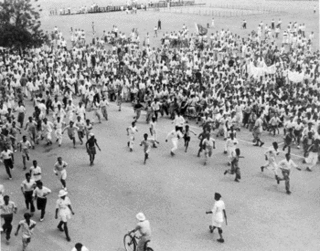
The first year of Merger proved to be a tumultous year for Singapore. While PAP leaders were shuttling back and forth from Kuala Lumpur to engage the Central Government in Parliamentary debates, political tensions arising from the Merger spilled onto the streets of Singapore.
On 21 July 1964, near Kallang Gasworks, fighting between Malay and Chinese youths during a Muslim procession celebrating the Prophet Muhammad's birthday erupted into racial riots, in which twenty-three people were killed and hundreds injured.
While Singapore and Malaysia were quick to pin the blame on Indonesia's President Soekarno, who had declared a state of Konfrantasi (Confrontation) against Malaysia and initiated military and other acts to provoke the Malays against the Chinese, historians suggest the communal tensions arising Singapore's merger had been the main catalyst.
Upon Merger in 1963, Malays and Muslims in Singapore were being increasingly incited by the Malaysian Federial Government's accusations that the PAP was mistreating the Malays. Numerous racial riots resulted, and curfews were common in order to restore order.
The riot on July 21 proved to be Singapore's most notorious, with twenty three killed and hundreds injured. Today, it is still disputed how it started, and theories include a bottle being thrown into a Muslim rally. More riots broke out in September 1964. The price of food heavily skyrocketed during this period due to the disruption in transport, which caused further hardship.
The race riots in Singapore in 1964 were a large contributing factor in the expulsion of the state from Malaysia.
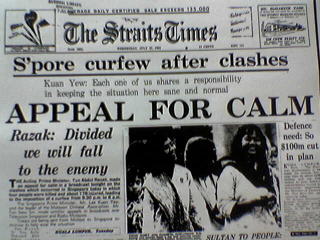
STRAITS TIMES, JULY 22 1964
The Acting Prime Minister, Tun Abdul Razak, made an appeal for calm in a broadcast tonight on the clashes which occured in Singapore today in which four people were killed and about 178 injured, leading to the imposition of a curfew from 9.30pm to 6am.
The Singapore Prime Minister, Mr Lee Lee Kuan Yew and the leader of the Malayan Chinese Association, Mr Tan Siew Sin, made similar appeals in broadcasts over Television Singapore and Radio Malaysia.
Troops are being sent from Malaya to Singapore tomorrow to help ease the situation.
In his broadcast, Tun Razak reminded Malaysians that they had lived together in peace for hundred of years.
Dangerous
Malaysians of different races and religion had never "disturbed" their good relations with one another.
"We now face a very critical situation. It is very dangerous for all of us, whether we are Chinese, Malays, Indians or other races.
"You must not forget that we are facing a common enemy. This is an enemy dangerous to us all. If we are divided, we shall be destroyed. "
Tun Razak warned that the Central Government "will not allow any group or community to be oppressed in Malaysia."
He added: "We have made our position positively clear. I ask you to place your trust in the Government to keep the peace and gurad the country in the interests of all races."
At 10.45 pm the Singapore premier went on the air and said: "this afternoon, shortly after five, when the procession of Muslims celebrating Prophet Mohammed's birthday was passing Lorong Soopoo, near the Kallang gas works, a member of the Federal Reserve Unit asked a group who were straggling away from the procession to rejoin the main stream.
"Instead of being obeyed he was set upon by them. Thereafter a series of disturbances occured as more groups became unruly and attacked passer-by and spectators.
"These disturbances have spread rapidly throughout the Geylang area between Kallang and Geylang Serai. By about 7.30, two hours after it started, disturbances took place in the city itself.
"After consulatations between Tun Abdul Razak with the Commissioner of Police and I, it has been decided that there would be a curfew from 9.30 tonight to 6.00 tomorrow morning.
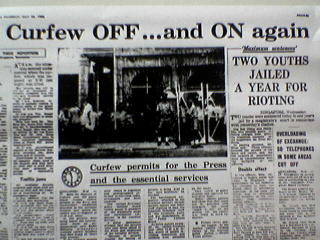
STRAITS TIMES JULY 23, 1964
At 6 a.m. the situation seemed under control when the curfew, which was imposed at 9.30 a.m. last night, was lifted.
But tensions was still high in the air as thousands of workers streamed into the city and business carried on as usual.
Ny 7 a.m. however, reports of sporadic clashes in various parts of the island began to trickle into Times House.
At 9.40 a.m. Tun Abdul Razak flew into Singapore to study the situation.
At 11 a.m. unconformed reports at the General Hospital recorded twp more deaths and 57 injured.
Interviewed in the hospital casualty room, most of the injured said they were on their way to work when they were being attacked by groups of marauding youths.
Traffic jams
At 11.10 a.m. Radio Singapore announced that the curfew would be re-imposed from 11.30 a.m. and advised people to stay indoors.
The annoucement caused office workers to rush home by whatever transport they could get. There were big traffic jams in several places.
All bars and restaurants were also closed and cinemas throughout the island cancelled their shows.
By 11.30 a.m. most of the shops and business establishments were closed.
At the C.I.D. the general alarm was sent out and all members of the police force were ready to go into action.

STRAITS TIMES, SEPT 5 1964
A "STATE OF DANGER" has been proclaimed in Singapore, where the casualty toll in 48 hours of sporadic Indonesian-inspired clashes was given officially this evening as eight killed and 60 injured - 14 of them in hospital.
The proclamation, under the Public Order (Preservation)Ordinance, was made by Dato (Dr.) Ismail bin Dato Abdul Rahman, Malaysian Minister of Home Affairs, this afternoon.
At 2 p.m. a curfew was imposed over the entire island. It will be lifted from 5.30 a.m. to 9 a.m. tomorrow.
Malaysian troops who have been fighting Indonesian commandos in Johore were moved this afternoon to Singapore to help maintain order.
'Trouble in Singapore not communal or racial but political'
Tengku blames Soek
TENGKU Abdul Rahman tonight blamed Indonesia for stirring the racial disturbances here and appealed to the people to be calm, cool and composed so that they would be in a better position to fight Indonesia or Soekarno and his agents.
Speaking in a television and radio broadcast here tonight, the Tengku said the trouble in Singapore started with the killing of an innocent old trishaw peddler.
Motive
He asked: "Who can gain by killing him? Neither the Chinese or the Malays. Who did it? Nobody knows. And waht was the motive in doing it? The authorities know."
He said it was done to stir up trouble when the people were celebrating their Merdeka to coincide with the landing of paratroopers from Indonesia.
"By this simple process of creating trouble and disturbance within the country Soekarno hopes that Malaysians themselves will make enough trouble in this country to bring about the end of Malaysia."
"Soekarno has made no secret of his intention to stir up trouble here. First, he started to attack the Chinese, now he has started to attack me by saying that the reason forming Malaysia is to persecute the Chinese."
Part ll of the retrospective on Singapore's road to independence

The first year of Merger proved to be a tumultous year for Singapore. While PAP leaders were shuttling back and forth from Kuala Lumpur to engage the Central Government in Parliamentary debates, political tensions arising from the Merger spilled onto the streets of Singapore.
On 21 July 1964, near Kallang Gasworks, fighting between Malay and Chinese youths during a Muslim procession celebrating the Prophet Muhammad's birthday erupted into racial riots, in which twenty-three people were killed and hundreds injured.
While Singapore and Malaysia were quick to pin the blame on Indonesia's President Soekarno, who had declared a state of Konfrantasi (Confrontation) against Malaysia and initiated military and other acts to provoke the Malays against the Chinese, historians suggest the communal tensions arising Singapore's merger had been the main catalyst.
Upon Merger in 1963, Malays and Muslims in Singapore were being increasingly incited by the Malaysian Federial Government's accusations that the PAP was mistreating the Malays. Numerous racial riots resulted, and curfews were common in order to restore order.
The riot on July 21 proved to be Singapore's most notorious, with twenty three killed and hundreds injured. Today, it is still disputed how it started, and theories include a bottle being thrown into a Muslim rally. More riots broke out in September 1964. The price of food heavily skyrocketed during this period due to the disruption in transport, which caused further hardship.
The race riots in Singapore in 1964 were a large contributing factor in the expulsion of the state from Malaysia.
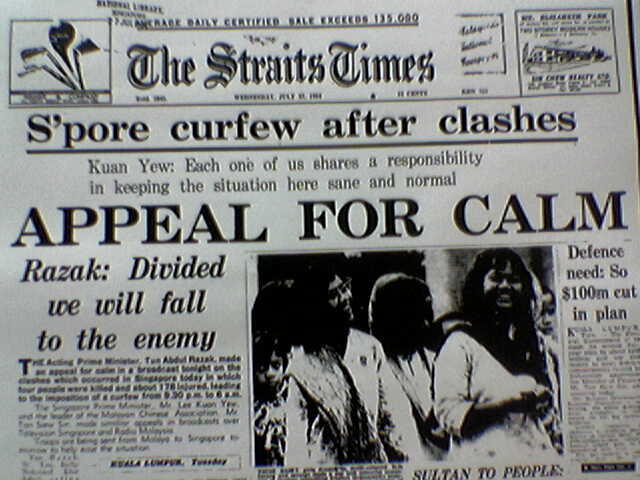
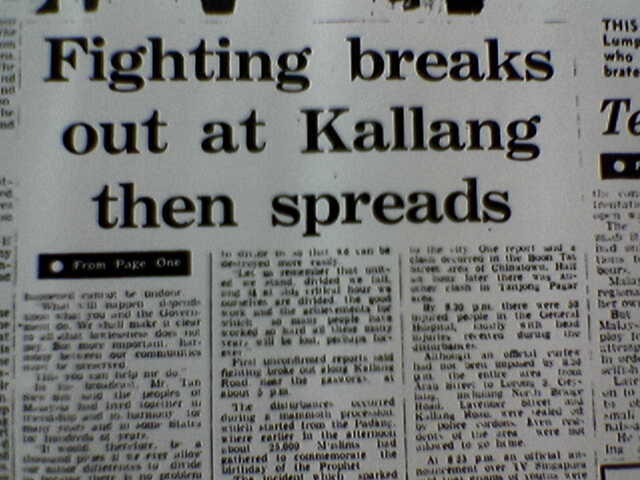
STRAITS TIMES, JULY 22 1964
The Acting Prime Minister, Tun Abdul Razak, made an appeal for calm in a broadcast tonight on the clashes which occured in Singapore today in which four people were killed and about 178 injured, leading to the imposition of a curfew from 9.30pm to 6am.
The Singapore Prime Minister, Mr Lee Lee Kuan Yew and the leader of the Malayan Chinese Association, Mr Tan Siew Sin, made similar appeals in broadcasts over Television Singapore and Radio Malaysia.
Troops are being sent from Malaya to Singapore tomorrow to help ease the situation.
In his broadcast, Tun Razak reminded Malaysians that they had lived together in peace for hundred of years.
Dangerous
Malaysians of different races and religion had never "disturbed" their good relations with one another.
"We now face a very critical situation. It is very dangerous for all of us, whether we are Chinese, Malays, Indians or other races.
"You must not forget that we are facing a common enemy. This is an enemy dangerous to us all. If we are divided, we shall be destroyed. "
Tun Razak warned that the Central Government "will not allow any group or community to be oppressed in Malaysia."
He added: "We have made our position positively clear. I ask you to place your trust in the Government to keep the peace and gurad the country in the interests of all races."
At 10.45 pm the Singapore premier went on the air and said: "this afternoon, shortly after five, when the procession of Muslims celebrating Prophet Mohammed's birthday was passing Lorong Soopoo, near the Kallang gas works, a member of the Federal Reserve Unit asked a group who were straggling away from the procession to rejoin the main stream.
"Instead of being obeyed he was set upon by them. Thereafter a series of disturbances occured as more groups became unruly and attacked passer-by and spectators.
"These disturbances have spread rapidly throughout the Geylang area between Kallang and Geylang Serai. By about 7.30, two hours after it started, disturbances took place in the city itself.
"After consulatations between Tun Abdul Razak with the Commissioner of Police and I, it has been decided that there would be a curfew from 9.30 tonight to 6.00 tomorrow morning.

STRAITS TIMES JULY 23, 1964
At 6 a.m. the situation seemed under control when the curfew, which was imposed at 9.30 a.m. last night, was lifted.
But tensions was still high in the air as thousands of workers streamed into the city and business carried on as usual.
Ny 7 a.m. however, reports of sporadic clashes in various parts of the island began to trickle into Times House.
At 9.40 a.m. Tun Abdul Razak flew into Singapore to study the situation.
At 11 a.m. unconformed reports at the General Hospital recorded twp more deaths and 57 injured.
Interviewed in the hospital casualty room, most of the injured said they were on their way to work when they were being attacked by groups of marauding youths.
Traffic jams
At 11.10 a.m. Radio Singapore announced that the curfew would be re-imposed from 11.30 a.m. and advised people to stay indoors.
The annoucement caused office workers to rush home by whatever transport they could get. There were big traffic jams in several places.
All bars and restaurants were also closed and cinemas throughout the island cancelled their shows.
By 11.30 a.m. most of the shops and business establishments were closed.
At the C.I.D. the general alarm was sent out and all members of the police force were ready to go into action.

STRAITS TIMES, SEPT 5 1964
A "STATE OF DANGER" has been proclaimed in Singapore, where the casualty toll in 48 hours of sporadic Indonesian-inspired clashes was given officially this evening as eight killed and 60 injured - 14 of them in hospital.
The proclamation, under the Public Order (Preservation)Ordinance, was made by Dato (Dr.) Ismail bin Dato Abdul Rahman, Malaysian Minister of Home Affairs, this afternoon.
At 2 p.m. a curfew was imposed over the entire island. It will be lifted from 5.30 a.m. to 9 a.m. tomorrow.
Malaysian troops who have been fighting Indonesian commandos in Johore were moved this afternoon to Singapore to help maintain order.
'Trouble in Singapore not communal or racial but political'
Tengku blames Soek
TENGKU Abdul Rahman tonight blamed Indonesia for stirring the racial disturbances here and appealed to the people to be calm, cool and composed so that they would be in a better position to fight Indonesia or Soekarno and his agents.
Speaking in a television and radio broadcast here tonight, the Tengku said the trouble in Singapore started with the killing of an innocent old trishaw peddler.
Motive
He asked: "Who can gain by killing him? Neither the Chinese or the Malays. Who did it? Nobody knows. And waht was the motive in doing it? The authorities know."
He said it was done to stir up trouble when the people were celebrating their Merdeka to coincide with the landing of paratroopers from Indonesia.
"By this simple process of creating trouble and disturbance within the country Soekarno hopes that Malaysians themselves will make enough trouble in this country to bring about the end of Malaysia."
"Soekarno has made no secret of his intention to stir up trouble here. First, he started to attack the Chinese, now he has started to attack me by saying that the reason forming Malaysia is to persecute the Chinese."
Saturday, July 23, 2005
The day when Singapore became part of Malaysia
Part l of the retrospective on Singapore's road to independence.
Before its own independence in 1965, Singapore had officially ceased to be a British colony when it decided to merge with its northern neighbour. On September 16, 1963, the new nation of Malaysia was born, comprising of Federation of Malaya, Sarawak, Sabah and Singapore. This was how the Straits Times reported the event.

STRAITS TIMES, SEPT 16, 1963
Intermittent cracker firing at midnight last night ushered in Malaysia. Hundreds of thousands of people jammed the gaily-decorated streets in all the 14 States till late in the night to greet the birth of the new nation.
The Prime Minister, Tengku Abdul Rahman, spent the evening quietly in the residency.
In all States colourful parades will be held this morning when the new Malaysia flag with 14 stars will be ceremoniously unfurled.
Singapore's big moment will come when the proclamation is read on the City Hall steps at 5 p.m.
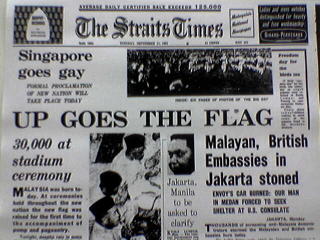
STRAITS TIMES, SEPT 17, 1963
Malaysia was born today. At ceremonies held throughout the new nation the new flag was raised for the first time to the accompaniment of pomp and pageantry.
Tonight, despite rain in some areas, the territories of Malaysia were a feast of light and colour and sound as 10 million celebrated.
More than 30,000 people Kuala Lumpur jammed the Merdeka Stadium in the early hours of the morning to witness the history-making Malaysia inaugural ceremony.
In Singapore, the moment of history was when the Prime Minister slowly intoned: "Now I, Lee Kuan Yew, the Prime Minister of Singapore, do hereby proclaimed and declare, on behalf of the people of Singapore, that as from today, the 16th day of September 1963, Singapore shall forever be a part of the sovereign and independent State of Malaysia, founded upon the principles of liberty and justice and ever seeking the welfare and happiness of her people in a more just and more equal society." Then to the strains of "Negara Ku", the Malaysian flag was raised.
STRAITS TIMES, SEPT 17, 1963
The Prime Minister, Mr. Lee Kuan Yew, makes his Malaysia proclamation from the City Hall Steps against a backdrop of a Malaysian multitude marching forward hand-in-hand.
This was Mr. Lee's proudest moment, and as read out the proclamation his voice shook with emotion and tears welled up in his eyes.
Independence through merger was the aim of the Premier and his People's Action Party which swept to power in 1959. This was his day of "fulfilment."
DR. LEE : WE OPPOSE MALAYSIA
One hour after the official proclamation of Malaysia in Singapore, the chairman of the Barisan Socialis, Dr. Lee Siew Choh, told a mass rally that his party would continue to oppose the new federation.
Dr. Lee, speaking at Tiong Bahru, added that his party would also continue to support the "demand of the people of Sarawak, Brunei and Sabah for self-determination and independence."
Dr. Lee, who was outlining the Barisan view on the "constitutional future" of Singapore, said:
"Since neo-colonialist Malaysia seeks to frustrate and deny the people their legitimate hopes and aspirations and to prolong colonial domination in South-east Asia, we must continue to oppose neo-colonialist Malaysia.
"We continue our struggle against colonialism and imperialism in all their forms."
"In respect of Singapore and the Federation we will continue to struggle for genuine reunification and for an independent democratic socialist Malaya (Singapore and the Federation) free of foreign troops and free of foreign control.
"Genuine reunification must be achieved on the basis of self-determination, equality, mutual benefit and mutual respect to both the Federation and Singapore.
"Therefore we continue our struggle for equality, for genuine common citizenship, for a common political life for the people of the Federation and Singapore; and we continue to safeguard and protect the economic interests of the people of Singapore.
Detainees
"Self-determination must of course include the immediate and unconditional release of all political detainees (especially those detained because of their anti-Malaysia activities) and the normalisation of all political life and activities in the country.
"Self-determination must include the restoration of all the fundamental rights of the people, including the freedom of travel, speech and publication, association and assembly.
"Self-determination must include the right to pursue an independent foreign policy of neutralism, and to oppose colonialist or neo-colonialist blocs, whether functioning under Malaysia or Seato.
Before its own independence in 1965, Singapore had officially ceased to be a British colony when it decided to merge with its northern neighbour. On September 16, 1963, the new nation of Malaysia was born, comprising of Federation of Malaya, Sarawak, Sabah and Singapore. This was how the Straits Times reported the event.
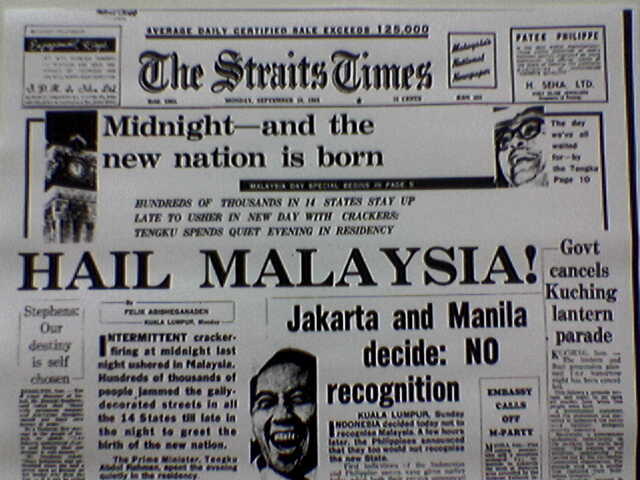
STRAITS TIMES, SEPT 16, 1963
Intermittent cracker firing at midnight last night ushered in Malaysia. Hundreds of thousands of people jammed the gaily-decorated streets in all the 14 States till late in the night to greet the birth of the new nation.
The Prime Minister, Tengku Abdul Rahman, spent the evening quietly in the residency.
In all States colourful parades will be held this morning when the new Malaysia flag with 14 stars will be ceremoniously unfurled.
Singapore's big moment will come when the proclamation is read on the City Hall steps at 5 p.m.
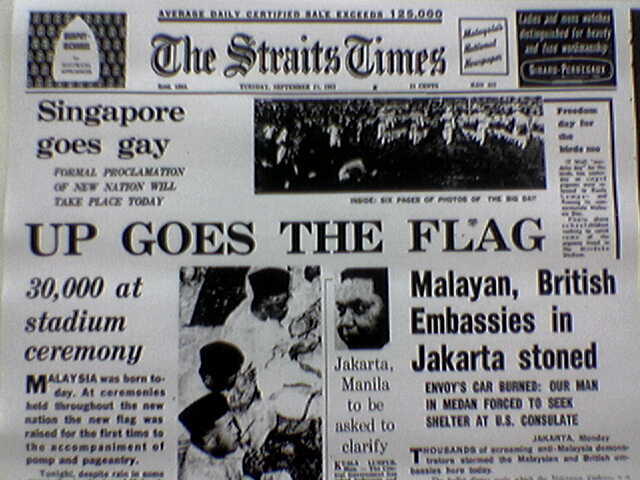
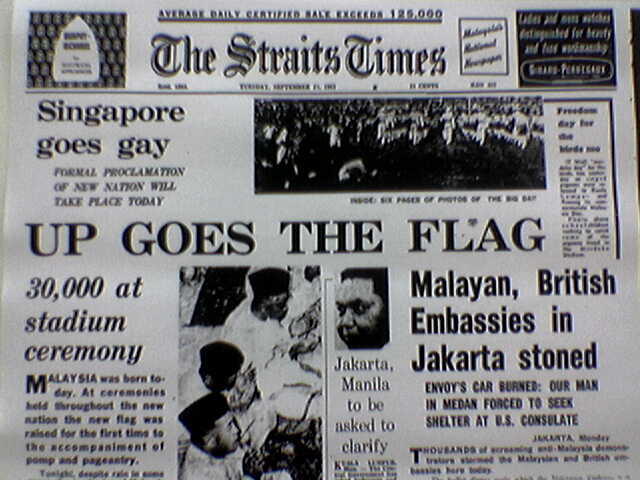
STRAITS TIMES, SEPT 17, 1963
Malaysia was born today. At ceremonies held throughout the new nation the new flag was raised for the first time to the accompaniment of pomp and pageantry.
Tonight, despite rain in some areas, the territories of Malaysia were a feast of light and colour and sound as 10 million celebrated.
More than 30,000 people Kuala Lumpur jammed the Merdeka Stadium in the early hours of the morning to witness the history-making Malaysia inaugural ceremony.
In Singapore, the moment of history was when the Prime Minister slowly intoned: "Now I, Lee Kuan Yew, the Prime Minister of Singapore, do hereby proclaimed and declare, on behalf of the people of Singapore, that as from today, the 16th day of September 1963, Singapore shall forever be a part of the sovereign and independent State of Malaysia, founded upon the principles of liberty and justice and ever seeking the welfare and happiness of her people in a more just and more equal society." Then to the strains of "Negara Ku", the Malaysian flag was raised.
STRAITS TIMES, SEPT 17, 1963
The Prime Minister, Mr. Lee Kuan Yew, makes his Malaysia proclamation from the City Hall Steps against a backdrop of a Malaysian multitude marching forward hand-in-hand.
This was Mr. Lee's proudest moment, and as read out the proclamation his voice shook with emotion and tears welled up in his eyes.
Independence through merger was the aim of the Premier and his People's Action Party which swept to power in 1959. This was his day of "fulfilment."
DR. LEE : WE OPPOSE MALAYSIA
One hour after the official proclamation of Malaysia in Singapore, the chairman of the Barisan Socialis, Dr. Lee Siew Choh, told a mass rally that his party would continue to oppose the new federation.
Dr. Lee, speaking at Tiong Bahru, added that his party would also continue to support the "demand of the people of Sarawak, Brunei and Sabah for self-determination and independence."
Dr. Lee, who was outlining the Barisan view on the "constitutional future" of Singapore, said:
"Since neo-colonialist Malaysia seeks to frustrate and deny the people their legitimate hopes and aspirations and to prolong colonial domination in South-east Asia, we must continue to oppose neo-colonialist Malaysia.
"We continue our struggle against colonialism and imperialism in all their forms."
"In respect of Singapore and the Federation we will continue to struggle for genuine reunification and for an independent democratic socialist Malaya (Singapore and the Federation) free of foreign troops and free of foreign control.
"Genuine reunification must be achieved on the basis of self-determination, equality, mutual benefit and mutual respect to both the Federation and Singapore.
"Therefore we continue our struggle for equality, for genuine common citizenship, for a common political life for the people of the Federation and Singapore; and we continue to safeguard and protect the economic interests of the people of Singapore.
Detainees
"Self-determination must of course include the immediate and unconditional release of all political detainees (especially those detained because of their anti-Malaysia activities) and the normalisation of all political life and activities in the country.
"Self-determination must include the restoration of all the fundamental rights of the people, including the freedom of travel, speech and publication, association and assembly.
"Self-determination must include the right to pursue an independent foreign policy of neutralism, and to oppose colonialist or neo-colonialist blocs, whether functioning under Malaysia or Seato.
Tuesday, July 19, 2005
Singapore drive on 'yellow culture' goes on
"I went for high culture, and forgot pop culture. That is where the money is."
- MM Lee Kuan Yew, Apr 17, 2005
More blasts from the past. In June 1959, jukeboxes and pin-tables got onto the nerves of the newly elected PAP Government headed by Lee Kuan Yew, Singapore's first Prime Minister.
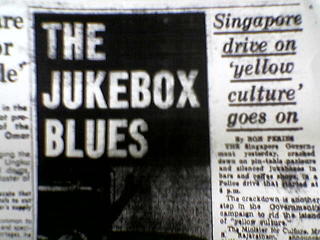
The Singapore Standard, June 13 1959.
By BOB PERIES
The Singapore Government yesterday cracked down on pin-table parlours and silenced jukeboxes in bars and coffee shops, in a Police drive that started at 6 p.m.
The crackdowm is another step in the Government's campaign to rid of the island of "yellow culture."
The Minister for Culture, Mr S. Rajaratnam, announced earlier in the week that rock n' roll and sentimental music would be drastically reduced in Radio Singapore broadcasts.
The Government has also ordered cinema exhibitors to withdraw from screening about 30 films and to send some back for re-examination by the censor.
Brutality, Low Moral Tone
The films came from America, Japan and Hong Kong.
It is understood that these films, in part, showed excessive brutality or were of a low moral tone.
The film censor, Mrs Cynthia Koek, however, would not comment.
Groups of Police officers, detectives and constables, acting on the instructions of the Government fanned out at 6 p.m. from all Police divisional stations to proclaim the big ban.
Armed with sheafs of documents authorising the ban, Policemen moved into hundreds of pintable arcades, bars and coffee shops.
After informing the proprietors of these establishments, they slapped the notices announcing the cancellation of their licences to operate the machines.
Saloons Quiet And Deserted
- MM Lee Kuan Yew, Apr 17, 2005
More blasts from the past. In June 1959, jukeboxes and pin-tables got onto the nerves of the newly elected PAP Government headed by Lee Kuan Yew, Singapore's first Prime Minister.

The Singapore Standard, June 13 1959.
By BOB PERIES
The Singapore Government yesterday cracked down on pin-table parlours and silenced jukeboxes in bars and coffee shops, in a Police drive that started at 6 p.m.
The crackdowm is another step in the Government's campaign to rid of the island of "yellow culture."
The Minister for Culture, Mr S. Rajaratnam, announced earlier in the week that rock n' roll and sentimental music would be drastically reduced in Radio Singapore broadcasts.
The Government has also ordered cinema exhibitors to withdraw from screening about 30 films and to send some back for re-examination by the censor.
Brutality, Low Moral Tone
The films came from America, Japan and Hong Kong.
It is understood that these films, in part, showed excessive brutality or were of a low moral tone.
The film censor, Mrs Cynthia Koek, however, would not comment.
Groups of Police officers, detectives and constables, acting on the instructions of the Government fanned out at 6 p.m. from all Police divisional stations to proclaim the big ban.
Armed with sheafs of documents authorising the ban, Policemen moved into hundreds of pintable arcades, bars and coffee shops.
After informing the proprietors of these establishments, they slapped the notices announcing the cancellation of their licences to operate the machines.
Saloons Quiet And Deserted
By 8 p.m., the saloons were deserted and the jukeboxes in bars and coffee shops blared no more.
A Standard reporter, who toured the island at 7 p.m. found several saloons in the Chinatown and Jalan Besar areas had closed down voluntarily - after getting wind of the impending swoop.
Unlicensed gaming shacks, which had mushroomed all over the island quietly shut their doors when messages were realyed through underworld agents.
This is an eye-witness account of the swoop: At 6 p.m., Police Officers moved in silently into saloons, bars and coffee shops and explained the ban to teh shocked proprietors.
They were warned that any breach of the ban would lead to a fine.
Notices were then pasted or nailed on the walls of the premises and above jukeboxes.
The proprietors asked their customers to leave and then shut their doors immediately.
The Singapore Standard, June 16 1959
Several hundred workers who have been thrown out of employment as a result of the ban on pin-tables amd jukeboxes have asked the Singapore Government to reconsider the order so that they would not add to the number receiving public assistance.
"We do not want to go on the dole," declared 300 employees of the Asia Novelty Emporium, one of the largest pin-table operating establishments on the island, whose licence was cancelled on Friday when the Government ban was imposed.
Twelve representatives of the workers, headed by the manager, Mr. Low Boon Kwee, yesterday met the Minister for Labour and Law, Mr. K.M. Byrne, to ask for the temporary rescindment of the ban so as to give them time to find other employment.
Mr. Low claimed that they were still uncertain if the ban was a temporary suspension of the game or a permanent prohibition.
As a result, the workers still keep coming to the place of work in case the suspension is lifted. They are not paid for it.
"The immediate closing down of the establishment has put us in a quandary and we are unable to find other jobs because it had been so sudden," he added.
Bread-winners
Of the 300 employees, 100 are girls, and they are the bread-winners for about a 1000 people, said Mr. Low.
At the one-hour meeting with the Minister yesterday, Mr. Low said that Mr. Byrne expressed his sympathy but said that he could not rescind the order. He would, however, bring the matter before the Cabinet and would give an answer to the delegation of the workers next Monday.
The emporium began functioning ten years ago and the workers are paid daily wages.
The Government, however, is not likely to reconsider its ban on the operation of jukeboxes and pin-tables.
Classical Music
The Minister for Culture, Mr S Rajaratnam said yesterday that it was up to the operators to convince the Government as to why the machines should not be banned.
Mr Rajaratnam said the suggestion by the operators that they were prepared to play classical music instead of provocative hits could not be entertained.
The Minister said it was not possible to check whether they were playing classical music as it would require a large staff of inspectors to watch them.
The decision to ban the jukeboxes and pin-tables was taken by the Ministry of Culture last week as part of the Government's policy to get rid of the "yellow culture" on the island.
Wednesday, July 13, 2005
Singapore police seized video at book launch
Over the weekend in Kuala Lumpur, Malaysians were treated to 38 films which had explicitly promoted themes of human rights, freedom of expression and other socio-political issues, including an unapologetically one-sided film higlighting the injustices of the Internal Security Act.
As a true blue, law-abiding Singaporean, I had asked the organiser of the Freedom Film Festival if any of the films were submitted to the authorities for approval. She looked at me, shrugged her shoulders and said, "No, but if they want to censor us, we'll defend our rights to freedom of expression."
So that's how things are in Malaysia. They just do it, and worry about consequences later.
After the festival, I took the coach back to Singapore. Upon crossing the causeway, I was greeted by this piece of news. The homecoming couldn't have been more sobering.
Published in the Straits Times, July 12 2005
No cert, so video shown at SDP leader's book launch seized
The police have seized a video that was screened at the launch of a book by oppoistion leader Chee Soon Juan last Saturday.
The organisers had not applied for a certificate to show the Hong Kong-made film, said the police.
The clip - titled July and which documents peaceful protests by Hong Kong people on July 1, 2003, against a proposed national security law - was screened while Dr Chee was signing copies of his new book.
The book, The Power of Courage, advocates the use of non-violent protests and civil disobedience against what Dr Chee described as "unjust laws" here.
The book launch at Grand Plaza Parkroyal was attended by about 50 members of the public, including supporters from Dr Chee's Singapore Democratic Party (SDP) and the Workers' Party.

"We have more important things to do!", said this unidentified police officer.
Yesterday, a police spokesman said: "During the event, a video disc was screened to the public.
"As the disc did not possess a certificate for its public exhibition, it was seized under the Films Act for investigations."
Asked if he knew that he could not air the film here without a certificate, Dr Chee, who organised the event, said he "didn't even know the video was being screened."
However, a presenter did announce that it would be screened during his autograpgh session.
When queried about the annoucement, Dr Chee said: "You will have to ask the presenter."
The police questioned Dr Chee on Saturday but declined to say if more people were being interviewed. They are still investigating the matter.
As a true blue, law-abiding Singaporean, I had asked the organiser of the Freedom Film Festival if any of the films were submitted to the authorities for approval. She looked at me, shrugged her shoulders and said, "No, but if they want to censor us, we'll defend our rights to freedom of expression."
So that's how things are in Malaysia. They just do it, and worry about consequences later.
After the festival, I took the coach back to Singapore. Upon crossing the causeway, I was greeted by this piece of news. The homecoming couldn't have been more sobering.
Published in the Straits Times, July 12 2005
No cert, so video shown at SDP leader's book launch seized
The police have seized a video that was screened at the launch of a book by oppoistion leader Chee Soon Juan last Saturday.
The organisers had not applied for a certificate to show the Hong Kong-made film, said the police.
The clip - titled July and which documents peaceful protests by Hong Kong people on July 1, 2003, against a proposed national security law - was screened while Dr Chee was signing copies of his new book.
The book, The Power of Courage, advocates the use of non-violent protests and civil disobedience against what Dr Chee described as "unjust laws" here.
The book launch at Grand Plaza Parkroyal was attended by about 50 members of the public, including supporters from Dr Chee's Singapore Democratic Party (SDP) and the Workers' Party.

"We have more important things to do!", said this unidentified police officer.
Yesterday, a police spokesman said: "During the event, a video disc was screened to the public.
"As the disc did not possess a certificate for its public exhibition, it was seized under the Films Act for investigations."
Asked if he knew that he could not air the film here without a certificate, Dr Chee, who organised the event, said he "didn't even know the video was being screened."
However, a presenter did announce that it would be screened during his autograpgh session.
When queried about the annoucement, Dr Chee said: "You will have to ask the presenter."
The police questioned Dr Chee on Saturday but declined to say if more people were being interviewed. They are still investigating the matter.
Tuesday, July 05, 2005
Singapore's war on pop culture
"I went for high culture, and forgot pop culture. That is where the money is."
- MM Lee Kuan Yew, Apr 17, 2005
It all began in 1959...
As part of my own commemoration of Singapore's upcoming 40th birthday, here is a series of historical snapshots from the Straits Times and The Singapore Standard.
Before independence in 1965, Singapore had been granted self-governance by the British.
On June 9, 1959, barely 10 days after being voted into public office, the new PAP administration initiated a clampdown on rock music, jukeboxes, publications, strip tease shows (yes, we used to have that!), films and all popular entertainment that were deemed as "yellow culture" contributing to "the decline in the moral standards of society."
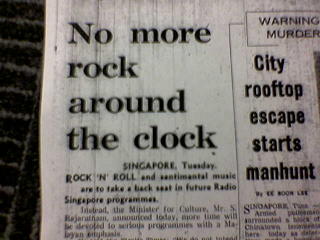
The Straits Times, June 10 1959 (Page 1 headlines)
RADIO: THE NEW ORDER
More serious programmes - with emphasis on Malaya
No more rock around the clock
Singapore, Tuesday
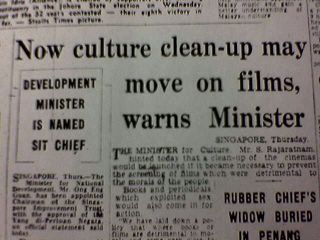
Straits Times, June 12 1959 (page 9)
The Minister for Culture, Mr. S. Rajaratnam, hinted today that a clean-up of the cinemas would be launched if it became necessary to prevent the screening of films which were detrimental to the morals of the people.
Books and periodicals which exploited sex would also come in for action.
"We have laid down a policy that where books or films are detrimental to morals and come very close to being classified as "yellow culture", it follows logically that they will be banned," he said.
"The film censorship policy will reflect this new attitude."
He said any action taken would be done in consultation with the Minister for Home Affairs, Mr. Ong Pang Boon, who deals with film censorship.
Pin-tables
Besides juke boxes, against which the Government is expected to take action, pin-tables are also likely to come in for similar action.
These are found in coffee shops and amusement parks. In some places they are the haunts of hooligans and gangsters.
The newly-appointed Parliamentary Secretary to the Minister for Culture, Mr. Lee Khoon Choy, today moved into his office adjoining that of Mr. S. Rajaratnam in the Department of Information Services.
The Minister and the Information Services expect to move into new offices in City Hall in about a fortnight.
- MM Lee Kuan Yew, Apr 17, 2005
It all began in 1959...
As part of my own commemoration of Singapore's upcoming 40th birthday, here is a series of historical snapshots from the Straits Times and The Singapore Standard.
Before independence in 1965, Singapore had been granted self-governance by the British.
On June 9, 1959, barely 10 days after being voted into public office, the new PAP administration initiated a clampdown on rock music, jukeboxes, publications, strip tease shows (yes, we used to have that!), films and all popular entertainment that were deemed as "yellow culture" contributing to "the decline in the moral standards of society."

The Straits Times, June 10 1959 (Page 1 headlines)
RADIO: THE NEW ORDER
More serious programmes - with emphasis on Malaya
No more rock around the clock
Singapore, Tuesday
ROCK N' ROLL and sentimental music are to take a back seat in future Radio Singapore programmes.
Instead, the Minister of Culture, Mr. S. Rajaratnam, announced today, more time will be devoted to serious programmes with a Malayan emphasis.
He told the Straits Times: "We do not intend to ban rock n' roll and other light music. We feel, however, that there is too much of it at present.
"We aim to achieve a more even balance.
"The new policy will apply to vernacular as well as English programmes. It will govern the selection of recorded programmes supplied by overseas broadcasting companies and corporations.
"News commentaries and reviews will be compiled first from the Malayan and then the Asian point of view.
"We want listeners to think as Malayans. It is no use looking at Asian affairs through Western eyes.
First choice
"Wherever possible, local men will be given priority in commenting on the news, though this does not mean that foreign commentators will be excluded altogether."
Mr Rajaratnam said he and officials of his Ministry were deciding how the broadcasting and information departments could be co-ordinated.
He said he might go to Kuala Lumpur for talks with Radio Malaya authorities. No date had been fixed for these talks yet, he added.

June 9 1959, The Singapore Standard
SINGAPORE'S Minister for Home Affairs, Mr. Ong Pang Boon, yesterday banned eight publications and withdrew the licence of the Mei Hua (Plum Blossom) Stage Show, which was playing at the Great World Amusement Park.
The Minister decided on the ban after consultation with Prime Minister Mr. Lee Kuan Yew and Senior Police officials yesterday morning.
The publications banned are: The Weekender (Free Press), the Free Press, Weekender Annual, the Nanyang Weekender, Arrow News, Kung Sang Pau, New Life News, Ti Press and the Fan Hua Pao.
Mr. Ong, in a written statement clarifying his decision to ban the stage show and the eight publications, said that it was part of "an active policy of eliminating all pornographic culture and all activities which are detrimental to the growth of a new and healthy society and culture."
He pointed out that under "colonial rule" Singapore had not only been exploited economically and politically but had also been culturally devastated.
Moral decline
"There has been a steady decline in the moral standards of society, particularly in the post-war decade, during which the degeneration has been very great," he said.
He pointed out that Singapore's young boys and girls "rock n' rolled" in the streets while its young wasted their time playing billiards and listening to sexy songs; striptease shows were performed freely and publicly.
"The continued development of such a situation will eventually lead to the total bankruptcy of the moral standards of our society," he said.
Mr. Ong said that the PAP told the people before it came into power that it would eliminate all the factors which contributed to the decline of moral standards of society and which stood in the way of the creation of both healthy social standards and of a healthy culture.

Straits Times, June 12 1959 (page 9)
The Minister for Culture, Mr. S. Rajaratnam, hinted today that a clean-up of the cinemas would be launched if it became necessary to prevent the screening of films which were detrimental to the morals of the people.
Books and periodicals which exploited sex would also come in for action.
"We have laid down a policy that where books or films are detrimental to morals and come very close to being classified as "yellow culture", it follows logically that they will be banned," he said.
"The film censorship policy will reflect this new attitude."
He said any action taken would be done in consultation with the Minister for Home Affairs, Mr. Ong Pang Boon, who deals with film censorship.
Pin-tables
Besides juke boxes, against which the Government is expected to take action, pin-tables are also likely to come in for similar action.
These are found in coffee shops and amusement parks. In some places they are the haunts of hooligans and gangsters.
The newly-appointed Parliamentary Secretary to the Minister for Culture, Mr. Lee Khoon Choy, today moved into his office adjoining that of Mr. S. Rajaratnam in the Department of Information Services.
The Minister and the Information Services expect to move into new offices in City Hall in about a fortnight.
S'pore make amends with film retrospective
After decades of weaning its population away from potentially decadent forms of popular entertainment, the Singapore government is now promoting local pop music and films, on its own terms, of course.
Excerpt of report published in the Straits Times, July 5, 2005
See Singapore morph from bucolic rural backwater to buzzing urban metropolis next month.
Screen Singapore: A Festival Of Singapore Films celebrates the nation's 40th birthday with a celluloid feast that serves up 31 feature films and 14 short films.
The programme runs the gamut from classic P. Ramlee films to controversial new offerings like Royston Tan's gangster movie 15.
The main attraction is a long-lost film from 1973 called Ring Of Fury. Directed by Tony Yeow and James Sebastian, it stars Singaporean karate master Peter Chong. But it was banned because of the storyline, which deals with a hawker facing extortion from a gang. It is receiving its Singapore debut 32 years after the fact.

Peter Chong from 70s homegrown flick Ring Of Fury, Straits Times, July 5 2005
Organised by Phish Communications, the festival is sponsored by the Singapore Film Commission and the Ministry of Information, Communications and the Arts.
Click here for the list of films to be shown at Screen Singapore. (Note that there are no local films at all from the eighties)
Excerpt of report published in the Straits Times, July 5, 2005
See Singapore morph from bucolic rural backwater to buzzing urban metropolis next month.
Screen Singapore: A Festival Of Singapore Films celebrates the nation's 40th birthday with a celluloid feast that serves up 31 feature films and 14 short films.
The programme runs the gamut from classic P. Ramlee films to controversial new offerings like Royston Tan's gangster movie 15.
The main attraction is a long-lost film from 1973 called Ring Of Fury. Directed by Tony Yeow and James Sebastian, it stars Singaporean karate master Peter Chong. But it was banned because of the storyline, which deals with a hawker facing extortion from a gang. It is receiving its Singapore debut 32 years after the fact.
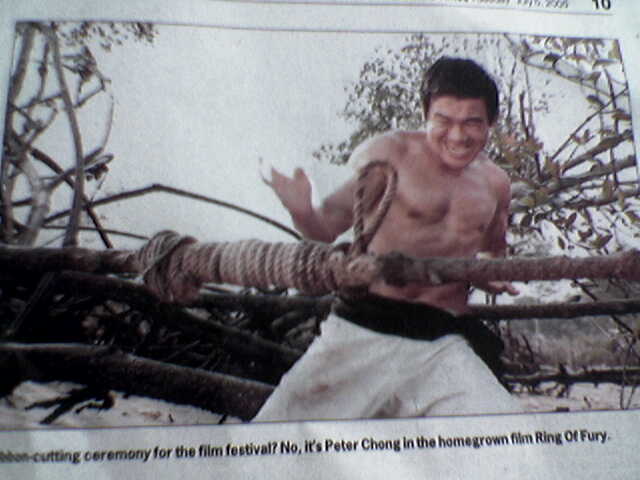
Peter Chong from 70s homegrown flick Ring Of Fury, Straits Times, July 5 2005
Organised by Phish Communications, the festival is sponsored by the Singapore Film Commission and the Ministry of Information, Communications and the Arts.
Click here for the list of films to be shown at Screen Singapore. (Note that there are no local films at all from the eighties)
Subscribe to:
Posts (Atom)