The wealth generated by Singapore's much-touted economic success story has not benefited everyone, least of all its senior citizens, a.k.a. the nation builders. Filmed on the streets and back-alleys of downtown Singapore in July 2007, this video does not contain any enactments or acting. Directed, shot and edited by Martyn See. Running time : 14 minutes.
Link to google video.
Martyn See's previous works, 'Singapore Rebel' and 'Zahari's 17 Years' are banned by the Singapore Government for their political content. The former was also the subject of a 15 month-long police investigation for alleged violation of the Films Act. Both films, however, are freely available for viewing on google video. See has gone on to make 'Speakers Cornered', which has yet to be submitted to the local censors. 'Nation Builders is his fourth video and the first to be made available on the web by the director himself. So far, the Singapore authorities has not sought any orders to have locally-banned videos removed from the internet.
Thursday, August 09, 2007


Friday, July 27, 2007
The Long Nightmare - Foreward excerpts
 The Long Nightmare: My 17 Years as a Political Prisoner is the second memoir written by Pak Said Zahari after Dark Clouds at Dawn. Though the title sounds poetic, it is written as a memoir, which notes the writer's experiences, observations and thoughts - the worldview, without distortion, of a veteran journalist and former political detainee held in Singapore prisons in the 1960s and 1970s.
Said Zahari's anti-colonial, anti-imperialist political stand is unmistakable in this book, as in his first book published in 2001. Similarly, his stand towards the PAP regime, under the leadership of Lee Kuan Yew, who was responsible for his arrest and imprisonment for 17 years, is very much unmistakable too.
In a brave and unflinching manner, Said Zahari reveals the cruelty of the PAP regime, especially towards its political opponents, whom they arrested and detained without trial, using laws inherited from the British colonial government. The tortures and persecution inflicted upon these political detainees are explained in detail by Said. It is hard to believe that such cruel acts happened, and we would not know, had they not been related by those who were tortured and persecuted.
Said Zahari was imprisoned without trial for 17 years. His guilt has never been proven despite his being imprisoned for so long. If this is not travesty, what is? However, after reading this book, we find a man who holds no rancour towards the person who slandered him and threw him in jail. What type of a person is this?
This second volume of Said Zahari's memoirs also tells the story of the
poignant sufferings of his wife and young children - whom he had to leave on 2 February 1963 when he was dragged to prison by the police of "Lee Kuan Yew's regime supported by the British colonialists".
Readers will find the story of the sufferings faced by Said Zahari's family during his imprisonment, awe-inspiring. We see how Said held on firmly to his principles and had no fear in defending justice and truth. But he is, in fact, a person with feelings and emotions. Like any other human being. He confesses, "I was shocked and overwhelmed. My soul was in turmoil when I heard, about the immeasurable sufferings of my wife for the first time, while in exile at Ubin Island before release."
He was deeply torn and burdened by his "sins" towards his wife and children. Said Zahari's introspection and admission of guilt is unequivocal. He asks for forgiveness from the Almighty for "breaking his oath when he betrothed" his wife, Salamah.
That was indeed a heavy "price" to pay his struggle against the slander and trumped up accusations made by Lee Kuan Yew, who conspired with the British colonialists. The challenge was to fight slander (in prison) on the one hand, and to fulfil one's responsibility towards the family (outside prison) on the other.
PROFESSOR DR NIK ANUAR NIK MAHMUD
Universiti Kebangsaan Malaysia
------------------------------------------------------------------------------------------
Born and educated in Singapore, Said Zahari went on to work and reside in Kuala Lumpur. In 1961, the Malayan authorities imposed a ban on his re-entry to the peninsula, thereby banishing him to the island republic. Less than two years later, the Singapore authorities arrested and detained him, a detention which was to extend for almost 17 years until his release on 22 August 1979. His detention spelt the end of his journalistic career. Said's prolonged detention became a cause celebre, and he was adopted as a Prisoner of Conscience by Amnesty International. In 1994, he applied and obtained permission to re-enter Malaysia to live near his children and grandchildren in Subang Jaya.
This is the second volume of Said Zahari's projected trilogy. This volume, originally subtitled "My 17 years in Lee Kuan Yew's prisons", was intended to chronicle his detention in Singapore. As part of this volume, Said has included a selection of his prison poems and translations in English written during the course of his long detention, which eloquently re-create the setting and mood of those years.
This volume also contains an account of the hunger strike by the political prisoners in Moon Cresecent detention centre in the early 1970s when they were housed in the newly-completed complex in separate small blocks, with not much opportunity to communicate and interact. The hunger strike was little publicized by the mass media at the time, and therefore, the general public in Singapore has remained largely unaware of the causes and duration of the strike.
Over the last decade, Said has emerged as an icon in both Singapore and Malaysia. He has come to symbolize, together with long-term political detainees in Singapore like Chia Thye Poh and others, an enduring profile of courage and human spirit rising above adversity and tragedy. In his own way, Said Zahari is waging an often lonely, but no less determined struggle to focus public attention on some ugly and less known aspects of Singapore's history, particularly the harsh repression against democratic and anti-colonial activists.
TAN JING QUEE
-------------------------------------------------------------------------------------------
 This volume of Said's memoirs, which centre on his 17 year incarceration in Singapore's prisons, serve as a poignant reminder to Singaporeans and Malaysians of the political abuse of detention-without-trial laws such as the ISA.
The PAP government repeated abuse of the ISA is highlighted by the 1987 detention of Singaporean church and political activists accused of engaging in a Marxist conspiracy. Recalling his shock at the crude and fanciful web of fabrication spun the PAP leadership, Said wrote, "I guffawed at such foolish lies... How could LKY pull the wool over Singaporeans' eyes with such blatant lies... This so-called Marxist conspiracy was created by LKY when he realised the existence of a new breed of political antagonists". Said observes that the detention and public 'confessions' of the so-called 'Marxist conspirators' was expected to reinforce "the culture of fear among the people of Singapore", thereby 'nipping in the bud' this new breed of antagonists.
Corroborating Francis Seow's experience of torture in Singaporean jails, Said's second memoir is strongly focused on exposing the mental and physical torture of political dissidents deprived of their civil liberties under the ISA. During their initial period of incarceration, detainees are often subjected to severe mental and physical torture. Said recalled the torment of a young detainee who was severely beaten for 22 days when he refused to betray his friends. He also denied being involved in an underground movement, carrying firearms and planning to overthrow the government. To shatter the spirit of detainees, prolonged periods of solitary confinement were enforced when they refused to 'confess' to crimes alleged by the government. Worn down by mental and physical stress, some agreed to public 'confessions' to secure their release. Confessions were also 'negotiated' by promises of attractive jobs upon release. Said has suggested that psychotropic drugs may have been prescribed to Operation Cold Store detainees, rendering them emotionally erratic and suicidal. The strain of detention was compounded further by the emotional and financial toll incurred by the families of detainees. In the 17 years of Said's incarceration, his late wife Salamah Abdul Wahab and their children suffered immense hardships. She struggled to make ends meet by running a food stall while the children often went to school without a cent in their pockets. Said's memoirs includes heartfelt snippets of the camaraderie, courage and dedication of many other political detainees who have become lifelong friends.
What will the political future hold for a post-Lee Kuan Yew Singapore? Will a post-PAP government unleash the ISA on former PAP government leaders known to have used the ISA against dissenting voices? Or will detention-without-trial laws be pronounced unconstitutional by a newly formed Constitution Court and Human Rights Commission? Will a post-authoritarian Singapore see the formation of a Truth Commission, set up to fully investigate the persecution of Singaporeans detained without trial, legally harassed and persecuted for their political convictions? Will a national apology be issued to political detainees incarcerated under the ISA? Will a post-authoritarian Singapore adopt foreign and security policies that are independent from the dictates of Washington, and acknowledge that the PAP government's support of the invasion and occupation of Iraq was a mistake? Will relations with neighbouring countries such as Malaysia, Indonesia and Thailand improve in a post-authoritarian Singapore not plagued by a kiasu mindset? The possibilities are endless.
I am deeply honoured to have been invited by Said to write a Foreword for the English edition of his second memoir. Said's moral courage, intellectual integrity, irrepressible spirit and multiracial ethos provide us with the inspiration to work towards a truly democratic Singaporean society. In this era of the so-called 'war on terror', which has enabled governments to resuscitate the existence of, and draw up even more, draconian laws, Said's plea that "these outdated, restricted laws such as the ISA are abolished" is particularly salient. Terima kasih Pak Said for showing us the way!
LILY ZUBAIDAH RAHIM
University of Sydney, Australia
----------------------------------------------------------------------------------------------
The book is now available in Malaysia at RM25. Select Books in Singapore may be be arranging to stock it but there is no confirmation as yet.
Book review of 'Ousted!"
How To Make Enemies and Alienate People . . . In Malaysia
Wednesday, July 18, 2007
Don't shade the past, tell it like it is, says LKY

Datuk Seri Zainuddin Maidin launching the book "Dalam Ribuan Mimpi Gelisah" and its English version "The Long Nightmare" authored by a former detainee, Said Zahari (next to Zainuddin). Pix: Noraini Ahmad
Said Zahari, a former journalist detained for 17 years without trial in Singapore, launches the English and Malay editions of his memoir in Kuala Lumpur. Officiating the launch is Malaysia's Information Minister Zainuddin Maidin, who elected to break into song midway into the proceedings and then quipped about sending Singapore's Lee Kuan Yew a copy of the book.
Watch the video here.
Malaysian opposition activist Tian Chua's blistering take of the launch
Kakiseni's report - complete with lyrics of song crooned by the Info Minister
Bernama's report - topped by a headline that bears no relevance to Said Zahari
Meanwhile, encouraged by an upcoming publication of memoirs to be written by former MPs, including those of the opposition, MM Lee Kuan Yew has written to the Straits Times to urge the authors not to fudge history, and to tell it like it is.
Strange call, this one. Almost as surreal as the one about allowing 'Singapore Rebel' if it was left up to him, and this recent one about decriminalising gays and senseless censorship.
In any case, the publishers should take his statement at face value and invite ex-political prisoner Chia Thye Poh to write his side of the story. After all, he was a MP from 1963 until his arrest three years later.
MPs should tell it like it is when writing memoirs
July 17, 2007
 I READ ST, July 11th 2007, the views of Dr Chiang Hai Ding and former PAP MPs on their writing of their memoirs.
They would refresh their memories if they read up old written materials, speeches, press cuttings, notes, letters and photos. It is worth the effort.
MPs are important actors in determining Singapore's history. I encourage all MPs, including those who opposed the PAP, to give their accounts of the past.
They will give a multi-dimensional view of past events and provide richness and texture to the story.
World War II accounts, whether in books, on TV or on film, that draw on sources from all parties, the Allies, Germans, Russians and Japanese, make fascinating reading because they give a three-dimensional depth to past events.
When writing memoirs, you are talking to posterity. Among them will be historians who will check what you write against the accounts of others. So do not shade the past.
I read Chin Peng's memoirs in English and the Plen's (Fang Chuang Pi) unfinished memoirs in Chinese.
I respected Chin Peng, so I asked to see him when he was in Singapore.
However, the Plen was a disappointment. He avoided the facts. Chin Peng did not.
Lee Kuan Yew
Minister Mentor
Wednesday, July 11, 2007
Founding PAP member and ex-political prisoner to pen memoirs
James Wong Wing On
Malaysiakini
Jul 9, 2007
Encouraged by the determination of fellow former political prisoner Said Zahari to unveil the other side of history, Singapore’s Dr Lim Hock Siew has also decided to publish his memoirs.
 “Although I have told my story in a documentary film many years ago, I have decided to write it down myself in the form of memoirs like my ‘good brother’ Said,” he told malaysiakini during an exclusive interview in Kuala Lumpur.
“I am now conducting research to find out more newly declassified materials in London to link up more dots,” added the 76-year old founding member of Singapore’s now ruling People’s Action Party (PAP).
Lim was detained without trial for almost 20 years from 1963 to 1982. (Which makes him the second longest-held political prisoner in Singapore after Chia Thye Poh)
According to him, although he was alleged to have participated in the activities of the so-called ‘Communist United Front’ in Singapore from the mid-1950s to early 1960s, he was never formally charged in any open court of law for the allegation.
“I still remember even my police interrogators told me that they knew I had never been a member of any communist party or group,” said Lim who was a central committee member of the opposition Socialist Front in Singapore at the time of his arrest.
He was detained during the 1963 Operation Cold Store, which saw more than 130 leaders of opposition parties, labour and student unions and journalists deemed to be left wing held as well.
Serving British interests

“Now, from all the already released records in London as well as other historical researches, it is clear that in launching Operation Cold Store, Lee Kuan Yew was serving the then strategic interests of Britain which wanted Singapore to continue to provide a forward military base in Southeast Asia,” said Lim
“It is also now an undeniable fact that Lee worked earlier for the Japanese military during the Occupation making Britain’s English materials available in Japanese-language for the occupiers,” he added.
Lim was a graduate of Singapore’s prestigious Raffles College and a medical doctor trained in University of Malaya, which was then located in Singapore.
“I was also a founder of University of Malaya’s Socialist Club which became the cradle for many politicians and intellectuals in both Malaysia and Singapore who fought for independence,” he recalled with a sense of pride.
“In those days, anti-colonialism was a very powerful and popular sentiment even in Singapore … I helped found the People’s Action Party (PAP) to fight for the freedom of Singapore from British rule and to reunite it with Peninsula to form an united, non-communal and progressive Malaya but when Lee turned right wing and started serving British interests, the party split and I left to join the Socialist Front,” he explained.
“We certainly opposed to Singapore being maintained as a military base for Britain and that was why Lee had to crush the Left in Singapore at all cost … The Left in Singapore also opposed to the 1963 merger because we thought it was an opportunistic adventure on the part of Lee who wanted to exploit Tunku Abdul Rahman’s anti-communism to suppress the Left in Singapore … we wanted merger but not in the 1963 version which proved to be an utter failure just two years later in 1965.
“I was completely English-educated,” stressed Lim, which was obviously a sarcastic and subtle rebuttal to the now stereotyped and widespread notion that the Left in Singapore in the 1950s and 1960s was a “Chinese-educated” phenomenon.
Political conviction
As for his detention, Lim said he did not suffer any physical torture.
“But, detention without charge or trial for an uncertain period of time is itself a form of torture, albeit a psychological one,” Lim said.
“When I was first arrested in February 1963, my son was only five-months-old but when I was released in 1982, he was already studying at the Cambridge University in Britain.
“I wish to thank my wife Dr Betruce Cheng for her understanding, fortitude and solidarity for the entire period of my 20-year detention and also for bringing up our boy,” he added.
Quizzed on what helped him preserve his sanity during his detention, Lim replied: “Political conviction, intellectual integrity and moral conscience”.
“I certainly have no regret for my involvement and participation in politics although I had to pay a heavy price for it. I am still a socialist who believes in democracy for the people and social justice for the working classes,” he stressed.
Malaysiakini
Jul 9, 2007
Encouraged by the determination of fellow former political prisoner Said Zahari to unveil the other side of history, Singapore’s Dr Lim Hock Siew has also decided to publish his memoirs.
 “Although I have told my story in a documentary film many years ago, I have decided to write it down myself in the form of memoirs like my ‘good brother’ Said,” he told malaysiakini during an exclusive interview in Kuala Lumpur.
 “I am now conducting research to find out more newly declassified materials in London to link up more dots,” added the 76-year old founding member of Singapore’s now ruling People’s Action Party (PAP).
Lim was detained without trial for almost 20 years from 1963 to 1982. (Which makes him the second longest-held political prisoner in Singapore after Chia Thye Poh)
According to him, although he was alleged to have participated in the activities of the so-called ‘Communist United Front’ in Singapore from the mid-1950s to early 1960s, he was never formally charged in any open court of law for the allegation.
“I still remember even my police interrogators told me that they knew I had never been a member of any communist party or group,” said Lim who was a central committee member of the opposition Socialist Front in Singapore at the time of his arrest.
He was detained during the 1963 Operation Cold Store, which saw more than 130 leaders of opposition parties, labour and student unions and journalists deemed to be left wing held as well.
Serving British interests

“Now, from all the already released records in London as well as other historical researches, it is clear that in launching Operation Cold Store, Lee Kuan Yew was serving the then strategic interests of Britain which wanted Singapore to continue to provide a forward military base in Southeast Asia,” said Lim
“It is also now an undeniable fact that Lee worked earlier for the Japanese military during the Occupation making Britain’s English materials available in Japanese-language for the occupiers,” he added.
Lim was a graduate of Singapore’s prestigious Raffles College and a medical doctor trained in University of Malaya, which was then located in Singapore.
“I was also a founder of University of Malaya’s Socialist Club which became the cradle for many politicians and intellectuals in both Malaysia and Singapore who fought for independence,” he recalled with a sense of pride.
“In those days, anti-colonialism was a very powerful and popular sentiment even in Singapore … I helped found the People’s Action Party (PAP) to fight for the freedom of Singapore from British rule and to reunite it with Peninsula to form an united, non-communal and progressive Malaya but when Lee turned right wing and started serving British interests, the party split and I left to join the Socialist Front,” he explained.
“We certainly opposed to Singapore being maintained as a military base for Britain and that was why Lee had to crush the Left in Singapore at all cost … The Left in Singapore also opposed to the 1963 merger because we thought it was an opportunistic adventure on the part of Lee who wanted to exploit Tunku Abdul Rahman’s anti-communism to suppress the Left in Singapore … we wanted merger but not in the 1963 version which proved to be an utter failure just two years later in 1965.
“I was completely English-educated,” stressed Lim, which was obviously a sarcastic and subtle rebuttal to the now stereotyped and widespread notion that the Left in Singapore in the 1950s and 1960s was a “Chinese-educated” phenomenon.
Political conviction
As for his detention, Lim said he did not suffer any physical torture.
“But, detention without charge or trial for an uncertain period of time is itself a form of torture, albeit a psychological one,” Lim said.
“When I was first arrested in February 1963, my son was only five-months-old but when I was released in 1982, he was already studying at the Cambridge University in Britain.
“I wish to thank my wife Dr Betruce Cheng for her understanding, fortitude and solidarity for the entire period of my 20-year detention and also for bringing up our boy,” he added.
Quizzed on what helped him preserve his sanity during his detention, Lim replied: “Political conviction, intellectual integrity and moral conscience”.
“I certainly have no regret for my involvement and participation in politics although I had to pay a heavy price for it. I am still a socialist who believes in democracy for the people and social justice for the working classes,” he stressed.
Monday, July 02, 2007
Video : Said Zahari launches book
Said Zahari, a former anti-colonialist newspaper editor, launches the Chinese edition of his autobiography 'The Long Nightmare - My 17 Years As A Political Prisoner' at the Southern College in Johor, Malaysia on 1st July 2007. The video includes an introductory speech by Dr Lim Hock Siew, a founding member of the PAP who broke ranks in 1961 to form the Barisan Sosialis, but was subsequently arrested and detained without trial for 20 years under the Internal Security Act in Singapore.
Friday, June 22, 2007
Former political prisoner Said Zahari to launch book
After a year-long delay, Said Zahari will finally launch his much-awaited book.Originally slated as 'The Long Nightmare - My 17 Years of Life in Lee Kuan Yew's Prison', the book's title has since been amended, at the behest of Utusan Publications, to 'The Long Nightmare - My 17 Years As A Political Prisoner'. Its contents, however, remains unchanged. The autobiography is the second installation of a planned trilogy by the former editor of the Malay-language daily Utusan Melayu, for whose brief involvement with the anti-colonial political opposition in Singapore culminated in his arrest and detention under Operation Coldstore in 1963.
Said Zahari is the only former long-term political prisoner to publicise his experiences of detention under the ISA in Singapore. His first book, 'Dark Clouds At Dawn', was published in 2001 and is available locally. ' Zahari's 17 Years', a documentary I had made about his years in detention, has been banned by the Singapore Government. In a recent statement explaining the reason for the film ban, the censors said that unlike a book, a film is likely to reach a wider audience and can easily "arouse emotive responses." 'Zahari's 17 Years' has since been uploaded for viewing on google video; and then uncharacteristically anchored two weeks later by a public remark from Minister Mentor Lee Kuan Yew that "all this censorship makes no sense."
Although Said is now a Permanent Resident of Malaysia, he has retain his Singaporean citizenship. In a recent conversation over the phone, he expressed his wish to visit Singapore soon to promote the book. It is unlikely that the Singapore Government will impose any official ban, but local distributors and retailers may be fearful of carrying the title.
'The Long Nightmare' is published in three languages - English, Mandarin and Malay. There are two launch dates - one for the Chinese edition and another for the English and Malay editions.
Launch of 'The Long Nightmare' (Chinese edition)
Date : Sunday 1 July, 2007
Time : 2 pm
Venue : Southern College, near Giant Supermarket off Skudai Road, Johor Bahru
Speakers : Dr Lim Hock Siew and Professor Chia Ai Ping
Launch of 'The Long Nightmare' (English and Malay edition)
Date : Monday 16 July, 2007
Time : 9.30 am
Venue : Dewan Bahasa dan Pustaka (Institute of Language and Literature)
Jalan Dewan Bahasa, Kuala Lumpur
Guest-of-honour : Datuk Seri Zainuddin Maidin, Minister of Information Malaysia
The author will be present on both dates.

Said Zahari shows his latest memoir in front of his books collection at his home in Kuala Lumpur, Malaysia, Saturday, March 25, 2006. Said Zahari, who was arrested in 1963 and detained without trial by Singaporean authorities for 17 years has written a memoir detailing his experiences as a political prisoner and hopes the book will provide a different perspective of the political events that shaped Singapore's road to independence in 1965 and its first decades of nationhood. (AP Photo/Andy Wong)
Friday, June 15, 2007
'Singapore You Are Not My Country'
"If you care too much about Singapore, first it’ll break your spirit, and finally it will break your heart." - Alfian Sa'at
Mr Alfian Sa'at, one of Singapore's brightest literary luminaries, was recently dismissed from his relief teaching job by the Ministry of Education. And it happened in spite of the fact that some of his writings have been approved, lauded and taught in classrooms run by the government. Much debate has since ensued, inspired no less by the Ministry's reticence in stating any specific reason for this abrupt termination of service.
Playwright's relief teaching application rejected
Alfian Sa'at's blog
Teacher unaccountably terminated
Stop Right There, Mr Alfian Saat
Changing the information landscape
 Alfian Sa'at (right) at A Night with Gay Poets, 2005
Rather than chipping in my five cents worth into the fray, I thought I'll just re-produced three of my favourite poems by Alfian here.
 But first I'll let you in on a little-known fact about the current Minister for Education, Mr Tharman Shanmugaratnam: In his days as a student at the LSE, he would visit the home of exiled dissident Tan Wah Piow to engage in an 'underground study group', along with other Singaporean students residing in UK at that time. Upon his return to Singapore during the early 80s, he was immediately hauled up by the ISD for a series of interrogations, but no arrests were made at the time. However, some of the other members of the 'study group' were eventually arrested and detained in 1987's 'Marxist conspiracy'. It is not known if Mr Shanmugaratnam was questioned again in 1987.
---------------------
The Interrogation Room
I imagine they took you to a room.
You were led to a chair
And there might have been a table.
There was a pen scathing
Or a tape recorder spool twisting
Your words back on itself.
"Are you a Marxist?
Which hand would you use
To hold the Constitution?
Do you talk in your sleep?
Which of the stars
Of the national flag
Represents death?
What kinds of friends
Have shared your cigarettes
Or rolled over in bed
Stretching his or her hand
To find you absent,
And believed that
You had been taken away?"
You swallowed your trembling
With the help
Of a cup of coffee
They had placed
In your trusting hands
You finally cleared your throat
As if pushed
Onto a funeral podium
To deliver a eulogy
For a man you did not know.
What is a word?
A needle's ballet
Stitching the chasm
Between a yes and a no.
- Alfina Sa'at, A History of Amnesia, 2001
Mr Chia Sits In His Dark Cell
For Chia Thye Poh, detained without trial under the ISA for 32 years
"I was put in solitary confinement in what was called the 'dark cell'. It's not an ordinary prison cell. It's totally dark, totally quiet. usually you could not hear or see anything either inside or outside your cell. To intimidate me, the Internal Security Department officers told me that prisoners held in such cells go totally insane in just a few days. One of my first nights there, I could hear someone in the next cell violently kicking his cell door. Hearing that noise, I thought someone really had gone insane." - Chia Thye Poh
Mr Chia sits in his cell
In complete darkness
Telling his right hand
From his left foot
He tries to recall
Which side he is on
He does not know
Which side has betrayed him
He pulls a blanket over his body
He has no idea what colour it is
Each time he takes in a breath
The room draws its bosom near
Mr Chia closes both his eyes
Then struggles to open them again
Or perhaps there was no struggle at all
Perhaps they had been open all this while
Mr Chia dreams his skin is a shroud
For the blood's conspirational hymns
Mr Chia prays for something to puncture him
An ice-clear circle on a pane of soot
Grasping in the dark he recognises shapes
His freedom the size of a keyhole's pupil
Fate in the cross-hatched lines of a palm
Wrapped around the barrel of a pen
Mr Chia slowly recites numbers
And is assured that all of them are present
There are more than enough for all his fingers
Just barely enough for the counting of hours
When the sun finally greets him like a stranger
Mr Chia will keep his mouth firmly sealed
A man who has eaten darkness will not let any light enter
The cave of his blind organs his speechless bones.
- Alfian Sa'at, A History of Amnesia, 2001
Singapore You Are Not My Country
Singapore you are not my country.
Singapore you are not a country at all.
You are surprising Singapore, statistics-starved Singapore,
soulful Singapore of tourist brochures in Japanese
and hourglass kebayas.
You protest, but without picketing, without rioting,
without Catherine Lim,
but through your loudspeaker media, through the
hypnotic eyeballs of your newscaster,
and that weather woman who I swear is working
voodoo on my teevee screen.
Singapore, what are these lawsuits in my mailbox?
There are so many sheafs, I should have tipped the postman.
Singapore, I assert you are not a country at all.
Do not raise your voice against me,
I am not afraid of your anthem
although the lyrics are still bleeding from
the bark of my sapless heart.
Not because I sang them pigtailed pinnafored
breakfasted chalkshoes in school
But because I used to watch telly till they ran out of shows.
Do not invite me to the podium and tell me to address you properly.
I am allergic to microphones and men in egosuits and pubicwigs.
And I am not a political martyr, I am a patriot
who has lost his country and virginity.
Do not wave a cane at me for vandalising
your propaganda with technicolour harangues,
Red Nadim semen white Mahsuri menses
the colourful language of my eloquent generation.
Your words are like walls on which truth is graffiti.
This has become an island of walls.
Asylum walls, factory walls, school walls,
the walls of the midnight Istana.
If I am paranoid I have learnt it from you,
O my delicate orchid stalk Singapore.
Always thirsty for water, spooked by armed archipelagoes,
always gasping for airspace, always running to keep ahead,
running away from yourself.
Singapore why do you wail that way, demanding my IC?
Singapore stop yelling and calling me names.
How dare you call me a chauvinist, an opposition party,
a liar, a traitor, a mendicant professor, a Marxist homosexual communist
pornography banned literature chewing gum liberty smuggler?
How can you say I do not believe in
The Free Press autopsies flogging mudslinging bankruptcy
which are the five pillars of justice?
And how can you call yourself a country, you terrible
hallucination of highways and cranes and condominiums ten minutes'
drive from the MRT?
Tell that to the battered housewife who thinks happiness
lies at the end of a Toto queue
Tell that to the tourist guide whose fillings are pewter
whose feelings are iron
whose courtesy is gold whose speech is silver whose
handshake is a lethal yank at the jackpot machine.
Tell that to my imam who thinks we are all going to hell.
Tell that to the chao ah beng who has seven stitches a
broken collarbone and three dead comrades but who
will not hesitate at thrusting his tiger ribcage into another fight
because the lanterns of his lungs have caught their own
fire and there is no turning back.
Tell that to the yuppie who sits in meat-markets disguised
as pubs, listening to Kenny G disguised as jazz
on handphone disguised as conversation and loneliness
disguised as a jukebox.
Tell that to all those exiles whose names are forgotten but
who leave behind a bad taste in the thoughtful mouth,
reminding us that the flapping sunned linen shelters a
whiff of chloroform.
Tell that to Town Council men who feed pigeons with
crumbs of arsenic.
Tell that to Maria Hertogh a.k.a. Nadra who proved to us
that blood spilled was thicker than water shed as she
was caught pining under a stone angel in the nunnery
for her husband.
Tell that to Ah Meng, who bore five hairy bastards for our nation.
Tell that to Lee Kuan Yew's squint.
Tell that to Josef Ng, who shaves my infant head admidst a
shower of one-cent coins, and both of us are pure again.
Tell that to my Warrant Officer who knew I was faking.
Tell that to the unemployed man who drinks cigarettes
smokes tattoos watches peanuts
unselfconscious of his gut belch debts and wife having an
affair with the Salesman of Nervous Breakdowns.
Tell that to Maya Angelou's who are screeching like
witches United Nations-style poems populated by
Cheena Babi Bayee Tonchet Melayu Malas Keling
Garagok Mat Salleh.
Tell that to the fakirs of civil disobedience, whose head-
phones are pounding the hooving basslines of
Damyata Damyata Damyata
Tell that to the statue of Li Po at Marina Park.
Tell that to the performance artists who need licences like
drivers and doctors and dogs
when all they really need is just three percent of your love.
Tell that to the innocent faggot looking for kicks on a
Sunday evening to end up sucking the bit-hard pistol-
muzzle of the CID, ensnared no less by his weakness for
pretty boys naked out of uniform.
Tell that to the caretaker of the grave of Radin Mas.
Tell that to Chee Soon Juan's smirk.
Tell that to the pawns of the Upgrading Empire who
penetrate their phalluses into heartlands to plant Lego
cineplexes Tupperware playgrounds suicidal balconies
carnal parks of cardboard and condoms and before we
know it we are a colony once again.
Tell that to Malaysia whose Desaru is our spitoon whose
TV2 is our amusement whose Bumiputras are our
threat whose outrage is our greater outrage whose
turtles are weeping blind in the roaring daylight of our cameras.
Tell that to the old poets who have seen this piece of land
slip their metaphors each passing year from bumboats
to debris to sanitation projects to drowning attempts
to barbed neon water weeds on a river with
no reflections a long way off from the sea.
O Singapore your fair shores your garlands your GNP.
You are not a country you are a construction from spare parts.
You are not a campaign you are last year's posters.
You are not a culture you are poems on the MRT.
You are not a song you are part swearword part lullaby.
You are not Paradise you are an island with pythons.
Singapore I am on trial.
These are the whites of my eyes and the reds of my wrists.
These are the deranged stars of my schizophrenia.
This is the milk latex gummy moon of my sedated smile.
I have lost a country to images, it is as simple as that.
Singapore you have a name on a map but no maps to your name.
This will not do; we must stand aside and let the Lion crash
through a madness of cymbals back to that darkjungle heart
when eyes were still embers waiting for a crownless
Prince of Palembang.
- Alfian Sa'at, One Fierce Hour, 1998
--------------------------------------------------
Finally, a more recent work
Death of a Tyrant
the ground will be the sort that will not yield a grave.
fountains will be turned off, men will arrange chairs
near sun-dusted windows, watching as if expecting
your black-suited procession to visit their streets.
you will refuse, of course, to fit into your coffin,
and they will have to anchor down the eclipses
of your eyelids over those outraged suns.
they will parade you, a gulliver,
with one hundred corpse-bearers taking turns,
because anyone within three feet of you
will sweat at the palms. there will be
junctions where citizens will want to spit
at your passing, but the memory of fines
will keep them mum. what an entourage
it will be, with the walkie-talkied mourners
throwing affidavits like hell money,
(for nobody but you could endure so much
damages in one lifetime), the sunglassed
actresses turning your acronym
into orgasms of mourning, and the cwo
sweepers blushing from behind.
and heading it all, a frisky lettuce-lion, to yap
at the invisible (unlawful?) gathering of hanged ghosts
who will weave for you, like a mute band of brothers,
a wreath of nooses, soiled as stillborn snakes.
your eulogy will be an edifice of fire,
sheer lightning in a cloudless sky,
(O architect of charisma, glorious historical weeper)
a baptism that will char dead trees into totems.
in life, your snort was a decree, your fart a sermon.
in death, a nation's silence will follow you to the grave.
only then will you know what it means to be exiled,
only then will they know what they have
been holding their breaths so long for:
the stench of your corruption,
and the clear, newborn coughing,
on a dawn-rinsed, tearless morning.
- Alfian Sa'at
Sunday, June 10, 2007
They came first for the communists ...
20 years after the "Marxist conspiracy" arrests, the jail cells of the ISD are again filled with more prisoners held without trial.
This week, the Ministry of Home Affairs announced the arrests and detention of five "self-radicalised" Islamic "militants", including lawyer and former rock musician Abdul Basheer Abdul Kader. They were arrested in the period between November and April. It seems that the use of the ISA has become so secretive that the time lapse between such arrests and its public announcement has widened considerably. Perhaps the interrogation teams now require more time to break their prisoners before the word gets out.
The Straits Times also reported that there are now 34 people detained under the ISA for alleged "terrorism" activities. What they don't tell you is that there may be an additional five prisoners held for alleged "espionage", and whose names and identities the Ministry has not disclosed. Probably nobody has bothered to ask - it's none of our business anyway.
Singapore Arrests Suspected Islamic Militants, Including Lawyer
An earler report
Singapore says it is holding 39 people for terrorism, espionage involvement, April 9, 2007
Here's that famous poem from Pastor Martin Niemöller. It works best as a template. Change the context to suit your own political situation and it should hit home.

They came first for the Communists,
and I didn't speak up because I wasn't a Communist.
Then they came for the Jews,
and I didn't speak up because I wasn't a Jew.
Then they came for the trade unionists,
and I didn't speak up because I wasn't a trade unionist.
Then they came for the Catholics,
and I didn't speak up because I was a Protestant.
Then they came for me,
and by that time no one was left to speak up.
This week, the Ministry of Home Affairs announced the arrests and detention of five "self-radicalised" Islamic "militants", including lawyer and former rock musician Abdul Basheer Abdul Kader. They were arrested in the period between November and April. It seems that the use of the ISA has become so secretive that the time lapse between such arrests and its public announcement has widened considerably. Perhaps the interrogation teams now require more time to break their prisoners before the word gets out.
The Straits Times also reported that there are now 34 people detained under the ISA for alleged "terrorism" activities. What they don't tell you is that there may be an additional five prisoners held for alleged "espionage", and whose names and identities the Ministry has not disclosed. Probably nobody has bothered to ask - it's none of our business anyway.
Singapore Arrests Suspected Islamic Militants, Including Lawyer
An earler report
Singapore says it is holding 39 people for terrorism, espionage involvement, April 9, 2007
Here's that famous poem from Pastor Martin Niemöller. It works best as a template. Change the context to suit your own political situation and it should hit home.

They came first for the Communists,
and I didn't speak up because I wasn't a Communist.
Then they came for the Jews,
and I didn't speak up because I wasn't a Jew.
Then they came for the trade unionists,
and I didn't speak up because I wasn't a trade unionist.
Then they came for the Catholics,
and I didn't speak up because I was a Protestant.
Then they came for me,
and by that time no one was left to speak up.
Thursday, May 17, 2007
"Marxist Conspiracy" arrests - 20 years on
There has never been a time in Singapore's history when its people were free from the prying feelers of the secret police, who, more often than not, operated against those who posed a political threat to the establishment, just as they do against genuine security threats to the State. Both the British Colonial and Japanese occupiers employed the Special Branch and Kempeitai respectively to monitor dissident movements amongst its subjects, namely the residents in Singapore. Under the PAP Government of an independent and sovereign Singapore, the Special Branch has since morphed into the Internal Security Department, and its subjects of surveillance are now its very own citizens. The modus operandi has largely remained unchanged since colonial times - sophisticated use of surveillance techniques, powers of detention without trial, oppressive methods of interrogation, solitary confinement, public confessions on state-controlled media - all conspiring to create a climate of fear and foster varying degrees of suspicion among ordinary people. The net result is this - government spies are everywhere, so let's not antogonise Big Brother by involving oneself in any social or political causes, even if they are legal.
The use of the Internal Security Act (ISA), which allows for indefinite detention without trial, sparked one of the most cataclysmic events in Singapore. In what came to be known as the "Marxist conspiracy" arrests, the detentions in 1987 of a group of young social workers, lawyers, businessmen, theatre practitioners and other professionals sent shockwaves across the nation and the world. It triggered the resignation of senior Catholic priests, prayer masses for the detainees, and unprecedented international condemnation from human rights groups and foreign governments. Although the "Marxist conspiracy" story effectively ended in 1990 when the last of its detainees, Teo Soh Lung and Vincent Cheng, were released, its effects are still being felt in Singapore today, particularly within civil society and the Catholic Church. A shadow of fear continues to hang over any discussion of the subject. Very few articles are written about it and many of its players, including ex-detainees living in and out of Singapore, are reluctant to speak about it in public.
However, one ex-detainee did speak out publicly against the detentions. Miss Tang Fong Har was a lawyer when she was arrested on June 20, 1987. She was released 85 days later, having had spend most of her time in solitary confinement. In April of 1988, along with eight others, she issued a joint statement alleging unjustified arrests, ill-treatment, forced TV confession and a recantation of their earlier signed confession. Immediately, the government ordered their re-arrests. Tang escaped re-arrest as she was overseas at that time, and has remained in exile ever since.
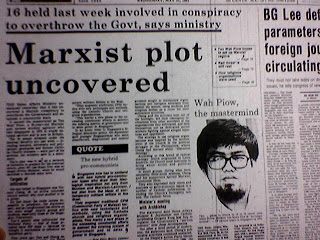 Dated 27 May 1987, this Straits Times headline was the first report of the "Marxist conspiracy" detentions which were actually carried out six days earlier on May 21. In my interview with Said Zahari, he had said that the first weeks of interrogation were the roughest. In this case, one would imagine the five day lapse between the initial arrests and the government's press release gave the ISD interrogators ample time to extract confessions and recantations from the detainees.
 This Straits Times headline on June 21, 1987 stated that the government had released four detainees and arrested six more. Therefore, although it is often quoted that the "Marxist conspiracy" involved 22 detainees, truth is not all of them were incarcerated at the same time. Miss Tang Fong Har is pictured on the top left between Vincent Cheng and Chew Kheng Chuan.
May 21, 2007 will mark the 20th Anniversary of the "Marxist conspiracy". As a personal commemoration, I went scouring for articles hitherto unavailable online and found a booklet of speeches made by Singaporean and Malaysian activists and academics in a conference held at the European Parliament in March of 1989.
The experience of detention under the ISA in Singapore
by Tang Fong Har
I was one of the twenty-two people arrested by the Singapore Government in 1987, detained for 85 days (of which 75 were in solitary confinement) and when released, was still subject to severe restrictions which infringed on my basic civil liberties.
The Government's accusations against the twenty-two people who were detained (who were made up of community and trade union workers, lawyers, amateur dramatists and other professionals) were that we were all involved in a 'marxist conspiracy' to overthrow the Singapore government.
After our release, in April 1988, some of us issued a joint statement in which we categorically denied the Government's accusation against us and we also described the ill-treatment that we had undergone while in detention. Within a day of the release of the statement, those who signed the statement who were in Singapore (eight people) were re-arrested, and today some of them are still in imprisoned by my Government.
Let me described a little of the experience of being detained in Singapore.
My ordeal began on the 20th June 1987, when at 1 o'clock in the morning, four plain-clothed police entered my house without a search warrant saying that they were looking for an illegal immigrant. They gained entry into my home and then stated that I was under arrest under the Internal Security Act. My husband and I were ordered not to move, speak to each other or make any calls to my lawyer or any family member. They systemically searched my house and confiscated my passport, diary, minutes of my law society meetings and other things. I should state that I was a lawyer and was actively involved in the Law Society of Singapore and also a member of a women's group.
Eventually, they took me to the Detention Centre. I was always guarded by two people. I was ordered to strip and change into prison clothing. Then I was photographed, finger-printed, and brought down a passageway. One of the doors of the passageway opened into a basement dungeon of many rooms. One of my first impressions was that the room was very cold, and the spotlights were such that I could not see the faces of my interrogators. I was ordered to stand with my hands behind my back, and then the interrogation began.
It was shouting, verbal abuse, about my Law Society activities, my work and my family life. I was threatened constantly with indefinite detention, and the name of Chia Thye Poh (who had been detained for over 20 years at that time) was referred to several times. They said that if I did not cooperate with the secret police, they would wait for me in the same way that they were still waiting for Chia. During my interrogation, which lasted non-stop for 20 hours, I obviously gave 'unsatisfactory' answers. I was slapped in the face, and the impact of the assault sent me rolling on the floor. There was a silence followed by further interrogation. After 20 hours I remember throwing up. I indicated to them I would be willing to sign a statement.
I was then moved from that room to another one. I started and finished my statement. After each page I had to give it to the case officer, who would look through it. If he was unhappy with any part of it, he would pass it back it again and I would have to re-do it until it was to his satisfaction. And so we continued in this fashion. I had to write about the Law Society, make a list of about a hundred people (of whom J.B. Jeyaretnam was one) and then I was told that if I did not publicly confess on TV, I would not be released. And so I went on TV.
Thereafter I was moved to a bigger cell. After the third week, I was allowed a few hours rest in a cell 3 ft. by 6 ft. by about 15 ft. high. This cell had no windows but had some ventilation slits. After one month, I was served with with a detention order for one year specifically on two charges of manipulating the opposition Workers' Party to further the marxist cause and of instigating the Law Society of Singapore to become a political pressure group. I was moved to a bigger cell but was still in solitary confinement. Family visits were limited to one visit of half-an-hour a week. At every visit, three internal security police stood in the same room, and we were told not to talk about the conditions of the cell or to talk about the statement. To ignore this would mean the loss of such visits. We were also strongly discouraged from filing habeas corpus actions to challenge the legality of the detentions.
Except for the sun and the weather, you have no idea of the time, no contact with the outside world and you know that the detention order is an administrative order. What this means is that the Minister of Home Affairs can decide, after the initial two years, to extend the order for another two years, and so on, ad infinitum.
At the end of 85 days in detention, I was told, at two hours' notice, that I would be released. I was also told that if I created any more trouble, I would be detained again and this time 'left to rot'. I was warned to be careful about what I said to the press, as this could jeopardise the release of those still held in detention. I was given conditions on my release: that I could not leave the country without permission, and that I could not join any society without permission.
I also had to periodically report to the police so that they could monitor my progress.
Let me take this opportunity to read from an Amnesty International report on the detentions in Singapore, who quoted the experience of another detainee:
What have the families of the detainees undergone and are still undergoing? Visits are limited and contact at the visits inhibited by a glass panel. If words are said which displease the security police present, they will cut off the telephone through which communication is made. There are many rules for the detainees. They are allowed to write letters but not allowed to draw any pictures or sketches. Cards, Christmas cards, cards from Amnesty International and other organisations and individuals are impounded. They are not allowed any papers or any other communication. There is no human contact beyond the occasional half an hour with their solicitor.
The Archbishop of Singapore has stopped saying masses for the detainees although families and friends continue to hold them. Recently, friends and supporters of detainees have started a regular monthly newsletter at very great personal risk, about the situation in the country.
As a conclusion, I would like to salute the spirit of the people who are still being held in detention, and emphasise most strongly how much they and their families need our support.
- Tang Fong Har, 1989
--------------------------------------------------------
Wikipedia on Marxist Conspiracy
Tang Fong Har remembers
Singapore says it is holding 39 people for terrorism, espionage involvement
The use of the Internal Security Act (ISA), which allows for indefinite detention without trial, sparked one of the most cataclysmic events in Singapore. In what came to be known as the "Marxist conspiracy" arrests, the detentions in 1987 of a group of young social workers, lawyers, businessmen, theatre practitioners and other professionals sent shockwaves across the nation and the world. It triggered the resignation of senior Catholic priests, prayer masses for the detainees, and unprecedented international condemnation from human rights groups and foreign governments. Although the "Marxist conspiracy" story effectively ended in 1990 when the last of its detainees, Teo Soh Lung and Vincent Cheng, were released, its effects are still being felt in Singapore today, particularly within civil society and the Catholic Church. A shadow of fear continues to hang over any discussion of the subject. Very few articles are written about it and many of its players, including ex-detainees living in and out of Singapore, are reluctant to speak about it in public.
However, one ex-detainee did speak out publicly against the detentions. Miss Tang Fong Har was a lawyer when she was arrested on June 20, 1987. She was released 85 days later, having had spend most of her time in solitary confinement. In April of 1988, along with eight others, she issued a joint statement alleging unjustified arrests, ill-treatment, forced TV confession and a recantation of their earlier signed confession. Immediately, the government ordered their re-arrests. Tang escaped re-arrest as she was overseas at that time, and has remained in exile ever since.
 Dated 27 May 1987, this Straits Times headline was the first report of the "Marxist conspiracy" detentions which were actually carried out six days earlier on May 21. In my interview with Said Zahari, he had said that the first weeks of interrogation were the roughest. In this case, one would imagine the five day lapse between the initial arrests and the government's press release gave the ISD interrogators ample time to extract confessions and recantations from the detainees.
 This Straits Times headline on June 21, 1987 stated that the government had released four detainees and arrested six more. Therefore, although it is often quoted that the "Marxist conspiracy" involved 22 detainees, truth is not all of them were incarcerated at the same time. Miss Tang Fong Har is pictured on the top left between Vincent Cheng and Chew Kheng Chuan.
May 21, 2007 will mark the 20th Anniversary of the "Marxist conspiracy". As a personal commemoration, I went scouring for articles hitherto unavailable online and found a booklet of speeches made by Singaporean and Malaysian activists and academics in a conference held at the European Parliament in March of 1989.
The experience of detention under the ISA in Singapore
by Tang Fong Har
I was one of the twenty-two people arrested by the Singapore Government in 1987, detained for 85 days (of which 75 were in solitary confinement) and when released, was still subject to severe restrictions which infringed on my basic civil liberties.
The Government's accusations against the twenty-two people who were detained (who were made up of community and trade union workers, lawyers, amateur dramatists and other professionals) were that we were all involved in a 'marxist conspiracy' to overthrow the Singapore government.
After our release, in April 1988, some of us issued a joint statement in which we categorically denied the Government's accusation against us and we also described the ill-treatment that we had undergone while in detention. Within a day of the release of the statement, those who signed the statement who were in Singapore (eight people) were re-arrested, and today some of them are still in imprisoned by my Government.
Let me described a little of the experience of being detained in Singapore.
My ordeal began on the 20th June 1987, when at 1 o'clock in the morning, four plain-clothed police entered my house without a search warrant saying that they were looking for an illegal immigrant. They gained entry into my home and then stated that I was under arrest under the Internal Security Act. My husband and I were ordered not to move, speak to each other or make any calls to my lawyer or any family member. They systemically searched my house and confiscated my passport, diary, minutes of my law society meetings and other things. I should state that I was a lawyer and was actively involved in the Law Society of Singapore and also a member of a women's group.
Eventually, they took me to the Detention Centre. I was always guarded by two people. I was ordered to strip and change into prison clothing. Then I was photographed, finger-printed, and brought down a passageway. One of the doors of the passageway opened into a basement dungeon of many rooms. One of my first impressions was that the room was very cold, and the spotlights were such that I could not see the faces of my interrogators. I was ordered to stand with my hands behind my back, and then the interrogation began.
It was shouting, verbal abuse, about my Law Society activities, my work and my family life. I was threatened constantly with indefinite detention, and the name of Chia Thye Poh (who had been detained for over 20 years at that time) was referred to several times. They said that if I did not cooperate with the secret police, they would wait for me in the same way that they were still waiting for Chia. During my interrogation, which lasted non-stop for 20 hours, I obviously gave 'unsatisfactory' answers. I was slapped in the face, and the impact of the assault sent me rolling on the floor. There was a silence followed by further interrogation. After 20 hours I remember throwing up. I indicated to them I would be willing to sign a statement.
I was then moved from that room to another one. I started and finished my statement. After each page I had to give it to the case officer, who would look through it. If he was unhappy with any part of it, he would pass it back it again and I would have to re-do it until it was to his satisfaction. And so we continued in this fashion. I had to write about the Law Society, make a list of about a hundred people (of whom J.B. Jeyaretnam was one) and then I was told that if I did not publicly confess on TV, I would not be released. And so I went on TV.
Thereafter I was moved to a bigger cell. After the third week, I was allowed a few hours rest in a cell 3 ft. by 6 ft. by about 15 ft. high. This cell had no windows but had some ventilation slits. After one month, I was served with with a detention order for one year specifically on two charges of manipulating the opposition Workers' Party to further the marxist cause and of instigating the Law Society of Singapore to become a political pressure group. I was moved to a bigger cell but was still in solitary confinement. Family visits were limited to one visit of half-an-hour a week. At every visit, three internal security police stood in the same room, and we were told not to talk about the conditions of the cell or to talk about the statement. To ignore this would mean the loss of such visits. We were also strongly discouraged from filing habeas corpus actions to challenge the legality of the detentions.
Except for the sun and the weather, you have no idea of the time, no contact with the outside world and you know that the detention order is an administrative order. What this means is that the Minister of Home Affairs can decide, after the initial two years, to extend the order for another two years, and so on, ad infinitum.
At the end of 85 days in detention, I was told, at two hours' notice, that I would be released. I was also told that if I created any more trouble, I would be detained again and this time 'left to rot'. I was warned to be careful about what I said to the press, as this could jeopardise the release of those still held in detention. I was given conditions on my release: that I could not leave the country without permission, and that I could not join any society without permission.
I also had to periodically report to the police so that they could monitor my progress.
Let me take this opportunity to read from an Amnesty International report on the detentions in Singapore, who quoted the experience of another detainee:
'The interrogation room was 16 ft. by 12 ft.. It was soundproof, and two teams of interrogators worked in twelve hour shifts, round the clock for the first three days. The worst treatment was during these first three days. While I was being questioned and shouted at, I was made to stand continuously for 32 hours in the cold air-conditioned room. My first non-stop interrogation lasted 64 hours. I received my first slap across the face three minutes into this interrogation. It was during the first 36 hours that I received all the slaps and hits. I would have received about 50 hand slaps across my face, chest, stomach and back.
According to others, they slapped man or woman alike if they did not get a satisfactory account. The slaps brought on uncontrollable coughing and head spun. I kept telling myself all the time that I was not a communist. They threatened to slap me more if I did not stop lying. I persisted and was slapped some more. It was incredible. My head was groggy and they threatened to pour cold water on me. But I gave the same answers to the same unreasonable questions. Water was thrown on me and I shivered uncontrollably. My jaws were chattering and I collapse to the floor.'
What have the families of the detainees undergone and are still undergoing? Visits are limited and contact at the visits inhibited by a glass panel. If words are said which displease the security police present, they will cut off the telephone through which communication is made. There are many rules for the detainees. They are allowed to write letters but not allowed to draw any pictures or sketches. Cards, Christmas cards, cards from Amnesty International and other organisations and individuals are impounded. They are not allowed any papers or any other communication. There is no human contact beyond the occasional half an hour with their solicitor.
The Archbishop of Singapore has stopped saying masses for the detainees although families and friends continue to hold them. Recently, friends and supporters of detainees have started a regular monthly newsletter at very great personal risk, about the situation in the country.
As a conclusion, I would like to salute the spirit of the people who are still being held in detention, and emphasise most strongly how much they and their families need our support.
- Tang Fong Har, 1989
--------------------------------------------------------
Wikipedia on Marxist Conspiracy
Tang Fong Har remembers
Singapore says it is holding 39 people for terrorism, espionage involvement
Saturday, April 28, 2007
Film ban "ineffective and counter-productive"
Censorship: What's the way forward?
By Loh Chee Kong,
TODAY Posted: 27 April 2007
SINGAPORE: The decision by the Ministry of Information, Communications and the Arts — and its use, for the first time, of the Minister's discretionary powers — to ban a film based on the arrest and detention of a former journalist and politician throws up a number of questions.
Why ban the film, Zahari's 17 Years, when it was passed with a PG rating not once but twice last year, to be screened at the Singapore International Film Festival and the Substation's Asian Film Symposium?
Neither organiser screened the film and it was reported that the Media Development Authority had told the Substation that the film may include defamatory content.
Why ban the film when the memoirs of Mr Said Zahari, a former editor of the Malay language newspaper Utusan Melayu and president of Parti Rakyat Singapura, are available in bookshops here?
As the 77-year-old told AFP: "What I said in the movie I have already said in my book, and much, much more."
Why create unnecessary curiosity and drive people online to watch the film, which has already found its way on to the Internet?
In today's wired world, it is more likely than not, the ban will be ineffective and counter-productive. Minister Mentor Lee Kuan Yew said as much recently: Censorship in the Internet age "makes no sense".
Indeed, a movie has a wider and more evocative reach than a book, since voice, motion, drama and images do tend to have a bigger impact on shaping the minds of audiences — which is why different rules must apply to different media, especially on issues that could get the viewers worked up.
I saw the film before the ban. It gave an account of Mr Said's arrest and detention days — including his recollection of taking Chinese lessons from a fellow detainee. He said he was not a foreign agent, nor a communist sympathiser. He also spoke critically about Mr Lee, when asked for his take on why he was detained.
Mica said that the film gives a "distorted and misleading" portrayal of Mr Said's arrest and detention and "could undermine public confidence in the Government". The film, it added, was "an attempt (by Mr Said) to "exculpate himself from his past involvement in communist front activities against the interests of Singapore".
Most Singaporeans recognise a good government — and a flat lie for that matter — when they see one. If the authorities were worried about whether the audience would be discerning enough to separate the wheat from the chaff, they could have given the film a higher classification rating.
If the intention was to send an unequivocal message, there are better ways to do so, including a rebuttal of the false accusations.
The Government has every right to take a stand against what it feels is a distorted account. If it felt that an open rebuttal would raise the film's profile unnecessarily — which it has inadvertently already done with the ban — the authorities could impose, as a condition for screening, a "government advisory" at the start or end of the film, to refute any misleading statements.
Actually, this was a great opportunity for the Government to engage Singaporeans on an important part of the country's history.
The tumultuous period from the '50s right through the '70s, with its backdrop of riots and demonstrations, can arguably be described as the defining period of nationhood.
These events, which were openly documented by newspapers, shaped the Republic's relatively short but no less rich history.
Yet, our school children do not get a good grasp of these events from our history textbooks — the same sources that described the '50s Hock Lee bus riots as having been primarily fuelled by dissatisfaction with long work hours and low pay.
Some researchers and historians have offered other possible reasons for the riots, such as anti-colonial sentiments and instigation by pro-communist quarters.
It is not that these accounts are not available here. One can go to the Internet, visit libraries and bookshops, attend forums — like the one held last year by former political detainees Messrs Tan Jing Quee and Michael Fernandez — or even get second-hand accounts from their parents or grandparents, to piece together this important chapter of the Singapore story.
Censorship is a double-edged sword, especially in today's YouTube world, where privacy is constantly under threat.
Allow anything and everything and you are likely to have an uncontrollable situation on your hands. Cut and censor and you will have a population hungry for the forbidden fruit.
So, how do we move forward?
Engage Singaporeans, let contrarian views find their voice and challenge the views of those who have different accounts.
The Government took a rare and bold move to debate ministerial salaries openly in Parliament, although it was not duty-bound to do so. Singaporeans wrote in to newspapers to give their views, not all of them agreeing with the Government.
Censorship deserves a similar airing. I can't think of a better way forward. - TODAY
----------------------------------------------
Further readings
Digging into foundations is mischief
Defending the national scripture
Now S'pore copies M'sia: Bans another film
By Loh Chee Kong,
TODAY Posted: 27 April 2007
SINGAPORE: The decision by the Ministry of Information, Communications and the Arts — and its use, for the first time, of the Minister's discretionary powers — to ban a film based on the arrest and detention of a former journalist and politician throws up a number of questions.
Why ban the film, Zahari's 17 Years, when it was passed with a PG rating not once but twice last year, to be screened at the Singapore International Film Festival and the Substation's Asian Film Symposium?
Neither organiser screened the film and it was reported that the Media Development Authority had told the Substation that the film may include defamatory content.
Why ban the film when the memoirs of Mr Said Zahari, a former editor of the Malay language newspaper Utusan Melayu and president of Parti Rakyat Singapura, are available in bookshops here?
As the 77-year-old told AFP: "What I said in the movie I have already said in my book, and much, much more."
Why create unnecessary curiosity and drive people online to watch the film, which has already found its way on to the Internet?
In today's wired world, it is more likely than not, the ban will be ineffective and counter-productive. Minister Mentor Lee Kuan Yew said as much recently: Censorship in the Internet age "makes no sense".
Indeed, a movie has a wider and more evocative reach than a book, since voice, motion, drama and images do tend to have a bigger impact on shaping the minds of audiences — which is why different rules must apply to different media, especially on issues that could get the viewers worked up.
I saw the film before the ban. It gave an account of Mr Said's arrest and detention days — including his recollection of taking Chinese lessons from a fellow detainee. He said he was not a foreign agent, nor a communist sympathiser. He also spoke critically about Mr Lee, when asked for his take on why he was detained.
Mica said that the film gives a "distorted and misleading" portrayal of Mr Said's arrest and detention and "could undermine public confidence in the Government". The film, it added, was "an attempt (by Mr Said) to "exculpate himself from his past involvement in communist front activities against the interests of Singapore".
Most Singaporeans recognise a good government — and a flat lie for that matter — when they see one. If the authorities were worried about whether the audience would be discerning enough to separate the wheat from the chaff, they could have given the film a higher classification rating.
If the intention was to send an unequivocal message, there are better ways to do so, including a rebuttal of the false accusations.
The Government has every right to take a stand against what it feels is a distorted account. If it felt that an open rebuttal would raise the film's profile unnecessarily — which it has inadvertently already done with the ban — the authorities could impose, as a condition for screening, a "government advisory" at the start or end of the film, to refute any misleading statements.
Actually, this was a great opportunity for the Government to engage Singaporeans on an important part of the country's history.
The tumultuous period from the '50s right through the '70s, with its backdrop of riots and demonstrations, can arguably be described as the defining period of nationhood.
These events, which were openly documented by newspapers, shaped the Republic's relatively short but no less rich history.
Yet, our school children do not get a good grasp of these events from our history textbooks — the same sources that described the '50s Hock Lee bus riots as having been primarily fuelled by dissatisfaction with long work hours and low pay.
Some researchers and historians have offered other possible reasons for the riots, such as anti-colonial sentiments and instigation by pro-communist quarters.
It is not that these accounts are not available here. One can go to the Internet, visit libraries and bookshops, attend forums — like the one held last year by former political detainees Messrs Tan Jing Quee and Michael Fernandez — or even get second-hand accounts from their parents or grandparents, to piece together this important chapter of the Singapore story.
Censorship is a double-edged sword, especially in today's YouTube world, where privacy is constantly under threat.
Allow anything and everything and you are likely to have an uncontrollable situation on your hands. Cut and censor and you will have a population hungry for the forbidden fruit.
So, how do we move forward?
Engage Singaporeans, let contrarian views find their voice and challenge the views of those who have different accounts.
The Government took a rare and bold move to debate ministerial salaries openly in Parliament, although it was not duty-bound to do so. Singaporeans wrote in to newspapers to give their views, not all of them agreeing with the Government.
Censorship deserves a similar airing. I can't think of a better way forward. - TODAY
----------------------------------------------
Further readings
Digging into foundations is mischief
Defending the national scripture
Now S'pore copies M'sia: Bans another film
Tuesday, April 24, 2007
RSF urges Singapore to lift ban
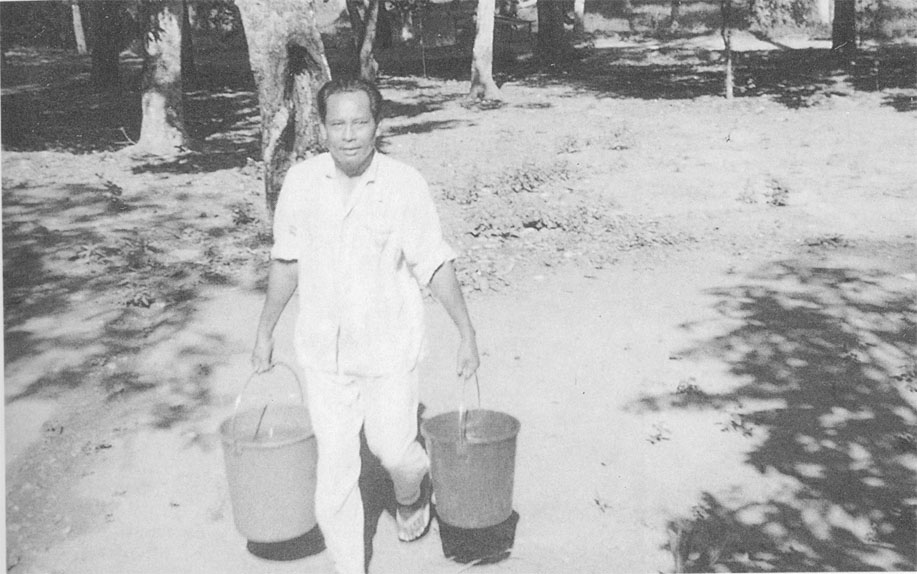 Said Zahari in forced exile on Pulau Ubin, 1979
SINGAPORE, April 24, 2007 (AFP) - A press freedom group called Tuesday for Singapore to reverse its ban on a film about a former political detainee.
Paris-based Reporters Without Borders (RSF) said the ban was "another authoritarian measure violating press freedom" in the city-state. Singapore banned the film on former detainee Said Zahari, calling it a"misleading and distorted portrayal" of his detention which could undermine confidence in the government.
The film "Zahari's 17 Years" was directed by Singaporean filmmaker Martyn See, who had earlier been investigated by police for making a film on opposition leader Chee Soon Juan.
"The ban on See's film must be lifted," RSF said in a statement.
"This act of censorship is all the more inappropriate and ridiculous as his films are available on websites," it said.
"We call for the liberalisation of the censorship and internal security laws that deprive Singaporeans of an environment favourable to free speech."
Singapore's ministry of information said See's film "gives a distorted and
misleading portrayal of Zahari's arrest and detention under the Internal Security Act in 1963."
It called the film "an attempt to exculpate himself from his past involvement in communist united front activities against the interest of Singapore."
In the film, the elderly self-exiled journalist, poet and author reflects on his 17 years in detention.
Singapore has often been criticised by human rights and media groups for maintaining strict political controls despite its rapid economic modernisation.
But the government says the strict laws are necessary to maintain law and order -- a pillar of the country's economic prosperity.
On Friday, producers of a Singapore film about a man and boy struggling with their mutual sexual desire said they had withdrawn it from public screening at the city-state's film festival.
The decision to withdraw "Solos" came after Singapore censors made three cuts to scenes depicting homosexual and group sex, the Singapore International Film Festival (SIFF) told AFP.
----------------------------------------
RSF's Press Release
AP report
Monday, April 23, 2007
All this censorship makes no sense : MM Lee
What are we to make of these uncharacteristically liberal remarks from the founding father? With champagne-popping optimism or heaps of salt? You go figure.

Minister says gay sex should be legal
Singapore must remain cosmopolitan to survive: MM Lee
A cold, hard reality check

Minister says gay sex should be legal
Singapore must remain cosmopolitan to survive: MM Lee
A cold, hard reality check
Sunday, April 22, 2007
'Zahari's 17 Years' now online
It has to happen when a film gets banned after more than a year in circulation.
The full 49 minutes of 'Zahari's 17 Years' is now available for viewing on Google Video. (Updated to youtube) I hereby declare that it wasn't uploaded by me as I've surrendered my remaining master copy to the censors on 11 April. Prime suspects should include festival organisers, film buffs, academics, historians, journalists, ex-detainees, all and sundry who may have seen the film or even possessed copies of it at one time or another.
Of course I can't direct you to the link as I will then be culpable of distributing a prohibited film which does carry a jail term. It first appeared in one of the 'Local Voices' blogs on the right column of this page.
Meanwhile you can watch this ITN news clip of the ban which features a rare appearance by former student leader Tan Wah Piow, a political exile residing in UK.
The full 49 minutes of 'Zahari's 17 Years' is now available for viewing on Google Video. (Updated to youtube) I hereby declare that it wasn't uploaded by me as I've surrendered my remaining master copy to the censors on 11 April. Prime suspects should include festival organisers, film buffs, academics, historians, journalists, ex-detainees, all and sundry who may have seen the film or even possessed copies of it at one time or another.
Of course I can't direct you to the link as I will then be culpable of distributing a prohibited film which does carry a jail term. It first appeared in one of the 'Local Voices' blogs on the right column of this page.
Meanwhile you can watch this ITN news clip of the ban which features a rare appearance by former student leader Tan Wah Piow, a political exile residing in UK.
Saturday, April 21, 2007
Film ban strange, says Said Zahari
Wong Yeen Fern
Malaysiakini
Apr 11, 07 3:31pm
Ex-political detainee Said Zahari is surprised by the Singapore government’s decision to ban a documentary film entitled Zahari’s 17 years directed by Martyn See.
 Said, who is the former editor-in-chief of Utusan Melayu, said the main reason could be that Singapore does not want its younger generation to know the political history of the state during the 50s and 60s.
“The (Singapore) government is afraid that more and more people will know about the nation’s history,” he added when contacted today.
However, Said, who was detained for 17 years, also said the move to ban the film was surprising because it has been around for the past one year.
He said the film has been distributed in many countries and it is strange why the Singapore government decided to ban it now.
Among others, the film has been screened in Malaysia and Canada.
“I have not seen the (Singapore) government’s statement but I don’t understand why they want to ban it only now?” he asked.
According to Said, what he had revealed during the 50-minute film was just a minor portion of what he had written in his book Dark Clouds at Daw published in Malaysia in 2001.
Security threat
A Reuters report yesterday stated that Singapore’s Ministry of Information, Communications and Arts had banned the film because it went against public interest.
 “The film gives a distorted and misleading portrayal of Said’s arrest and detention under the Internal Security Act (of Singapore),” said the ministry.
It claimed that the film was an attempt by Said “to exculpate himself from his past involvement in communist united front activities against the interests of Singapore.”
The ministry said the film had to be banned because it posed a security threat as it sought to undermine public confidence in the government.
The film’s director has been asked to turn over all copies of the film by Singapore’s Media Development Authority.
Previously, See was investigated by the Singapore police after he produced a documentary about opposition leader Chee Soon Juan in 2005.
Government bans film on journalist detained without trial for 17 years
Country/Topic: Singapore
Date: 20 April 2007
Source: Southeast Asian Press Alliance (SEAPA)
Person(s): Martyn See, Said Zahari
Target(s): other
Type(s) of violation(s): banned
Urgency: Threat
(SEAPA/IFEX) - The Singapore government has banned an independent film about a former top journalist and political activist who was held without trial for 17 years in the island republic, deeming the documentary to be "against public interests".
"Zahari's 17 years" by local filmmaker Martyn See is a 49-minute interview with Said Zahari about his arrest and subsequent detention under the draconian Internal Security Act in 1963.
In a statement on 10 April 2007, the Ministry of Information, Communications and the Arts announced the ban under the Film Act, saying the documentary was an attempt by Said "to exculpate himself from his past involvement in communist united front activities against the interests of Singapore".
"The government will not allow people who had posed a security threat to the country in the past to exploit the use of films to purvey a false and distorted portrayal of their past actions and detention by the government," the ministry said, adding that this may "undermine public confidence in the government."
However, Said's political memoir, "Dark Clouds at Dawn", on which the film interview is based, is available in local stores. Said is most famed for staging a three-month strike against a political takeover of the then-leading nationalist newspaper, "Utusan Melayu", of which he was editor-in-chief in 1961. He failed to prevent the takeover, but earned a place in the history of Malaysia and Singapore for leading the first and, until today, only journalists' strike over the principle of press freedom.
"Zahari's 17 years" is not listed in the Media Development Authority's database of classified films, although reportedly given a PG (parental guidance required) rating twice in 2006, when it was submitted for screening at the Singapore International Film Festival in January and a film symposium in August. On both occasions, the film was never screened, with no reasons given. An application for an exhibition licence in January 2007 was abandoned midway, and the ban followed three months later.
As the ban covers exhibition, possession and distribution of the film, See surrendered his master copy to the censors on 11 April. However, the film can be viewed at: (Do a search on google video - Martyn)
This is the second documentary by See to be banned. In 2005, police investigated him for 15 months after he produced "Singapore Rebel", which documents the trials and tribulations of opposition leader Dr Chee Soon Juan, who has been imprisoned repeatedly for exercising his right to free speech and sued for defaming present and past prime ministers (see IFEX alerts of 26 September, 31 August, 11 May and 23 March 2005).
Bizzare ban on Pak Said film in Harry's S'pore
Taken off the blog of Malaysian journalist James Wong Wing-On
Those who have read Singapore's former PM and SM, MM Lee Kuan Yew's memoirs know for sure that the name of Said Zahari never appears as a historical record, let alone the reason or reasons for his 17-year detention without trial under Lee's premiership. Now, according to the Ministry of Information, Communication and Arts of Singapore which has recently banned a made-in-Singapore historical documentary about Said Zahari, the latter was allegedly involved in what is said to be "communist united front activities against the interests of Singapore". However, my friend Amir Muhammad's films Lelaki Komunist Terakhir and Apa Khabar Orang Kampung which documents the stories of self-identified hardcore and real communists like Chin Peng, Abdullah C.D, Suriani Abdullah, Abu Samah and other can still be screened and watched publicly in Singapore. Said Zahari, the trilingual former editor-in-chief of Utusan Melayu whose computer was stolen from his Subang house together with the manuscript of the last installment of his trilogical memoirs during last year's Christmas vacation, of course, now lives in Malaysia as my cherished neighbour, good friend and esteemed sifu .
Malaysiakini
Apr 11, 07 3:31pm
Ex-political detainee Said Zahari is surprised by the Singapore government’s decision to ban a documentary film entitled Zahari’s 17 years directed by Martyn See.
 Said, who is the former editor-in-chief of Utusan Melayu, said the main reason could be that Singapore does not want its younger generation to know the political history of the state during the 50s and 60s.
“The (Singapore) government is afraid that more and more people will know about the nation’s history,” he added when contacted today.
However, Said, who was detained for 17 years, also said the move to ban the film was surprising because it has been around for the past one year.
He said the film has been distributed in many countries and it is strange why the Singapore government decided to ban it now.
Among others, the film has been screened in Malaysia and Canada.
“I have not seen the (Singapore) government’s statement but I don’t understand why they want to ban it only now?” he asked.
According to Said, what he had revealed during the 50-minute film was just a minor portion of what he had written in his book Dark Clouds at Daw published in Malaysia in 2001.
Security threat
A Reuters report yesterday stated that Singapore’s Ministry of Information, Communications and Arts had banned the film because it went against public interest.
 “The film gives a distorted and misleading portrayal of Said’s arrest and detention under the Internal Security Act (of Singapore),” said the ministry.
It claimed that the film was an attempt by Said “to exculpate himself from his past involvement in communist united front activities against the interests of Singapore.”
The ministry said the film had to be banned because it posed a security threat as it sought to undermine public confidence in the government.
The film’s director has been asked to turn over all copies of the film by Singapore’s Media Development Authority.
Previously, See was investigated by the Singapore police after he produced a documentary about opposition leader Chee Soon Juan in 2005.
Government bans film on journalist detained without trial for 17 years
Country/Topic: Singapore
Date: 20 April 2007
Source: Southeast Asian Press Alliance (SEAPA)
Person(s): Martyn See, Said Zahari
Target(s): other
Type(s) of violation(s): banned
Urgency: Threat
(SEAPA/IFEX) - The Singapore government has banned an independent film about a former top journalist and political activist who was held without trial for 17 years in the island republic, deeming the documentary to be "against public interests".
"Zahari's 17 years" by local filmmaker Martyn See is a 49-minute interview with Said Zahari about his arrest and subsequent detention under the draconian Internal Security Act in 1963.
In a statement on 10 April 2007, the Ministry of Information, Communications and the Arts announced the ban under the Film Act, saying the documentary was an attempt by Said "to exculpate himself from his past involvement in communist united front activities against the interests of Singapore".
"The government will not allow people who had posed a security threat to the country in the past to exploit the use of films to purvey a false and distorted portrayal of their past actions and detention by the government," the ministry said, adding that this may "undermine public confidence in the government."
However, Said's political memoir, "Dark Clouds at Dawn", on which the film interview is based, is available in local stores. Said is most famed for staging a three-month strike against a political takeover of the then-leading nationalist newspaper, "Utusan Melayu", of which he was editor-in-chief in 1961. He failed to prevent the takeover, but earned a place in the history of Malaysia and Singapore for leading the first and, until today, only journalists' strike over the principle of press freedom.
"Zahari's 17 years" is not listed in the Media Development Authority's database of classified films, although reportedly given a PG (parental guidance required) rating twice in 2006, when it was submitted for screening at the Singapore International Film Festival in January and a film symposium in August. On both occasions, the film was never screened, with no reasons given. An application for an exhibition licence in January 2007 was abandoned midway, and the ban followed three months later.
As the ban covers exhibition, possession and distribution of the film, See surrendered his master copy to the censors on 11 April. However, the film can be viewed at: (Do a search on google video - Martyn)
This is the second documentary by See to be banned. In 2005, police investigated him for 15 months after he produced "Singapore Rebel", which documents the trials and tribulations of opposition leader Dr Chee Soon Juan, who has been imprisoned repeatedly for exercising his right to free speech and sued for defaming present and past prime ministers (see IFEX alerts of 26 September, 31 August, 11 May and 23 March 2005).
Bizzare ban on Pak Said film in Harry's S'pore
Taken off the blog of Malaysian journalist James Wong Wing-On
Those who have read Singapore's former PM and SM, MM Lee Kuan Yew's memoirs know for sure that the name of Said Zahari never appears as a historical record, let alone the reason or reasons for his 17-year detention without trial under Lee's premiership. Now, according to the Ministry of Information, Communication and Arts of Singapore which has recently banned a made-in-Singapore historical documentary about Said Zahari, the latter was allegedly involved in what is said to be "communist united front activities against the interests of Singapore". However, my friend Amir Muhammad's films Lelaki Komunist Terakhir and Apa Khabar Orang Kampung which documents the stories of self-identified hardcore and real communists like Chin Peng, Abdullah C.D, Suriani Abdullah, Abu Samah and other can still be screened and watched publicly in Singapore. Said Zahari, the trilingual former editor-in-chief of Utusan Melayu whose computer was stolen from his Subang house together with the manuscript of the last installment of his trilogical memoirs during last year's Christmas vacation, of course, now lives in Malaysia as my cherished neighbour, good friend and esteemed sifu .
Tuesday, April 10, 2007
Zahari's 17 Years - rated PG by censors, banned by Minister


The above documents were delivered to my home this afternoon. One is a public statement while the other is a letter specifically addressed to me.
Both documents basically dictated the same message - that as of April 12 2007, the film 'Zahari's 17 Years' will attain the same illicit status in Singapore as a copy of Playboy or FEER. Anyone caught in possession or distribution of the material will be liable on conviction to a fine or imprisonment. The public statement did not spell out the penalties but the letter to me most certainly hit home the point.
The public statement also made no mention of the fact that the Minister himself has banned the film under Section 35(1) of the Films Act, which basically accords absolute discretionary powers to one person to decide if a film is suitable for public viewing. This is unlike the case of 'Singapore Rebel', which was deemed to have violated Section 33 which bans political films with "biased references". I was told by a Straits Times reporter earlier that this marks the first time that Section 35 has been evoked to ban a film.
Further, in the public statement, it said that I had submitted the film for classification, as if it was the first submission. Indeed, I had gone to the Board of Film Censors on January 11 this year, but it wasn't for the purpose of classification. I was there to make an application to obtain an exhibition licence to screen the film. I was made to understand that a film passed by the censors does not entail a licence to screen it publicly. A separate permit is required.
Here it gets a little screwy.
'Zahari's 17 Years' was first submitted to the Board of Film Censors by the Singapore International Film Festival around March of 2006. Information obtained from MDA by journalists at Today and ZaoBao indicated that the film had been passed clean with a Parental Guidance (PG) rating. Yet, the SIFF did not screen it, and has refused to disclose any reason for the no-show.

Then the Asian Film Archive decided to make another application to screen the film as part of the Substation's 6th Asian Film Symposium in September. Again the film was passed clean with a PG rating (see document on the left). But again the festival organisers withdrew the film with no official explanation.
It was on the premise that the film had already been cleared twice by the censors that I decided to apply for an exhibition licence on January 11, only to be slapped, three months later, with yet another ban.
The Government has shown itself incapable of engaging in any kind of open dialogue on its dark history of detentions without trial. It has refused to acknowlege the fact that the ISA has been used in many instances to achieve its political ends. And interestingly, despite its regurgitation of Said Zahari as a former security threat, the international press continues to tag him a former "political detainee".
__________________________________________________________
Singapore bans documentary about former political prisoner
Tanalee Smith
Published: Tuesday, April 10, 2007
SINGAPORE (AP) - Singapore said Tuesday it would ban a documentary about the 17-year detention of a former leftist activist because its "distorted and misleading" portrayal of the events could undermine confidence in the government.
"Zahari's 17 Years" is a 49-minute interview with Said Zahari, who was arrested in 1963 on suspicion of plotting violent acts and detained without trial for 17 years. Said, 78, now lives in Malaysia.
The Ministry of Information, Communication and the Arts, which vets all films before release, said in a statement that the film was an attempt to clear Said of his involvement in activities against Singapore.
"The government will not allow people who had posed a security threat to the country in the past, to exploit the use of films to purvey a false and distorted portrayal of their past actions and detention by the government. This could undermine public confidence in the government."
Filmmaker Martyn See, who was under investigation last year for a documentary about an opposition leader, said he was surprised by the ban. He said the film, produced at the end of 2005, had been approved twice last year with a PG rating. When it was not shown at the 2006 Singapore International Film Festival, as he expected, See applied for an exhibition licence to screen it publicly.
"I don't know what changed. Maybe different people with different views watched it this time," See told The Associated Press. "I based my questions to Said on his first book, which is sold in Singapore. So what is in the film is not something the government didn't know."
He said he had been ordered by the censorship board to surrender all copies of the film by Wednesday afternoon.
Said, contacted by telephone at his home in Malaysia, was shocked to hear of the ban. He said he had already accepted an invitation to come to Singapore next month to give a speech at the film's screening by a university film institute.
"This is very funny. I don't understand why they would ban it at all. What I said in the movie I have already said in my book, and much, much more," he told AP. "That was 40 years ago. Is the government still afraid?"
"I feel sorry for Singaporeans who have not been given a chance to see the other side of Singapore history, particularly the 1960s and '70s. It's not fair," he said.
Said's detention came in the early years after British colonizers gave self-government to Singapore in 1959. In the early 1960s, authorities arrested left-wing politicians, trade unionists and Chinese students involved in strikes and rallies, accusing them of being violent subversives planning a communist state.
Said was detained on Feb. 2, 1963, hours after he was appointed president of a left-wing party.
Singapore, which was planning a merger with what later became Malaysia, said the swoop was aimed at individuals threatening to use violence to sabotage the proposed amalgamation. The detainees were jailed under the colonial-era Internal Security Act, which allows for arrest without charge and indefinite detention without trial.
Said, who denied the accusations, was held for years, sometimes in solitary confinement, after the merger failed in 1965 and Singapore became independent.
He was released in 1979, at age 51. A stroke in 1992 left him reliant on a walking stick and prompted his move to Malaysia, where his children had relocated.
The banning of "Zahari's 17 Years" under the Film Act prohibits exhibition, possession and distribution of the film.
The film's director, See, was investigated by police last year concerning a documentary he made about an opposition leader. He was given a "stern warning" but could have faced prison time or a fine if convicted of knowingly producing and distributing a "party political film."
That film, "Singapore Rebel," was screened at film festivals in New Zealand and the United States, but not in Singapore.
Amnesty International criticized Singapore for that case against See, saying the city-state was stifling artistic freedom and preventing citizens from expressing dissenting views.
Singapore authorities tightly restrict media and political speech, moves that regularly draw criticism from international human rights groups. Prime Minister Lee Hsien Loong has acknowledged tensions over the regulations but defended them as necessary to maintain order.
Singapore bans film about ex-political detainee
Reuters
Tuesday, April 10, 2007; 9:05 AM
SINGAPORE (Reuters) - Singapore is banning a film about a former political detainee who was held for 17 years without trial to protect public interests, the government said.
The film "Zahari's 17 Years" about former journalist Said Zahari -- arrested in 1963 for suspected subversive activities, including communist sympathies -- will be banned because it is "against public interests," the Ministry of Information, Communications and the Arts said on Tuesday.
"The film gives a distorted and misleading portrayal of Said Zahari's arrest and detention under the Internal Security Act," the Ministry said in a statement.
"Zahari's 17 Years" is directed by local film director Martyn See, who was investigated by the Singapore police for a year after he produced a documentary about opposition leader Chee Soon Juan in 2005.
Singapore, which is frequently criticized by human rights groups for its restrictions on the opposition and media, bans political films that contain "biased references to or comments on any political matter."
See said he has been asked to turn over all copies of the banned film on Tuesday by Singapore's Media Development Authority, which has also rejected his application to screen it in the city-state.
"Zahari's 17 Years" is a 50-minute long interview with Zahari about his 17-year detention -- one of the longest in Singapore -- and the fear among former political detainees to talk about their experience, See said.
"The government is clearly not allowing history to be heard. It does not want to acknowledge the history of detention because it is an acute embarrassment," See said.
The film has been screened in film festivals in Malaysia and Canada, he said.
The Ministry said "Zahari's 17 Years" was an attempt by Zahari "to exculpate himself from his past involvement in communist united front activities against the interests of Singapore."
"The government will not allow people who had posed a security threat to the country in the past to exploit the use of films to purvey a false and distorted portrayal of their past actions and detention by the government," the ministry said, adding that this may "undermine public confidence in the government."
Thursday, April 05, 2007
Lee-fearing Nation
"Ordinary people do not fear the Internal Security Act as much as they fear that if they voice criticisms against the government they will be punished in ways that can directly affect their livelihoods. Shopkeepers and taxi-drivers worry their licences will be revoked, and businessmen whether big or small, have the same apprehension. Civil servants fear their independent views on public matters will deprive them of promotions or get them transfers to insignificant ministries or the ultimate punishment - loss of employment. The press fears. The police fears. The ISD (Internal Security Department) fears. The army fears. The PAP MPs fear. And the ministers fear...Everyone fears Lee."
- T.S. Selvan, author and former ISD officer
"Between being loved and being feared, I have always believed Machiavelli was right. If nobody is afraid of me, I'm meaningless."
- Lee Kuan Yew, Oct 6, 1997
 Lee's Legacy
Opinions of Lee in the country are many. More often than not they are a curiously alternating vocabulary of praise and criticism. As his talents and gifts are many and unusual, so are some of his defects. They tell on the way people view him when in their different moods. When people are angry, they forget his merits, and when are happy, they ignore his faults. He then becomes the only barrier between man and chaos. He is glorified to a point where it is said that since God has forgotten to endow the country with any natural resources, he redresses the oversight by giving Lee to the country.
Some are genuinely caught in a moral dilemma because as they condemn of some of his shortcomings they cannot easily overlook his outstanding contributions to their material well-being. He has not been a mindless despot like some of the Third World politicians. Some, however thankful they are, still find it hard to morally excuse him for treating his political opponents with an almost neurotic disapproval and condemnation. He is accused of binding everyone to his system while he himself stays out of it. Even the Godless think he plays God. But they do not say whether God is a dictator.
But what is the long and short of it? Where does Lee stand? Curiously, what will Lee himself think of his role as he continues to lead his flock? Will he be chuffed by his admirers' adulations? Will he be stung like Prometheus by the diatribes of his critics? Or does he have his hopes pinned on history's final judgement?
To look back. When the British finally left the island, the migrants invested Lee with the power of sovereignty and they expected this sovereignty to be used in their rights and interests. The migrants did not wish the bossy and holier-than-thou colonial type authority. That phase was over. It was time, the migrants rightly thought, to belong and identify, to participate and be counted. It was in recognition of this right that the Sahib had also returned the island to the people.
Lee took over. Democratic politics immediately became an irredeemable sin; a political perversion. An Easterner by upbringing and a Westerner by education, a Machiavellian by instincts and a Zarathustran by genes, he at once concluded that a state could neither be run on Judeo-Christian virtues nor by any airy-fairy Western liberal exhalations. He sought authority in the way the East and governments of all larger states had been ruled before the British, American and French revolutions. Lee must have also picked up some handy habits from his early partnership with the communists. Communism, which believes that the state is a divine idea, subsumes the complexities of human experience under a rigid collectivist and monolithic order - one single will, one single state, one single party rule. More importantly, the communists' faith in the grave philosophy of the end justifying the means became a lethal weapon in Lee's hands. Not to forget, once in power, the communists do not capitulate; they want to rule forever.
As soon as he took over he made his people recognise and accept without question the absolute sovereignty of the state which became synonymous with his own sovereignty. The man and machine became one. He smashed all threats to his power. As ends and means became entangled in his politics so were the problems of the state and his own became enmeshed into one and the same. He fustigated the communists, set the dogs on a free trade union movement, and closed the doors on a free press. The communalists and racists had to be flattened because they subverted the nation. Many of his political opponents were kicked around like dogs. Some yielded entirely and became his willing poodles. To his credit, there has never been an instance of political killing in three decades. When this fact was pointed out to a Westerner, a frequent visitor to the country, he said, "When you have detention without trial, your problems disappear very fast. You don't have to worry about wanting to make people disappear."
To sustain and legitimise his moral authority he constantly emphasised the weaknesses of man. He could call up at will historical precedents, imperatives, and cruel memories of a dark age. Unquestionably, he created a permanent sense of crisis. Again and again he went back to the question of the country's security: He warned of the shortage of natural resources and the smallness of the country. He reminded people of the divisive racial and linguistic pulls, and fretted nighmarishly of Humpty Dumpty going to pieces. To a migrant society without permanent security and without much education, these fears, real as they were, became dangerously real. So fearing the decay, and fearing Lee's Leviathan, they fearfully accepted his authority. Here it must be said that although Lee is a propagandist, he actually believes, one thinks, in what he says about the past and the calamitous history of the country. But if the purpose of the propaganda is to teach, it is also intended to sustain his own power.
Lee is completely and consumately absorbed with power, but no leader can continue to hold on as long as he has and be counted credible if he does not deliver. People in the end get tired of fine talk. When the masses get tired, no fear, no tyranny, can hold back the bursts. And this is where Lee is unequalled by many other authoritarian rulers. It is from his ability to pay well that most of his arrogance and invincibility stems which in turn moves his politics. As he made people fear his political ruthlessness, he also shared his extraordinary gifts as a professional businessman; a first-rate achiever. As fast as possible, he gave as much as possible. It was a bang-up job. A materialist, he believed that facts and figures shout louder than slogans.
As he continued to deliver, he also continued to erect comprehensive social policies, his Facts of Life, to consolidate society. He never tolerated state welfarism, never allowed self-indulgence, insisted on hard work, tabooed pornography, told parents to discipline their children, drilled the youths in the army, admonished the people to uphold the family system, kissed the jury system goodbye, ordered the police to administer proper justice to the criminals, hang the heavy peddlars of dope, campaigned for the people to bow their heads in courtesy, urged his people to take better aim in public toilets, and guide their saliva into a spittoon.
"I am often accused of interfering in the private lives of citizens. Yes, if I did not, had I not done that, we wouldn't be here today. And I say without the slightest remorse, that we wouldn't be here, we would not have made economic progress, if we had not intervened on very personal matters - who your neighbour is, how you live, the noise you make, how you spit, or what language you use. We decide what is right. Never mind what the people think."
- Prime Minister Lee Kuan Yew, Straits Times, 20 April 1987
 Lee-fearing society
In short, Lee has so far created from irrelevance a successful society where economic security and social order flourish. This in itself is an extraordinary tour de force but the setback to the system is the lack of political liberty. This appears to be Lee's biggest failure. Foreign critics are not quite out of touch with Singapore when they describe it as a "city of fear". The fear is real, and it is not just at the top-layer of people's feelings. It is deep. Worse, people are sometimes terrified out of their wits. Worse still, there is a lot of fear but no courage.
Ordinary people do not fear the Internal Security Act as much as they fear that if they voice criticisms against the government they will be punished in ways that can directly affect their livelihoods. Shopkeepers and taxi-drivers worry their licences will be revoked, and businessmen whether big or small, have the same apprehension. Civil servants fear their independent views on public matters will deprive them of promotions or get them transfers to insignificant ministries or the ultimate punishment - loss of employment. The press fears. The police fears. The ISD (Internal Security Department) fears. The army fears. The PAP MPs fear. And the ministers fear. No joke. Once in the mid 1980s, a senior civil servant went to discuss certain aspects of a policy decision with a minister. The minister said, more or less, that he was willing to say what he really thought about the decision but was reluctant to do so because it could be carried to the Old Man's ears. ...Everyone fears Lee.
The perception of fear is something that refuses to go away. More often than not some of these fearful people exaggerate (before they do this they look to the right, left, and over their shoulders) their self-importance and value by attributing their personal failures to having the guts (imagined, of course) to go against some of the government policies. As much as fear is real in the country, this group of self-important people is also real. Most of these people can be found predominantly among top civil servants, university lecturers and business elites.
Young yuppies who may have the inclination to go into opposition politics are hesitant because they, among other things, think that the government with its powerful machinery will rake up past indiscretions, however silly they are, and distort them into acute public embarrassment. We are here talking about PAP gutter politics. There is also the fear that the government will continue to hound them in the future through other means. The concern is valid because the record of the government is unhelpful to its image. On the other hand, some use this fear as a convenient excuse for not entering politics. Life, you must remember, is bountiful under Lee.
As fear threatens the people, something else is beginning to scare Lee and his government. The society is slightly more complex now than it had been a decade or two ago. Wide diffusion of English education, economic opportunities, the power of machine, social mobility, and exposure to other political viewpoints, are all conspiring to shape the political attitudes of the citizens. In other words, Lee's very success is working against him.
The young are particularly resentful of the way they are being governed : control, yet more control. Look, it is happening again, they sneer. They feel that the over-administration of the classroom suffocates creativity and individuality. They are gradually beginning to reject Lee and his moral prophecies because they suspect the perpetual hand of a controller yet again trying to manoeuvre his way through to increasing his own glory and power. Although they were born and bred under the PAP regime, they are beginning to break free like rebellious adolescents often do. Lee is not their king. Youth, with its idealism and energy, is Lee's greatest threat.
Nurturing indifference
How long can a government continue to suppress real discussion and be intolerant of mediocrity? How long could it avoid compassion and caring for the really under-privileged? How can a society hope to mature and progress if there is little political intelligence and awareness? Can political loyalty to the system be taken for granted when the people are suspicious that Lee and his party control all the rules of the game? Perhaps there is a question to ask: could Lee himself, presuming that he is an ordinary man (i.e. not a politician), live in such a society without being too constrained and unhappy? Could he bear to see his prime minister enjoying all the freedom while he is denied it?
The kind of political system that is found in the country is bound to nurture indifference. When the citizens, if the government so decides, can be arrested without the due process of law, it strikes fear. It erodes loyalty. The government urges the different races to be tolerant and to harmonise their relationships to build a nation together but its own intolerance of critics and differing viewpoints is seen as Double talk. The government is happy when the press, whether local or foreign, pleases it but comes down vindictively when it ceases to praise. When a foreign press criticises the government it is accused of involving itself in the political process but when its own citizens, those who think differently, question and challenge some of its policies, they are being put down for the very act of participation. For example, immediately after the 1984 general elections, the government seemingly opened up the system and invited discussion and feedback. When the Law Society of Singapore attempted to do just that (the Law Society sought to persuade the government to change its mind about the Amendment Acts to the Press, and it did not encourage the citizens to disobey or break the law - there is a big difference here) it was disgraced out of court. One of its members was kicked around like a ball. Can a system be thought of a great success when it brings unnecessary pain to others?
Lee's Singapore or the Singaporean's Singapore?
Why is Lee, given the intensity of his Superman vision, so obstinate in his heroism in not wanting to allow for real democratic changes? Power is just part of the explanation, though a good part of it. But more importantly, is Lee certain of his vision of the future? Will he be proven right and others wrong in the end?
Lee has no God but he cannot give up playing God. He will always think he is right. That is his destiny; his own star to follow. "If there are gods," exclaimed Zarathustra, "how could I bear to be not a god?"
His adversaries who do not like Lee and his politics and would like to see him go, will have a mountain of a task to crush him. Their Macbeth is not ripe for shaking, yet. And one thing appears certain. Whether you like him or not, Lee is a legend. If Raffles was the taker of Singapore, Lee certainly is the creator, and a better story to tell. For the moment one hesitates to place him alongside the other Asian greats - Gandhi, Nehru, Mao - although intellectually he could claim equal, if not better depth. Using a different scale, if one gives Pol Pot 1, Marcos 3, the late Sukarno 5, Tengku Abdul Rahman 7, Lee gets a 9. If either of the scales does not fit that must be because Lee is quite clearly in his own league.
Before Singaporeans reach their own decision on their most famous legend and his creation, are they themselves clear in what they want of society, of life? Do they think someone else could do a better job? With the same per capita income, jobs, houses, schools, hospitals, roads, snazzy cars, snappy clothes, but more democratic politics. What is their dream of an ultimate island? If people are inclined to accuse Lee of becoming an island unto himself, are they becoming an island unto themselves? Are they themselves naively prone to over-emphasise their own importance and wisdom (and I don't write this with any kind of sneer or cynicism) as Gibbon, the great historian, thought the Greeks did? Commenting on the Byzantium, Gibbon said: "Among the Greeks, all authority and wisdom were overbonne by the impetuous multitude, who mistook their rage for valour, their numbers for strength, and their fanaticism for the support and inspiration of Heaven."
Human societies appear hopelessly destined to a cyclic process of growth, decay and disintegration. But a good vision is said to change or delay this process to some extent. Without this vision a society perishes quickly and when that happens all the King's men could not put back Humpty Dumpty. The poetry will made short. It is a dance of death on a narrow wall.
On the first day that he took over the leadership of the island from the white man, on 3 June 1959, Lee told his semi-colonised people: "Once in a long while, in the history of a people there comes a moment of great change..." The change has come, but is not great. The quintessential Lee Kuan Yew's Singapore (it should not happen, but it does) must be turned into Singaporean's Singapore. We must hope for the real Lee Kuan Yew to emerge over a period of time.
- T.S. Selvan, 1990
Subscribe to:
Posts (Atom)